
[Photography by Georgina Hinton]
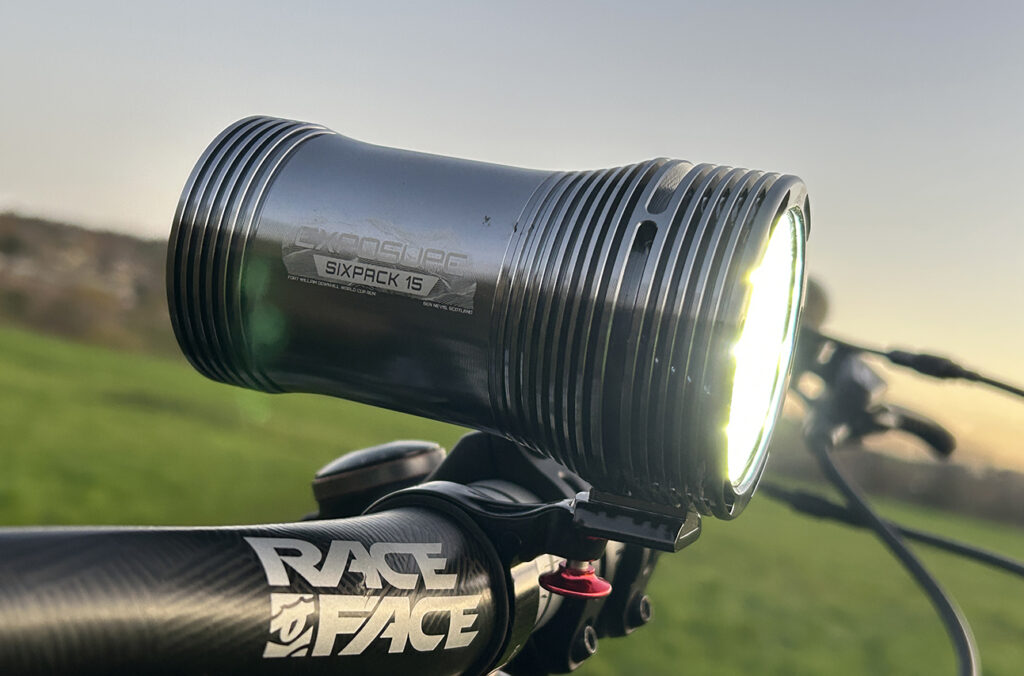
2025 marks the latest release of the Exposure Six Pack light – now the Mk15. It’s been a solid-performing light for many years, and the latest update bumps up the Lumen count to make it its brightest light ever. It’s still a massive investment, and one that may be out of reach for some, but it lights up the trails with vivid clarity, is clever and easy to use.
- Best mountain bike lights 2025 – top-rated lights for night riding
- Sinewave Beacon 2 Dynamo Light review
- Get your glow on with our top tips for mountain and gravel bike riding at night
Exposure Six pack 15 – Technical details
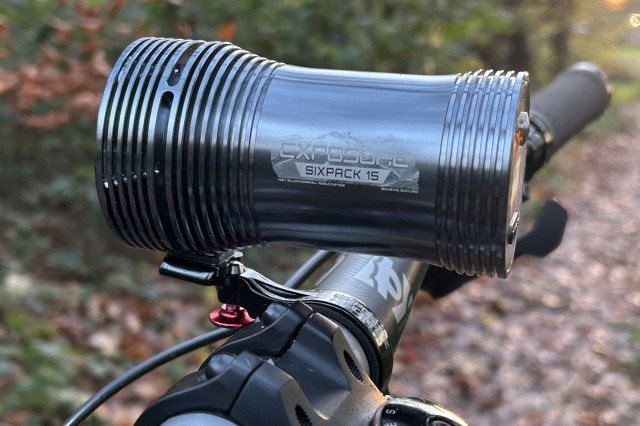
The Exposure Six Pack 15 resembles the previous USE Exposure Six Pack Mk14 version, sharing the same stunning build, beautifully machined from 6063 Aluminium with a gunmetal anodised finish. Deep vents taper from the front, at the head of the light, to guide air for cooling. It’s a true whopper, measuring 110mm in length and 63mm at the head, and it weighs in at 406g with the mount.
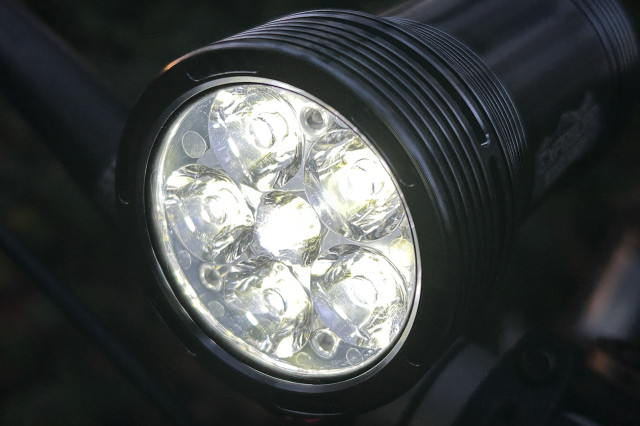
The Six Pack now belts out a maximum of 6,000 lumens, delivered via six white XPL2 (W3) LEDs, trumping its predecessor slightly at 5,800 lumens and still houses the same 20,000 mAh lithium-ion battery inside the aluminium shell. Exposure claims 2-36 runtime, depending on the mode used.
It now features a USB-C charging port, making it way more convenient, simple and quicker to charge than the previous model – a reported 66% faster. Used as a power bank, it’s simple to charge a Garmin or smartphone on the move or when the light is turned off.
The tech hidden inside is pretty impressive. The Reflex 2.0 technology is supposed to be even more accurate than the previous model. It’s designed to make the Six Pack a mostly hands-off riding experience by learning how you ride, reacting to changes in your speed, angle and frequency of movement, to deliver the right light output automatically. It uses 3D digital accelerometers; electric sensors that measure acceleration forces in three different axes to read movement and vibration, as well as a gyroscope and thermistors to cleverly calculate and learn how you ride – all very clever stuff.
It only works in modes 1-3 but learns to dial light output back on long climbs and gentler terrain, dimming down after 20 seconds when you stop to save on precious battery life. ITM (Intelligent Thermal Management) is another feature designed to reduce power if the light begins to go past its optimum temperature.
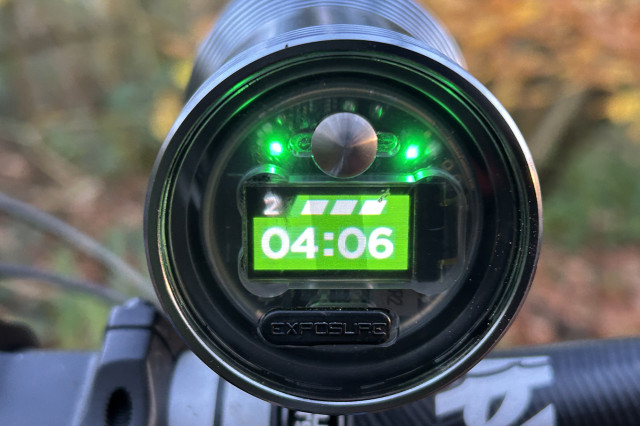
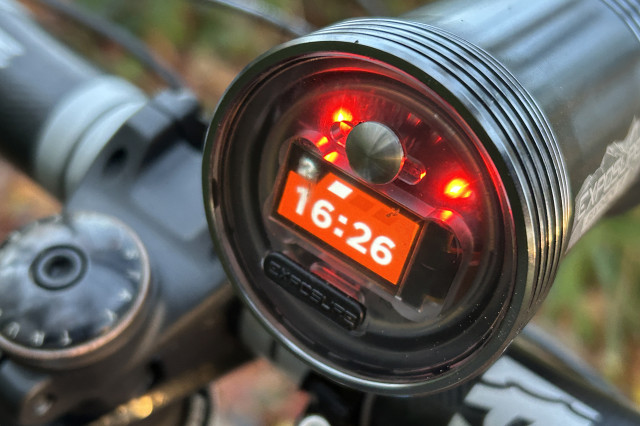
A welcome update is the OSD Plus display. All modes, battery life and data are now displayed 70 per cent bigger on a full colour LED screen, making it way easier to navigate than previous models. Talking of modes, there are seven using the OMS (Optimised Mode Selector) used to tailor it to your output needs. Etched into the body of the light is a table showing the different modes and burn times available within the programs – but good luck reading them without a magnifying glass, so be sure to read the instructions! Simply hold down the power button when the light is off until you see the function symbol, and then cycle through the OLED screen to set your desired mode.
Double-click the button to activate the Six Pack, which once again displays the OMS mode and its max preset burn times. It will then switch the display to its current estimated remaining burn time in the setting you are in, on the big bright and easy-to-read display.
Modes 1-4 have high and low burn time presets, 1-3 featuring the highest power output and the only ones to utilise the Reflex 2.0 feature. Modes 5 and 6 are the only settings to have a medium burn time preset, and flash mode can be accessed at any time by holding down the button for 2 seconds.
There is also a reserve mode that springs into action once the on-screen runtime runs out. It kicks in and is designed to run at 10 percent power for 30 minutes, which, if you are lucky enough, may see you home.
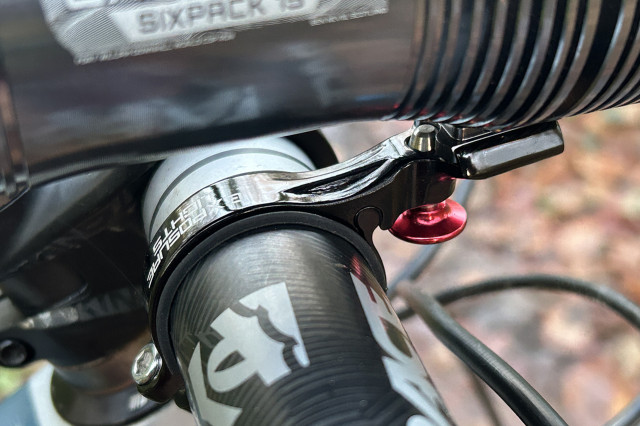
It’s good to see that the handlebar fixing bracket is still the same as previous models, which means I can run multiple mounts on various bikes without having to keep changing it around. The new one comes with rubber shims for use on both 31.8mm and 35mm bars. And the metal mounting foot attached to the bottom of the light is the same, too. Also included in the hard case is a USB-C cable and charging block with both USB and USB-C ports.
Exposure Six pack 15 – Performance
For a light that has undergone numerous revisions over the years and garnered significant media attention, I was very interested to see what all the fuss was about, and I’ve been blown away. My experience of Exposure lights dates back to 2008 (ish) when I started to use the Maxx-D, Enduro and Joystick models – all pre-Reflex technology of course.
Fitting the handlebar bracket was simple; I had no qualms bolting it to my 35mm carbon bars. Luckily, I own quite a few brackets from past models, and they haven’t changed over time, so I could swap the Six Pack between test bikes quickly. Fitting the light is fast and faff free, the light felt safe and secure once clipped in place, attached by only that little foot plate.
It is a massive unit, and although it looks like you’re strapping a beer can to your bars, I kinda dig it; it’s simple, no cables, no bulky battery pack to strap to your frame.
A proper read of the instructions and I was off. It’s pretty user-friendly, which is a godsend for me as I’m quite often left cycling through functions, pressing buttons, and generally making a hash of things in the dark.
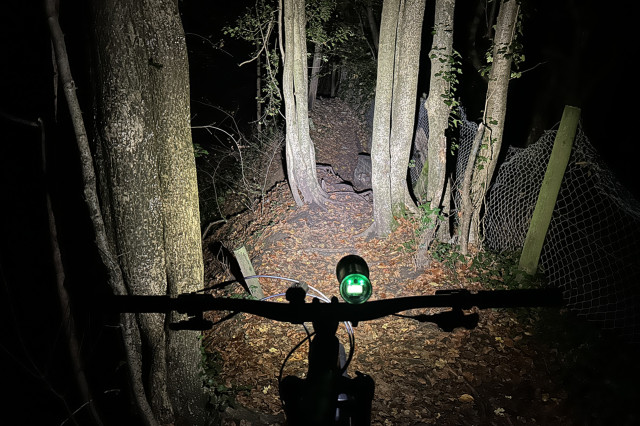
The light thrown out by the Six Pack is fantastic, with a smooth, even beam pattern and massive reach down the trail. Peripherally, it throws a soft vignette at the edges of your vision, which helps with focus when riding at speed, especially in turns. Riding with a weaker, more focused beam can create eyesight fatigue and mental overload when trying to read the trail in the dark. I didn’t experience any of that with the Six Pack, I felt laser-focused.
Although I’ve tried out a few of the modes, I settled on Mode 1, boasting the full 6000 Lumen count, for my night rides that sit under 3 hours. The Reflex 2.0 technology takes some getting used to, but after a while, I loved the fact that I didn’t need to mess around whilst riding, or, to actively dim the light when stopped, and the fact that it learns as you ride meant that I’d usually be reaching to hit a lower power setting on long traverses, but it does it for you. Full power kicks back in as soon as you wiggle your bars from being stationary, which extends battery life, and it never let me down transitioning from slow to fast on the bike.
The OSD Plus display is an absolute winner. Big, bright and easy to read, even with my crappy eyesight. I found it easy to identify what mode I was in, how much burn time was left, and the fuel gauge function is an easy visual way to know what percentage of battery power is left.
I had no issues with the Six Pack unit or mount working loose; however, I’ll admit I’ve had some issues with older models in the past. More likely caused by fiddling with the light unit mid-ride. I crashed a few times – luckily nothing major, and the Six Pack has survived unscathed.
Recharging is pretty quick, and although I’ve only tried the powerbank mode briefly, I can see it’s a neat addition, especially if you carry a USB-C cable with you.
The Six Pack 15 seems to have hit its zenith, but of course, it’s still eye-waveringly expensive.
Exposure Six pack 15 – Verdict
For the asking price of £495, it’s one hell of an outlay, and whilst it seems to be at the vanguard in terms of tech and build, it may only be a viable option if you are a serious night rider with deep pockets.
That said, if you still want a cheaper light, you could look at the Exposure Toro 16, which shares all the same tech but in a smaller, lighter and less powerful lumen count of 3850.
Ty rated the Magicshine Monteer 6500S V2.0 light. It knocks off a hefty chunk of cash, down to £300, but you’ll sacrifice the convenience of going cable-free and have to strap on the battery. But with excellent battery life and a good, wide spread of light, it’s also a great option.
The Exposure Six Pack 15 is a powerhouse that packs in a ton of tech to make night riding more seamless. It’s lighter than external battery models and very quick and convenient to use, making it one of the best on the market.
You might also like:
- How to spend a night in the wilds and still make it to work on time
- Your complete guide to bikepacking – what kit you need, how to plan and prepare plus inspiration for an adventure
- Exposure Lights MaXx-D MK15 review
All the deals displayed on our review pages are pulled from a constantly updating database feed of the best affiliate deals available. The criteria for deciding on what are the best deals is who is offering the lowest, delivered price. In most cases we will be showing the very best deal available online, but sometimes you may be able to find an item cheaper. If you can please feel free to post a link in the comments box below. To find out more about affiliate links on road.cc click here.