



Campaigners in Exeter who took matters into their own hands last month by acting as “human bollards” to enforce a bus gate that was constantly being violated by motorists – and saw two cyclists, including a child and a mother with a baby, struck by drivers – have welcomed the police’s decision to undertake “random and unpredictable enforcement” at the entrances to the low traffic neighbourhood.
This week, Devon and Cornwall Police, along with Devon County Council, announced that an “occasional, unannounced joint presence” will be implemented at the bus gates heralding the entrance to the controversial Heavitree and Whipton Active Streets Trial, where motorists have been “driving through with impunity” since the traffic-calming scheme’s introduction in August, according to campaigners.
The tendency for drivers in the city to ignore the restrictions was also described by the police and local authority in a statement as “unacceptable”, placing “other road users, particularly those who are vulnerable, at increased risk”.
The Heavitree and Whipton Active Streets scheme in Exeter, like other similar low traffic neighbourhood initiatives across the UK, features modal filters using bollards or planters in a bid to prevent through traffic and increase safety, encourage walking and cycling, and reduce pollution on residential roads, while bus gates were installed to allow access to local residents, cyclists, buses, taxis, and emergency vehicles.
These bus gates, however, have been viewed by local activists as one of the “outstanding issues” associated with the trial, which has been at the centre of a prolonged political controversy in the city fuelled by vocal, and often confrontational, opposition, vandalism, protests, and an aborted attempt in January by some council officials to bring the 18-month trial to an immediate and premature halt.

Lorna Devenish, the spokesperson for the Heavitree and Whipton Liveable Neighbourhood Group, told road.cc that many motorists have simply been ignoring the bus gates, often speeding through them, while some signs have been sprayed over by vandals.
This situation, Devenish says, has led to drivers coming into conflict with the increased number of people walking and cycling in the area thanks to the scheme’s initial promise of quieter, safer streets.
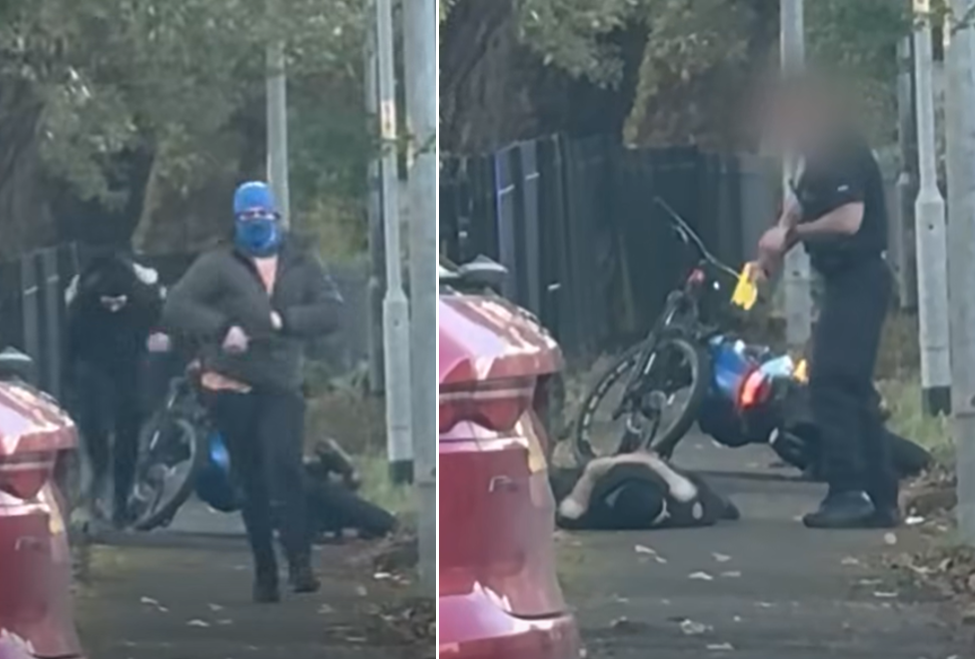
Outside Ladysmith School, located within the boundaries of the Active Streets trial, a child was knocked off their bike by a motorist, while a woman riding a cargo bike with her baby in the back was reversed into by a driver attempting to manoeuvre around the bus gate.

These incidents prompted local campaigners to take action two weeks ago by blocking the bus gates – in a “human bollard” protest inspired by fellow LTN campaigners in Oxford – while holding up a banner calling for “safe streets now”.
That week-long action, and its criticism of the lack of policing of the bus gates, has now spurred Devon County Council and Devon and Cornwall Police to increase their presence within the low traffic neighbourhood.
Tensions boiled over this morning in #Exeter as campaigners who support the #LowTrafficNeighbourhood trial stopped 50 drivers in an hour from flouting the restrictions@ExeterCycling @countcaspargh
More here: https://t.co/WGTQSrPiwm pic.twitter.com/KMDQgTQfPC
— Greatest Hits Radio Devon News (@GHRDevon) February 19, 2024
According to a statement released this week, the two bodies met to “review the issue of non-compliance with the bus gates at Whipton Lane and Ladysmith Road”.
“The council and Police agree that the behaviour of some drivers who routinely ignore the restrictions is completely unacceptable and places other road users, particularly those who are vulnerable, at increased risk,” the local authority said.
“The council applied to the Department for Transport in November 2023 for Moving Traffic Enforcement Powers under the Traffic Management Act 2004 and is currently awaiting a response. If the application is approved, these powers will enable the authority to consider a number of tactical options, including 24/7 enforcement coverage.
“In the interim, Devon and Cornwall Police will undertake random and unpredictable enforcement at the bus gates and will ensure an occasional unannounced joint presence with enforcement officers from the council.
“The Police will also accept online reports from the public where clear and unambiguous evidence exists of an offence. Individuals are strongly advised not to provoke conflict by filming at the roadside for prolonged periods.
“Both organisations have agreed to meet on a monthly basis to review the position and inform ongoing activity and enforcement posture.”
The announcement was praised by local residents, who pointed out that the lack of enforcement has severely impacted the success of the trial so far.
“A 40 per cent increase in cyclists could mean over 100 people on the roads taking advantage of the quieter streets to do short journeys by bike or on foot instead of in a car,” Heavitree and Whipton Liveable Neighbourhood spokesperson Ben Patridge said in a statement today.
“But without enforcement of the bus gates the streets were not as quiet as they were at the beginning. Also, illegal drivers who flouted the bus gates typically did so at speed, so we were very worried about the safety of vulnerable road users.”

The group also called on the council – when compiling data to assess the success of the trial – to take into consideration the delayed nature of this week’s enforcement action.
“Since it’s only now that enforcement is happening, the council need to treat any data accordingly, and we need a good length of time to collect and analyse any changes before decisions are made. This is essentially a significant ‘change’ to the trial,” Partridge said.
That particular stance, as well as the now seemingly answered need for proper policing of the bus gates, was echoed last month by fellow Liveable Neighbourhood group member Lorna Devenish in a lengthy discussion about the trial – and the challenges it faces – on the most recent episode of the road.cc Podcast.
“The bus gates violations are an outstanding issue for the trial. We have two bus gates, and people worked out within two or three months that they weren’t really being policed,” Devenish told road.cc.
“And one of them was sprayed with a thick black paint on Boxing Day. At the beginning of the trial, the county council had been absolutely brilliant about rapidly replacing bollards, but following this report [which called for the trial to be prematurely scrapped] and the county council going cold on it, no one had been out to clean these signs. So, people were just driving through with impunity.
“So we really fear that the violations around the bus gate are skewing the figures [for the trial], but because people are being encouraged to cycle more and people are driving through the bus gates, there are people who may be cycling for the first time who are not as safe as they should be. We cleaned the signs, and amazingly enough that had an immediate effect. Fewer people drove through it, now that you could see the restrictions again.”

She continued: “We’ve been inspired by campaigners in Oxford to take some direct action, to do some human bollarding, to really call on Devon and Cornwall Police to properly police it. They say they aren’t resourced sufficiently, but I think with the power of social media, they really only need to issue letters to ten per cent of the people we reported, and that would go around like wildfire.
“It probably wouldn’t take too much effort, a few random visits by a patrol car at key times, even just having the parking wardens there at school pick up and drop off.
“So all these things could be done, and I don’t think it would be a huge use of resources, but there seems to be an impasse on that. So that’s our next action, to get these bus gates properly policed.”













11 thoughts on “Police vow to clamp down on “unacceptable” drivers flouting bus gates and putting vulnerable road users at risk, after child knocked off bike by motorist in low traffic neighbourhood”
What a load of rubbish.
What a load of rubbish. Everyone knows that drivers have insurance and number plates and therefore don’t break the rules. It was probably pesky cyclists disguised as cars trying to stoke the war on motorists.
Why don’t they just have
Why don’t they just have camera enforcement? Seems like the obvious/easy solution
The council decided not to
The council decided not to because “it was only a trial”. Yea an 18 month one.
Surely someone makes a temporary/portable bus gate camera?
I’m pretty sure the residents
I’m pretty sure the residents would have been quite happy to provide video evidence to the police if only they would act on it.
D&C Cops arent known for
D&C Cops arent known for being the best. Would rather sit on bridges over the A30 catching grockles for speeding at 80 than do anything useful.
Not that Im bitter 😉
I did think it odd that there
I did think it odd that there’s a recommendation not to record for extended periods of time, supposedly to to avoid conflict. I’d have thought volunteers taking turns to record any cars continuing to ignore the rules would be a helpul supplement to an occasional police presence.
Locals may not always know if a car is really a taxi, or has some other exemption, but it would be easy enough to for the local licensing board to check if conveniently provided with footage. A little bit of extra work, but most of the work being done for them.
The council should announce
The council should announce that the trial will be extended by an equivalent period, and state that if there isn’t adequate compliance they’ll continue to extend the trial accordingly. Although with next to no enforcement that might not bother some.
I have a bit of sympathy with not wanting to install a camera. Temporary cameras are clearly possible, but there are additional costs, especially if there’s a risk of the cameras being vandalised. You’d like to think they aren’t necessary, but you wonder if the decision was made by someone who thought a few people flouting for the rules was fine. Or at least that making it possible for some to flout the rules would mean they’d face less aggrevation from those against the proposals.
Fair play to the residents for manning the gate, and shaming at least some people into obeying the law. Hopefully once people get fed up with turning back I’d hope that they’d stop trying.
‘Random and unpredictable
‘Random and unpredictable enforcement’ – sounds a bit like what the police do in response to OpSnap reports.
https://www.devonlive.com
https://www.devonlive.com/news/news-opinion/exeter-ltn-haters-must-come-9142035
‘Exeter LTN haters must come up with 10-year plan’
‘I have yet to hear what an “anti-woke” transport policy looks like other than venting anger’
Hirsute wrote:
We’ve already seen signs of it with bus seats etc.
https://www.bbc.com/news/stories-43171799
Hirsute wrote:
Excellent! Although presumably that would be “It looks just like now, but somehow with both cheaper fuel / insurance / parking / lower taxes / higher speed limits / no potholes (and thus more driving and parking) and fewer delays / more convenience / nice places to walk around in”.
Presumably the best thing to do would just knock all the historic stuff down and tarmac it over – or just make it into a massive mall?