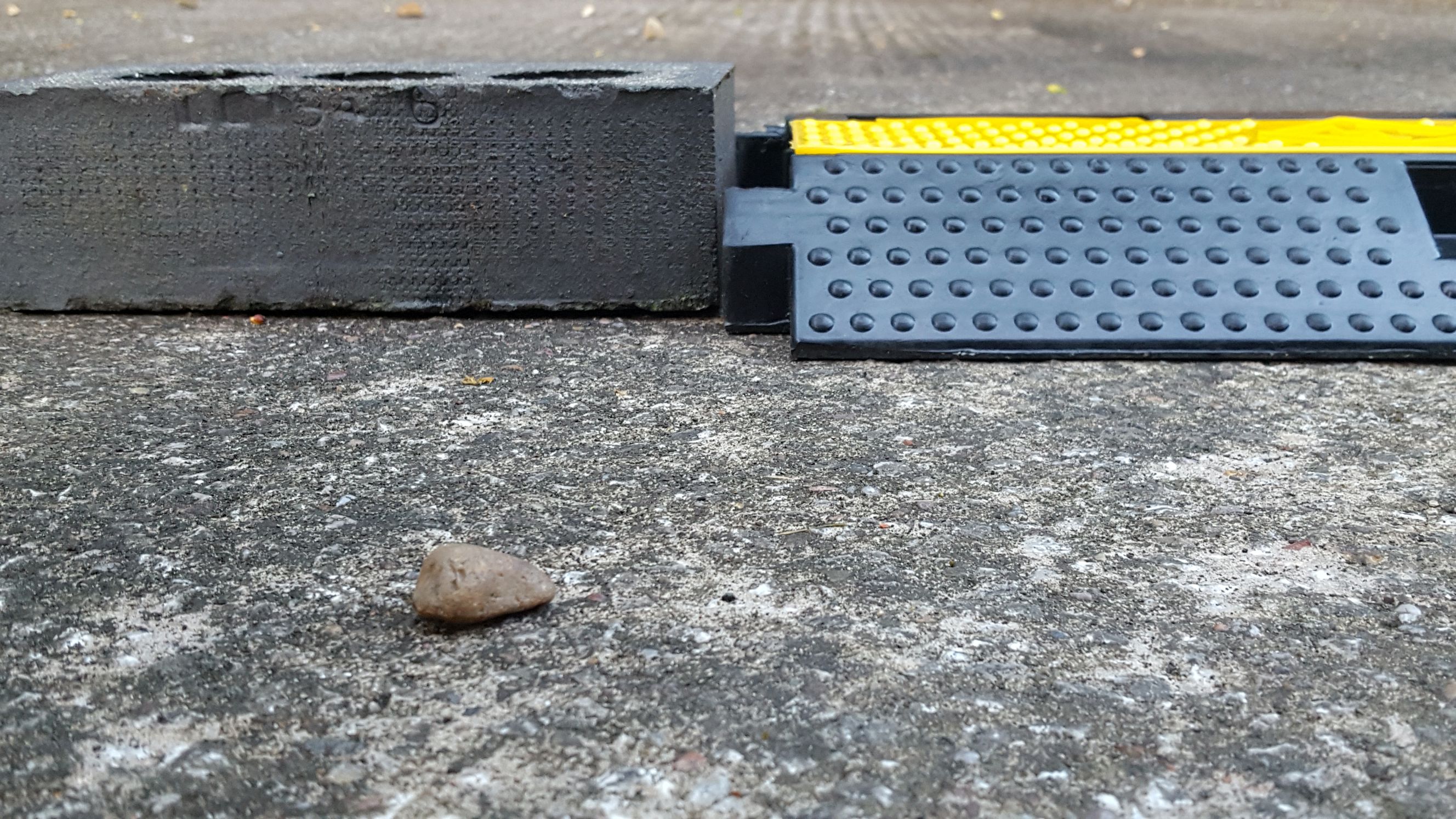
Pavement obstruction by Charging Cable Protectors

  • This topic has 32 replies, 9 voices, and was last updated 2 years ago by mattw.
  • Creator
    Topic
  • #32862
    mattw

    This is an issue I literally ran into – one of these across a shared use pavement in my town. I’m posting here to ask for thoughts, experiences and opinions on an issue I am not clear about yet.

    The cable protector I came across on my utility cycle, which is a Brompton size e-folder with 16″ wheels was the size of a bolt down road-hump across the pavement, and is advertised as a “Pavement Cable Protector”.

    It is 45mm high and 270mm side to side with 45 degree slopes. The height is the same as a scaffold plank.

    Once we get any number of these, these shared pavements will be unusable by my I think, and even more unusable by wheelchair users etc.

    Warwickshire Council have published guidance permitting use of these because ‘haf their housing stock does not have parking off-street, and denying they have any responsibility in law.

    Below is a piece I wrote to highlight the question for Wheels for Wellbeing’s Disabled Cycling Activists Network.

    I’d welcome any thoughts from anyone.
    ————————————————————————————
    Councils are starting to promote use of cable protectors across pavements when charging electric cars.

    Warwickshire Council for one are specifically offering advice that these are acceptable, and cable protectors, and have published guidance. This is all the info I have, I have not gone after the EIA, which should exist but I bet does not.

    [i]Close to half of Warwickshire’s housing stock has no off-street parking, such as a driveway, which can make the charging of an electric vehicle difficult. In order to address this problem, Warwickshire County Council is allowing residents to place a charging cable across a pedestrian footway (e.g., a pavement) when using a cable protector.[/i]

    They also specifically say all legal responsibility for any problems caused is down to the owner.

    IMO this is a lie, and is directly against the EA Provision of Equal Service, and the PSED – especially when we consider the disruption caused by the 2-5 of these we will end up with for every 10-20 houses in areas where they are needed given charging times.

    AFAICS the typical size of “cable protectors” are up to 45mm (2 inches) high, 300mm wide and with 45 degree sloped. Aren’t drop kerbs 5mm? And front wheels of a manual wheelchair 75-150mm?

    Linked below one of these big ones with 150 reviews.

    Looks like a recipe for huge conflict and abuse, and one that Councils will try to slope shoulders on.

    HTH,

    Warwickshire council article
    https://www.warwickshire.gov.uk/news/article/4348/making-electric-vehicle-charging-more-accessible-in-warwickshire

    Warwickshire guidance
    https://api.warwickshire.gov.uk/documents/WCCC-1615347118-1185

    Pavement Cable Protector Product Link
    https://www.theworkplacedepot.co.uk/pavement-cable-protector

    Below
    Warwickshire guidance
    “Pavement Cable Protector” Photo and Dimension

Viewing 15 replies - 1 through 15 (of 32 total)
  • Author
    Replies
  • #1021681
    0
    mattw

    They also pretend they do not

    They also pretend they do not have legal responsibilities under:

    1 – Equality Act 2010 to provide equal services, and reasonable adjustments for disabled people.
    2 – The Pubic Sector Equality Duty, which is proactive.
    3 – Highways Act (various) to keep Public Highways unobstructed.

    What is interesting is that under HWA LHAs can be forced to take action. Not sure on exact detail, but the Open Spaces Society got this in CROW 2000 when Essex County Council tried to cave in to Nicholas von Hoogstraten rather than make him remove his barn from a Public Footpath.

    https://campaignerkate.wordpress.com/the-framfield-footpath-story/

    #1021679
    0
    lonpfrb

    Huge conflict conflict missed
    Huge conflict conflict missed opportunity:

    “Cables should be laid flat and never be extended from an upper storey to a vehicle,
    nor should they be hung from any street furniture including lamp columns or trees.”

    Haven’t they heard of telegraph poles or power cable regulations already in use…

    #1021677
    0
    lonpfrb

    Huge missed avoidance of
    Huge missed avoidance of obstruction:
    Cables should be laid flat and never be extended from an upper storey to a vehicle,
    nor should they be hung from any street furniture including lamp columns or trees.

    It’s like they never heard of telegraph poles nor the regulations on overhead power cables..

    #1021675
    0
    lonpfrb

    The product blurb states:
    The product blurb states:
    Suitable for pedestrian areas, not vehicular traffic.

    So wheelchairs and bicycles are disregarded!

    #1021673
    0
    Kapelmuur

    With regard to disabled

    With regard to disabled people it’s already difficult them because of the number of vehicles parking on pavements.   
     

    It seems to me that allowing vehicles unrestricted parking sets a precedent for future footway obstacles.

    #1021671
    0
    mattw

    Robert Hardy wrote:

    Robert Hardy wrote:
    Lamp post charging will need a huge investment in upgraded sub pavement cabling with all the associated investment in new street furniture along with all the potholes the required digging and filling will produce a few years down the line., A slightly less ideal, but vastly cheaper solution like cable channels is preferable.

    As I note, Notts for one are doing a trial on this. 
    https://www.nottinghamshire.gov.uk/transport/travel-notts/electric-vehicle-charging-in-and-around-nottinghamshire/electric-vehicle-cable-channel-evcc-pilot-programme

    #1021669
    0
    mattw

    Robert Hardy wrote:

    Robert Hardy wrote:
    Currently Nottingham too, an acceptable compromise, electric cars may not pay fuel tax, but those of us who live in terraced properties currently typically pay between 50 and 80 pence a kWh to charge our cars at charging stations, whether local authority or commercially provided, a cost very similar or greater to the price we would pay if we were running an internal combustion engined vehicle (my Zoe does between 3.8 and 4.2 miles per kW hour depending on ambient temperature, my previous diesel averaged 11.5 miles per litre). As a cyclist I would much prefer to share my road space with modest electric vehicles, most adult cyclists also drive a car so making it easier for people to make the switch is a compromise worth putting up with a little pavement inconvenience. I rarely charge from home, I think 3 times in the six months I have owned the car, but the protector I use 15mm upstand and 90 mm wide makes the cable both obvious and considerably less a trip hazard. We live in a crowded country where a measure of tolerance for the less than perfectly personally convenient is the necessary grease for a happy life.

    I appreciate the reply – I have strong views, but I’ve deliberately opened this up as a debate because I don’t know enough yet to reach a fully considered view..

    The important phrase is “reasonable compromise” around “who is defining “reasonable”, and “who is rquired to make the compromise”. I don’t think costs of electricity are relevant here, as the primary conversation is around right to access pavements. Challenges around the cost of charging must be fixed by fixing electricity prices, and not compromising legal rights of pavement users. “Your” basic rights cannot be compromised by “My” desire to save money.

    Trip hazards are one aspect, but physical blocks for wheelchair users and others are another, and imo if any pavement is made unusable for any person then that is unreasonable by definition.

    If it was about me needing to be more careful when walking, that is a compromise. When it is about whether my neighbour can wheel down the street for a bottle of milk, or not at all, that is beyond compromise in my opinion. And taking care to look more carefully is not a compromise visually impaired people can easily make.

    Plus there is the issue of counncils which have chosen to create cheapskate cycling infra by creating shared pavements. Can I ride across these on my 16″ wheeled foldeing cycle? Can people with conditions where their bodies react to bumps and shakes?

    What I expect this Govt to do is *nothing*, which means that if we have unacceptable physical barriers imposed by Cable Protectors, then it will not be noticed until it is too yet and avoidable conflict will be created when pavements are blocked. Then we will be back into the same abuse-cycle as generated by unacceptable pavement parking – nothing is done, and it is allowed, so it becomes a ‘Right’ by osmosis, and pavement users who cannot get past are subjected to endless abuse / bullying by some.

    On the dimensions, we have the maximum height of a pedestrian accessible drop kerb defined as being 6mm, with a defined slope for with 1 in 12 gradients the max from there. That is in teh Inclusive Mobility national guidelines.

    So that seems to me to define the max *possible* for a pavement cable protector. Which becomes more critical when there may be 5-10 of them across the pavement on a street.

    The one I bought having looked around is slightly smaller in height than a house brick – and is 45mm high with side slopes at 40 degrees.

    I think I’m inclined to what is essentially an except-in-emergencies ban-by-Byelaw on putting cable across pavements, with channels in the pavement treated like drop kerbs – you can apply and pay to install one. That is based on the basic principle that the footway is a pedestrian space that cannot be obstructed. 

    The appropriate solution for emergencies is perhaps a portable battery pack to let the vehicles driver get to the local charging point.

    I note that some places eg Nottinghamshire are running pilot projects along these lines.

    https://cdn.road.cc/wp-content/uploads/roadcc/20240515_204241-s1600.jpg

    #1021667
    0
    chrisonabike

    Compromise – in favour of the

    Compromise – in favour of the status quo e.g. the vast numbers with cars – will no doubt occur.

    Not that they get much of a look-in normally anyway but you’ll be aware that adding more impediments / hazards to pavements is as popular as dogpoo icecream with those with disabilities.  And in fact (because proportions of population) the largest numbers tripping up on these are likely to be … drivers and car users without disabilities.

    Plus of course as with everything “motoring” everyone will end up paying for this (either as a taxpayer or because “priorities” mean that money is spent here rather than on other things).  Including those who rarely / don’t / can’t drive.

    It’s certainly not perfection I’d hope to see, just some sign that authorities are taking note of this and seriously exploring solutions other than “just let everyone work it out for themselves”.  First stop – do other places have some good ideas?

    #1021665
    0
    hawkinspeter

    Robert Hardy wrote:

    Robert Hardy wrote:
    Currently Nottingham too, an acceptable compromise, electric cars may not pay fuel tax, but those of us who live in terraced properties currently typically pay between 50 and 80 pence a kWh to charge our cars at charging stations, whether local authority or commercially provided, a cost very similar or greater to the price we would pay if we were running an internal combustion engined vehicle (my Zoe does between 3.8 and 4.2 miles per kW hour depending on ambient temperature, my previous diesel averaged 11.5 miles per litre). As a cyclist I would much prefer to share my road space with modest electric vehicles, most adult cyclists also drive a car so making it easier for people to make the switch is a compromise worth putting up with a little pavement inconvenience. I rarely charge from home, I think 3 times in the six months I have owned the car, but the protector I use 15mm upstand and 90 mm wide makes the cable both obvious and considerably less a trip hazard. We live in a crowded country where a measure of tolerance for the less than perfectly personally convenient is the necessary grease for a happy life.

    As a non-driving cyclist, I also much prefer electric vehicles, even the car-shaped ones and don’t mind a bit of compromise to get people to switch.

    However, putting obstructions over the pavements isn’t a very workable system if we have a sizable percentage of people doing so. Where I live, there’s a lot of old mining terraced housing, so the pavements would presumably have a lot of cables draped across them, though I expect that a lot of people don’t get to park near their house anyway. I don’t mind stepping over cable protectors, but the issue is with older folk that may be partially sited or less steady on their feet and of course there’s people using wheelchairs or pushing their kids around in prams etc.

    I think we should be making an effort to keep pavements clear of obstructions, but I would also consider that parking on pavements should also be prohibited.

    I suspect that the eventual “solution” would be that big shops pay for and install charging stations as that almost guarantees extra footfall as drivers wait for their car to be charged up.

    #1021663
    0
    Robert Hardy

    Lamp post charging will need
    Lamp post charging will need a huge investment in upgraded sub pavement cabling with all the associated investment in new street furniture along with all the potholes the required digging and filling will produce a few years down the line., A slightly less ideal, but vastly cheaper solution like cable channels is preferable.

    #1021661
    0
    Robert Hardy

    Currently Nottingham too, an
    Currently Nottingham too, an acceptable compromise, electric cars may not pay fuel tax, but those of us who live in terraced properties currently typically pay between 50 and 80 pence a kWh to charge our cars at charging stations, whether local authority or commercially provided, a cost very similar or greater to the price we would pay if we were running an internal combustion engined vehicle (my Zoe does between 3.8 and 4.2 miles per kW hour depending on ambient temperature, my previous diesel averaged 11.5 miles per litre). As a cyclist I would much prefer to share my road space with modest electric vehicles, most adult cyclists also drive a car so making it easier for people to make the switch is a compromise worth putting up with a little pavement inconvenience. I rarely charge from home, I think 3 times in the six months I have owned the car, but the protector I use 15mm upstand and 90 mm wide makes the cable both obvious and considerably less a trip hazard. We live in a crowded country where a measure of tolerance for the less than perfectly personally convenient is the necessary grease for a happy life.

    #1021659
    0
    Hirsute

    Given you have to go on a

    Given you have to go on a £146 course to hang baskets off lamp posts, I wonder what electrical safety testing will be required and what checks and documentation will have to be regularly done.

    #1021657
    0
    armb

    There are UK councils looking
    There are UK councils looking at better solutions like Kerbo or ChargeArm. It’ll take a while for anything to be deployed at scale though. Similarly kerbside charging solutions based on lampposts or converted BT green boxes, or community charge points.

    #1021651
    0
    mattw
    brooksby wrote:
    Presumably you’d need to get some really expensive third party public liability insurance, too?

    Interesting thought. Would this be like cycling and covered under Household Insurance 3rd Party Liability?

    Also, I wonder if the HSE have anything to say.

    #1021655
    0
    mattw

    chrisonabike wrote:

    chrisonabike wrote:
    Wait – are there places near you where motorists haven’t colonised the footways already?

    They will be colonising the 25-100cm inadequate gap they currently leave.

Viewing 15 replies - 1 through 15 (of 32 total)
  • You must be logged in to reply to this topic.