
Pavement obstruction by Charging Cable Protectors

  • This topic has 32 replies, 9 voices, and was last updated 2 years ago by mattw.
  • Creator
    Topic
  • #32862
    mattw

    This is an issue I literally ran into – one of these across a shared use pavement in my town. I’m posting here to ask for thoughts, experiences and opinions on an issue I am not clear about yet.

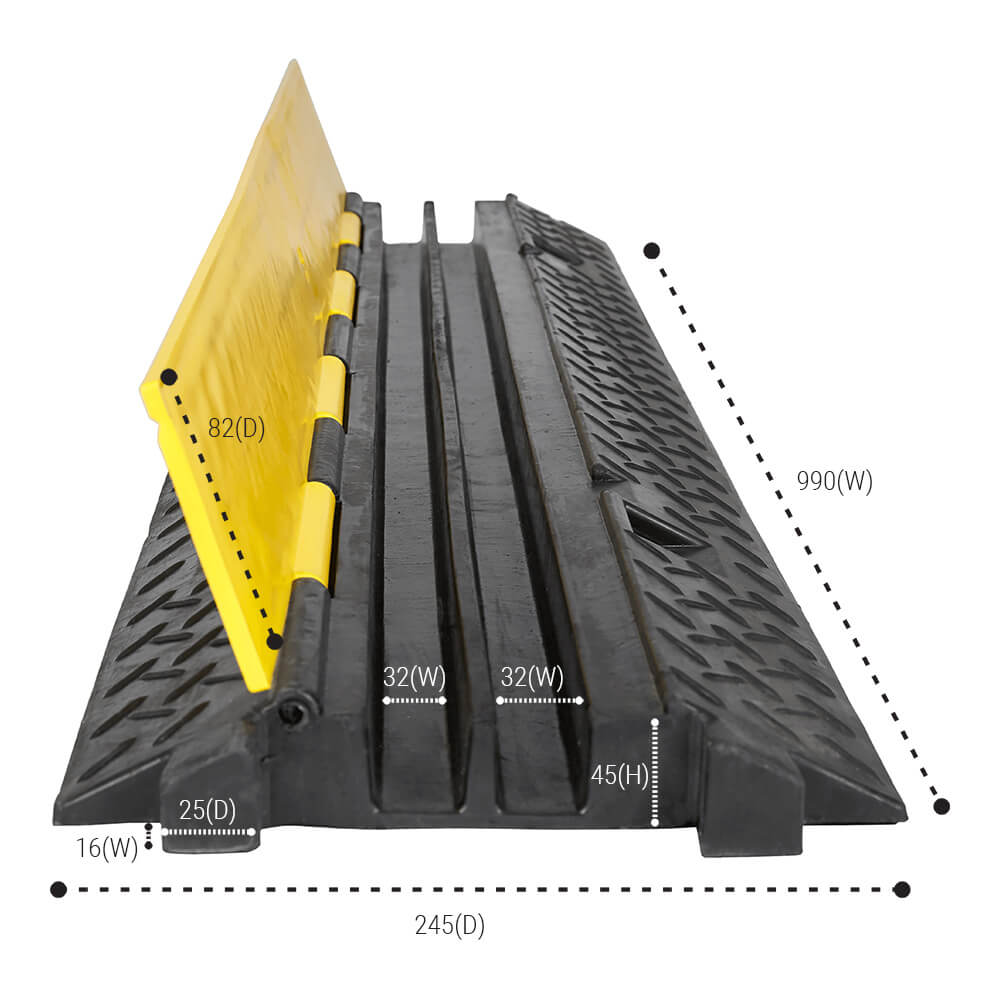
    The cable protector I came across on my utility cycle, which is a Brompton size e-folder with 16″ wheels was the size of a bolt down road-hump across the pavement, and is advertised as a “Pavement Cable Protector”.

    It is 45mm high and 270mm side to side with 45 degree slopes. The height is the same as a scaffold plank.

    Once we get any number of these, these shared pavements will be unusable by my I think, and even more unusable by wheelchair users etc.

    Warwickshire Council have published guidance permitting use of these because ‘haf their housing stock does not have parking off-street, and denying they have any responsibility in law.

    Below is a piece I wrote to highlight the question for Wheels for Wellbeing’s Disabled Cycling Activists Network.

    I’d welcome any thoughts from anyone.
    ————————————————————————————
    Councils are starting to promote use of cable protectors across pavements when charging electric cars.

    Warwickshire Council for one are specifically offering advice that these are acceptable, and cable protectors, and have published guidance. This is all the info I have, I have not gone after the EIA, which should exist but I bet does not.

    [i]Close to half of Warwickshire’s housing stock has no off-street parking, such as a driveway, which can make the charging of an electric vehicle difficult. In order to address this problem, Warwickshire County Council is allowing residents to place a charging cable across a pedestrian footway (e.g., a pavement) when using a cable protector.[/i]

    They also specifically say all legal responsibility for any problems caused is down to the owner.

    IMO this is a lie, and is directly against the EA Provision of Equal Service, and the PSED – especially when we consider the disruption caused by the 2-5 of these we will end up with for every 10-20 houses in areas where they are needed given charging times.

    AFAICS the typical size of “cable protectors” are up to 45mm (2 inches) high, 300mm wide and with 45 degree sloped. Aren’t drop kerbs 5mm? And front wheels of a manual wheelchair 75-150mm?

    Linked below one of these big ones with 150 reviews.

    Looks like a recipe for huge conflict and abuse, and one that Councils will try to slope shoulders on.

    HTH,

    Warwickshire council article
    https://www.warwickshire.gov.uk/news/article/4348/making-electric-vehicle-charging-more-accessible-in-warwickshire

    Warwickshire guidance
    https://api.warwickshire.gov.uk/documents/WCCC-1615347118-1185

    Pavement Cable Protector Product Link
    https://www.theworkplacedepot.co.uk/pavement-cable-protector

    Below
    Warwickshire guidance
    “Pavement Cable Protector” Photo and Dimension
Viewing 2 replies - 31 through 32 (of 32 total)
  • Author
    Replies
  • #1021621
    0
    mattw

    Pic of cable protector w

    Pic of cable protector w/dimensions
     

    https://cdn.road.cc/wp-content/uploads/roadcc/CABLE-2CHANNEL-DIMENSIONS_2.jpg

    #1021619
    0
    mattw

    Warwickshire Guidance Text

    Warwickshire Guidance Text
    —————————-
    Warwickshire County Council

    Use of cable protectors for electric vehicle charging

    Guidance for Residents

    Warwickshire County Council (WCC) wants to lead on tackling climate change. One
    of the ways we can do this is encourage a switch away from fossil-fuel powered
    transport to more sustainable travel options. In particular, electric vehicles (EV) can
    make an important contribution to this move towards greener transport choices and
    WCC recognises the significant benefits of doing so, particularly in relation to air
    quality, public health and reducing carbon.

    EV usage is increasing year on year and the county council is working hard to
    provide more publicly available charging infrastructure and to make it as convenient
    and attractive as possible to switch over to EVs.

    However, WCC recognises that many Warwickshire residents live in houses which
    do not have off-street parking. This guidance has been produced to aid residents for
    whom off street parking is not available but wish to drive an EV and charge their
    vehicle close to their home.

    Anyone wishing to install a private residential charging point should satisfy
    themselves, by contacting their local planning authority at the district or borough
    council, that they have complied with all relevant planning conditions before doing
    so.

    Before charging, you should refer to your vehicle’s handbook and any instructions for the use of cables, including extension cables, and, if necessary, seek advice from a qualified electrician before charging an electric vehicle.

    Charging cables may be placed across footways only if they are housed in
    appropriate cable protectors. It is important to consider public safety and existing
    legislation when placing the cable from the power supply in your home to your
    vehicle. Any legal liability arising from the placement of the cable or protector
    is your responsibility. You may wish to speak to your home insurer to confirm that
    your home insurance policy covers any situation arising from use of

    It is the responsibility of the person charging the vehicle to adhere to any
    parking restrictions that may be in place and to avoid obstructing the footway
    or any accesses. This guidance is intended to help residents make informed
    decisions about how they can charge a vehicle in these locations. It is the
    responsibility of the person charging the vehicle to avoid putting themselves
    and others at risk when trailing a cable across a footway or an area people
    may cross.

    Parking your vehicle for charging

    Vehicles should be parked as close to the property as possible. Where a vehicle
    cannot be parked immediately outside the property, the cable should be run along
    the carriageway channel against the kerb. The recommended maximum distance
    from a point outside the property is 10 metres (approximately 2 car lengths).
    The cable should not cross the carriageway. Your vehicle should always be parked
    on the same side of the road as your property.

    Any vehicle parked on the highway must always adhere to any local parking
    restrictions that may be in place and should not obstruct the footway.
    Charging your vehicle

    Whenever you are charging your vehicle, you should always follow all guidance and
    recommendations in your manufacturer’s handbook (this may differ depending on
    the vehicle).

    Any extension lead that is required should be suitable for external use. You should
    read any instructions on the correct use provided with your extension lead.

    Cables should be laid flat and never be extended from an upper storey to a vehicle,
    nor should they be hung from any street furniture including lamp columns or trees.

    A cable should only be placed over the footway when the vehicle is charging and
    should always be removed when not in use.

    It is the resident’s responsibility to ensure that the cable does not cause a danger or
    nuisance to the public.

    Cables should be laid flat so that they do not cause a danger or nuisance to the
    public. The cable use shown above is not an acceptable way to charge an EV.
    Using a cable protector

    The most appropriate solution for getting the cable from your property boundary to
    your vehicle safely is to use a suitable cable protector. Cable protectors are regularly
    used in public spaces and areas of high footfall to cover cables or wires on a
    temporary basis.

    Any cable protector used should cover the area likely to be walked across, including
    the full width of any footway and verge between the property and the vehicle.

    The cable protector should be non-slip, have contrasting colour markings e.g. yellow
    and black, have anti-trip sloped sides, and be of a tough construction suitable for
    outdoor use.

    It is your responsibility to ensure that the cable protector is used in
    accordance with the manufacturer’s instructions and that it is suitable for
    outdoor use and durable. You should remove any cable protector as soon as
    charging has finished.

    Cable protectors should be visible, durable and laid across the footway as shown

    Cable licensing

    Currently an EV charging cable does not require a licence. However, as policies are
    reviewed and updated this may change in the future.

    Although no licence is currently required, where a location is not suitable then the
    County Council has existing powers under Section 162 of the Highways Act to seek
    to have the cable removed. We reserve the right to require inappropriately used
    cables or those which cause obstruction to be removed.

    A licence is required for all other temporary placement of cabling on or over the
    Highway.
    —————————


Viewing 2 replies - 31 through 32 (of 32 total)
  • You must be logged in to reply to this topic.