


- This topic has 82 replies, 19 voices, and was last updated 3 years, 9 months ago by
chrisonabike.
-
CreatorTopic
-
January 5, 2023 at 5:29 pm #32387
 Secret_squirrel
Friendly warning. Ashley Neal’s gone full on troll (if he wasnt already). If you havent seen his latest piece of them and us trash I’d block him before your blood pressure goes up like mine.
Do a favour and dont link it on here. (though Im sure it will be on the live blog soon).
-
CreatorTopic
-
AuthorReplies
-
Ta! Summarising myself “it
Ta! Summarising myself “it takes both skill AND infrastructure to keep safe”.
In the UK we already have a surprising amount of infra to help make it easier to get it right than make a mistake AND to mitigate consequences of errors. (So ubiquitous it is very easily overlooked). However this is overwhelmingly designed for motor traffic. And not just for safety – also to facilitate throughput / convenience.
Currently in the UK – especially as a cyclist (and often even as a pedestrian!) – you need not just a certain level of skill but also to be alert to avoid incidents. I’d expect this for driving because in a motor vehicle you are often moving faster AND you represent a greater danger to others. Currently you need similar levels of awareness when cycling – or more so. The severity of the consequences is asymmetric and is bourne by the more vulnerable road user.
For all road users – the penalty for most simple mistakes should not be death. By that criteria much UK infrastructure is substandard.
In the UK you’d be well advised to take a second before setting off on any journey to just remind yourself – driving or cycling is mundane but isn’t a trivial task. (Folks like Ashley making “continous development” videos / reminders is a great thing for helping here.)
And if you ever want to walk / cycle, or your children / parents to be able to do so safely – ask your council / the government what it’s doing to make that as safe and convenient as for those who drive?
 mattw
mattw
Good comments. I’m drafting a
Good comments. I’m drafting a summarised comment for this vid, whichj I’ll also post here.
So Ashley finishes on (6:02)
So Ashley finishes on (6:02) “we cannot put blame / lay blame on infrastructure”. I understand his point – in the final analysis we’re responsible for our own (and others) safety on the roads. However I disagree and by this point I think he’s already shot down his own argument at three points at least (see * infra in my last comment).
We (ought to) know in the UK we shouldn’t trust the infra (signs, lights etc) or even other people following the rules. Unfortunately we have to trust some of it to some extent – otherwise you’ll be going several tens of miles slower than all other drivers and probably get road raged! If we didn’t want to encourage a “false sense of security” we surely would remove lane markings, traffic lights etc!
Also – “security” for the driver of a motorised vehicle is not the same as for e.g. a cyclist. Although we mix these modes and expect them all to follow (most of) the same rules there is a category difference in what the risks are and likely outcomes. For instance motor vehicles don’t normally slip and crash driving around tram tracks nor crash if someone else clips them with a wing(!) mirror… Although traumatised the motorist was not physically injured in the collision and was never likely to be. I bet this had a psychological impact on the cyclist too!
As someone in the comments to this video pointed out it is more sensible to continue to train people to be personally responsible but make it as easier for them to do the right thing rather than the wrong thing. We know humans make mistakes – and we already cater for this in many ways – just not nearly enough IMO. I don’t think it’s good enough to end with “we are where we are…” and assign everything else to laziness, idiocy or deliberate rule-breaking of the road users. (Although that is sometimes the case!)
If we’re actually interested in safety as a priority AND more than motor traffic (clue – we currently have “maximum safe throughput of motor vehicles” as our primary goal) then we should extend this to apply for all. The Dutch “sustainable safety” system is the exemplar of this.
Ashley – thanks for noting
Ashley – thanks for noting this and thanks for doing another video on this. Not least to say “I’ve reconsidered some aspects”. Takes a big person to do that. I agree with most points although not your last.
Also there are mostly very thoughtful comments over on the video too – which slightly surprised me rather than “BlOoDY cYcLiStS!”.
Didn’t want to worry this one to death but I already have… Also your general point (from the first video) stands separately and is not affected by your choice of example here (as people have pointed out). That that deserves its own comment but another time! Anyway just a couple of notes on the specifics of this latest vid. Again – thanks for the time.
a) (3:45) It is a bit unclear
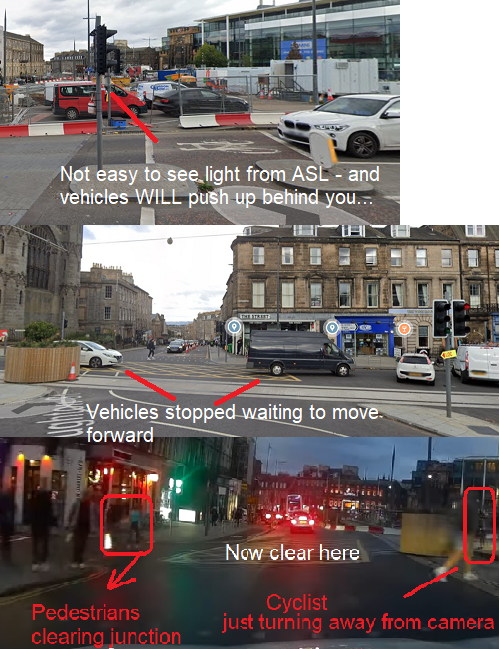
a) (3:45) It is a bit unclear in the footage but it seems (also likely from other vehicle positions) the cyclist is stopped perfectly correctly within the ASL, not ahead of it. In which case it may be difficult or impossible to see the near light (see image). As for “the majority of road users go too far forward…” – could they have positioned slightly further back to allow them to do this? Yes – but the infra guides them not to, and motor vehicles will regularly push forward behind you so there is pressure to be well into the ASL. Also there are what appear to be straight repeater lights right in front so why would you think “I better be able to see both sets of lights?” (* see infra notes) I don’t think in this case it’s a matter of “if you’re in that much of a rush…” (4:14). I don’t think the cyclist is ahead of the ASL. Where that would be the case is e.g. when you see motorists stoppping in the ASL in clear conditions (many ASLs are very worn and / or not clear in the dark). So in this case people following the guides the environment (infra) gives them has led them to not be able to correct one source of error.
b) (4:23) “Not seeing the vehicles that had already passed through the junction”. As you go on to say because the cyclist is dutifully following the guide track (* see infra notes) they would not be looking towards the pedestrians crossing the junction. And if they think they’ve a green light why would they (yes – better road craft etc.). Additionally it appears that crossing pedestrians had almost cleared the junction (last image). It’s busy here so it’s quite common to see pedestrians crossing out of turn. If you are cycling slowly and with care it is perfectly possible to continue and navigate around them safely – this isn’t so much the case in a motor vehicle simply because of that being wider and less manoeuverable.
RE: cars going though – the cars had cleared the box (see middle image). Unfortunately at this point it is not uncommon to see vehicles stopped here (joining back of queue) or even still passing after the end of their turn in the light cycle so “no vehicles in box” would reinforce “it’s my turn”.
c) The arrow on the far lights does indeed point to the left – but – especially following the “safe across the tracks” guide line – that is exactly the direction you’re going in! (* see infra notes)
d) As you and others say the planter is acting as a temporary tram stop / buffer AND may be there to visually guide traffic. It is a massive mistake and poorly placed IMO. I’ve been past there and checked (and the video shows) and the only up-side is it could have been worse – it doesn’t completely block the view of cyclists *during* the left-moving part).
Ashley Neal
It needed covering, and this
It needed covering, and this forum rubberstamped that also. Keep safe!
mattw
Noted. Will be over for a
Noted. Will be over for a view.
Just released Matt https:/
Just released Matt https://youtu.be/WkcA3UQITWE
Nothing! And they could do
Nothing – they could hop over the railings – or just walk past them! (It’s maybe surprising they didn’t put railings everywhere although I’m kind of glad they didn’t…) And they could do the same by cycling the wrong way up the lane from further west. Or heading off at right-angles to the road – if the tram didn’t get them, the buses and cars would as they crossed all the lanes.
Hence the “without being very careless” line. I would count “setting off into the road without looking” as “dangerous”. I’m just pointing out that the scenario of behing squashed because there is no room for both a bike and a tram requires you to do something I’d consider reckless. It’s more than an “easily made mistake”. The design does at least try to guard against that as you approach from the East (with the diversion / separate lights).
So I’d say the “crushed by tram” is less a factor here. Riding parallel and close to the rails though? That has the potential for a slip to put you under a bus or taxi. Sadly this has been proved since someone on a bike has died – not here (injuries) but at the West End. Likely due to the tram tracks. That is what I’d describe as “you could be punished for a simple easily-made mistake by death”.
The Picardy Place junction (where this all started) has a different set of hazards. Multiple confusing lights, a diversion which swings you across a lane and street furniture blocking the view. I’d say that is also likely near “too easy to make a fatal mistake”.
Again I would be very happy had the council had taken advice before this project e.g. paid heed to the independent report funded by Spokes, the local cycling campaign. Then found some way of engineering out any of these scenarios and avoiding having people riding around tram rails.
Or even if they’d taken the 776 million for the first part of the project (no idea what the second is going to cost) and spent that on making a “good enough” safe and convenient network of cycling infrastructure (key – fix the junctions). Or even maybe improving the 22 bus route / airport buses, if that was the big deal?
 Backladder
chrisonatrike wrote:
Backladder
chrisonatrike wrote:Edinburgh resident; good summary for most of it but just some minor pedantry. There was another thread where this came up. If it’s the bit I think you’re thinking of I’d completely agree that this section isn’t good at all (injuries here, I think) but it isn’t the death trap your paragraph makes it sound. Cyclists are sent onto the parallel street to the tram and held at separate lights (much clearer than the Picardy Place ones!) so separated in time. Caveat – I probably only pass that way every month or so. However I’m pretty sure you’d never be at the narrows at the same time as a tram. Without being very careless or indeed reckless!
The street view shows several bikes locked up outside the bar, what is to stop these riders just joining the cycle lane and then finding a tram following them?
mattw wrote:I was trying to be, shall we say, concise – having written a short essay rather than a comment. … I would argue that for ‘passive’ safety, we also require “separation in space” from cycling immediately alongside exposed tram tracks … design out the risk. Yet we now in 2023 have these hundreds of metre long similar wheel grabbing grooves next to where we expect the public to cycle!Agree with all of this. And you’re right – even if you’re not likely to get hit by at tram at this point cycling close to and parallel to tram tracks is a hazard (see court reports).
We already do apply some engineering “passive safety”. Mostly for drivers though. If we assumed we were all alert and competent etc. we wouldn’t need high-vis signs on low bridges or special rumble strips at the edges or bumps to alert us to approaching junctions. (There are lots of other examples.)
For other modes “safety” is almost always at the expense of convenience. Consider walking – you get a pavement but it’s often narrow and full of signs for vehicles, there’s a fence in the way to stop you crossing “where it’s not safe” … (also lots of other examples).
I’d say this all derives from the fundamental purpose of the system. In the UK the goal is maximum throughput of motor vehicles that is consistent with safety. In e.g. NL the goal is safe and efficient movement of people. That small change ends up making a vast difference. (Yes – we’ve got the effect of history but the NL also went down the same path as us for generations. The difference [for road safety] is that NL have started to turn the ship around).
Getting speculative this may also reflect some deeper cultural elements. With “public transport” we seem to be happy to apply a “systems / health and safety” approach. For driving this seems to be more about individual liberties / responsibilities. There are so many inconsistencies around this. As mentioned we do apply passibe safety for drivers. For another there’s the notion of “individual skills” – but yet we only train and test once a lifetime…
mattw wrote:Is it fair to suggest that optimal ‘passive safety’ cannot practically be added afterwards, and must be designed in from the start?Generally it’s much more expensive and not as effective to retrofit, where it’s possible at all.
mattw
chrisonatrike wrote:mattw wrote:There is, for example, a cycle lane under 1m wide in the Haymarket – a busy, complex junction – which is painted right up to the tram track, where cyclists are directed to cycle. But the trams are 2.6m wide and overhang the 1.4m tram track by 0.6m each side.Edinburgh resident; good summary for most of it but just some minor pedantry. There was another thread where this came up. If it’s the bit I think you’re thinking of I’d completely agree that this section isn’t good at all (injuries here, I think) but it isn’t the death trap your paragraph makes it sound…
Thanks for the reply. Very fair observation. Yes that’s the section I am thinking of. I was trying to be, shall we say, concise – having written a short essay rather than a comment.
It is certainly a useful distinction between 1 – the presence of a tram track right alongside a cycle lane, and 2 – the presence of a tram driving down the tram track with a cyclist at risk of going underneath.
“Separated in time” is a good observation about managing the second risk, but that does not prevent KSIs from the other one.
I would argue that for ‘passive’ safety, we also require “separation in space” from cycling immediately alongside exposed tram tracks, and that is the thing that Edinburgh has missed; it should have been a basic principle of the design guide. In my own local tram system in Nottingham there are a couple of similar places. Here in Ashfield we even have the Liitle-and-Large asinine politics – active travel improvements weaponised between District and County Councils (Ash. Independents vs Tories), which is galling.
Perhaps a good parallel example of passive safety design is how we switched the angle of longitudinal bars on drain covers to be crossways, such that they can no longer jam front wheels – design out the risk. Yet we now in 2023 have these hundreds of metre long similar wheel grabbing grooves next to where we expect the public to cycle!
Is it fair to suggest that optimal ‘passive safety’ cannot practically be added afterwards, and must be designed in from the start?
One advantage imo of trying to insist on passive safety as far as we can, rather than just active, is that reliance on a positive road culture is removed. If I’m not on the road on my bike, they can’t hurt me whether by neglect or deliberate action – and in the UK we can’t rely on a helpful road culture at present.
In terms of Ashley’s work, I think he focuses on what I would call *active* safety, which is around all the skills and attitudes we use as drivers or cyclists. And which is what we can affect individually. In my conversations over there, I try to point up the importance of designing out risk to take the debate forward.
But TBH on road.cc I think all I have said above is probably teaching grandma to suck eggs.
mattw
Thanks for that Ashley.
Thanks for that Ashley.
HoarseMann
Well all this talk of
Well all this talk of reckless, abusive, red-light jumping cyclists made me think of checking in on one of YouTube’s most controversial bike-cammers, ZeroEnigma.
Turns out he recently got knocked off his bike – the time he didn’t run a red light…
https://youtu.be/m-6Usw1vC0M?t=1057I think he is abusive and potty mouthed, not the best rider, but not actually a massive risk taker (well, for riding around NYC anyway).
mattw wrote:There is, for example, a cycle lane under 1m wide in the Haymarket – a busy, complex junction – which is painted right up to the tram track, where cyclists are directed to cycle. But the trams are 2.6m wide and overhang the 1.4m tram track by 0.6m each side.Edinburgh resident; good summary for most of it but just some minor pedantry. There was another thread where this came up. If it’s the bit I think you’re thinking of I’d completely agree that this section isn’t good at all (injuries here, I think) but it isn’t the death trap your paragraph makes it sound. Cyclists are sent onto the parallel street to the tram and held at separate lights (much clearer than the Picardy Place ones!) so separated in time. Caveat – I probably only pass that way every month or so. However I’m pretty sure you’d never be at the narrows at the same time as a tram. Without being very careless or indeed reckless!
Otherwise I’d certainly agree it’s far from optimal for safety or convenience. Even without the tram, it’s a really busy intersection with lots of coaches and buses and taxis pulling in / out / turning. No Dutch city would countenance anything like that! Agree that the council at best buried its head in the sand over the issue. (As you allude to it’s a tangled and messy story as you’d expect given the money involved…)
-
AuthorReplies
- You must be logged in to reply to this topic.