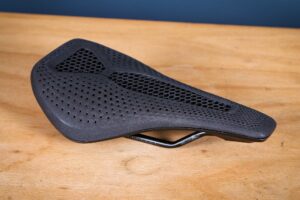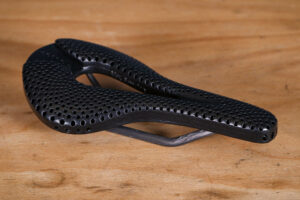

Saddles are incredibly personal things, they’re not one size fits all, which can make the whole saddle purchasing journey a tricky endeavor. However, as it 3D prints every saddle especially for each customer’s anatomy, Posedla aims to make buying the perfect saddle simple. And that, it does as its Joyseat 3.0 Plus brings excellent comfort for all kinds of riding. However, it’s not without a weight penalty, a bit of a break-in period, and a considerable investment.
- Best mountain bike saddles 2025 – the best off-road options tested
- Proxim Nembo saddle review – Tonnes of support let down by stiffness
- Women’s saddle guide – how to choose the best women’s saddle
Posedla Joyseat 3.0 Plus – Technical details
With a range of saddles primed to suit all riding styles, from road, gravel, TT, and MTB Posedla has all bases covered, especially as there are also three constructions available – Plus, Pro and Ultra. Plus is the more basic build that utilises a nylon shell with stainless steel rails, Pro gets a twill carbon shell and UD rails, while Ultra gets a reinforced UD (unidirectional) shell and rails. Here on test, we’ve got the Plus model.
Something that should be mentioned is that each construction offers a different load limit. The Plus can cope with all of the load, according to the brand, while the Pro can accommodate up to 100kg and the Ultra, 110kg.
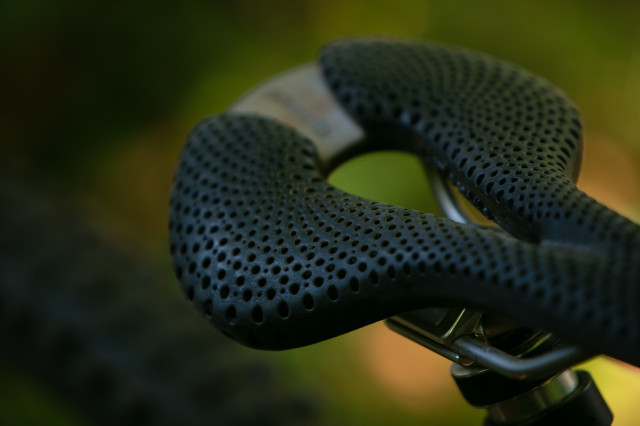
Although all of the saddles follow a similar general design, the MTB one gets a profile that’s more curved for better support on the climbs, there’s thicker padding for better damping, and it loses the pressure cutout towards the nose of the saddle. That’s because we mountain bikers tend to move around on the saddle a lot and sit on the nose when the climbs get particularly nasty.
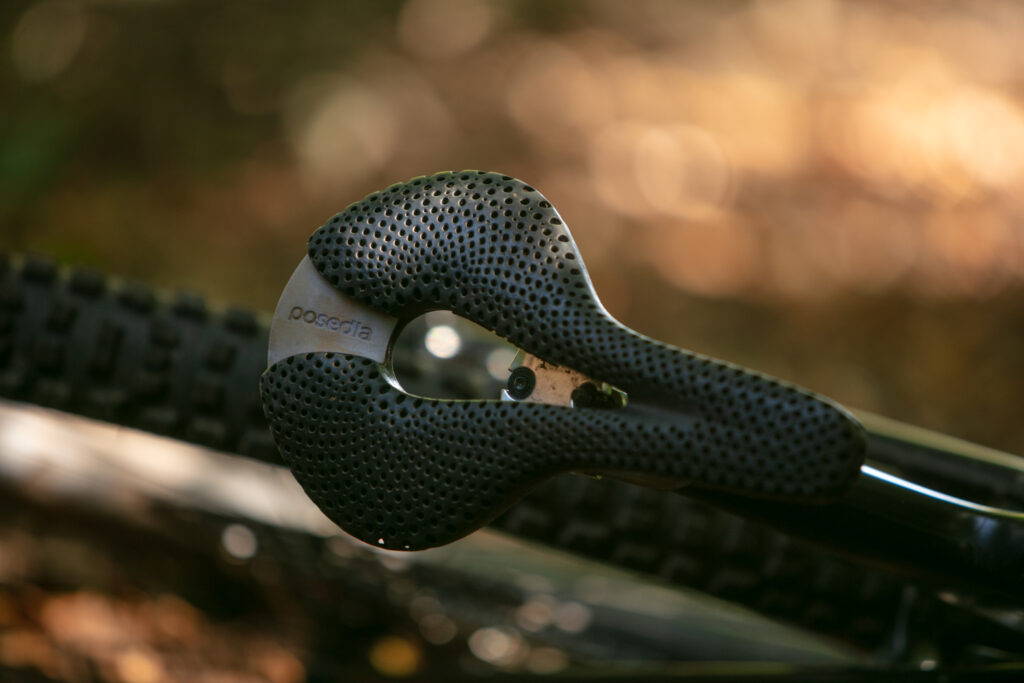
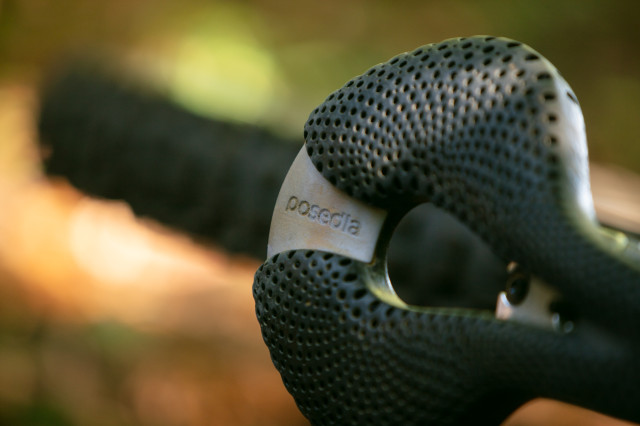
As this is a 3D-printed saddle, the Joyseat 3.0 uses a rather different construction. Posedla builds its saddles using thermoplastic polyurethane, which is formed into a supportive lattice that’s tweaked and formed to the customer’s riding profile and pressure zones.
The brand’s preference to 3D print each and every saddle brings big benefits to its offering. Each saddle is printed with stiffness zones, shapes, and widths that are unique to the customer. And these shapes and designs have been developed after years of data gathering, which has been done in collaboration with NMS Market Research and a whole lot of science.
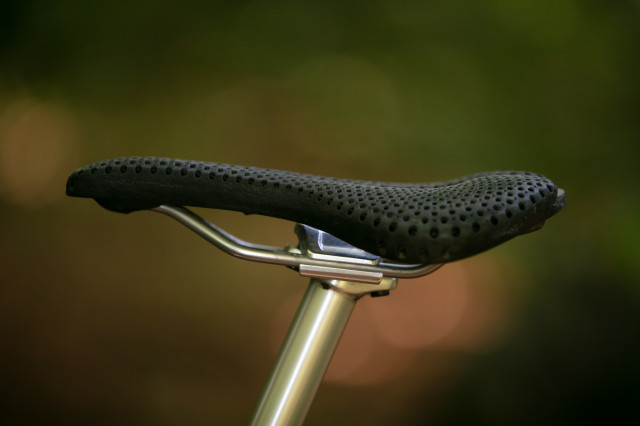
Of course, depending on the riders’ anatomy and the saddle that’s produced for it, the overall weight of the finished product will change. The saddle that I’ve been riding ended up being 151.5mm wide and 295g in weight. Now, that weight is certainly a bit more than what you’ll find from an off-the-shelf saddle, but this is far from off-the-shelf.
Posedla Joyseat 3.0 Plus – The process
Being a completely custom saddle, there is a bit of a process that takes place before it shows up at your door. First, Posedla needs to take measurements, but fortunately, the brand has made this incredibly easy.
Before the scientists behind the brand start conjuring up a saddle, you’ll receive a Smiling Butt Kit. It’s basically a fancy slab of foam that you’ll carefully sit on, before taking pictures of it from a dictated selection of angles. This is just part of the story in dialling in what the brand reckons is the perfect shape.
After uploading the images of your arse imprint to Posedla’s website, you’ll then be asked a collection of questions, like the type of bike you ride, whether or not it’s an e-bike, the kind of mileage you’ll do over a year, and your average ride length. You’ll also be asked about your gender, height, and weight.
Once that’s all put in, the website will then take you to another page that asks more questions, and it’s totally optional. However, as you’re investing a fair bit of cash, it’s worth filling out. Here, you’ll be asked about how flexible you are, and such.
This process not only allows the saddle builders to determine where more support is needed, thus bolstering certain areas of the saddle with more internal supports to do so, but it also tailors the width of the saddle that should work best for you.
As soon as you’ve wrapped up with this, it’s just a wait until the saddle arrives, and the website will give you a rough idea of how long it’ll take. I was promised six to eight weeks, however, my saddle turned up quite a few weeks later than that, unexpectedly. Though I’m told that this was due to stock shortages, which have since been rectified.
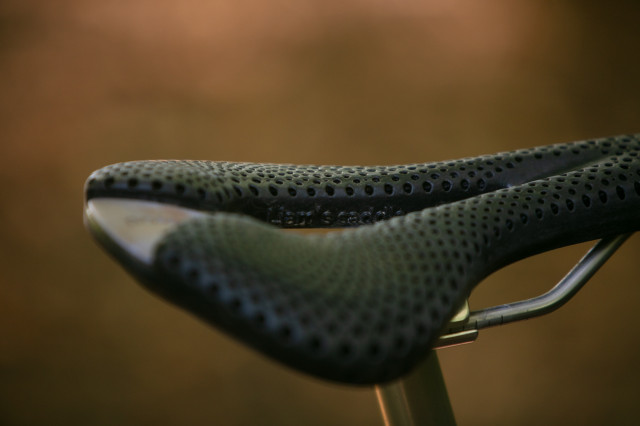
A neat feature is that, as well as a completely customised saddle, there’s an opportunity to have your name, or whatever else you like, printed onto the saddle. As you can see, I got pretty imaginative with mine.
Posedla Joyseat 3.0 Plus – Performance
If you’ve read any of my reviews on saddles, you’ll already know that I’m mighty fussy about them. Only with a few have I found good long-term comfort, but the Joyseat 3.0 takes all of the guesswork out of saddle shopping, as even when you’re measured up, it can still be a case of trial and error.
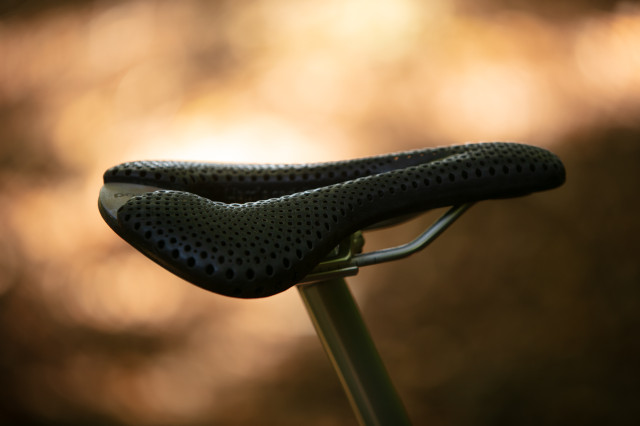
Although it’s filled with perforations and it looks a little mental, it’s still a saddle and it does exactly what it’s meant to do. However, I couldn’t help but let a healthy dose of scepticism seep through.
Though every one of my hesitations over the saddle was quickly dispelled during my first ride. It fits incredibly well, which you would hope for in a custom saddle. At first, I felt as if it was a little wide, but that helps bring plenty of support to the places that really need it.
But during those first rides, it became clear that a break-in period was needed. That’s because it’s quite a flexible saddle, especially in the middle portion. While this does an excellent job of damping high-frequency vibrations, while pedalling, I could feel it move slightly. Usually, that’s no bad thing, but as the upper of the saddle is perforated, it felt a little abrasive on my undercarriage. But as I clocked in more miles, this faded as the saddle bedded in.
With a little more confidence in the Joyseat 3.0, I threw it on my cross-country bike before heading to Iceland for the RiftMTB where I racked up nearly 300km of riding over 20 hours. I’ll admit, some numbness and discomfort crept in, but that certainly wasn’t the saddle’s fault. Rather, it was simply all of that distance on an unconditioned body. In fact, the saddle brought comfort wherever it could. Again, it delivered plenty of support in the right places, and there aren’t any particular spots on the saddle that presented unwarranted pressure. Then, as its nose is fairly flat, and its overall length presented me with plenty of room to move over the saddle, and reposition myself.
But with so many of those kilometres being in the saddle, its width raised questions about how it would perform with the seat post dropped, and the saddle out of the way. After a few trail rides under its belt, it never got in the way of my body when cornering, jumping, or any other trail-based shenanigans. It does its job when it needs to, but keeps well out of the way when not needed.
Durability is top-notch, too. Although the black sheen does rub away after plenty of use, it’s showing absolutely no signs of wear. Even the rails are looking as good as new.
Posedla Joyseat 3.0 Plus – Verdict
At £299, the Joyseat 3.0 is definitely an investment, but if, like me, you suffer with generic saddles and ride an awful lot, it’s well worth considering. Although it’s a lot of money to spend, Posedla’s offering is mighty competitive when compared to those from other brands.
One of which is Fizik and its One-to-One program. For a custom Fizik saddle, expect to part ways with £500. It requires a much more involved fitting process, too, which involves an app and a person. This can only be done via a Fizik dealer and not in the comfort of your own home. However, these saddles get rails made from more exotic materials. That said, Posedla’s top-end Ultra construction costs £469.
Reform’s saddles achieve a custom fit differently. They’re not built from scratch for your very body, but at £230 to £252, they use a thermo-moldable tech that means the saddle needs to be plugged into a power outlet to warm, then you ride the saddle for it to mold to your contours. Reform’s offering brings carbon and titanium rails to the mix at a lower price, but these saddles are more semi-custom in practice.
Then other adaptive, or 3D printed, saddles will cost an arm and a leg. Take, for example, Specialized’s S-Works range and the recent Cadex AMP 3D. The former will set you back £379 and the latter £350. These do get fancy rail materials.
However, there is one key player in the market that needs to be mentioned – SQlab. I’m a big fan of the 60X Ergowave Active 2.2, and while it’s far from custom, it comes in plenty of widths, and the brand has a measuring method that should make finding a saddle that works for you easy. But as much as I like that saddle, the Joyseat 3.0 feels much more natural and brings consistent comfort deep into long-distance rides.
Although Posedla’s Joyseat 3.0 Plus requires a reasonable investment, it’s a more accessible entry into a custom-made saddle. And through the brand’s diligent research into anatomy and its heft of data collection, it has successfully built a saddle that delivers plenty of natural-feeling comfort in a fuss-free manner. Measuring is easily done at home, and the result is a saddle that just works. It does require a bit of a break-in period before it provides the best of its comfort, and it is a little weighty, but for me, that’s a welcome compromise.
You might also like:
- Best gravel bike saddles 2025 – the best off-road options for going long or short
- Ergon SR Allroad Core Comp Saddle review
- SDG Bel-Air V3 Overland Lux-Alloy saddle review
Product purpose:
Build extra:
road, gravel, MTB, TT
Rails
7×7 mm
(read more)
Load limit
none
Weight
from 220 g
Materials
stainless steel alloy rails
glass-reinforced nylon shell
100% custom TPU padding
Product construction
Product construction extra:
Product performance
Product performance extra:
Product durability
Product durability extra:
Product weight
Product weight extra:
Product comfort
Product comfort extra:
product value
All the deals displayed on our review pages are pulled from a constantly updating database feed of the best affiliate deals available. The criteria for deciding on what are the best deals is who is offering the lowest, delivered price. In most cases we will be showing the very best deal available online, but sometimes you may be able to find an item cheaper. If you can please feel free to post a link in the comments box below. To find out more about affiliate links on road.cc click here.