



A council leader has hit back at the protests of residents and opposition politicians outraged by the idea of the local authority attempting to create a safer route for cyclists through their village.
The Hertfordshire row concerns a proposal from Three Rivers District Council to approve priority routes as part of its local cycling and walking infrastructure plan. One of these, the ‘Watford Route’, has attracted fierce opposition over a stretch through the village of Abbots Langley.
The Watford Observer reports the main opposition has come from locals and councillors who have branded the plans “insane” and “an accident waiting to happen”, they say, because it will pass narrow roads and under two railway bridges.
Now, an online petition has urged the council to “withdraw its plans to build a cycle lane up Gallows Hill”, the opposition to the scheme stating the local authority has “agreed to a plan to build a cycle lane up Gallows Hill: with a severe impact on pedestrians and road traffic”.
“The council has proposed this be ‘largely separated’, saying ‘stepped tracks would provide appropriate separation from traffic’. This means a cycle lane,” it continues.
The local Conservative councillors have been vocal in their opposition, the petition concluding: “This plan was opposed by Abbots Langley’s Conservative councillors, as it will necessarily create bottlenecks at the arches, while the dipping and winding Gallows Hill is not a safe route to narrow — so would inevitably become one-way (as the Lib Dems proposed in Chorleywood).
“However, other than the Conservatives’ objections, it was voted through with almost no public awareness or scrutiny. We are therefore launching a petition below to pressure Three Rivers to reverse its decision.”
However, while councils’ cycling infrastructure projects are rarely strangers to outspoken opposition from sections of local communities, where things get confusing in this case is that Lib Dem council leader Stephen Giles-Medhurst has rubbished the petition and online claims in a video urging residents “not to be misled”.
He said the idea the council had approved “a cycle lane along this narrow road” was “just not true”.
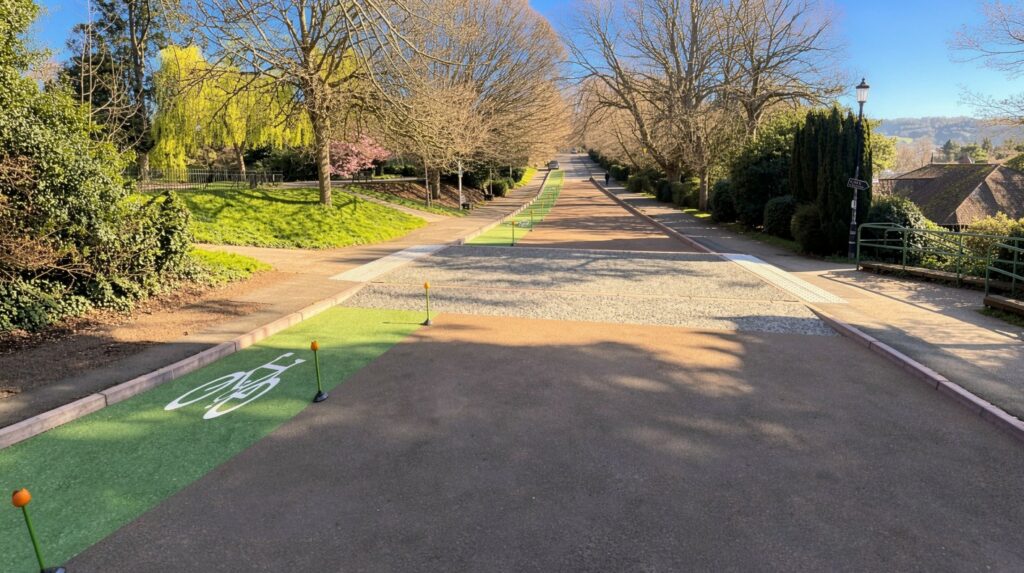
“The council meeting agreed that this would be an ideal route to make improvements to enable cyclists to move safely along here, such as junction improvements with Gallows Hill and other side roads that run off it,” the council leader said.
When the petition was shared on social media, Cllr Giles-Medhurst commented there too, again stating, “No plans for a cycle lane have been proposed or agreed. It is just not true.”















13 thoughts on ““Just not true”: Council rubbishes anti-cycle lane backlash and urges residents “not to be misled” by online claims”
The tories are getting
The tories are getting increasingly desperate, trying to wrest the badge of populism from RefUK, and little things like facts aren’t going to stop them. If the road is so dangerous for cyclists, surely it makes sense to make it safer for them? Not, apparently, if you’re a tory. There were two council bye-elections last week, both won by the Greens, with the tory vote less than five percent in one, and less than three percent in the other: the tories are toast.
This entire row demonstrates the depths to which petrolheads will twist the facts to get their way.
I’m getting a sense that some
I’m getting a sense that some bits of the motorist lobby are trying to be harder edged.
I think I’ve just been chucked off a large motorists group on Facebook when I started saying that disabled people with mobility aids need bus stop bypasses and mobility tarcks to keep them safe, and that all groups must be considered.
They seem to be going for Ref UK more, given that the Cons are headless chickens. If they are lying their heads off it is entirely consistent with the current habits.
Well lying and making stuff
Well lying and making stuff up is an eternal tactic eg. “our party stands foursquare against taxing working people at 500% and giving the money to demons to cover the fuel costs in hell, unlike our opponents …”
There does seem to be an appetite for *more* partial, partisan tactics and frank acceptance that “truth” is a minor concern compared to things like attention (again nothing new but it’s a question of degree – but eg. Trump has lied so frequently and blatantly it may seem a more qualitative change than quantitative. – see references here https://en.m.wikipedia.org/wiki/False_or_misleading_statements_by_Donald_Trump)
At some point reality can’t be cheated, but that may come too late to be helpful. (See “oh no – my urban environment has become an unpleasant asphalt jungle, the roads are trashed, there’s congestion everywhere, taxes keep going up – *and I have to drive*”).
Local Cycling and Walking
Local Cycling and Walking Infrastructure Plans (LCWIPs) are merely proposals for where safer cycling and walking routes are needed. They’re not plans to build.
As a precursor to their adoption there must be a public consultation so the petrolheads get to have their say.
From the description it sounds exactly like a route where safer infrastructure is needed for those not in cars.
How about someone in a car or
How about someone in a car or on a bicycle/motorbike take a moving video of the roads as they are, and of the planned cycling/walking route? Then get the local people who will use the new routes to see and address this problem.
nordog wrote:
I think it’s exactly the latter which is the problem. It’s difficult to get people to engage in “boring civic stuff”. And there is a measure of “don’t want to see it” – until it’s clearly going to happen and it’s something people think will have a negative impact.
*Then* they’re out in force!
This is compounded by the greatest benefits from (proper) cycle infra (in terms of numbers affected and positive changes) being to *those who don’t currently cycle*. That is: those who now drive but might cycle in future if it was attractive *relative* to driving. And in fact – also today’s drivers who will still drive that trip in the future!
Because the main problem for motorists is not cyclists or any other vulnerable road users, or “roads are too narrow” – it is *all the other motorists*.
Short: people dig their heels
Short: when faced with change people dig their heels in and say it’s impossible given their current life and routines.
They are usually correct. … But it’s also true that change happens all the time, people adapt and the previous situation is quickly forgotten.
In fact when things improve the number of people who say – after the fact – that a) there was no big drama and b) they were in favour from the start (or at least weren’t shouting against it) – is remarkable…
The four stages of acceptance
The four stages of acceptance: 1. This is worthless; 2. This is interesting, but perverse; 3. This is true, but quite unimportant; 4. I always said so.
“how dare the council
“how dare the council identify this route as needing improvement for cycling – it’s lethal because of narrow railway bridges”
I mean how stupid are people making the councils argument for improvement as a reason to oppose it…
From Streetview, the railway
From Streetview, the railway arches have traffic light control now, so presumably it is already the bottleneck! Not sure how it’s lethal, but . . .
“. . . severe impact on pedestrians and road traffic” Cyclists ARE ‘road traffic’ just not the four wheeled motorised type
I suppose any ‘improvements’ won’t be opposed by the combine harvester driving lobby!
“This would be an ideal route
“This would be an ideal route for a cycle path but don’t worry, we’re going to try our best to make sure it never happens.”
There’s a much cheaper
There’s a much cheaper solution to all of this cycle lane malarkey…
If the roads are safe for bicycles, then surely the same must apply to pedestrians?
Just a quick change should make it all work, footpaths become cycleways and pedestrians can walk in the gutter or existing 30cm wide previously designated “cycling infrastructure” the Councils have marked off to tick their “sustainable travel corridors?”
Or even just alternate it, on even calendar days it’s a footpath on “odd” days a cycleway? Surely that’s the most elagertarian approach?
Or am I missing something, and perhaps roads aren’t that safe afterall??? 🤔
Disgusted of Tunbridge Wells
Even better – if it’s safe for vulnerable road users then simply return to the original state * where there is no “footway”. There is just the “road” – for cars, cyclists, horsists and people on foot!
This will have several benefits: if the several people (well – mostly two) on this forum who pop up to decry the very concept of separate infra are correct this will not just save money (no expensive footways or cycle paths) but be safer for everyone! (History wants a word on this one. **)
Perhaps we should run the trains along the same routes too?
Maybe it’s a good idea to also adopt the road surfaces of yore also e.g. generally unmetalled / unpaved (before surfaces were improved – for motor traffic obviously)? That will save more money, and perhaps also encourage slower driving? (Until everyone is in an SUV which is actually capable of handling more off-road conditions…)
* or not – see e.g. Pompeii with footways – although I think that was to keep people out of the poo, food waste and animal parts. (The Romans were behind some other cultures in sewer systems).
** This idea keeps coming back in different variations. e.g. “shared space” – which almost always ends up with confused drivers (not in fact conducive to safety) and the rule of “might is right”. Then there’s “vehicular cycling” where the focus is on “our rights to cycle on the roads” – missing (or deliberately uninterested in) the fact that even most adherents were quite happy not to demand to cycle on motorways, and that for the vast majority this “right” was an entirely theoretical one they would never desire to exercise because drivers are humans too.
In fact … contrary to some straw-manning by some who are opposed to “cycle infra” it is perfectly possible to mix some different modes, but this needs several things to be true and – at least in urban areas – it involves quite a bit of work to engineer the conditions.