Repeated broken rear spokes on Trek District 4 Equipped

  • Creator
    Topic
  • #32792
    andystow

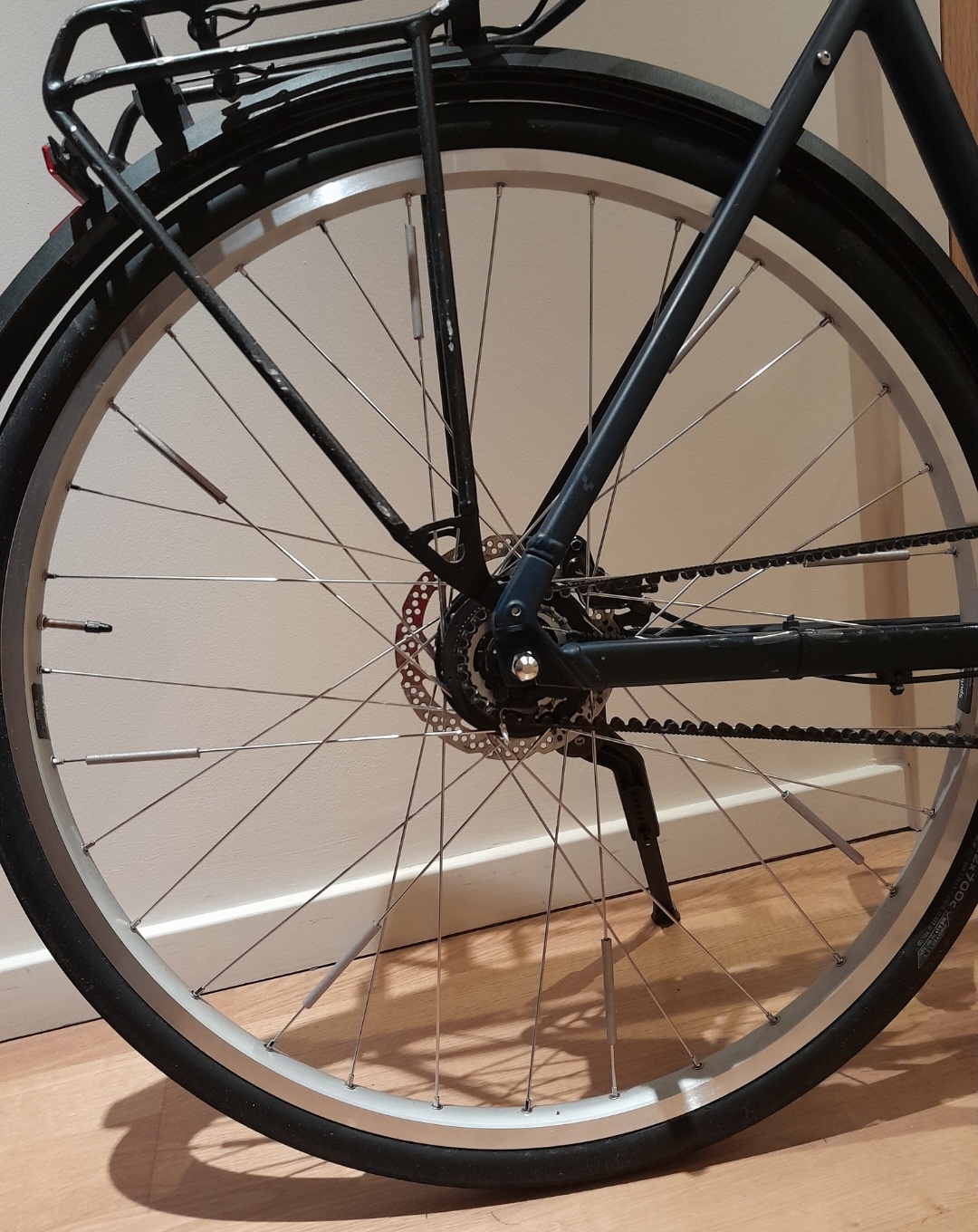
    I have about 4000 miles now on the Trek District 4 Equipped I bought new last year, and I think I’ve now had five or six broken rear spokes. It has a Shimano Alfine 8 rear hub laced to a Bontrager rim with 32 straight gauge spokes, and has 700C x 40 mm tyres.

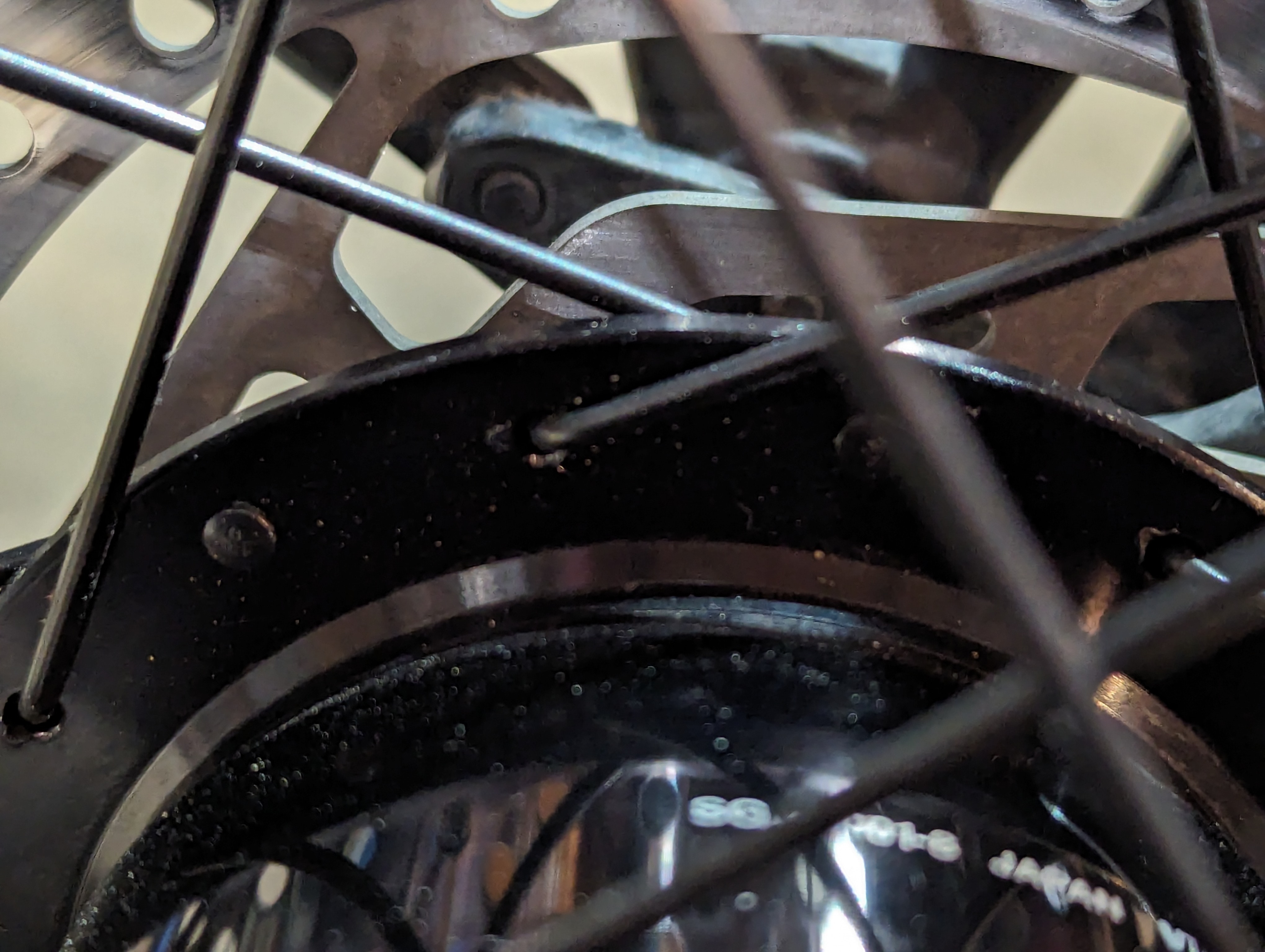
    The shop has been great at replacing them under warranty, and last time they even got Trek to give me a new rear wheel on the theory that maybe it was built wrong. Well, that was less than six months and 1500 miles ago, and I’ve just dropped it off again when I found another broken one. They all break at or just inside the nipple, with a few threads left on the spoke.

    I bought the bike in late March of 2023, so I have about six weeks of warranty left. I am well, well under the weight limit for the bike at about 165 lb / 75 kg, have never used it for heavy loads, and about the roughest thing I do to it is slow rides up or down 6″ dropped kerbs. I also don’t put out massive power, especially when I ride this bike, which is mainly my commuter. Any thoughts? I’m not looking to return the bike. My thought was once it’s out of warranty I’ll just rebuild it myself with quality double butted spokes and upgrade to brass nipples, probably $50 (£40) per wheel if I do the labour myself. I told the shop owner that, and he assured me they “won’t let it get that far.”

    My intent with this bike, with its belt drive, internal gears, and generator lights, is it would be an unstoppable 100% reliable pub bike to get me home at night without any mechanical issues, and to be fair it has been. Even with two broken spokes there was enough chain stay clearance to handle the wobble.

    Any theories as to what the cause might be other than “maybe the spokes aren’t strong enough?”
Viewing 15 replies - 1 through 15 (of 27 total)
  • Author
    Replies
  • #1020389
    0
    Anonymous

    Breaking multiple spokes in a
    Breaking multiple spokes in a row is a sign of a bad repair job. The wheel needs to be slacked off a bit and more or less be built back up to tension after the missing spoke/s were inserted.

    Lousy bikes shops or over worked bike shops like to take short cuts. So they will slap the missing spoke in and tighten surrounding spokes till the wheel is true again. This will lead to more broken spokes in a short time.

    IF they did their job they would slacken all spokes off a bit, insert the missing spoke, then true the wheel back to tension and being true. But doign this takes time and skill. Not something all bike shops have.

    #1020387
    0
    andystow

    I got it back a few days ago.
    I got it back a few days ago. The new and old spokes measure right at 2 mm, so 14 gauge. They’re built three cross, but the third cross is basically behind the flange.

    I still haven’t had a chance to check the tension.

    https://cdn.road.cc/wp-content/uploads/roadcc/PXL_20240218_193508617.jpg

    #1020385
    0
    chrisonabike

    Sounds like you’ll just see

    Sounds like you’ll just see how the new wheel works now.  I’ve not had issues but I’ve done much less distance.  Probably had somewhere north of 500 miles in the last build of this bike (theft, recovered it but needed a rear wheel rebuild) with no issues.  Couple of hundred this time round.

     RABBITHOLE ALERT!

    I had a quick look online and the Alfine wheels of this diameter I could see all had the same spoke pattern.  The angles at rim do seem to be greater on this hub (because the wider hub flange?) though.

    For deeper dives into wheelery-spokery there are of course SpokeCalc and FreeSpoke.  The latter gives you a nice visualisation with angles.  Plus a wealth of nerding from engineers, the late great Sheldon Brown etc.

    #1020383
    0
    chrisonabike

    I’ve one of these (also 32
    I’ve one of these (also 32 spokes, Ryde sputnik rim (622x19c rim), not sure the spokes, 3 cross). Just by eye the alfine hub appears to have a thick flange not just a wide one (but haven’t checked with a gauge). That wouldn’t explain issues at the nipple ends though. As others say perhaps lacing pattern?

    https://cdn.road.cc/wp-content/uploads/roadcc/Screenshot_20240210_215748_Gallery.jpg

    #1020381
    0
    don simon fbpe

    Which is all well and good,

    Which is all well and good, and hopefully built well, but we still don’t know the cause of the previous failure.

    #1020379
    0
    andystow

    I stopped by today to buy a
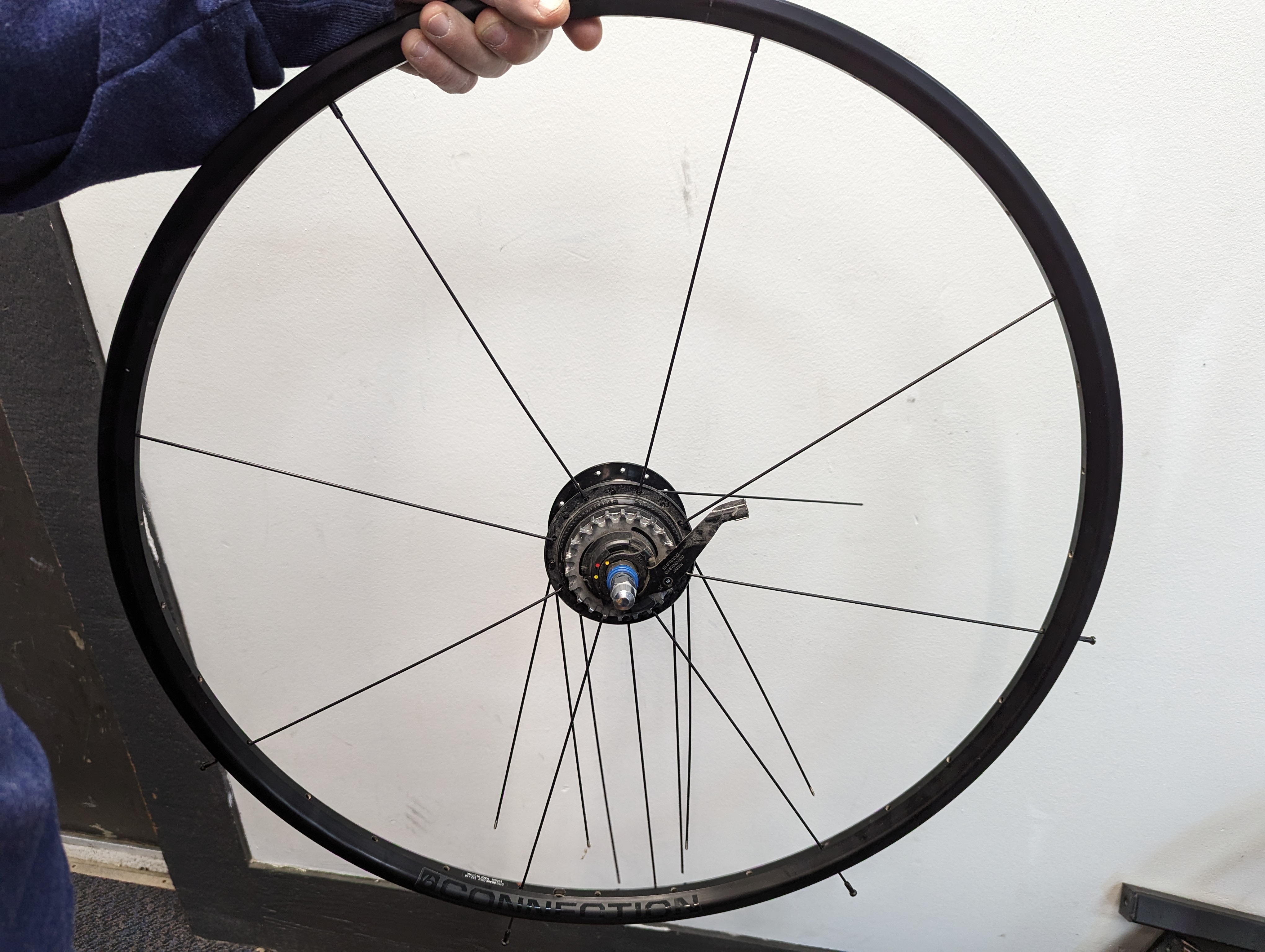
    I stopped by today to buy a couple of things, and this is the state of my wheel. He’s rebuilding it three cross with all new spokes.

    https://cdn.road.cc/wp-content/uploads/roadcc/PXL_20240210_194935401.jpg

    #1020377
    0
    andystow

    David9694 wrote:

    David9694 wrote:
    I assume the breaks are happening at the J?

    Nope, just inside the nipple.
     

    David9694 wrote:
    ive never got to the bottom of spoke tension on rear wheels.  Even on each side, ping on the NDS and pong on the DS. 

    I know you said “don’t tell me the spokes aren’t strong enough”, but for whatever reason(s) you’ve got too much flex (e.g. weight, riding surface, less likely – riding style) and the spoking you’ve got cannae take it, Captain.

    75 kg, maybe 200 W on a good day, and this bike gets used almost entirely on smooth surfaces except for the occasional kerb hop at low speed.

    #1020375
    0
    hawkinspeter
    Creakingcrank wrote:
    Correct length spoke – ends up roughly flush with top of nipple. Spoke overtightened – sticks out of nipple on the inside – pierces rim tape – punctures tube. Less likely on a box section rim, but potentially a problem on a “basic” shaped one.

    Aha – that makes sense now.

    #1020373
    0
    David9694

    It’s a regular enough pattern

    It’s a regular enough pattern, but I don’t like the way the spokes run in pairs to (?) adjoining holes on the rims.  3x (the only method I’ve used) is always better. I’d recommend Sapim Strong for for DS and Sapim Race for NDS if you go the rebuild route. 

    I assume the breaks are happening at the J? 
     

    ive never got to the bottom of spoke tension on rear wheels.  Even on each side, ping on the NDS and pong on the DS. 

    I know you said “don’t tell me the spokes aren’t strong enough”, but for whatever reason(s) you’ve got too much flex (e.g. weight, riding surface, less likely – riding style) and the spoking you’ve got cannae take it, Captain.

    #1020371
    0
    Creakingcrank

    Correct length spoke – ends

    Correct length spoke – ends up roughly flush with top of nipple. Spoke overtightened – sticks out of nipple on the inside – pierces rim tape – punctures tube. Less likely on a box section rim, but potentially a problem on a “basic” shaped one.

    #1020369
    0
    hawkinspeter
    don simon fbpe wrote:
    They’re unlikely to be extra tight, you’d have a particularly hard ride and potentially many punctures, unless short spokes have been used and we go back to their QC dept. Again the wheel being true radially and axially doesn’t really mean that much if the spoke tension isn’t within tolerance. I’ll assume that when spokes have been added that attention has also been paid to other spokes across the wheel.

    First port of call for me would be checking spoke tension.

    It’d do no harm to strip it down and rebuild it, if Trek can’t sort it out under warranty, there’s nothing to lose.

    I also share CreakingCrank’s scepticism of how much spoke tension contributes to the ride feel. I’d expect tight spokes to put extra force on the rim which can lead to rim failure (it goes from a circle to a (mathematical) saddle shape) but does it really affect how much the spokes stretch?

    Also, how does spoke tension affect the numbers of punctures – I haven’t heard that theory.

    #1020367
    0
    don simon fbpe
    Creakingcrank wrote:
    Scared to get into an engineering debate, but:

    I don’t think spoke tension has much of an effect on wheel stiffness/ride feel, provided the spokes are tight enough that the bottom ones don’t lose all their tension under load.

    The stiffness of a spoke depends upon the Young’s Modulus of the material and its cross section, neither of which change that much in “normal” operating/assembly conditions. Here’s a link to some experiments.

    There’s a slim chance the wheel was built with the rim backwards, so the nipples come out at the wrong angle and the spokes have to bend a long way to compensate.

    Overall, however, I’m betting on a root-cause of “crappy spokes”

    I maybe misunderstood teacher.

    #1020365
    0
    Creakingcrank

    Scared to get into an

    Scared to get into an engineering debate, but:

    I don’t think spoke tension has much of an effect on wheel stiffness/ride feel, provided the spokes are tight enough that the bottom ones don’t lose all their tension under load.

    The stiffness of a spoke depends upon the Young’s Modulus of the material and its cross section, neither of which change that much in “normal” operating/assembly conditions. Here’s a link to some experiments.

    There’s a slim chance the wheel was built with the rim backwards, so the nipples come out at the wrong angle and the spokes have to bend a long way to compensate.

    Overall, however, I’m betting on a root-cause of “crappy spokes”

    #1020363
    0
    don simon fbpe

    It’s possible that they ran

    It’s possible that they ran out of correct length spokes and had to overtighten a shorter spoke or resort to 2 cross and overtighten, but having seen production wheels being built, I can’t see this sort of thing happening. Might be the frame material, might be a tightly laced wheel causing harshness. Easiest way is to eliminate the possibilities and get that tensionometer to do its thing.

    #1020361
    0
    andystow

    don simon fbpe wrote:

    don simon fbpe wrote:
    They’re unlikely to be extra tight, you’d have a particularly hard ride and potentially many punctures, unless short spokes have been used and we go back to their QC dept.

    It did have the harshest ride of any of my bikes, but I attributed it to the aluminium frame (the rest are steel.) I actually put a ShockStop stem on it to stop the harshness at the bars.

Viewing 15 replies - 1 through 15 (of 27 total)
  • You must be logged in to reply to this topic.