



Virtual reality could be the Next Big Thing. Apple is rumoured to be developing a virtual reality product, and Facebook recently acquired Oculus VR for $2 billion, a manufacturer of the Rift virtual reality headset. Virtual reality is set to be big business then.
Does virtual reality have any applications for cycling? Quite possibly; Zwift has shown the popularity of an indoor training programme, and we’ve been impressed with just how immersive an experience it is.
Virtual reality would take the immersion to a whole other level, with 360-degree videos. Look over your shoulder and you would see virtual riding buddies wheel-sucking you. You’d no longer be in the living room, you would have the illusion of being anywhere in the world. On the Alpe d’Huez climb perhaps.
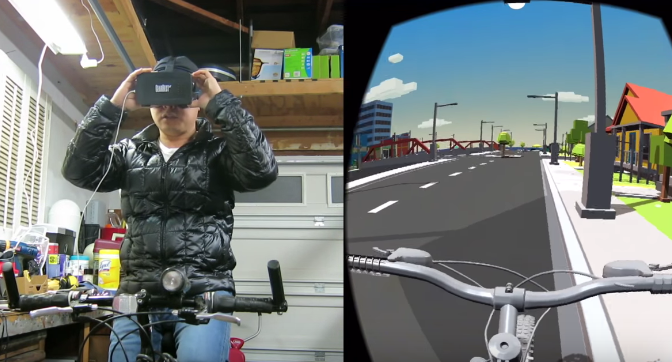
Such state-of-the-art VR headsets aren’t cheap though. But what if you could make one yourself for about $40? Paul Yan is an inventive chap and has developed his own home-brewed virtual reality device. He explains how to do just that in this video:
Yan has a bicycle set up on a turbo trainer and has wired up a sensor to the rear wheel, which relays speed information to his smartphone via Bluetooth. His smartphone is encased in a headset viewer strapped to his face and Yan has built a virtual reality environment using software called Unity and Google’s Cardboard to render the virtual experience.
Okay the virtual reality doesn’t look very real, we’ll admit, and we’re not sure we’d have the confidence to replicate the contraption. We’d make a mess of it basically. If you’re smarter than us and do give it a go, do let us know. The best thing about it though is the price, it cost Yan just $40 – just over £27 – to put it all together. You can’t put a price on the expertise required to make the setup all work, however.
Yan has made available the details for the Arduino speed sensor. We’re sure it could be hooked up to a regular cycle speed sensor with Bluetooth, or better yet a smart trainer with power and cadence.
See the full details on Paul Yan’s website.




















4 thoughts on “Here’s how to make your own virtual reality indoor trainer for just $40”
Good idea to give a greater
Good idea to give a greater sensation of riding on a proper bike on the road. Except for one thing it will be useless for training, those goggles will fill up with sweat! It will like underwater swimming with leaky goggles:D
Need to re think cardboard goggles 🙂
I find it sad to say but this
I find it sad to say but this does have some appeal.
I saw this on geek.com, and
I saw this on geek.com, and this looks fun. Now if only we could import cities from SimCity or Skylines. Or Civ V for Audax type rides. I’d never leave the house.
Occulus rift apparetnly works
Occulus rift apparetnly works with zwifit or they have worked on it which is cool, but there are other apps like elite myEtraining which could be slightly modified to work wiht cardboard or other VR devices.