


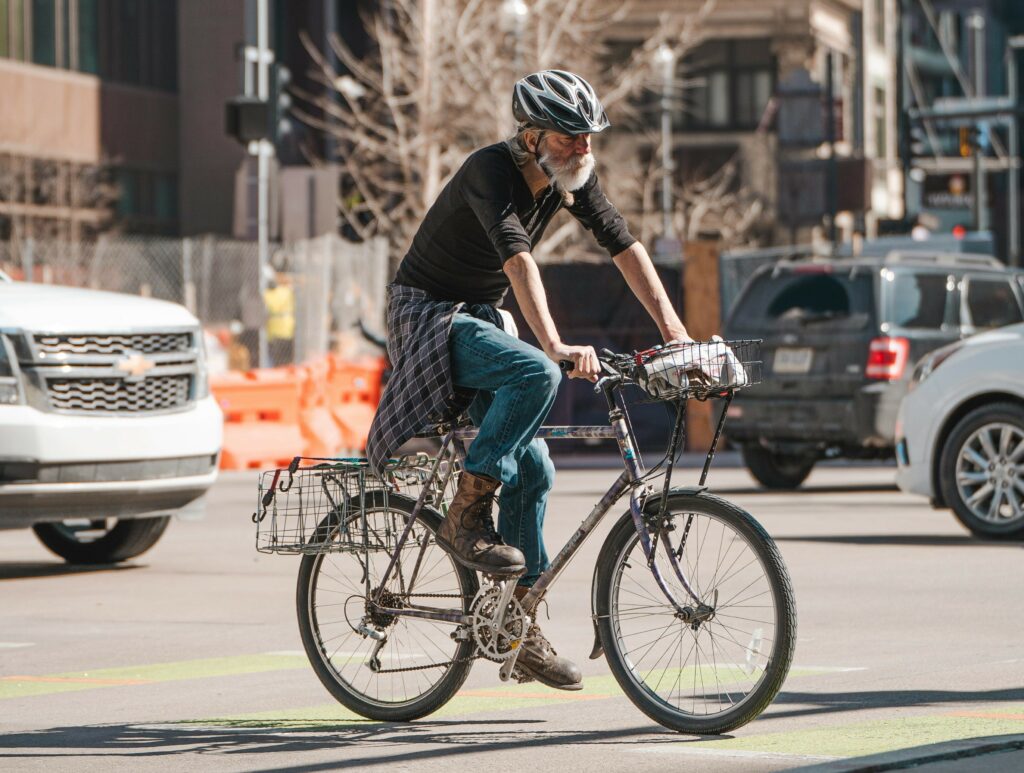

The Supreme Court in the US state of Pennsylvania has ruled with a cyclist over a controversial ‘take the lane’ case, overturning the fine given to him by a police officer for impeding the flow of traffic and confirming that cyclists do not have to get off the road to let traffic pass.
It all stems from a $25 ticket that cyclist Brendan Linton received back in July 2021, a Pennsylvania State Trooper having fined the rider after sitting in a queue of about 10 drivers following the rider as he rode at 19mph in a 55mph. The Philly Voice has covered the case locally and reported that all the motorists were able to pass Mr Linton within two minutes but the police officer, Joshua Osche, stopped and fined him for disorderly conduct, violating the duties of a vehicle operator and failing to use reasonable effort to avoid slowing traffic.
As per the traffic laws applicable to the state, those travelling below the speed limit on a two-lane road are told to “drive completely off the roadway and onto the berm or shoulder” at the first opportunity to avoid impeding traffic. For cyclists, it is required that you “use reasonable efforts so as not to impede the normal and reasonable movement of traffic”.
In Mr Linton’s case, police dash-cam footage showed the shoulder of the road covered in gravel, potholes, storm drain grates and a construction vehicle and worker. At a local appeal court, the conviction had been upheld at appeal, but now a Pennsylvania Supreme Court justice, Kevin Dougherty, concluded the laws were not intended to force cyclists to get off the road to let faster-moving traffic through.
Justice Dougherty concluded, communicating the majority 5-2 decision in Mr Linton’s favour and overturning his $25 fine: “In some cases, the circumstances might require a pedal cyclist to temporarily but completely exit the roadway to allow traffic to pass. In others, it may not be safe or reasonable to expect a pedal cyclist to do so, or at least not right away. And in others still, a pedal cyclist may only need to move to the right side of the lane to comply with (the traffic code).
“Given the typically smaller size of pedal cycles relative to other vehicles, it may be possible to safely pass a pedal cyclist that remains on the highway,” he added, confirming as long as “reasonable efforts” are made to avoid impeding the flow of traffic, then there is no need for punishment.
Cycling groups have praised the court’s decision, the Bicycle Coalition of Greater Philadelphia saying ruling with the police “would have made it that much harder to use the road”.
“I hear from cyclists that they just don’t feel safe on the road. I think what makes it scary is that people who are driving don’t always understand they have to share the road,” Chris Gale, the group’s executive director said.
While many states have a version of the law that tells cyclists to stick to the right of a lane as far as is practicable, the exact rules of the road can, of course, vary from state to state in the US, but here in the United Kingdom the Highway Code tells cyclists to ride in the centre of the lane on quiet roads, in slower-moving traffic and at the approach to junctions.
In the case of riding on quiet roads, it adds: “If a faster vehicle comes up behind you, move to the left to enable them to overtake, if you can do so safely.” In the slower-moving traffic example, it also adds: “When the traffic around you starts to flow more freely, move over to the left if you can do so safely so that faster vehicles behind you can overtake.”
More generally, when riding on busy roads, the Highway Code states: “When riding on busy roads, with vehicles moving faster than you, allow them to overtake where it is safe to do so whilst keeping at least 0.5 metres away, and further where it is safer, from the kerb edge.”











9 thoughts on “Pennsylvania Supreme Court rules cyclists don’t have to get off the road to let traffic pass, after rider fined for “impeding traffic””
Quote:
Bit of a fine line here. You can’t drive on the roadway below the limit, and presumably you’ll be fined if you drive on the roadway above the limit.
Fine all those drivers
Fine all those drivers sitting in traffic jams! They’re impeding other more important people!
My understanding is that
My understanding is that driving above the limit is expected.
As most drivers will have
As most drivers will have their phones with them, with their data and GPS systems switched on…
The authorities can make use of all that information and issue mililons of fines every day to all of them for holding up traffic behind them.
The deficit will disappear in no time.
Most people in the UK think
Most people in the UK think cyclists “must get out of their way” but happily sit behind a tractor trundling down the local A road on a Friday afternoon…
No doubt Jezza Clarkson and his horde of merry motaheads will be able to justify such paradoxical behaviour as farmers are “feeding the nation” etc etc etc…
Have cycled in the USA, in
Have cycled in the USA, in California anyway, and a lot of drivers there are just completely unaware of cyclists. They will just pass you and then immediately turn right without a care. The main roads are wide with fastish traffic that gives 0 fscks about bikes. Going through residential estates was a bit better, but often you can not avoid those main roads.
The craziest was the over/under-passes to cross over/under the 230 motorway. You basically get this little “murder strip” in the middle of the car lanes, with cars under-taking you on the right to go onto the motorway, and cars passing on your left as you approach the pass; then you’ve a section of a fairly narrow lane by US standards (with their massive vehicles) with fast traffic passing; and then finally on the other side you have fast traffic coming off the motorway on your right and traffic passing on your left. That was utterly horrid, and there’s no way to avoid those horrid passes if you want to get from the valley to the nice redwood hills.
E.g. Alpine road: https://maps.app.goo.gl/ZN6uqvNGLo6nVktm7
Sand hills road: https://maps.app.goo.gl/9GqiPjh1cJkMj148A
And if/when you do move over
And if/when you do move over even a little, car drivers will push past with little or no clearance. So, if you take the lane, you’re holding up traffic, but if you move over you’re inviting a close pass (while being cursed at!)!
This will encourage close
This will encourage close passes ,hes basically saying m9ve over to allow traffic to close passing you
Thank goodness common sense
Thank goodness common sense prevailed. It might easily not have done.
I assume that this upstanding police officer regularly pulls over and stops as soon as a Ferrari driver comes up behind him, for fear of him holding up traffic. Bonkers.