


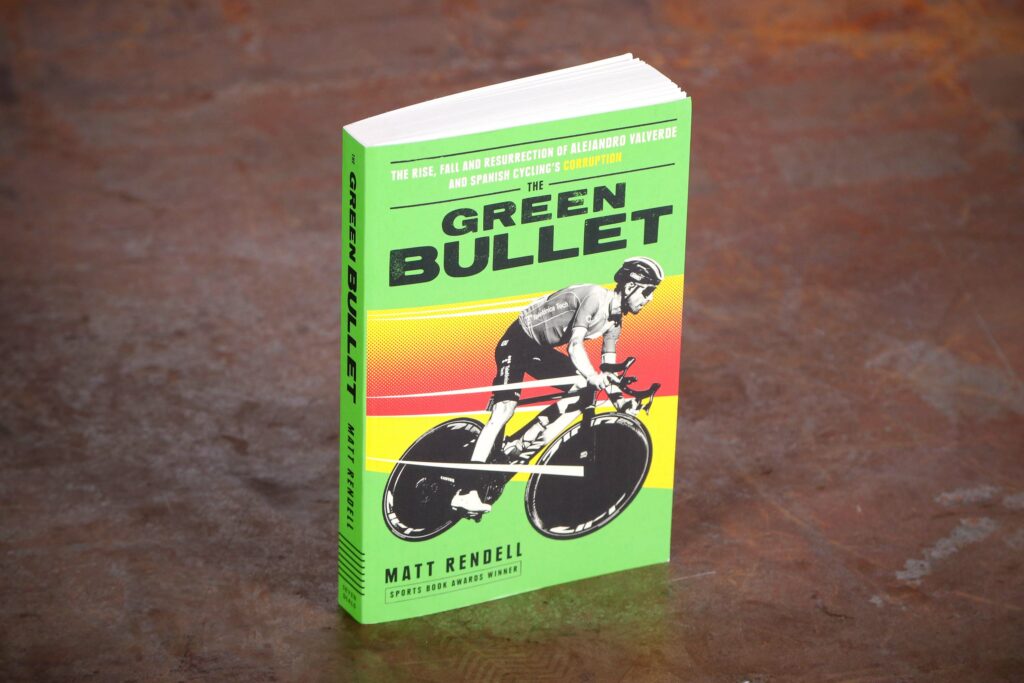

“From award-winning author Matt Rendell, an examination of the phenomenal success of Alejandro Valverde and the moral decay at the heart of Spanish cycling,” is the synopsis of The Green Bullet on Rendell’s publisher’s website. I interpreted this to mean that the book would be centred on Valverde, but found it had more detail on Spanish politics and the finer nuances of Operation Puerto than Valverde’s character. If you’re interested in the former then I could recommend it, but personally I found The Green Bullet a hard read.
> Buy now: The Green Bullet by Matt Rendell for £12.34 from bookshop.org
I’ve read plenty of books on cycling, including Rendell’s best-known publication, The Death Of Marco Pantani (which I’d thoroughly recommend). I was excited to get stuck into The Green Bullet and learn more about one of the most controversial figures in modern cycling, who, in my eyes, serves as a bridge between the Armstrong era and the modern peloton as we know it.
Valverde has always been a touchy subject in cycling, and going into this book, I was keen to see how Rendell cut through the broad variety of opinions on him. He was the subject of one of the biggest doping busts the sport has ever seen, but after serving his ban continued to win at the highest level, becoming World Champion and racing into his 40s.
As controversial as he was, you can’t deny that Valverde was a great racer to watch. He was dynamic and aggressive, punchy and sharp, and he won massive races all the way through his career. However, if you went purely off Rendell’s book, I don’t think you would know any of that. Pretty much any mention of Valverde’s race results are very factual, and fail to really capture the imagination or convey the flair that Valverde was known for.
If you don’t know much about Valverde, I’d suggest doing a light Google search on his career to understand the scope of how long he raced for, how much he won, and how he raced. I say this because, in truth, I don’t think Rendell’s book goes much further than this when it comes to Valverde the bike racer. After slogging through the introduction – which reads to me like Bala’s Pro Cycling Stats page put into prose – I was slightly concerned the rest of the book would continue in the same way; stat and fact heavy with little deeper research to really lift the lid on Valverde’s character, motivations, or personality. Sadly, I think I was right.
I think the book is generally interesting if you’re interested in Spanish politics or Operation Puerto, telling you everything you would want to know and more – but not if you’re interested in Alejandro Valverde, in my opinion. Sadly, Rendell seems more set on going down rabbit holes and riding tangents for pages and pages at a time, often focusing on the minutiae of the political landscape in Spain, rather than telling us anything we didn’t know about Alejandro Valverde.
I really struggled to get through Rendell’s copy. He hasn’t really spoken much to anybody else throughout the book and it’s really crying out for at least the tiniest input from Valverde himself.
The real gut punch comes in Rendell’s conclusion. Orion, the publisher, states: ‘Even today, Valverde maintains his reticence. The Green Bullet breaks the silence’ – an assertion that is objectively opposed by Rendell’s own conclusion where he confesses to not having had access to Valverde, despite positing a lot of (actually quite interesting) questions he would have posed to him – “but that’s for another book.” The lack of access to Valverde here is really telling, and I think titling the book ‘The Green Bullet’ is quite misleading, given the number of pages dedicated to almost anything other than Bala.
Overall, I think if you want to dedicate some time to reading a book about a controversial figure in the world of cycling, there are better out there. God Is Dead by Andy McGrath is a personal favourite of mine, and even Rendell’s own The Death Of Marco Pantani would be a better use of your time. If you’re really interested in Spanish politics, or you want a very detailed and well-researched account of Operation Puerto, take a look at this one. If not, I’d say this is a book you won’t feel too bad about missing.
Verdict
Promises a story about one of the most controversial cyclists of all time, but in my opinion it delivers something totally different
> Buy now: The Green Bullet by Matt Rendell for £12.34 from bookshop.org
All the deals displayed on our review pages are pulled from a constantly updating database feed of the best affiliate deals available. The criteria for deciding on what are the best deals is who is offering the lowest, delivered price. In most cases we will be showing the very best deal available online, but sometimes you may be able to find an item cheaper. If you can please feel free to post a link in the comments box below. To find out more about affiliate links on road.cc click here.
road.cc test report
Make and model: The Green Bullet by Matt Rendell
Size tested: Paperback
Tell us what the product is for and who it’s aimed at. What do the manufacturers say about it? How does that compare to your own feelings about it?
The Green Bullet is the latest book from Matt Rendell – esteemed cycling author and journalist – which promises to chronicle the rise and fall of Alejandro Valverde.
Tell us some more about the technical aspects of the product?
Paperback / ISBN-13: 9781474609753
Would you consider buying the product? No
Would you recommend the product to a friend? No
Use this box to explain your overall score
Overall a bit of a miss from Matt Rendell – though I think it’s well worth a read if you want a detailed and well-research account of Operation Puerto
About the tester
Age: 28 Height: 175cm Weight: 67kg
I usually ride: Road (Tarmac SL7) My best bike is:
I’ve been riding for: 10-20 years I ride: Every day I would class myself as: Expert
I regularly do the following types of riding: road racing, time trialling, cyclo cross, commuting, mtb, Occasional Ultra Racing

7 thoughts on “The Green Bullet by Matt Rendell”
The Green Bullet is worth
The Green Bullet is worth reading, I would agree with the authour of the review on some of the points but suggest that the authour is disingenuous on others.
The Green Bullet is not an biography but it is a story with Valverde at the centre, reading or listening to some of Rendells other books they aren’t easy going holiday fiction. I find his reads good, informative but I wouldn’t class it as an easy read.
Suggestions Rendall ‘did a light Google search’, ‘almost like a cut and paste from Wikipeda’ or ‘we can’t find out from his Wiki page’ – put another way this is a 1,000 word article or 8 paragrahs and three of them suggest the reviewer has some issues with the article.
This book isn’t a five star book, it is heavy at time, but it’s a solid 6 or 7.
I’m going off to finish ‘Colombia Es Pasion!’ then I think I may loop back around to The Green Bullet.
Hi, this is the author.
The Green Bullet is a 270-page account of Valverde’s career from start to finish in chronological order. The index alone has two and a half inches of entries for “UCI World Championships,” another two and a half for “Tour…” and three and a half inches for “Volta” or “Vuelta,” so the contention that ”he won massive races all the way through his career [but] if you went purely off Rendell’s book, you wouldn’t know any of that” is plain silly. It does rather suggest that the composer of the above rant, who claims to have “read plenty of books on cycling,” didn’t do the road.cc readership (or me) the courtesy of reading this one.
In the past road.cc has published critical but generally positive comments on my work – 4.5 out of 5 for The Road Book 1989, 4.5 out of 5 for Colombia Es Pasión, nice words for a podcast I used to do, among other things. These reviews generally recognise the thorough and uncompromising research that is central to my books, journalism and broadcast work. Readers at my book events sometimes comment on the sheer amount of painstaking fact checking (multilingual, obvs.) that are evident in the text of The Green Bullet. All of which makes it doubly disappointing, not to mention mystifying, to see that at least one reader, @Natrix (in the first Comment, above), has been persuaded by your review that “Matt Rendell seems to have used wikipedia to get most of his information.” Point me at that Wikipedia page and I’ll churn out a book a week, although not under my own name.
It’s the comprehensive lack of generosity in the above review that I find shocking. Did your reviewer really know all of the conclusions of all my investigative work beforehand? Is there really nothing in the book to like–not a single metaphor, turn of phrase, telling detail or sweeping interpretation?
Mind, he’s spot on about “light Google searches.” It took several to find, online, the 353-page Caso Nóos judgment (and related documents running into hundreds more pages), the 361-page Operación Puerto judgment, the multiple TAS rulings, the Operación Galgo documents, the USADA investigation into Lance Armstrong, and the hundreds of newspaper reports described on p. 21 and in the 15 pages of endnotes (although the complete Puerto documentation was not online and came from another source).
But then I had to read and digest every one of what turned out to be many thousands of pages of legal Spanish and Italian, together with technical texts explaining legal concepts I found puzzling (and their nearest equivalents in English law), which took a bit more effort, as did getting permission to speak to the Carabinieri officer who investigated Valverde, and whose work brought down Alejandro and, ultimately, Lance Armstrong too, as published for the first time in the book. Where the review calls Valverde as “a bridge between the Armstrong era and the modern peloton,” it could have mentioned this relationship, but opted out.
It also calls Valverde “the subject of one of the biggest doping busts the sport has ever seen.” He was and he wasn’t, as the book explains:
“…in the twenty-thousand-word case summary submitted before the 2006 Tour de France…, he went unmentioned. Nor did his name appear anywhere in the 360-page sentence issued after the Operación Puerto trial in April 2013, or the eighty-four pages of the appeal court judgment in June 2016… Nor, indeed, in any of the eleven thousand pages that made up the thirty-six volumes of the investigation and the eight folders of annexes…”
And yet he was at the heart of it, and was eventually the only person punished for it. It’s an extraordinary story.
On the subject of interviews, during my time working for Movistar Team and for other teams with Spanish staff, I gleaned a very great deal of hearsay which I then researched thoroughly enough to be able to publish (and the bar is not low). Many interviews underlie the book, although they couldn’t possibly be referenced explicitly.
One of the book’s many tasks is to show how Valverde’s astonishing win rate was used by highly questionable sponsors, political groupings, members of the royal family, even the occasional religious organisation, to distract public attention from their nefarious conduct. To do this, it was absolutely necessary to explore various so-called “rabbit holes and tangents.” How else could you grasp the hair-raising degree of the corruption at Banesto or at Kelme sponsor Terra Mítica, or at Illes Balears (which led, circuitously, to the abdication of King Carlos in 2014), or the financial (and political) mess at Kelme when Valverde was there, or the bizarre role of Telefónica/Movistar providing safe havens and escape routes for disgraced politicians and royalty, all the while being able to count on Valverde’s reliable brilliance to cover up the malfeasance? How else could you see how deep it goes? None of this has ever been explained in a single book before, and much of it ever in English in any form, short or long.
These stories are not tangential. They show the systematic and highly politicised role that professional cycling has long been playing in Spain, and emphasise the way cycling forces riders into selling their talent to sometimes questionable sponsors– and we can all think of plenty of them in the WorldTour peloton today. In short, for thirty years we thought doping was the big cycling story, when we should have been following the money.
To finish, your reviewer will be delighted that The Green Bullet has never done well commercially (I wonder why?) but I absolutely stand by it. No one much likes revisiting their own work once it’s out, but I recently re-read it and felt proud of my work. I’m happy to be judged on its merits and failings, provided the criticism is done in good faith. That can’t be said of this review. Something else is going on here, although I’m at a loss to know what. I can only encourage your readers to form their own opinion about how well-founded the above opinions are likely to be.
@mattrendell *I stand with Rendell* – for obvious reasons, but apart from a shared name (about time you learned to spell it correctly mind you) this review does seem to be written with an agenda to rubbish your work as much as possible. I haven’t read this one but having read and enjoyed some of your other books I’d say something would have to have gone catastrophically wrong for this one to be as bad as the reviewer makes it sound. The determination to perform a hatchet job seems exemplified in the penultimate paragraph:
Clearly the publisher means that your work breaks the silence, not that Valverde has done so. To apply the reviewer’s interpretation to this obvious meaning seems to me to be either staggeringly obtuse or deliberately malicious. Quis custodiet ipsos custodes – if tasked to review this review I don’t think I could go much above a solid 2.5/10.
I wouldn’t rule out obtuse, given that they seem to have only managed to read the first line of the surtitle and then been confused that there was a lot of stuff about corruption in it.
@Rendel Harris I think that’s a slightly harsh review of the review. I haven’t read the book myself, but I can appreciate that a detailed, well-researched book about Spanish politics, corruption and doping, and an insightful biography of Alejandro Valverde, are not the same thing.
If you are expecting the latter and get the former, I can see why you might be disappointed. Especially as the reviewer, Ollie, is a keen racer, he may have been hoping to get under the skin of Valverde and better understand how a world class racer ended up where he did, embroiled in the middle of it.
@OnYerBike The publisher touts the book as “An examination of the phenomenal success of Alejandro Valverde and the moral decay at the heart of Spanish cycling”. Nowhere does the book claim to be a biography of Valverde, so to mark it down for not being something that it never claimed it was seems a little perverse.
@Rendel Harris I read a few lines of you review of the review, and I’m afraid that while you obviously have a lot of detail for the enthusiast in there I am still left wondering about the overall motivation for the review, or indeed whether I should read it.
Overall I recommend readers should seek out some of your other review reviews.