


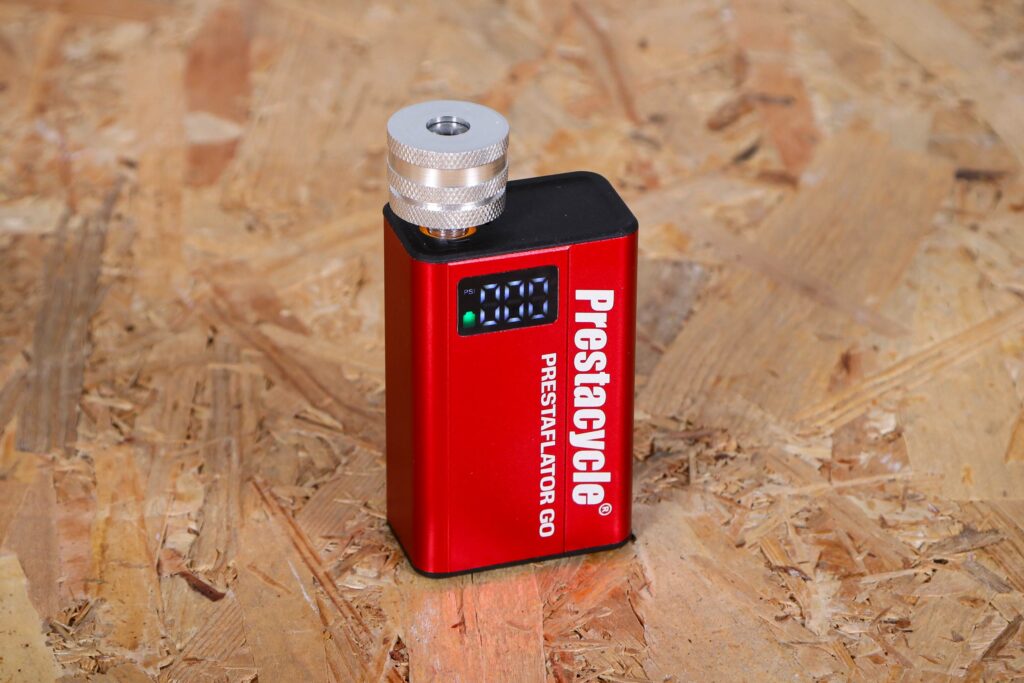



If you’re on the fence about portable electric inflators, the Prestacycle Prestaflator Go might just be enough to get you to ditch your manual mini-pump or CO2 cartridges. It’s great! Fast, reliable, and easy to use, and just the right size.
> Buy now: Prestacycle Prestaflator Go for £99 from Prestacycle
Before the Prestaflator Go arrived, I have to say I was pretty sceptical about electronic inflators. Like all new cycle tech, I wanted to try it for the novelty but I doubted we’d become friends. CO2 cartridges are fine, and mini-pumps so good and so small nowadays, why bother? And then I remembered thinking electronic gears were a silly weighty unnecessary failure-inviting boondoggle, right up until the moment I spent some time with them. Disc brakes, too, didn’t want them, didn’t need them. Until I tried them. But that’s it. Oh, and e-bikes. Hated the idea of e-bikes, until I tried them.
Can you see the pattern? Tech comes to something that works well already, claiming to fix a problem I think doesn’t exist, and I’m disdainful right up to the point I try it. Then I’m hooked. Here and now in 2025, I’ve been spoiled by electricity and technology – and going back to rim brakes, mechanical shifting, and non-electric cargo bikes seems barbaric.
So it was with the Prestaflator Go. It arrived and I unboxed it without expectations. The packaging is inexpensive and functional, and it includes a USB-C cable. Some people will expect one and become vitriolic when one isn’t included; I’m in the other camp, I’m drowning in USB-C cables, 70 or 80,000 at the last count. I see it as a waste of money that could have gone into a minutely better product perhaps, or a cheaper product and less e-waste. But I understand companies that play it safe by including one, and I can only hope we reach critical USB-C cable mass soon.
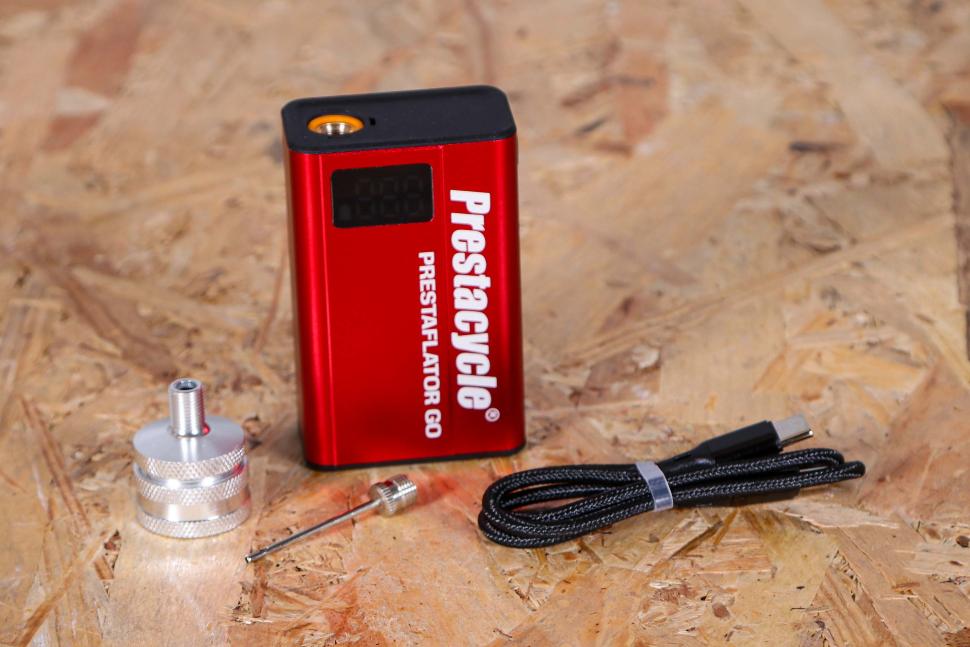
There’s a plastic Ziplok-like bag to keep the pump in, a football needle and a Presta head adaptor. (There’s a case and an extender hose available too, though not included.) It’s also, allegedly, compatible with Schwalbe’s new Clik valves.
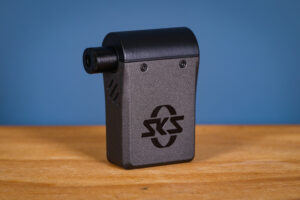
It’s a nice looking bit of kit, well made, and it feels premium.
In use
While unboxing the Prestaflator Go, sitting in my very echoey office, I of course inadvertently turned it on. It’s the most I’ve jumped in decades. It’s VERY loud for something so small. As soon as that happened, I remembered people mentioning the volume in reviews. Once you’re expecting it, and you’re outside, it’s not a problem. About the same noise level as a hairdryer.
For my first go of the Go, I set the pressure at 37psi to inflate a 38mm Gravel King tyre, after letting the air out and squeezing it to dead flat.
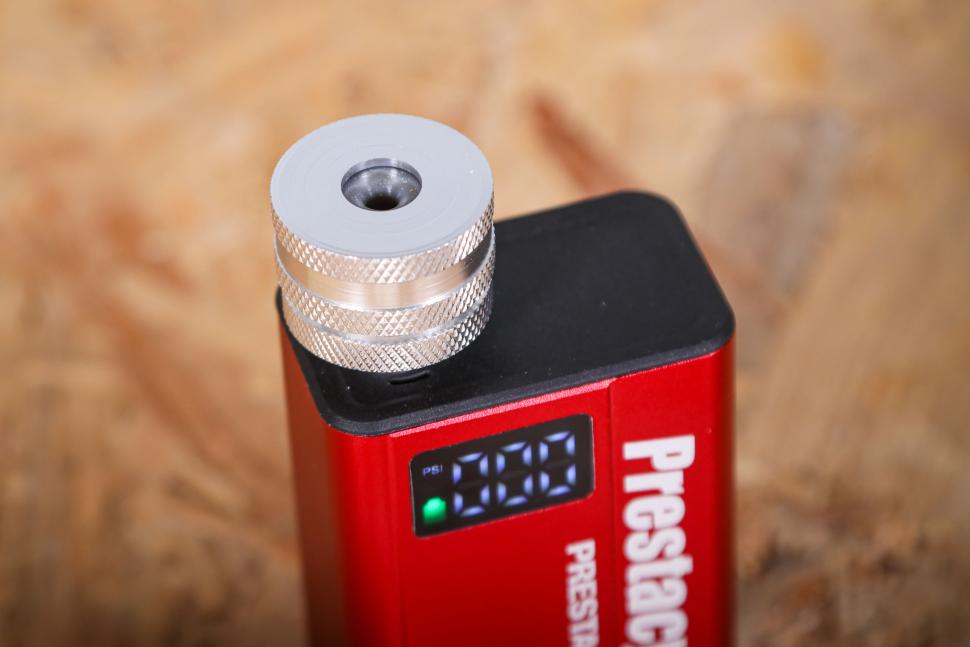

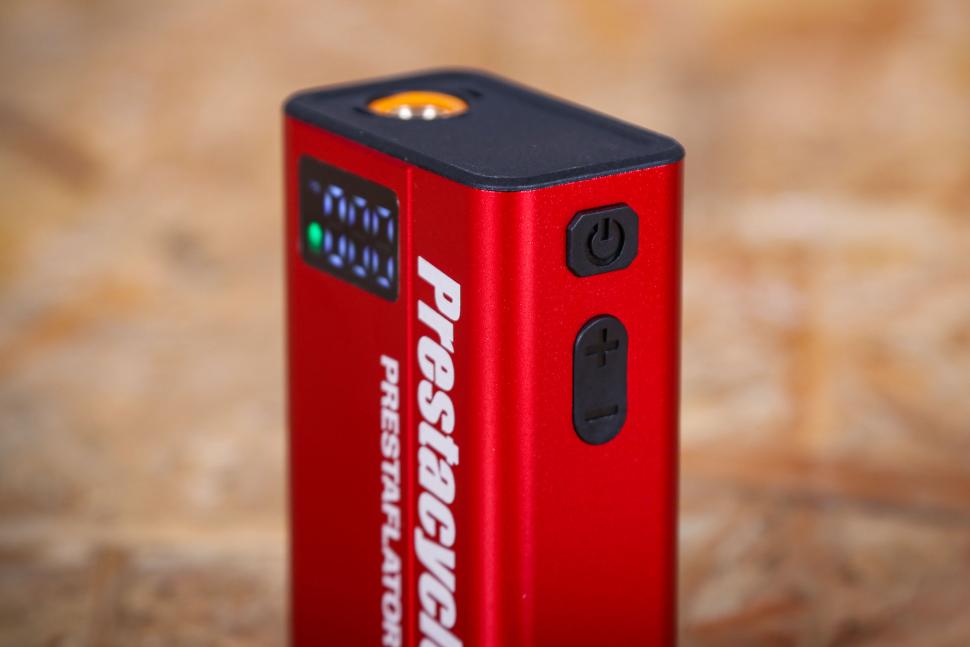
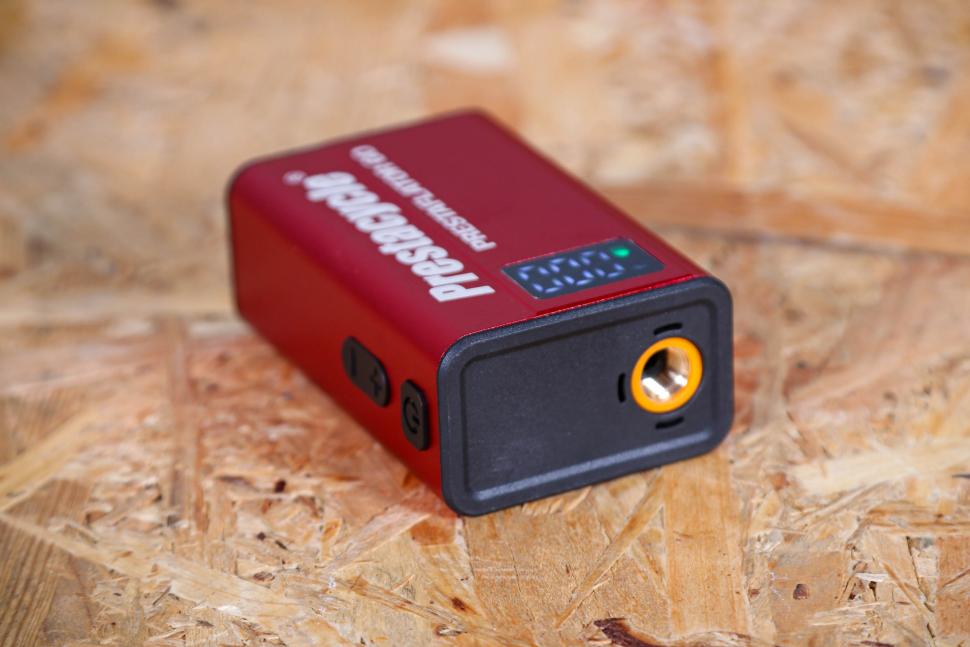

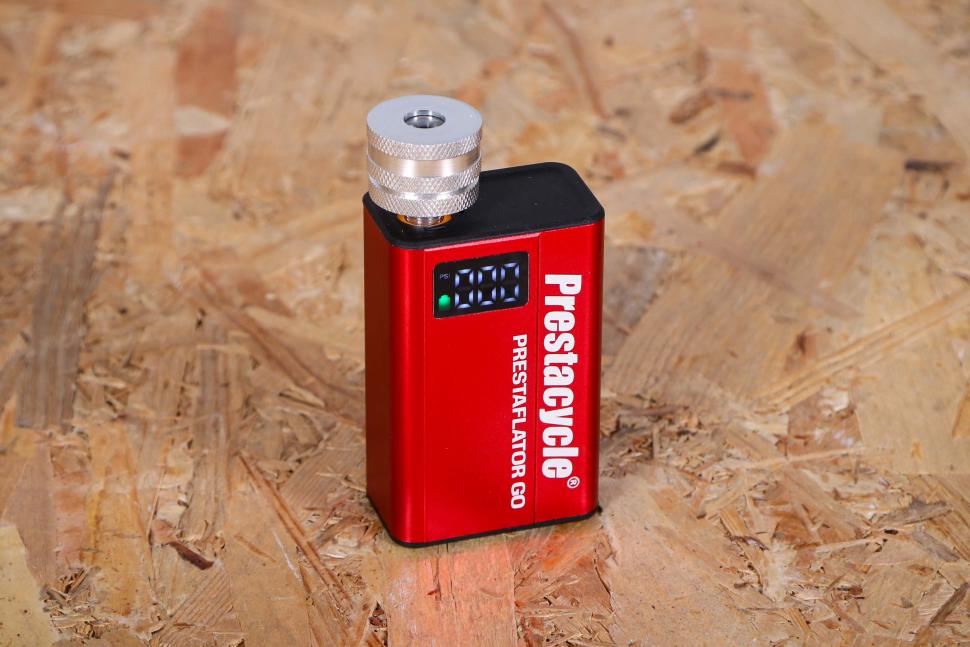
The Presta head adaptor screws into the Schrader-sized hole in the inflator (where it will remain), and then you simply push the valve into the head. It has a urethane seal in the head that grips the valve, so you can literally just push it on, and pull it off when it’s finished. The seal is tight and strong enough to support the weight of the inflator, so you can have your valve at the top of the wheel pointing down, and the pump will hang off it no problem.
Turning it on and watching the tyre inflate before my eyes was unexpectedly pleasing. It was also rapid. This is a fully charged inflator bringing my 38mm tyres up to 37psi from dead flat. Quick and easy. (Note, the screen is stable and doesn’t flash, this is just a mis-sync between the camera’s frame rates and the Prestacyle’s screen.)
I became a child once again. When you get a new tool and you’re delighted with how it works, you inevitably wander around the house trying to find excuses to use it, and to hell with the consequences and casualties.
When I tested the enormous Kärcher pressure washer last year, I immediately aimed it at my fence, promptly stripping the paint from it and ripping the top layer of wood off. Oops. With this, I immediately thought of all the things I could inflate, and set off looking for them. All my tyres got the treatment, as did a rugby ball, a football, and I wished we had an air mattress… and it’s lucky we don’t have a pet puffer fish…
Happily, no inflatable bladders or other objects were harmed this time. In short, I ran out of inflatables before the pump ran out of milliamps.
So, should you buy an electronic pump and should you buy this one?
I really want to shout ‘Yes!’ so you too can experience the joy, but I’ll try to be a bit more circumspect; only you can decide where and if ‘want’ becomes ‘need’, and if that becomes ‘purchase’.
CO2 is fine, though the ease of ‘fire once’ is as much a bug as it is a feature (it’s easy and works well, until something goes wrong and you’ve wasted your one shot). It’s also often advised against with tubeless. And the trade-off with the tiny form factor of mini-pumps that makes them so easy to carry is that it also makes pumping tyres hard work, time-consuming and fiddly.
For my part, I’d take the mini-pump and CO2 out of my saddle bag and replace them with this. It’s a 20g penalty over my hybrid CO2 inflator and mini-pump, though more compact and easier to pack. In fact, in the last few weeks it’s sort of replaced my track pump too. It’s simply faster to set the pressure I want, press the inflator onto the Presta valve and wait usually no more than a few seconds as the pump brings the tyre up to pressure before every ride. It then goes straight into my saddle bag and we’re away.
Gauge the pressure
Before I used this one, I’d already concluded that it would be a bit pointless getting an electric pump without a pressure gauge, and I haven’t changed my mind. Not having a pressure gauge would limit it to emergency use only on the trail, and I’ve been most surprised by how the Prestacycle is in fact a quality-of-life upgrade, for use at home, before every ride.
Prestacycle claims a 1% accuracy of the gauge, up to 100psi. I didn’t have any calibrated equipment to test this against, but my old faithful track pump reported identical pressures in the tyres, so I’m happy to take Prestacycle’s word for it.
How much does it blow?
Electric car drivers talk about range anxiety, and I think this see-saw of trade-offs, size vs battery capacity, will be at the forefront of most people’s purchasing decisions when it comes to electric mini-pumps.
So let’s talk about how much it blows. A great deal, it turns out. Prestacycle rates this as 7+ inflations of a 40mm gravel tyre to 35psi. I think that’s conservative. I got just under nine inflations on a brand new, fully charged battery to 37psi, leaving two minutes between inflations. I was deeply impressed. For 28mm road tyres to 80psi, it’s rated to 4+, and with Prestacycle’s conservative estimations, I bet you’d get five or more.
Any downsides?
First off, the ‘format’ of e-pumps. Batteries run out, and the more juice you want out of your mini-pump, the bigger it’ll have to be before it’s not terribly mini anymore.
And heat. As the pressure you’re filling increases, physics says that generates heat. So the pump gets hot after ‘longer’ use and at higher pressures. Filling two gravel tyres to 37psi never really exceeded ‘warm’, but if you’re running TPU inners at high pressure you might want to buy the optional extender hose, as TPU has a comparatively low melting point. (I didn’t test this, and Prestacycle rates the pump as TPU safe, but if you’re filling multiple TPU tubes… like all e-pumps, the heat builds.) Similarly, if you run super-high-pressure tyres you might melt an inner, or even your valve, but this is just the physics of high pressure and temperature, and isn’t unique to this inflator. I don’t ride anything more than about 40psi anymore, so it’s a non-issue for me.
> How to choose the best bike tyre pressure — balancing speed, comfort and grip
If forced to find fault with the Prestacycle, I found only two, and they’re quite minor.
First, the three buttons on the device have a cheap, slightly rattly and incongruous plastic feeling in an otherwise really premium solid-feeling product. But they work just fine. Trivial stuff.
Second, the battery indicator was not super accurate, and shows only three different colours (not unusual amongst its peers): red for 0-30%, yellow for 30-60%, and green from 60-100%. So green could be 100% or 61%, and I think a 40% swing of ambiguity and uncertainty is slightly too large. This is compounded by it not being a reliable barometer of remaining capacity. After seven complete inflations it still showed ‘green’, indicating (unbelievably) more than 60% capacity remaining. It went orange during the eighth inflation, and red during the ninth and final inflation.
Weights, measures & the competition
I imagine everyone will arbitrate for themselves the perfect intersection of battery capacity vs size. You can get bigger and you can get smaller, and their size corresponds to the number of tyres they can inflate on a single charge.
The Prestacycle measures 78x51x31.5mm and combines two batteries connected, I presume, in series, effectively to yield a single 750mAh battery.
Comparing it with other electric mini pumps out there, just going by stats for some, others we’ve reviewed… Muc-Off’s AirMach Electric is 12mm shorter and 40g lighter (claimed); but with a comparatively small 300mAh battery and no pressure gauge, this is an emergency-only option (enough for roughly two inflations). It is cheaper at £75, and a full review is on its way.
There’s a Pro version that ups the price to £100 and the mAh to 450, and includes a pressure gauge. Stu reviewed it recently and thought it was very good. The Prestacycle is fractionally longer, about a cm, but narrower, lighter, and with a notably higher inflation capacity.
The Cycplus AS2 Pro that Dave loved, and was awarded a road.cc Recommends badge, is 0.8cm shorter and about 13g lighter, with a 420mAh battery. Dave’s only negative was the limited capacity. The Prestaflator, for an extra 13g and 8mm (and an extra £17.50 – the AS2 Pro is currently £81.47), almost doubles the battery capacity and the number of inflations. There’s a Max version of the AS2 Pro with higher capacity for £96.89 (currently reduced to £85.63), but it’s a chunkier 205g and 54x32x81mm.
Topeak’s E-Booster Digital is 99p more, 7mm longer (though it has a ‘built-in’ head), 12g heavier, and has a 600mAh battery giving fewer inflations.
And the Flextail Pro is again all but identical in dimensions, 20g lighter, but with significantly less battery capacity at 450mAh, though a lower RRP of £64.
In short, you could have something a fair bit smaller with no pressure gauge and only a third the number of inflations, or roughly the same size but with a little less capacity. Or if you need something with much more capacity you have to start looking at noticeably bigger and heavier 200g plus pumps.
Conclusion
For me, the Prestacycle has fallen perfectly into the Goldilocks zone: it’s compact enough, and nine inflations for a mid-volume gravel tyre is well beyond plenty. On the size vs capacity front, it also seems to beat every other unit we’ve had in to test. Whatever wizardry the Prestacycle people have used to fit 2x750mAh batteries into the device is paying dividends – it has more capacity than anything else we’ve tested for the same size, and even equals some pumps that are around the 200g-plus mark.
I’ve read reviews of other electronic mini-pumps elsewhere, and some people conclude and assert that it/they ‘won’t fully replace a handpump’. The truth is, for me it does. And it’s mostly replaced my home track pump too. And I think it’s better than CO2 for tubeless. I didn’t in my testing, nor do I think I have ever, suffered a puncture or series of them that this wouldn’t have solved, that a CO2 or mini-pump would. It made me want to buy one to keep in my Tern e-cargo bike. I feel I see someone changing a puncture on a London road once every week or two, and I’d love to pull in to help, and offer it like a friendly roving inflating Samaritan. Wouldn’t that make your day as you fumbled with your micro-pump?
This is a brilliant product and a real quality-of-life upgrade.
I haven’t tried it, but the Cycplus AS2 Pro is our current champ of the electronic inflators. It’s a smidge smaller and lighter, but the Prestaflator almost doubles the Cycplus’s battery capacity, which is a huge upgrade for a 13g penalty and a £10 up-charge.
If you’re on the fence about mini-pumps, with ‘inflation anxiety’, the Prestaflator Go is what you’ve been waiting for, and has to be the new champ.
> Buy now: Prestacycle Prestaflator Go for £99 from Prestacycle
Verdict
Almost flawless electric mini-pump, small enough and with enough oompf and capacity to convert the sceptics – I was one
All the deals displayed on our review pages are pulled from a constantly updating database feed of the best affiliate deals available. The criteria for deciding on what are the best deals is who is offering the lowest, delivered price. In most cases we will be showing the very best deal available online, but sometimes you may be able to find an item cheaper. If you can please feel free to post a link in the comments box below. To find out more about affiliate links on road.cc click here.
road.cc test report
Make and model: Prestacycle Prestaflator Go
Size tested: n/a
Tell us what the product is for and who it’s aimed at. What do the manufacturers say about it? How does that compare to your own feelings about it?
The Prestaflator Go is the latest in a growing field of electronic tyre inflators, contending they can do the job of a mini-pump or CO2 kit inflators. Its diminutive size and high capacity mean it’s at home in the saddlebag of a road, gravel or mountain bike. It also makes a pretty decent replacement for your home track pump.
Prestacycle says:
“Imagine never struggling with tire inflation again”just attach, press start, and go! The Prestaflator GO is your ultimate electric bike pump, designed for speed, precision, and reliability so you can focus on the ride, not the hassle of pumping.
Whether you’re tackling a gravel adventure, racing on the road, or hitting the trails, this powerful, rechargeable inflator delivers the perfect pressure – every time. No guesswork, no wasted energy, just effortless inflation at the push of a button.”
I have to agree; it’s versatile, easy to use, and absolutely delivers on the promise of easy inflation.
Tell us some more about the technical aspects of the product?
From Prestacycle:
Premium Power & Performance –
High-speed brushless motor inflates faster with less battery drain.
Lightweight lithium polymer batteries (2*750mAh) pack more inflations per charge.
Fast USB-C recharge – ready to go in just over an hour.
Ultimate Precision –
4-120 PSI (1 PSI increments) / 0.3-8.2 BAR (0.1 BAR increments).
Top-of-the-wheel mounting keeps excess sealant out, so your pump stays clean.
Fast and long lasting –
7+ Gravel Tyres: 700x40c (0-35 PSI in 45 sec each).
4+ Road Tyres: 700x28c (0-80 PSI in 55 sec each).
4+ MTB Tyres: 29×2.4″ (0-22 PSI in 77 sec each).
Tough Yet Lightweight – Durable aluminium casing resists drops and keeps cool – unlike cheap plastic pumps.
I found these estimates to be a touch conservative, and the most impressive feature of the Prestaflator Go is its huge battery capacity. It inflated my gravel tyres nearly nine times consecutively from dead flat. It charged quickly, too.
Well-made, premium-feeling unit, save for some slightly rattly and plasticky buttons.
Nearly flawless performance; the only negative was that the battery gauge was rather unreliable.
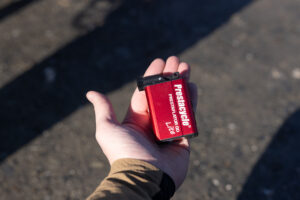
Seems well made, no obvious weak points. The red finish might scratch, but I have to say it didn’t in my use.
Compared to the competition, it packs more inflations into a smaller, lighter package. The only way to get materially smaller and lighter is to forgo the pressure gauge, and more than half the battery capacity. A trade-off not worth making.
Not hugely applicable, but it was easy to use.
I’d say this is good value. It’s towards the more expensive end of electric inflators, but offers better performance than others similarly priced, making it better than average value.
Tell us how the product performed overall when used for its designed purpose
Nearly flawless performance in use.
The only negative was the unreliable battery gauge, remedied by keeping it topped up.
Tell us what you particularly liked about the product
It replaced my track pump, my CO2 and my on-bike mini pump. It could replace the track pump too, though I’d keep one just in case – perhaps a tubeless tyre would need the extra oompf…
It also made inflation so easy and quick that I did it before every ride, a quick top-up, which I would almost never do with the track pump.
Tell us what you particularly disliked about the product
The battery gauge could have more gradations, five perhaps, and be more accurate and reliable.
How does the price compare to that of similar products in the market, including ones recently tested on road.cc?
I think it’s a winner. It brings better performance to inflators at around the same sub-£100 price.
Did you enjoy using the product? Very much.
Would you consider buying the product? Yes
Would you recommend the product to a friend? Yes
Use this box to explain your overall score
Dave gave the Cycplus inflator 9/10, and this seems to be as good everywhere, but with an 80% boost to capacity. Nearly flawless, a mark off for the unreliable battery gauge. It’s excellent.
About the tester
Age: 45 Height: 177 Weight: 95
I usually ride: Custom titanium gravel My best bike is:
I’ve been riding for: Over 20 years I ride: Most days I would class myself as: Experienced
I regularly do the following types of riding: commuting, touring, club rides, sportives, general fitness riding, fixed/singlespeed, mtb,

25 thoughts on “Prestacycle Prestaflator Go”
99 quid for that got another
99 quid for that got another (cycplus) for less you can get 3 inflated (to a 100psi) – middle variant tho 👍
I might have missed it but
I might have missed it but can a user replace the battery?
Perhaps a dumb question, but
Perhaps a dumb question, but can you use these things to seat tubeless tyres? ie, are they like-for-like CO₂ replacements when used for that purpose?
I have a GPUTek mini electric
I have a GPUTek mini electric pump, and I’d say “no”. There’s no rush of air like you get from an AirShot or a big compressor. If you read most reviews, you’ll see it takes a minute or so to get from say 0 to 75psi on a 700c tire.
Well I asked the same about a
Well I asked the same about a similar product last year, so not a dumb question.
The reply was they don’t deliver the volume required in one go, so I suspect it is the same for all these types.
I’d buy one that does seat tubeless tyres though!
Hirsute wrote:
Thanks both. These things seem very much
landfilla novelty to me. I mean, is using a hand pump that _never_ needs charging really such a chore?ped wrote:
Yes and no.
If you’ve ever been at the side of a road in the pouring rain trying to get a tyre to inflate, then you might appreciate quick and easy inflation. Also, these things are great if you’ve issues with your shoulder, arms, back or hands.
hawkinspeter wrote:
I have often. And my pump works to do that just fine.
Good point!
Cycling Weekly did a review
Cycling Weekly did a review of a bunch of these recently and stated some (Air Bank Mini, Fumpa Nano, Muc-Off AirMach and Cycplus AS2) seated tubeless tires.
Bearing in mind that Cycling
Bearing in mind that Cycling Weekly will seemingly give 4 of 5 stars for a product just because it didn’t burn their house down, I’m not sure how much credibility they have, but got a link? I can see specific reviews that don’t mention this but no group test.
I also don’t understand how these things could seat while also taking minutes to get up to pressure. Is there a massive drop off after an initial burst? Sounds like physics-defying magic to me!
Here’s one review of muc off
Here’s one review of muc off airmach from cycling news
A few other small issues are that it does not have a fast enough flow of pressure to seat tubeless tyres as easily as CO2, a key benefit of those and why they are so popular for both road, and especially gravel where tubeless is the most common tyre setup type now. I found trying to seat a pair of Pirelli P Zero Race RS TLR 28mm tyres was not really doable, even with the valve core removed, but it was better on a set of Vittoria Terrano Dry 38mm tyres.
Might work if the tyre and wheel are super compatible but that’s not my experience.
I don’t have a link at the
I don’t have a link at the moment I’m afraid as it was in last week’s magazine. I’d think it’d be online fairly soon as they have another issue out now.
https://www.youtube.com/watch
https://www.youtube.com/watch?v=YSebat-v-48
https://www.youtube.com/watch
https://www.youtube.com/watch?v=YSebat-v-48
ped wrote:
I’ve got a NiteCore EBP10 Mini pump that’s similar in specs and that just provides a constant flow of air. It’s faster than a typical mini-pump, so may work for some tubeless tyres, but probably less effective than the sudden rush you get with CO₂ .
By the way, using CO₂ isn’t the best idea for when you’ve got sealant in the tyres as the sudden cold shock can render the sealant next to useless. When doing it in an emergency, position the valve at 12 o’clock so the sealant pools at 6 o’clock and gives the CO₂ a chance to warm up slightly before hitting the sealant.
ped wrote:
Flat out no. There’s no way an electric pump delivers the same instant inrush as CO2, and any magazine claiming they do is testing using a rim/tyre combo that would have seated using a floorpump anyway.
A fair comparison would be to find a wheel system that only just seats with CO2, *then* try an inflator.
With enough tape / a tight enough fit, you can seat tubless with a mini pump. It’ll take you ages to inflate, but it can be done.
What very few people do is test their tubeless re-seating using their roadside rescue kit. The answer is *always* ‘more tape’. Eventually you get to a thickness of tape where there’s a good-enough seal to allow any decent pump to inflate it.
Pro tip: if you can slip your tyre around on the rim uninflated, it’s going to be too loose to re-seat roadside. MOAR TAPE.
Can you explain a bit more
Can you explain a bit more about the tape. When I have failed with a track pump, the air escapes along the side even with one bead on.
Where do I put extra tape ?
Hirsute wrote:
Apply more tubeless tape around the rim bed. It has the effect of further preventing air escaping through the rim/spokes and raises the rim bed so that it makes a tighter fit with the tyre beads. That should prevent air escaping and thus push the tyre beads up until they seat correctly.
I tease the overall thickness
Increase the overall thickness around the entire rim. You need tape about 2mm wider than the rim internal width. Buy TESA 4289 tape from eBay – that’s what many brands re-badge as their own, and it works perfectly
Start opposite the valve hole, add two full circumferences, then test dry. If it can’t seat, add another layer. Clean with iso alcohol before, and rub the new tape down hard with a cloth as you proceed to remove bubbles
I’ve had matching wheels and tyres with one needing four more layers of tape than the other to behave because tolerances
if you want a faff-free roadside experience, it needs to be able to re-seat with whatever you’re bringing along dry (or ideally never unseat).
glad you are considering
glad you are considering battery capacity in these review, but you also need to consider voltage (formula is something like watts = mAh x V). i suspect most of these devices use batteries of similar voltage ~7V, but have seen some that use 11V (a decent chunk more watts).
or better yet – as these devices become more maintream – please settle on a standardised inflation test. you did MTB, but road was pure speculation…
Thanks HP and KiwiMike – one
Thanks HP and KiwiMike – one for a rainy bank holiday Monday !
A photo with a cartridge and
A photo with a cartridge and a mini pump for size comparison would be great.
cdamian wrote:
On the dimensions given it’s roughly (within 10 mm) one cartridge high, one cartridge deep and three cartridges wide; mini pump would depend on the brand, say a Topeak Roadie is roughly twice the height, the same depth and about a third of the width.
I actually bought one of
I actually bought one of these, and am quite happy with it. It is comically, attention-drawingly loud, though. It sounds like one of those vibrating metal engravers. But louder.
A always have a pump with me, but occasionally I do get slow leaks on my tubeless tyres requiring me to top one up before I leave work, and this is faster and easier than using my mini pump.
Bought the Cycplus AS2 Pro
Bought the Cycplus AS2 Pro just over a week ago and was used in anger on first ride. Had just taken my gravel bike across rough stuff (MTB territory – Princetown to the ‘scout hut’ for those who know) and was pretty knackered after 4 hours. Punctured 5 miles from home on light trail and the machine got me from 10psi up to 37psi – no way my 57 year old arms would have managed that on 47mm tyres with a minipump (and I would have probably snapped the valve AGAIN). Tyre up, sealant worked and home. In truth it is quite heavy which I don’t mind on the gravel bike in a saddlebag or small rucksack but will probably stick with decent pump on the road bike as a bit big for a jersey. If away from the local ‘wife rescue, lift of shame’ area I will stick in the saddllebag.