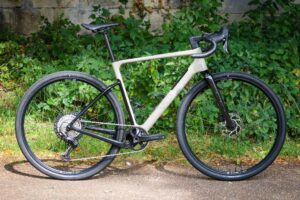
GT was arguably one of the driving forces behind the gravel bike concept, and this Grade Carbon X showcases where the genre is headed. With 45mm tyre clearance, a suspension fork and a dropper post, it’s snapping at the heels of hardtail mountain bikes while maintaining its roadie roots of being light, nimble, and one hell of a lot of fun to ride.
- Best gravel bikes 2025 – drop-bar bikes for off-road riding
- Fara Cycling F/Gravel Apex XPLR AXS ´24 gravel bike review
- Gravel bike suspension and dropper posts – do you need them?
GT Grade Carbon X gravel bike – Technical Details
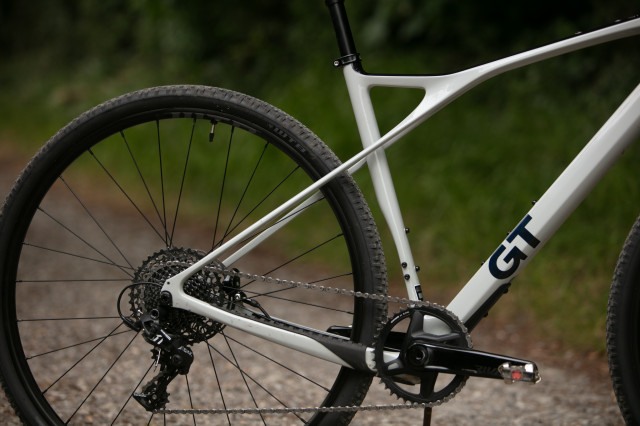
One thing that hasn’t changed since its introduction in 2014 is the frame’s triple or ‘floating’ triangle design, where the seat-stays branch off from the top tube around two-thirds along its length and bypasses the seat tube without touching it – hence ‘floating’.
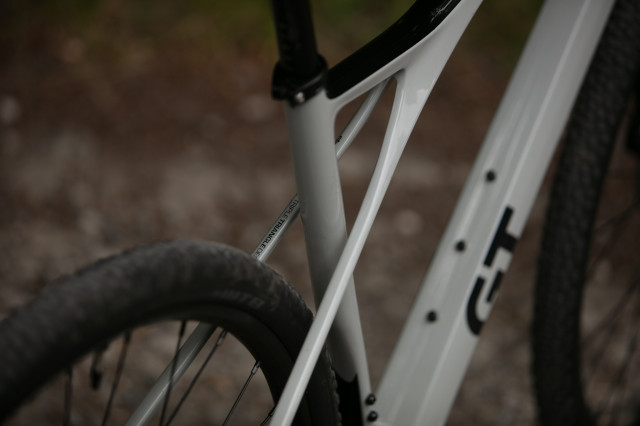
It’s not just an aesthetic thing; it is designed to allow for flex or movement-boosting comfort when the terrain gets rough. ‘Gravel Travel’ is how GT describes it, and it’s created by using a combination of low modulus, solid core, and long strand glass fibres, which are then wrapped in carbon fibre to add strength and smooth transitions.
Does it work? Well, yes.
GT says it offers as much as 30mm of movement, and while it’s nearly impossible to measure that outside of a lab, in the real world, you can definitely feel some flex, which reduces the main bumps and crashes from the rear wheel when you hit tree roots or bigger rocks.
I don’t like the feeling of a soggy rear end but, even with the flex there, the back end of the bike feels tight and you don’t get any bounce or feeling of wasted energy when pedalling hard.
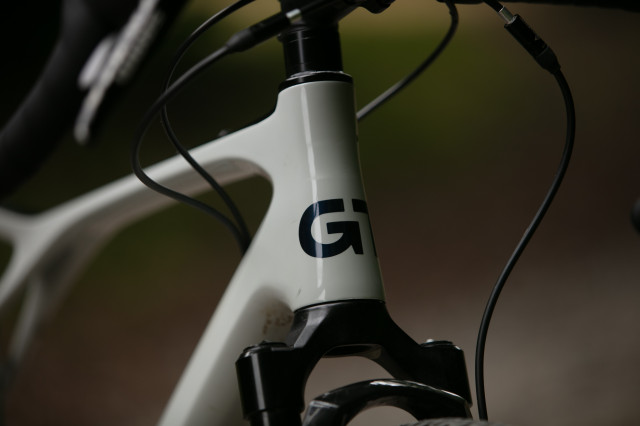
The frame comprises a mixture of carbon fibre grades to create a balance of stiffness and comfort, and the company has done a good job. With the tyres pumped up hard for road riding, the Grade’s frame showed some impressive ride quality while still feeling tight where it needs to be – the head-tube area and the bottom bracket junction for instance.
The Grade uses a 68mm threaded BSA setup, which is always great to see on a gravel bike. Generally, it’s a robust design, and when the need to replace the BB unit arises, it’s a simple home mechanic job.
Other neat frame features include bottle cage mounting points in the traditional position plus another set on the upper face of the top tube, commonly known as ‘Bento Box’ mounts. To protect the underside of the down tube, you’ll also find a tough frame cover, and another section to protect the drive side chainstay from chain suck or dropping.
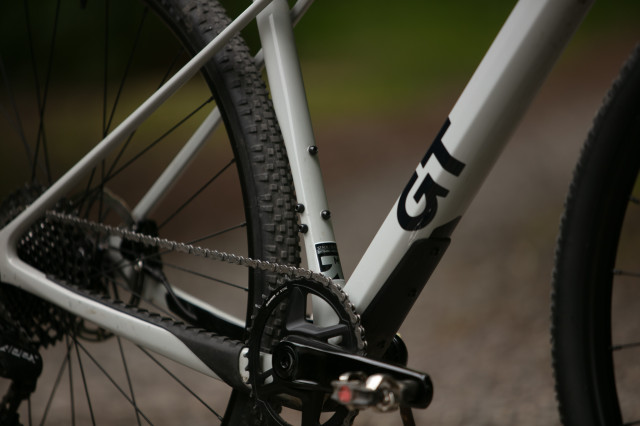
You’ll also find mounting points for a front mech, although it’s covered up here due to the 1x chainset being used.
For a relatively clean look, the Grade’s hoses and cables are run internally – and with this model using a 1x groupset, the dropper post cable can be run internally, too.
I first rode a GT Grade back in 2016 and it’s mad to look back and see that the max tyre clearance was just 32mm. I remember fitting some 35mm cyclo-cross tyres for the 2017 edition of Dirty Reiver and I rubbed the paint off of the chainstays.
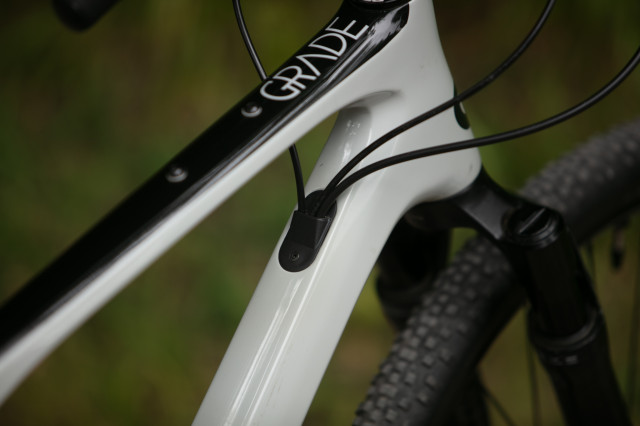
The latest frame will comfortably swallow knobbly tyres up to a maximum of 45mm.
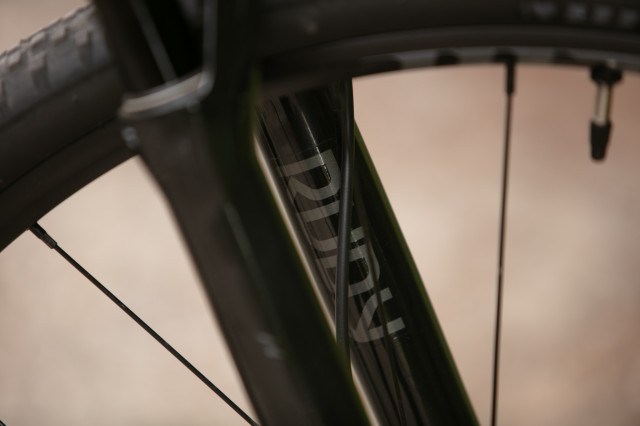
Some Grade models still use a rigid fork, but this Carbon X model gets a RockShox Rudy XPLR with 40mm travel. It’s specifically designed for gravel, but I would like to see a lock-out when linking gravel trails with Tarmac sections.
You can fettle the setup to work with your weight so ‘bob’ is kept to a minimum but I’d still like the option to lock it out completely especially when climbing out of the saddle.
The XPLR will accept up to a 50mm tyre.
The Grade is available in four sizes ranging from S to XL, which, according to GT’s size guide should cover riders ranging from 5’3” to 6’5” or 1.6m to 1.96m.
Unlike road-based gravel bikes, the Grade uses quite a long top tube, but the reach can be offset by running a much shorter stem.
For instance, a medium model in most brand’s ranges would have around a 540mm to 550mm top tube while running a 100mm or 110mm stem. On the Grade you are looking at a 581mm top tube, but an 80mm stem to keep that saddle-to-handlebar measurement sensible.
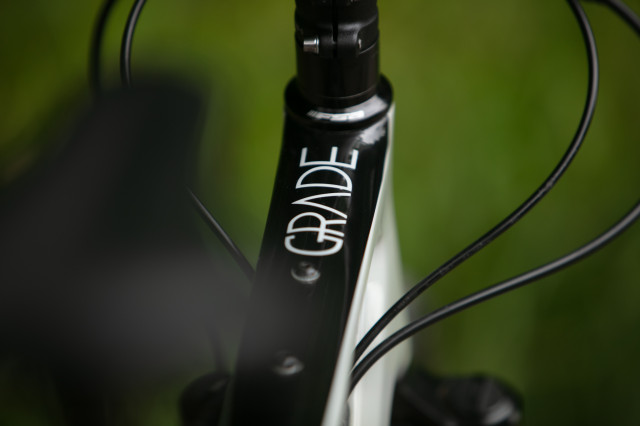
The stack and reach figures are 577mm and 405mm respectively.
At 134mm, the head tube length sounds quite short, but it has been reduced to offset the added height of the suspension fork compared to a rigid one. This means the front end is low enough to allow for an aero position in the drops but not so low that comfort is impacted during long distances on the hoods.
The head angle is 70-degrees and, when paired with the 55mm rake of the XPLR fork, gives a stable and predictable front end. A 1,069mm wheelbase incorporating 430mm chainstays also adds to that stability.
The seat tube sits at a much steeper 73-degrees – but this allows you to get a forward position on the saddle.
GT Grade Carbon X gravel bike – Componentry
This £3,000 Carbon X model is built up using SRAM’s 11-speed Apex 1 mechanical groupset, which runs a 40T chainring and 11-42T cassette, so a decent spread of gears for a 1x system.
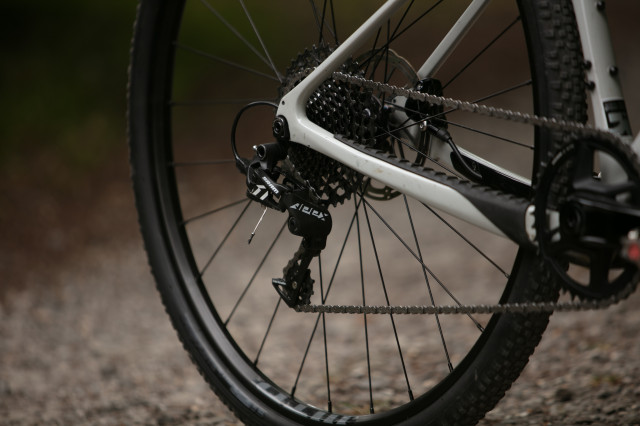
I’m a big fan of SRAM’s paddle-operated DoubleTap shifters and the fact that the unused one on a 1x system can be used to operate the dropper post keeps the handlebar looking uncluttered. The TranzX dropper post offers 50mm of travel on small and medium bikes with a jump to 70mm for the large and extra-large models.
The Grade runs 160mm disc rotors front and rear so there is plenty of stopping power on offer, the only downside being that this bike in particular tended to suffer from a lot of brake squeal. It wasn’t new when it arrived with me so I can’t be sure how they’ve been treated previously to cause it.
The cockpit comprises GT’s own parts with a DropTune RS alloy handlebar. It has quite a shallow drop and a 16-degree flare on each side, giving you a wider stance when in the drops for stability on loose surfaces. Widths range from 42cm to 46cm, depending on frame size.
The 3D Forged SL stem is a simple affair but does the job.
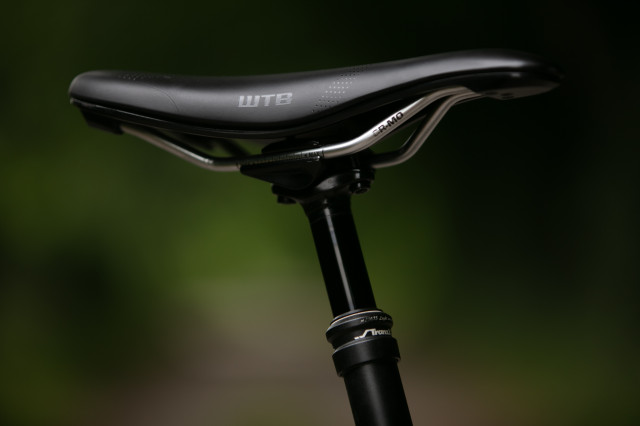
The WTB Silverado saddle has a good amount of padding, but I found its shape a little on the flat side for my taste. I prefer something a little more ‘swoopy’ but I could live with the WTB if needs be.
WTB also supplies the wheels and tyres. The wheels are built using Formula hubs running 12mm thru-axles and six-bolt disc rotors, while the rims are ST Light i23 TCS 2.0s. Both front and rear wheels use 28 spokes, and everything is ready to be set up tubeless.
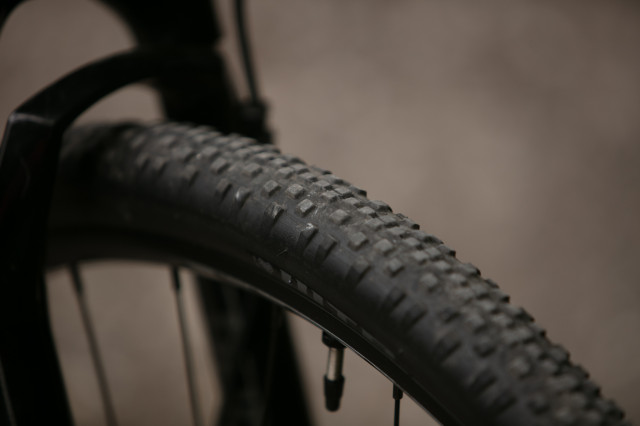
The WTB Resolute TCS Light tyres are 42mm in width and have a tread pattern well suited to most gravel scenarios and other dry surfaces. They’ll still cope when the going gets soft as long as things aren’t too extreme.
They’re decent all-rounders though and will cope with most seasons other than the depths of a harsh winter.
GT Grade Carbon X gravel bike – Performance
Like any frame material, carbon fibre can create a dead-feeling frame if not used correctly, but the Grade feels very responsive throughout. The amount of feedback passed through from the tyres was great and helped me choose my line and body position as it was so obvious what the bike was up to beneath me, which helped boost the fun factor.
The frame is so good that even the flex at the rear and the suspension fork up front can’t take away from how good the feedback is, they only enhance it.
The Grade feels fast, it has a racy nature to it helped by the way that the suspension allows it to almost float over the terrain. That and the ride position led me to hammer the pedals on nearly every trip and smash it around the local trails. The way it behaves is very confidence-inspiring and there were a few times I probably let my excitement outrun my talent level.
At just over 10kg, it’s not as light as some gravel bikes but doesn’t feel sluggish. It all seems quite lively, and the grams added by the fork and dropper post over rigid options are easily wiped out by the efficiency and comfort they provide. I never felt like my climbing performance was hampered due to the weight and accelerations from a standing start or when rolling felt responsive.
I’d say the Carbon X can be used for racing and events. Overall, unless you are primarily after a lightweight race machine, the Grade Carbon X covers all the bases and excels.
GT Grade Carbon X gravel bike – Verdict
Gravel bikes with suspension have been around for a while, but the market isn’t exactly awash with them – brands such as Specialized and Trek don’t have any models in the 2025 line-up.
Giant has released the Revolt X though, and, while the 2024 Advanced Pro 2 model came with pretty much the same spec as the Grade Carbon X, the new 2025 version gets a bump up to Apex AXS 12-speed for the same RRP of £4,499.
If you are happy with the 2024 model with Apex mechanical, it’s currently reduced to £2,269 in limited sizes on Giant’s website.
Canyon’s Grizl is available with the 30mm RockShox XPLR fork and SRAM’s Rival XPLR AXS groupset for a respectable £2,999. You don’t get a dropper post, but you do get the S15 VCLS 2.0 seatpost, which has a leaf-spring design.
But if you outlay the three grand on the GT, you’ll get a very capable machine that is a lot of fun to ride. It’s got a great design and has brought the Grade right to the forefront among the best gravel bikes.
You might also like:
- 2025 Gravel Burn stage race – everything you need to know
- Ribble Gravel SL Pro review
- Best gravel tyres 2025 – fast and grippy rubber for all conditions
About the bike
Tell us what the bike is for, and who it’s aimed at. What do the manufacturers say about it? How does that compare to your own :
It is definitely a versatile bike and is a real laugh to ride.
State the frame material and method of construction. List the components used to build up the bike.:
The frame uses a range of carbon fibre grades and added glass fibres in its construction.
Fork: Rockshox Rudy XPLR, 40mm, 51mm offset, Solo Air
Rims: WTB ST Light i23 TCS 2.0, 28h, Tubeless Ready
Front Hub: Formula, 12x100mm 6-Bolt
Rear Hub: Formula, 12x142mm 6-bolt
Tyres: WTB Resolute TCS Light, 700x42c, SG2 Dual DNA Compound, TCS Aramid Bead
Rear Derailleur: SRAM Apex1
Shifters: SRAM Apex1
Cassette: SRAM PG-1130, 11-42T
Chain: SRAM Apex, 11-speed
Crank: SRAM Apex 1 Wide, DUB, 40T
Brakes: SRAM Apex, 160mm rotors
Bottom Bracket: SRAM DUB BSA, 68mm Wide
Handlebar: GT DropTune RS, Alloy, 16° Flare (Width: S & M- 42cm, L – 44cm, XL – 46cm)
Stem: GT 3D Forged SL Alloy, 31.8
Bar Tape: GT Gravel Grip Premium Tape
Headset: FSA No.42 ACB
Seatpost: TranzX Dropper Post, 27.2mm (S/M-50mm, L/XL-70mm)
Saddle: WTB Silverado SL Fusion
Frame & Fork
How much suspension travel does the fork have?:
Was the bike comfortable to ride? Tell us how you felt about the ride quality.:
How was the bike in terms of sizing and angles? How did it compare to other bikes of the same stated size and intent?:
Overall rating for frame
How much suspension travel does the rear end have?:
Did the bike feel stiff in the right places? Did any part of the bike feel too stiff or too flexible?:
Tell us about the build quality and finish of the frame:
Tell us about the geometry of the frame:
Tell us about the materials used in the frame:
Riding
How did the bike transfer power? Did it feel efficient?:
How would you describe the steering? Was it lively, neutral or unresponsive?:
Tell us some more about the handling. How did the bike feel overall? Did it do particular things well or badly?:
Rate the bike for sprinting:
Rate the bike for high speed descending
Rate the bike for technical descending:
Rate the bike for flat cornering:
Rate the bike for technical climbing:
Rate the bike for climbing efficiency:
Rate the bike for agility:
Suspension
Rate the fork for performance:
Rate the fork for durability:
Rate the fork for efficiency:
Tell us some more about the fork. Anything you particularly did or didn’t like? Any features which didn’t work well together?:
Drivetrain
Rate the drivetrain for performance:
Rate the drivetrain for durability:
Rate the drivetrain for weight:
Tell us some more about the drivetrain. Anything you particularly did or didn’t like? Any components which didn’t work well to:
Wheels & tyres
Rate the wheels for performance:
Rate the wheels for durability:
Rate the wheels for weight:
Rate the wheels for comfort:
Tell us some more about the wheels.Did they work well in the conditions you encountered? Would you change the wheels? If so, wha:
Rate the tyres for performance:
Rate the tyres for durability:
Rate the tyres for weight:
Tell us some more about the tyres. Did they work well in the conditions you encountered? Would you change the tyres? If so, what:
Controls
Rate the controls for performance:
Rate the controls for durability:
Rate the controls for weight:
Rate the controls for comfort:
Tell us some more about the controls. Any particularly good or bad components?:
Summary
Did you enjoy riding the bike?:
Would you consider buying the bike?:
Which components had the most effect (good or bad) on the bike’s performance? would you recommend any changes?:
Would you recommend the bike to a friend?:
Rate the bike overall for performance:
Rate the bike overall for value:
Use this box to explain your score:
All the deals displayed on our review pages are pulled from a constantly updating database feed of the best affiliate deals available. The criteria for deciding on what are the best deals is who is offering the lowest, delivered price. In most cases we will be showing the very best deal available online, but sometimes you may be able to find an item cheaper. If you can please feel free to post a link in the comments box below. To find out more about affiliate links on road.cc click here.