


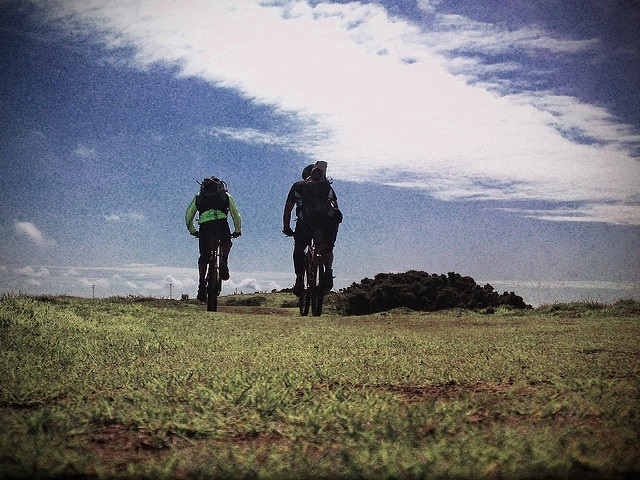

Cycling UK has emphasised that it is happy to work with local branches of the Ramblers Association to address concerns following suggestions that a number of local groups oppose the organisation’s campaign to open up more of the nation’s landscape for off-road cycling.
Rides of Way, Cycling UK’s off-road report found that a third of off-road cyclists ride regularly on trails whose status they do not know, while a further 74 per cent consider the current Rights of Way unsuitable.
At the moment cyclists (and horse riders) only have access to just over a fifth of England and Wales’ 146,000km rights of way network – 22 per cent in England and 21 per cent in Wales. According to Cycling UK’s Campaigns Coordinator, Sam Jones: “That’s largely down to the archaic laws laid down prior to the invention of the bicycle, so it seems about time we looked into this and addressed the imbalance.”
The Craven Herald reports that a number of local Ramblers groups are against such a move with formal resolutions being taken resisting any change to the law that currently restricts off-road cycling to public bridleways and byways.
However, Jones clarifies: “We’re not calling for blanket access across the whole network, merely increased access.”
While he agrees that there are clearly routes which most likely aren’t suitable for cycling, such as the “narrow, steep and winding footpaths” cited in the Craven Herald article, he highlights metalled tracks which cars are currently allowed on, but cyclists are not, and says “that’s clearly something which needs to change.”
Cycling UK claim to be maintaining a ‘good dialogue’ with the Ramblers Association national body. Speaking to the Environment, Food and Rural Affairs (EFRA) select committee earlier in the year, Cycling UK’s Policy Director Roger Geffen noted that conflict between different user groups is not inherent, but can arise when there are too many users in too little space.
The British Horse Society’s Mark Weston echoed that point and suggested that by increasing access by even a small amount, the load would be better spread across the network, rather than concentrated in smaller areas.
Nor are cyclists keen to come into conflict with walkers. As Jones points out, “those cyclists heading off-road are quite often people who enjoy a walk too.”




















41 thoughts on “Local Ramblers groups opposing calls for more countryside access for cyclists”
Would that be the same
Would that be the same Ramblers Association as this?…
Walking in the countryside, or rambling, became a popular form of recreation in the 19th century. For many people living in towns and cities, walking offered a welcome relief from a polluted environment and the stress of daily life. Access to the countryside, however, was becoming more of a challenge thanks to the Enclosure movement, with many private landowners closing off their land. In response, the number of walking clubs and groups that campaigned for walkers’ rights grew from the mid-nineteenth century to the 1930s.
In 1931, six regional federations representing walkers from all over Britain joined to create the National Council of Ramblers Federations, a body that could advocate on behalf of walkers’ rights at a national level. During the following year, 400 walkers took part in the landmark Kinder Scout Trespass. Although not all members of the Ramblers Federations were in favour of the trespass, the event added considerable momentum to the campaign for walkers’ rights.
My, how times change.
RA, the new NIMBY.
This story and the recent
This story and the recent story on barbed wire across bike trails highlights the very different attitudes in England and Scotland to land access.
What England needs is the right (or freedom) to roam concept of Northern Europe. One of the best bits of recent(ish) Scottish legislation was the 2003 Land Reform act that codified long held access rights to land. When it was brought in there was a minority that said it would cause chaos. That has not happened and it is almost universally approved of.
Worth reading this to understand more
https://en.wikipedia.org/wiki/Freedom_to_roam
but this is the key bit.
In Scotland the Land Reform (Scotland) Act 2003 comprehensively codified into Scots law the ancient tradition of the right to universal access to the land in Scotland. The act specifically establishes a right to be on land for recreational, educational and certain other purposes and a right to cross land. The rights exist only if they are exercised responsibly, as specified in the Scottish Outdoor Access Code.
Access rights apply to any non-motorised activities, including walking, cycling, horse-riding and wild camping. They also allow access on inland water for canoeing, rowing, sailing and swimming. The rights confirmed in the Scottish legislation are greater than the limited rights of access created in England and Wales by the Countryside and Rights of Way Act 2000 (CRoW).[8]
So in England pretty much the
So in England pretty much the only place you’re technically allowed to ride a bike is on the road, though it is effectively legal for motorists to run you over.
Jackson wrote:
No, it depends on the status of the right-of-way – footpath or bridlepath. Bridlepath is OK for cyclists, footpath currently isn’t.
dottigirl wrote:
I was being facetious. Basically it seems nobody wants us anywhere.
As both a regular cyclist and walker who has just returned this afternoon to one of the most polluted and noisiest parts of London (under the flight path into Heathrow) from a 5 hour walk in northernmost Hertfordshire I’d have to say re Jackson’s “…nobody wants us anywhere”, for Christ’s sake stop that self-pittying snivelling, learn a bit of the law and try a bit of commonsense!
There’s reasons for the designation of rights of way that make sense. Footpaths are nothing more than mud tracks, sodden and ankle deep in mud in winter, unsurfaced and liable to be destroyed by heavy use, especially by anything heavier than your average bod. I’ve walked tracks that in winter are literally running streams where one has to have a stick to keep one’s footing. I’ve seen them washed a way and destroyed by over use.
That’s why horses, motorbikes and motor cars are all not supposed to use them. Cyclists are admittedly not as destructive as the others, but any over use of them will damage (rut, break up) the surface. I’ve often struggled to walk tracks designated as Byeways Open to All Traffic – BOATs, that are rutted to knee deapth by motorcar off roading enthusiasts.
Cyclists Are allowed to use anything designated as a bridleway or above. The surfaces of such paths are often maintained (built) to a higher standard by the local authority of your area so that they can take the wear. Footpaths probably aren’t. In my experience, the higher the classification the greater the size of the track and the greater the work needed to buid it.
Finally, I’d ask you to consider that the solitude offered by walking in the countryside is something that is very important to many people, myself included. Where I live there are aircraft passing over our house every two minutes at a few hundred feet, which is why I go a long way out of my way to seek peace and quiet. Having it disturbed by often inconsiderate and ill informed cyclists and motorcyclists (I have been threatened by the latter for failing to step aside so they can pass by on a footpath) is not something that needs to be. There’s space out there for all to enjoy an appropriately.
HV3 wrote:
Not all cyclists or even motorcyclists are ill mannered and inconsiderate; some but not all pedestrians *are*. Some cyclists get outside because they want quiet and solitude too (myself included) – not all cyclists in the countryside are LET’S OFF ROAD, you know.
HV3 wrote:
You may, for all I know, be right in S E England, but in the Lakes the distinction is essentially historic, rather than about his ‘built’ the path is.
Fortunately we lack this weird differentiation in Scotland.
HV3 wrote:
Generalisations… there is a ‘footpath’ I walk on occasionally that has houses either side of it and it is surfaced with bitumen – cars drive over it to ge to the houses. I can’t, however legally ride my bike on it. There are many footpaths that are wider and more robust (surface wise) than bridleways, certainly where I ride/walk. If it is wide enough for two or three people to walk side by side then it can easily be shared with cyclists – and indeed, for the most part, common sense prevails and we all get on happily together.
Sorry folks but I’m entirely with the ramblers on this one and I say that as an active cyclist of more than fifty years experience. There is no quicker way to spoil the enjoyment of a quiet walk than to introduce bikes, their silent approach is enough to prevent walkers from relaxing, dog walkers from releasing their pets and horse riders from teaching a completely stress-free animal.
In the same way that we cyclists often resent having to share space with the car, so are other path users reluctant to be pushed aside by bicycles in a hurry. There is nothing wrong with wanting to unwind, to think at walking speed and to be free of the worry of other, faster traffic.
Is thirty thousand kilometres of bridleway and cyclepath not enough? Or are we behaving exactly like motorists, who want it all?
mike the bike wrote:
I was going to say something similar. Country paths are for leisure and fresh air/pretty views, and you can get those just as easily on foot, so I don’t really care if bikes are not allowed – I’ll just walk those routes.
Would rather stick to battling the legions of the motor-lobby – I see no gain in opening a second-front with the wooly-hat and rucksack brigade.
But… the point in the article about some such routes allowing motor vehicles but not bikes suggests there might be a valid argument for changing the rules slightly in some cases.
mike the bike wrote:
Horses on a footpath?
mike the bike wrote:
I don’t understand this. Why shouldn’t I be able to (try, in some cases) ride my bike where I like? What’s the difference between me and my bike, and say a dog Walker and the animal, or a horse rider? If the horse or dog aren’t controllable, they shouldn’t be around the public.
It’s just countryside, why is a walker, or someone with an animal, more able to use it responsibily than me?
Daveyraveygravey wrote:
Sorry folks but I’m entirely with the ramblers on this one and I say that as an active cyclist of more than fifty years experience. There is no quicker way to spoil the enjoyment of a quiet walk than to introduce bikes, their silent approach is enough to prevent walkers from relaxing, dog walkers from releasing their pets and horse riders from teaching a completely stress-free animal.
In the same way that we cyclists often resent having to share space with the car, so are other path users reluctant to be pushed aside by bicycles in a hurry. There is nothing wrong with wanting to unwind, to think at walking speed and to be free of the worry of other, faster traffic.
Is thirty thousand kilometres of bridleway and cyclepath not enough? Or are we behaving exactly like motorists, who want it all?
— Daveyraveygravey I don’t understand this. Why shouldn’t I be able to (try, in some cases) ride my bike where I like? What’s the difference between me and my bike, and say a dog Walker and the animal, or a horse rider? If the horse or dog aren’t controllable, they shouldn’t be around the public. It’s just countryside, why is a walker, or someone with an animal, more able to use it responsibily than me?— mike the bike
Normally because the person walking isn’t trying to do 15+ MPH down hill and round a blind bend.
It dosen’t end well.
I know this. Been flattend once and had a couple of close calls in the last 12 months.
EDIT removed the reference to horses, they should be on the footpathh either….
mike the bike wrote:
There is no quicker way to spoil the enjoyment of a quiet walk than to introduce DOGS.
Horses are not allowed on footpaths.
mike the bike wrote:
I agree with you on this one. There ought to be spaces free of the probability of an interaction with a much faster road user. I am both walker and cyclist and do not appreciate sharing paths with cyclists.
On the other hand, if either cyclists or walkers have wended their way to one of the last pockets of greenery and tranquility using a combustion engine then they can suck it as far as I’m concerned.
mike the bike wrote:
I quite agree – a view that is reinforced by recent experiences on the Bristol-Bath cycle path, where cyclists in a hurry make it simply too dangerous (at least in the rush hour within the Britol ring road) for anyone else.
I already have to keep looking around when walking along local towpaths, the rea Valley route etc.and I do enjoy meandering around the countryside (on foot) withour having to worry about faster “traffic”, thankyou!
RMurphy195 wrote:
I think the Bristol Bath Railway Path is a completely different animal to what the Ramblers are talking about. During rush hour, it is a major cycle commuter route and the rest of the time it’s the safest and most convenient way to get between the two cities on a bike.
Complaining that the BBRP is too busy with bikes would be like trying to make the Cycle Superhighways in London shared-use IMO.
It’s not as if a blanket
It’s not as if a blanket right to use any footpath is necessary, just some joined up thinking to join up the existing bridlepath network and even then, only where the trail is suitable.
I don’t see what’s wrong with
I don’t see what’s wrong with dismounting if necessary and then being on your way again. I’ve been on footpaths and come cross 2 people in the same number of miles. It’s not like riding on the pavement in a busy town.
Yorkshire wallet wrote:
Ah but Surrey byelaws forbid you to walk with, or even carry, a cycle on a footpath:
https://www.surreycc.gov.uk/environment-housing-and-planning/countryside/footpaths-byways-and-bridleways/find-out-about-rights-of-way/signs-in-the-countryside
Personally I think that’s a bit too draconian, and needs to be challenged.
Regarding mikethebike’s “horse riders from teaching a completely stress-free animal” – just to reinforce what others have posted, can mike clarify under what circumstances cycles and horse riders are not allowed to share a path?
Bikes belong on roads.
Bikes belong on roads.
And mountain biking is so immature.
Valbrona wrote:
No, you are. So nerrr.
Valbrona wrote:
Time to go back to the golf course.
I’m guessing that the vast
I’m guessing that the vast majority of walkers that I see are not Ramblers Association members. This probably explains why in nearly 25 years of riding off-road I’ve had no more than half a dozen people comment on me being on a footpath.
Of those, one individual claimed bikes were ‘well known as silent killers’ so she revealed herself to be a loon. Another I can recall taking offence at me but, being diplomatic, it looked like the whole family’s first walk in decades. The fair weather brings them out, suddenly claiming ownership. In one case when I advised a gentleman that my alternative was a couple of miles along a fast, busy ‘A’ Road he understood why the footpath was the only option. Despite the mud bath.
Slow down, tell people you’re there, give way, smile, say hello, exchange pleasantries, hold a gate open. Works wonders 99.9% of the time and we all get along.
It is a pompous tit who
It is a pompous tit who thinks he/she has the right to ride their bike on footpaths.
Be more responsible … don’t do it … because it is not allowed.
Nuanced debate.
Nuanced debate.
1. Horses cause a huge mess, for everyone. They cause the same damage to trail surfaces as motocross bikes. Therefore there is no comparison – horses are not cycles. They are also a tiny minority of overall recreational users, and serve no useful purpose such as transport or improving health. They are a carbon-intensive folly. I say this as a father of two horse-mad girls who has sunk a shitload of cash into the beasts over the years.
2. Cycles, OTOH, cause as much damage as pedestians. Often less, as they are less concerned about keeping feet dry so don’t widen paths to skirt around puddles, causing more erosion and damage to vegetation.
3. Funnily enough no-one keeps statistics on offroad cyclist-pedestrian collisions because they are so rare as to not register above the noise floor of statistical sensibility. Anyone citing risk of collision as reason to ban cycling can be safely ignored once this point is clarified.
4. People cycling in the countryside are highly likely to be decent people there for exactly the same reasons as the walkers – enjoying the outdoors away from cars.
5. People cycling have as much to loose from a collision as the pedestrian does, if not more. There is an inherent bias not to be a tit.
6. The Ramblers et al are simply selfish in not wanting to see bikes on tracks where cars and farm vehicles are often present.
7. Public policy should not be made based on what might happen, rather on evidence-based fact of what has happened, and can meaniningfully be ameliorated through change of policy.
8. I’m all for just riding everywhere, being nice, and smiling, apologising and moving on if someone gets upset. In the last thirteen years of riding local footpaths around my village, I can’t recall a single cross word with anyone. Mostly because in an hour’s riding I hardly ever meet anyone.
These are vastly, massively underutilised resources for recreation, and the Ramblers STILL want them all to themselves, whilst the cyclist taxpayer funds them but can’t use them.
Meanwhile we have a child and adult obesity epidemic.
KiwiMike wrote:
All of this, I rarely ride off road these days but the attitude of some walkers is way in excess of the alleged dangers presented.
Absolutely you will come across some people that ride bikes that are annoying/careless and in some cases even a bit dangerous, however the OTT reaction by a fairly significant proportion of walkers/ramblers to people just sidling by quietly with no fuss or presenting any danger is riduclously excessive. Usually starts with tuts and mild expletives under the breath, then that will go further with more vocal swearing despite all the while you not even coming within an armspan at a few mph. Then it extends further when they deliberately try to block you by walking off the path even when you’re attempting to go well wide to avoid disturbing them, then further where people have being grabbed and assaulted.
Absolutely those that come bombing round a bend and cut far too close deserve a stiff arm tackle but for the most part the reaction is massively OTT.
BehindTheBikesheds wrote:
The likelihood is that they are timid, wee, cowering car drivers, fearful that they shall now be treated the way they treat other road users.
I’m with KiwiMike on this. I
I’m with KiwiMike on this. I just ride responsibly with very little reference to what the actual path is graded as.
There are certain bridleways i wouldn’t consider riding during winter (when they are often very muddy and/or, I would cause a lot of trail damage) or on a busy Bank Holiday weekend when they’ll be rammed with walkers.
There are certain footpaths I can quite happily ride with no issues at all because they’re remote or well surfaced or there’s a tacit understanding with the landowner.
Even riding that way in the Lake District & Peak District, I’ve rarely encountered any problems. Descending a footpath once on my CX bike, a lone woman walker started with the “i don’t think you should be here” routine. I was just about to respond with claiming ignorance of the trail status or being lost when she clarified her statement with the words “it’s ever so rocky and difficult, you must be VERY good!”
🙂
Get away from the stupid busy honeypot areas and people get on just fine mostly.
If you’ve ever tried to plan
If you’ve ever tried to plan a cross-country off road ride in the northern half of Sussex, you will know that the bridleway network is a sick joke. It is virtually impossible to come up with a route that isn’t well over 60% on road. This is a huge barrier to people cycling with kids. If you have a snobby attitude to cycling off-road, you should understand that many kids that start off riding off road (too yound to safely negotiate motorised traffic danger) ride on road later. Getting people cycling off road is good for cycling generally.
The rights of way system in England is basically broken. The process for getting a footpath upgraded to bridleway or restricted byway is excessively bureaceatic and most councils aren’t processing their backlogs due to cuts. Unfortunately there is a cut off in a few years to get historic rights of way recognised. 🙁
I fully support the Cycling UK campaign. I think Scotland’s model and think we shiuld adopt it, possibly with exceptions for the very busiest areas to reduce conflicts.
DaveE128 wrote:
An excellent example of a busy area exception is the voluntary ban on Snowdon. That works almost perfectly, it was agreed between user group representatives and cyclists stay off the mountain until after 5pm to ensure that walkers going up are not met by hoards of MTBers screaming down. And it’s still a voluntary ban, not actually legally enforceable yet it works. (albeit, Snowdon is fairly extreme terrain and therefore self-selects the riders that would attempt to ride it anyway!)
Can we talk about anglers?
Can we talk about anglers? 😀
First things first: Take away
First things first: Take away all the car parks in the countryside, and just have bus stops instead. Sort the walkers from the motorists.
nowasps wrote:
ftfy
beezus fufoon wrote:
Hmm. Hadn’t fully considered the sexual freedoms angle.
I live near a wide coastal
I live near a wide coastal path that is a designated shared route for walkers and cyclists. It was recently tarmaced specifically to encourage more cyclists to use it.
I’m friendly to all the walkers and the dog owners but I was getting tired of a few dog owners who would see you approach and then purposely let their dog drift across the path on the lead – or those walkers absorbed in their phones who would glare at me when I shouted ‘hello’ as I approached.
The solution? I bought bells for all my bikes (even a subtle Knogg Oi bell so as not to sully the summer bike) and obeying the highway code has never been more enjoyable. No more “get a bell!” and I so love the furious glares from the few who hate cycling in all it forms but know they can’t argue with the ‘ting’ of the bike bell… Especially when I have to use it repeatedly. Ting! Ting! Ting! TING! Try it: obeying the letter of the law can be practical and so much fun.
WolfieSmith wrote:
In Japan it is acceptable (although no longer entirely lawful) to ride a bike on the pavement/paths. As a walker it scares the sh!t out of you the first couple of weeks you live there as you think you are going to get hit by the highly unskilled masses cycling along on their “sit up and beg” bikes (better known there as “Mama Chari’s). I’ve even had policemen there advise me, when riding on the road, to consider riding on the pavement as it is “safer”. Everyone has adapted though: people ride at the appropriate speed on the pavement (apart form the odd idiot); walkers don’t get scared or angry; and accidents rarely happen (if they do the larger “item” is always to blaim and can be sued for large amounts of money, which again calms down the speed of cyclists on paths)
My point wasn’t actually going to be the above, although in writing it, I realise its probably the more important point. What I was actually going to say, was, that as a result of being able to cycle on pavements and it being a legal requirement there to have a sounding device on the bike to alert people of your approach, we often got to the better cycling routes along safe pathways happily ringing our bells ….or better still cycling hooters!
“While he agrees that there
“While he agrees that there are clearly routes which most likely aren’t suitable for cycling, such as the “narrow, steep and winding footpaths”
Problem is that’s exactly the paths mountain bikers want to be on.
Can one legally carry a horse
Can one legally carry a horse on a Surrey footpath?
barbarus wrote:
Only if it’s folded.