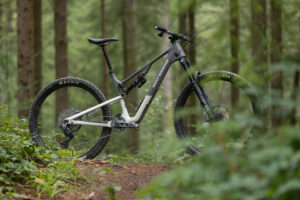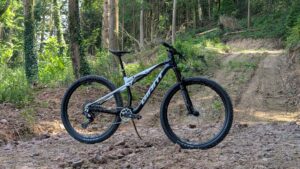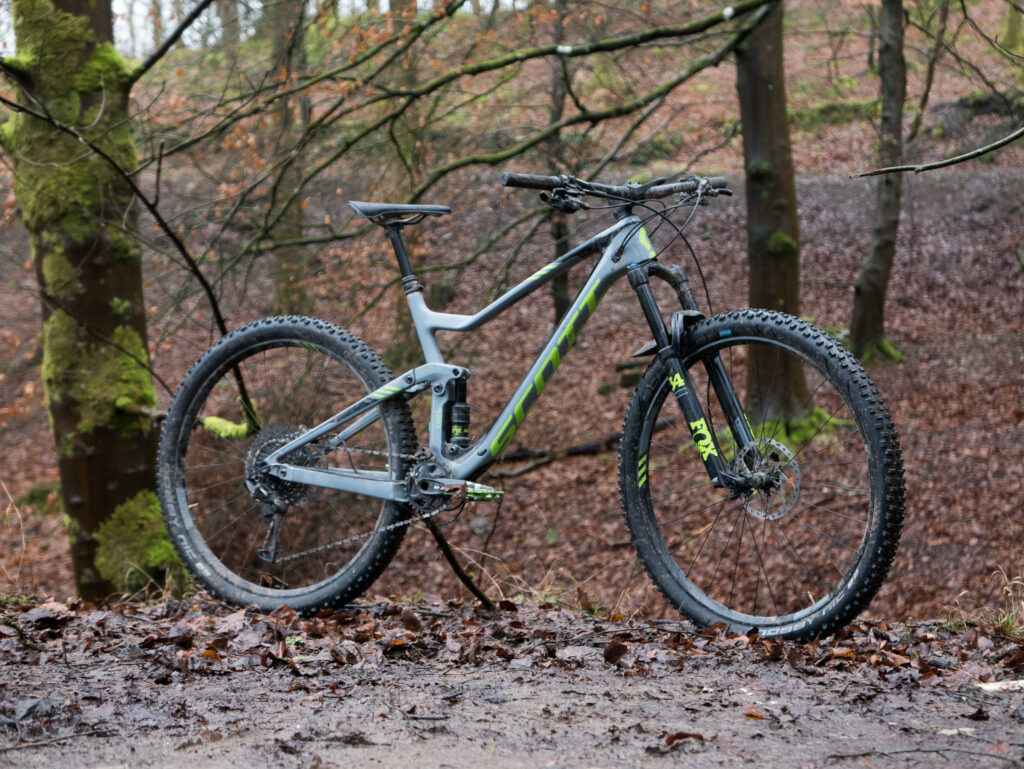

Scott’s all-new Genius range packs 150mm of travel into a chassis with progressive geometry and your choice of 650b or 29er wheels, both shod with extra fat rubber. This Genius 920 sits near the top of the range, using a carbon front triangle paired with an alloy rear and 29″ wheels. Overall, it’s a hugely impressive long travel trail bike but this particular build has a few componentry bugbears.
- First Ride: 2018 Canyon Spectral CF – 27.5″ trail bike gets improved suspension
- Buyer’s guide to mountain bikes: get the best bike for you and your budget
- Review: Starling Cycles Murmur Factory frameset – steel, single pivot 29er
While the 2018 Genius is totally distinct from the old model, the basic chassis layout comes from the much-lauded Spark cross-country machine. It’s a really neat design, relocating the shock’s mounting position on the frame from the top tube on the old bike to near the bottom bracket junction on the new bike to help drop weight.
However, while the Spark relies on flex in the rear triangle to deliver its travel, the Genius requires an extra pivot to squeeze 150mm out of the design, with the additional one mounted on the chainstay in a Horst-style configuration. It does also get the clever Twinloc shock system, which pairs the fork and shock with a bar mounted remote.
At the rear, the fully open mode can be switched to a setting that restricts it to 120mm of travel with a stiffer spring curve before the final, locked-out setting. It also alters the geometry slightly, due to the smaller amount of sag in the medium and lockout modes. At the front, the Fox GRIP damper in the fork is correspondingly stiffened up, though travel remains unaltered.
Scott has also radically revamped the geometry. With a reach of 466mm for a large frame, it’s pretty spacious in that department, while a head angle of 65º is slack for a 29er in anyone’s money. At 74.8º, the seat angle is decently steep to help keep weight centralised on steeper climbs, while short 438mm stays make for a lively back end and a 27.6mm bottom bracket drop/346mm height adding stability – though as the stays don’t grow with the larger frame sizes, taller riders may feel somewhat unbalanced front to rear.
It is possible to alter the bottom bracket height via a small flip chip in the shock mount, meaning that any Genius model can run 650b wheels with fat 2.8″ tyres or 29″ hoops with chubby 2.6″ rubber without messing up geometry – the Genius 720 is exactly the same bike spec, just with 650b wheels. Interestingly, Scott has dropped the ‘Plus’ designation for both of these tyre sizes, treating high volume rubber on wide 30mm+ rims as the new normal.
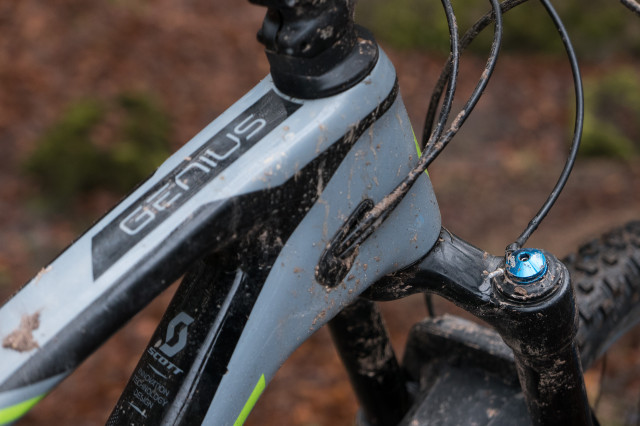
Elsewhere on the frame, there’s some nice detailing, with special flush fit spacers on the headset that integrate neatly with the stem and top cap. While they look tidy, you’ll need to replace them all with normal ones if you want to use an aftermarket stem.
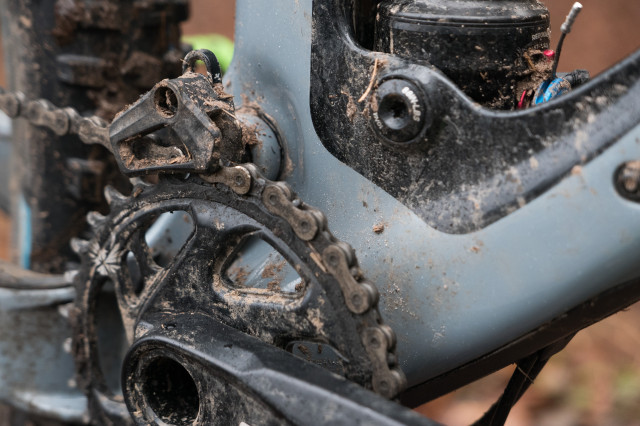
The internal cable routing is all very tidy and rattle free and there’s a very tidy upper chain device that mounts directly to the main pivot. The frame is will work with a front mech, which seems a bit odd as it requires a narrower main pivot stance that means a less stiff rear end. I suspect that’s a nod to the European market, where having a gigantic gear range is still popular for hauling up mountains on the ‘freeride tours’. There’s also a Press-Fit bottom bracket, which I’m not a huge fan of as they can be problematic in terms of noise and premature wear.
The spec
For a bit over four thousand quid, it’s obvious that has invested most of that in the high-end HMF carbon frame rather range-topping components. Fox provides the suspension, with the Scott-specific Nude EVOL at the rear and a Fox 34 Float Performance fork with remotely controlled GRIP damper up front and a natty Scott integrated mudguard on it. Interestingly enough, though there’s no hint on the outside, the fork uses much thicker than standard upper legs – the same as those specced on the e-bike specific 34 – to boost stiffness.
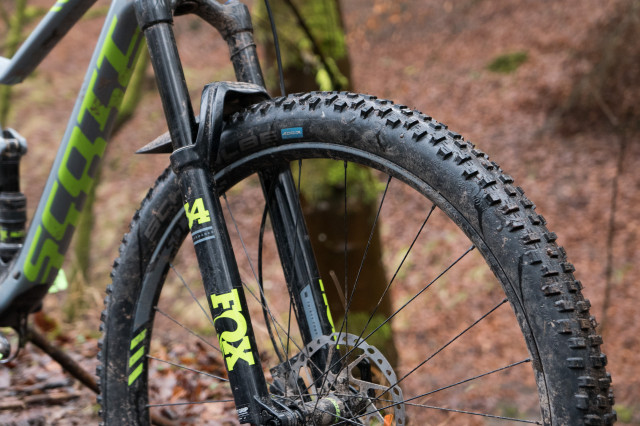
I queried Scott about why they’d used this rather than just speccing the larger legged Fox 36 model out of the box and they told me: “Because we were looking for more stiffness in combination with 29 x 2.6″ tyres, we created a special spec, by using the E-Bike upper tubes.”
“Also, the 34 is a little more sensitive at the beginning of the stroke than the 36 because of less friction – larger diameter increases the friction. This is quite important for a trail bike and this combination is also lighter than the 36 option.”
I’ve no Fox 36 Performance with GRIP damper on hand to verify the latter claim, however.
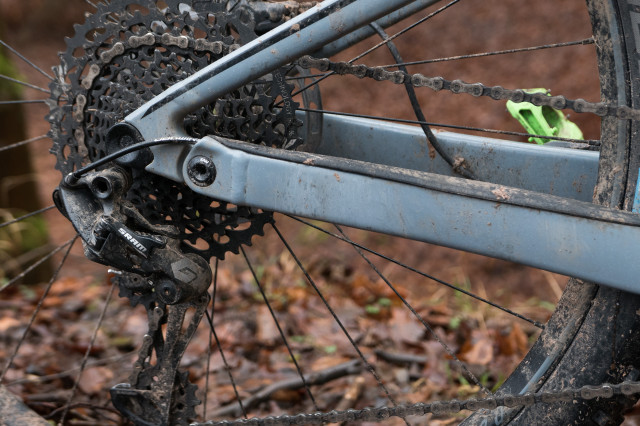
The drivetrain is from SRAM, with a 12spd X01 Eagle single-ring groupset with a big old 10-50T with a 32T ring up front. Shimano provides the SLX stoppers with 180mm rotors front and rear and there’s a 150mm travel Fox Transfer dropper post on large (tested) and extra-large frame or 125mm on medium and 100mm on a small.
House brand Syncros provide much of the finishing kit, with a 50mm stem and 760mm wide bars that do the trick just fine, though a little more width might have been welcome. The saddle was pleasingly comfy for long stretches, however. The 30mm internal width Syncros TR2.5 wheelset is plenty wide enough for the rotund 2.6″ Schwalbe Nobby Nic rubber, which uses the trail riding ready, mid stickiness Addix compound.
The ride
Despite the decent reach figure and reasonably slack head angle, the Genius certainly doesn’t feel like some kind of lumbering beast when you first set off on it. In fact, I found the riding position to be nicely centred, with a short head tube preventing the front end from feeling distant, despite the big wheels and fat rubber.
Thanks to the low weight – 13.6kg for this large – the bike is extremely sprightly uphill or on the flat. SRAM’s GX Eagle occasionally doesn’t have the most smooth or snicky feeling of shifts, but it gets the job done and the gearing was bob on for everything from all-day epics to hard and fast woodland thrashing.
Pointed on a really steep uphill, I did notice that the offset seat tube does mean that despite the steep effective seat angle, your weight can be pushed a bit further rearwards than ideal. Nudging the saddle forward on the rails effectively cured that and it’s well mannered on flatter singletrack – not that sat-down pedalling is really what this bike encourages.
Talking of pedalling, I’m not a huge fan of lockout devices on trail bikes – I don’t see the point on a bike not meant for cross-country racing – but I did make use of the reduced travel setting of the Twinloc system to firm up the otherwise extremely supple and sensitive full travel mode. It makes sense to optimise full travel for grip when descending and use the other settings to stop it being terrible up hills or on the flat and that’s exactly what Scott has done – not that the Genius is all that bad to pedal when it’s left alone.
I did find that the having it linked to the fork was less useful and I ended up disconnecting the front remote from the GRIP damper, which allowed me to have an active and supple fork and just adjust the rear depending on whether I was climbing or not. That did mean I didn’t have any compression damping adjustment options up front, but that wasn’t the end of the world.
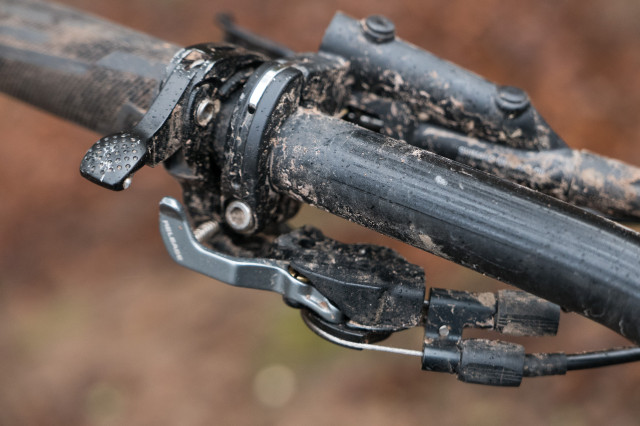
Slightly annoying is the fact that the Twinloc remote sits under the bar, where you’d usually expect to find the dropper post remote, which instead is mounted on the end of the left hand lock-on grip collar. Until I’d ridden the bike a few times, I kept locking the bike out rather than dropping the post, which was sub-optimal when pedalling into a descent. If it’s your main bike – and at this price I’m guessing it would be – then that’s not really too much of an issue but it’s a pain if you regularly switch back and forth. To add insult to injury, Scott has chosen to use Torx head bolts for the lock on grips, with the one that secures the post remote being a different size to the other. Neither are commonly found on a multitool, so if your grip starts slipping mid-ride, it’s a proper pain in the arse.
Mild grumbles aside, when you have figured out the plethora of controls and drop into the trail, the Genius really shines. I found that the relatively short back end allowed me to accurately pick up and place the rear wheel on tight turns, while the overall length and slack head angle meant the bike was confidence inspiring on steep terrain but would still carve through tight turns between trees with the best of them.
Even when the trail starts to move into territory that’s well above the bike’s theoretical pay grade, it manages to hold its own, with the plush and progressive rear suspension working hard to maximise traction. It’s really very resistant to bottoming out at the rear, despite sitting quite deep into the travel – in fact, it’s probably at the upper end of how progressive you’d want it to be, which is good to see as a stock setup on a bike.
The fact that it sits into the travel does mean that the low bottom bracket makes itself known. I found myself getting pedal strikes when pedalling out of bermed corners until I learnt to temper my enthusiasm somewhat. It’s an odd turn of affairs that the geometry adjust could come in useful to raise the bike if you find this a hindrance. It’s almost universally used for the reverse on most bikes and then left there.
Despite being very capable, there’s no double that this is still more of a lightweight, long travel trail bike rather than a short travel enduro racing slugger. The Fox 34 fork might be stiffer than stock, but there’s still a hell of a lot of leverage on it when you slap down from drops or jam the brakes on hard into a corner and it feels much more pliable and less accurate than burlier units.
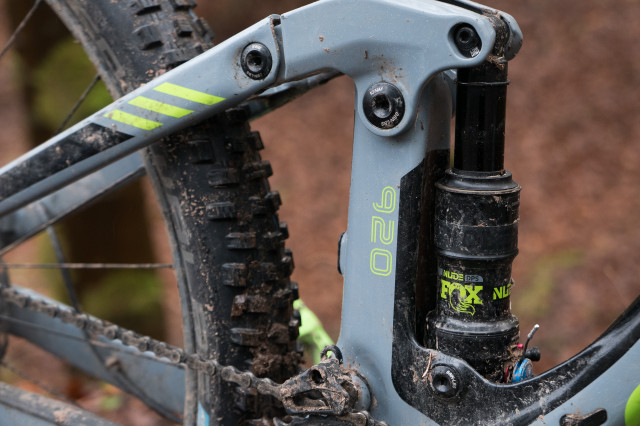
The Nude DPS shock does a noble job of keeping things under control at the rear, but on long, rough descents there’s a hint of fade as the rebound starts to speed up as the limited volume of oil gets heated.
That said, it’s a compliment to the chassis that you’ve got enough confidence to keep pushing hard enough to provoke these in the first place. I’ve no doubt that with a piggyback shock and a burlier fork up front it’d cope just fine but that’s almost certainly where something that would fill the vacant (for now) boots of the old Genius LT would be in the range.
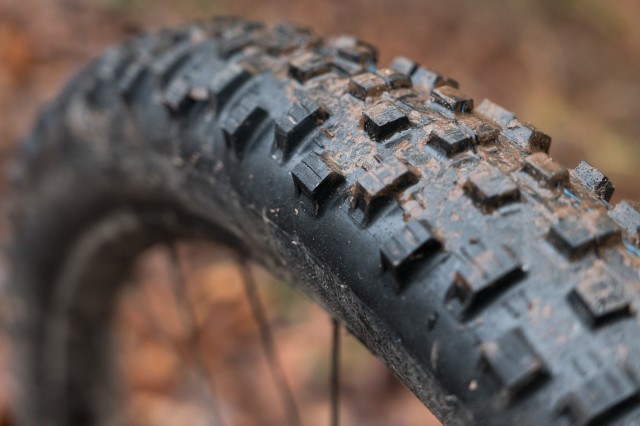
Those big fat Schwalbe tyres do an excellent job of cutting down on trail chatter, but that’s about where my love for them ends. The tread pattern is moderately aggressive, but the shape of the carcass is overly round, so it’s difficult to feel the edge of the tyre and therefore judge when you’re liable to start drifting. Much like any high-volume tyre, you also need to run a fine window between keeping the pressure low enough to get decent deformation and traction and keeping it high enough to stop the tyre folding. While they roll quickly and are generally inoffensive on hardpack, they tend to clog in mud. During my sloppy test period, I quickly switched the front out for a Maxxis Shorty 2.5″ Wide Trail and it improved the bike no end – a much more predictable bite with masses more feedback at the limit. Throw something similarly sized and shaped but faster rolling on the rear and you’d be cooking with gas.
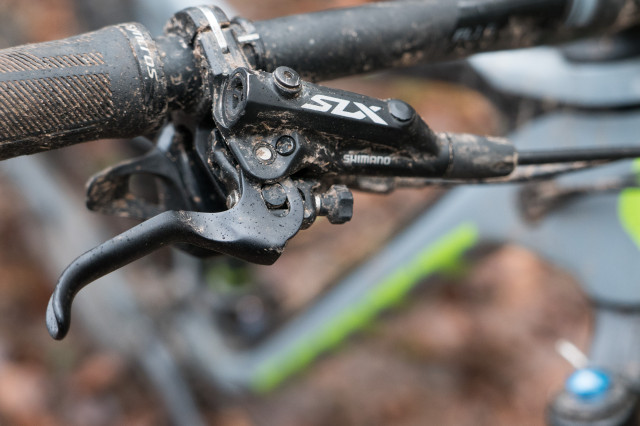
Another letdown – and one more expensive to cure – were the Shimano SLX brakes. They offered decent power but they were inconsistent to the point of being dangerous, with a bite point that moved in and out at will. I like to run my levers so they bite close to the bar – I find it helps lessen arm pump – and the first time it happened, the lever pulled all the way to the bar. On the second panicky application, the bite point then moved back out to where it should be and I regained braking.
Despite bleeding, it remained completely unpredictable and I turned to running the levers much further out so I would be guaranteed that they’d bite at some point – even if I didn’t know where. This is an issue that colleagues have experienced on a few sets of Shimano XT and SLX brakes recently, so while I hope it’s an isolated case I’m not convinced.
In summary
If you want a lightweight, incredibly capable and versatile machine for going fast, up down and along, then it’s hard to imagine a better platform than the Genius. The Twinloc system takes a bit of getting used to but it serves a useful purpose at the rear, while the handling is amongst the best in class, without a doubt. The lightweight carbon frame means it’s a pleasure to ride uphill as well and it can session trails or ride cross-country with the best of them.
It’s a shame that both the tyres and brakes let the bike down out of the box. The former is easier to fix, while the latter is a bit more involved – and the only bike not to use Shimano brakes in the range is the £6999 Genius 900 LTD. If you’re willing to make a few changes out of the box despite that fat price tag, the Genius really is a smart choice for a rider that wants to do it all – and fast.
You might also like:
- First Look: Mondraker’s Foxy Carbon RR SL looks splendid – and is very spendy
- First Ride: 2018 Canyon Spectral CF – all-new high-value trail bike
About the bike
Tell us what the bike is for, and who it’s aimed at. What do the manufacturers say about it? How does that compare to your own :
State the frame material and method of construction. List the components used to build up the bike.:
-
FRAME
Genius Carbon / IMP technology / HMF Mainframe
BB92 / Alloy SL 6011 swingarm
Virtual 4 Link Design
27.5 (2.6 & 2.8) and 29 (2.4 & 2.6) tire compatible with Geo -BB adj.
SW dropouts for Boost 12x148mm
TBC Trunnion box construction -
FORK
FOX 34 Float Performance Air
Grip 3 / 3-Modes / 15x110mm QR axle / tapered steerer
Reb. Adj. / Lockout / 150mm travel -
REAR SHOCK
FOX NUDE EVOL Trunnion
SCOTT custom w. travel / geo adj.
3 modes: Lockout – Traction Control -Descend
DPS / Reb. Adj.
Travel 150 – 100 – Lockout / 185X55mm -
REMOTE SYSTEM
SCOTT TwinLoc Suspension System
TSP Suspension – Seatpost Remote
below Bar / 3 modes / integ. Grip clamp
-
HEADSET
Syncros FL2.0 Press Fit E2 / Tapered 1.5″ – 1 1/8″
OD 50/62mm / ID 44/56mm -
REAR DERAILLEUR
Sram GX / Eagle 12 Speed
-
FRONT DERAILLEUR
SCOTT Chainguide
-
SHIFTERS
Sram GX Trigger
-
BRAKES
Shimano SLX M7000 Disc
180mm F & R / SM-RT64 CL Rotor -
CRANKSET
Sram X1 1000 Eagle GXP Boost PF
QF 168 / 32T -
BB-SET
Sram GXP PF integrated / shell 41x92mm
-
HANDLEBAR
Syncros FL1.5 mini Riser / Alloy 7050D.B.
12mm rise / 9° / 760mm
Syncros Pro lock-on grips
Frame & Fork
How much suspension travel does the fork have?:
Overall rating for frame
How much suspension travel does the rear end have?:
Riding
Rate the bike for sprinting:
Rate the bike for high speed descending
Rate the bike for technical descending:
Rate the bike for flat cornering:
Rate the bike for technical climbing:
Rate the bike for climbing efficiency:
Rate the bike for agility:
Suspension
Rate the fork for performance:
Rate the fork for durability:
Rate the fork for value:
Rate the rear suspension for performance:
Rate the rear suspension for durability:
Rate the rear suspension for efficiency:
Rate the rear shock for value:
Rate the balance and performance of the suspension overall:
Drivetrain
Rate the drivetrain for performance:
Rate the drivetrain for durability:
Rate the drivetrain for weight:
Rate the drivetrain for value:
Wheels & tyres
Rate the wheels for performance:
Rate the wheels for durability:
Rate the wheels for weight:
Rate the wheels for value:
Rate the tyres for performance:
Rate the tyres for durability:
Rate the tyres for weight:
Rate the tyres for value:
Controls
Rate the controls for performance:
Rate the controls for durability:
Rate the controls for weight:
Rate the controls for comfort:
Rate the controls for value:
Summary
Did you enjoy riding the bike?:
Would you consider buying the bike?:
Would you recommend the bike to a friend?:
Rate the bike overall for performance:
Rate the bike overall for value:
All the deals displayed on our review pages are pulled from a constantly updating database feed of the best affiliate deals available. The criteria for deciding on what are the best deals is who is offering the lowest, delivered price. In most cases we will be showing the very best deal available online, but sometimes you may be able to find an item cheaper. If you can please feel free to post a link in the comments box below. To find out more about affiliate links on road.cc click here.