


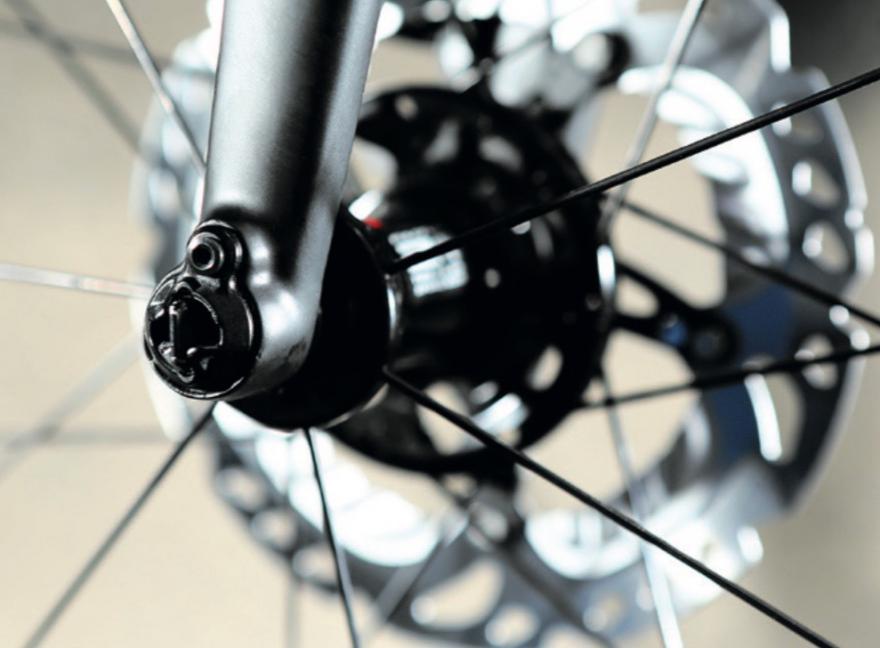

Peter Sagan has said that either all riders in the peloton need to ride on bikes with disc brakes – or none should.
The back-to-back road world champion was talking at a press conference ahead of tomorrow’s Strade Bianche, the one-day race in Tuscany that has now been elevated to UCI WorldTour status.
He said: “I don’t think I’m using them tomorrow.
“Why not? If we use them, the entire group needs to use them, not just one person.”
World cycling’s governing body, the UCI, reinstated its controversial trial of the technology at the start of the season.
After a crash at last month’s Abu Dhabi Tour in which Team Sky’s Owain Doull claimed a deep cut in his shoe was due to a disc brake rotor on the bike of Quick Step Floor sprinter Marcel Kittel’s bike.
While it’s far from clear that a disc rotor was indeed to blame for the damage to Doull’s shoe, the professional riders’ association, the CPA, has called for safety features such as guards to be introduced.
> Pro riders’ union threatens to go legal in row over disc brakes in the pro peloton
Manufacturers, however, insist that the UCI should push ahead with the trial.
>> Manufacturers hit back in pro peloton disc brake row
Asked whether fears of the perceived risks associated with disc brakes motivated his decision not to use them on tomorrow’s race across the white gravelled roads that give the event its name, Sagan had a biting response.
“Safety concern? No. No,” he replied. “By now, safety is not even a concern in cycling.”
Kittel’s team mate Tom Boonen has emerged as the highest profile champion of disc brakes in the peloton, and in January became the first man to win a professional bike race on them.
Ahead of last week’s Classics season opener in Belgium, the Omloop Het Nieuwsblad, Boonen claimed he could stop a disc brake rotor spinning at 60kph with his hand – a theory the newspaper that sponsors the race put to the test with the help of a mechanic from the Veranda’s Willems Crelan team.




















16 thoughts on “Peter Sagan says all riders must ride on disc brakes – or none should”
No. If a company refuses to
No. If a company refuses to embrace a market shift, they should be forced to deal with the consequences. Pro cycling should be embracing these changes. If uniformity is the the end goal, have everyone ride neutral service bikes.
http://www.nieuwsblad.be/cnt
http://www.nieuwsblad.be/cnt/dmf20170225_02750888 the link of the 60kph thing. i dont think its 60kph of course though its still pretty nice if true 😉
I’m inclined to respect the
I’m inclined to respect the opinion of the World Champion. He seems pretty handy on a bike. :/
The evil spinning discs of
The evil spinning discs of death!
MTBers must be pissing themselves laughing at the hysteria and BS.
It really is simply hysteria,
It really is simply hysteria, but none of them will realise it until years later, and it’ll all be a bit cringe.
Fair enough, we all get caught up in it at times. Trump at the moment is a great example. The guy’s a populist simpleton who trash talks, but the planet is freaking out like he’s waging WW3. He bucks a trend, and that’s all it takes to get people in a fit these days.
unconstituted wrote:
I agree that it’s hysteria, but not that it’s simple – the question is about who has the power – the riders dislike being dictated to by manufacturers pushing technology onto them
beezus fufoon wrote:
Merely one of many issues that appear if you examine it.
None of the issues warrant the hysteria, which to be clear is the point.
unconstituted wrote:
the alternative to hysteria is obsessionality – a step backwards
just look at the number of comments from people who just can’t stand the uncertainty!
beezus fufoon wrote:
hmm really?
Every year we egerly await for the new tech to arrive on the pro scene and they proudly uses their newest tech upgrades such as shoes, clothing crankset, frame etc etc!!!
It is dictated on them all the times.
hsiaolc wrote:
you eagerly await the “new tech” – ahh, you’re already hysterical, you’ve got nothing to worry about
beezus fufoon wrote:
hmm really?
Every year we egerly await for the new tech to arrive on the pro scene and they proudly uses their newest tech upgrades such as shoes, clothing crankset, frame etc etc!!!
It is dictated on them all the times.
beezus fufoon wrote:
hmm really?
Every year we egerly await for the new tech to arrive on the pro scene and they proudly uses their newest tech upgrades such as shoes, clothing crankset, frame etc etc!!!
It is dictated on them all the times.
I think Sagan is bang on, not
I think Sagan is bang on, not for the first time, as is Kittel. I haven’t seen them suggest that discs are dangerous, just that they’re not worth the shit and disunity that appears to be the fall-out.
Can I suggest Doull et al are tinfoil hattists without starting a helmet debate…?
Helmets – pay attention at
Helmets – pay attention at the back. I’m one of the antis on here. Do I wear one? Unfortunately yes: the TTs, CXs and triathlons I do demand I wear one, which means loads of my other rides I take the opportunity to try them out/make wearing one second nature.
There are some similarities in pushing kit without demonstrating benefits and winning that argument first: I hear that. But Doull is taking an even less scientific standpoint; unless his left foot has the ability to bend spacetime, he’s blaming kit that didn’t make contact with him for sawing through his shoe. Same with the other guy last year.
davel wrote:
personally I suspect it’s a bit of a red herring – maybe others in the peloton even put them up to it – as to the protesting riders’ aim in this I have no idea…
but in the meantime – we’re all talking about them, and shoving our cucumbers into the spinning discs
beezus fufoon wrote:
personally I suspect it’s a bit of a red herring – maybe others in the peloton even put them up to it – as to the protesting riders’ aim in this I have no idea…
but in the meantime – we’re all talking about them, and shoving our cucumbers into the spinning discs— davel
looking at his expression as he made the claims he did look sick at having to say it. Either that or he really is a righr whinger.