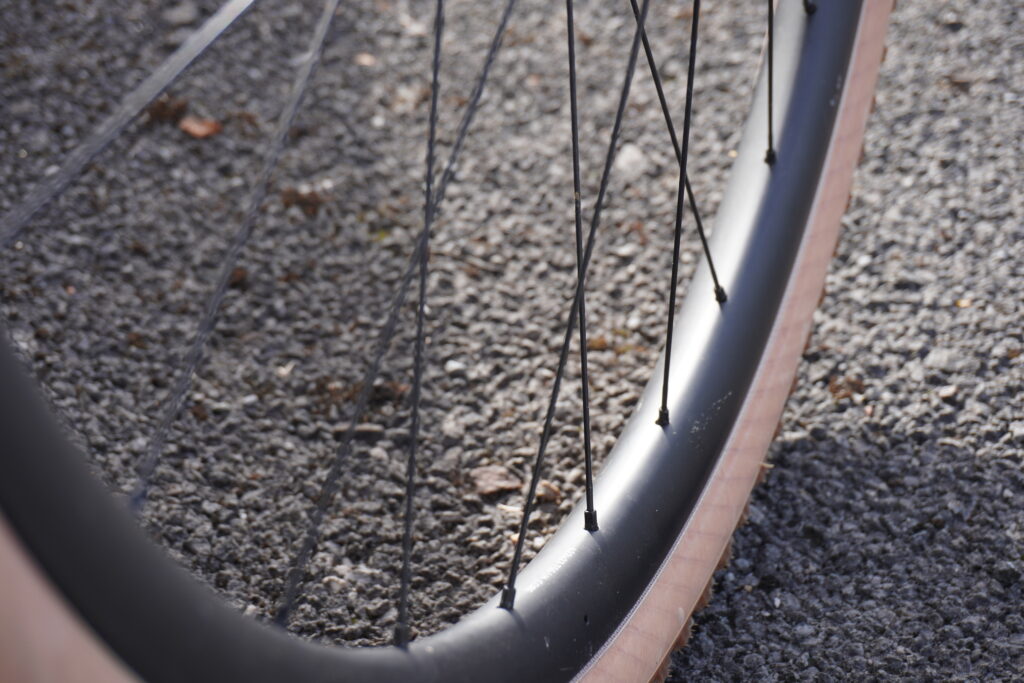

A staple in every press release for a new wheelset is the word ‘compliance’, and how brands aim to build their wheels compliant and comfortable. Allowing something that’s under constant tension to bend means that when it does bend, it should explode, right? I caught up with Hunt’s wheel engineers, Oli Mant and Paddy Brown, to find out how on earth wheel compliance works.
The beauty of bicycle wheels is that despite using the exact trio of componentry – a rim, hub, and a bunch of spokes (ignoring nipples, bearings, etc), they’re not all built the same. Brands choose different rim depths, spoke counts, and rim cavity structures all to save grams, introduce aero gains, and/or strengthen a wheel. But the key feature of any wheel is that it’s a component that’s under an impressive amount of tension. Spokes not only provide support, but they also work to keep the wheel round and true by being tightened to a specific amount.
And bike wheels are weird things. As they’re always under such tension, you would expect it to fall apart if a specific area were to lose that tension all of a sudden, as it complies over a bump, for example. But they don’t… Unless you whack something properly hard.
Why don’t wheels break easily under impact?
The answer to why they don’t catastrophically fail under impact is that wheels are basically over-complicated springs, or pre-stress structures. In fact, it’s a technology pinched from when folk were building biplanes.
“A wheel doesn’t work in the way that we expect a wheel to work”, says Patrick Brown
Spokes are preloaded and constantly under tension. Under compression, the spokes lose tension and give a resistive force to the rim. In layman’s terms, that means that when some spokes lose tension, that force is spread to other spokes throughout the wheel until those spokes regain tension. Of course, if you were to hit something hard enough, a wheel will fail.
How can a hub promote compliance/stiffness?
A wheel’s hub is its very heart. It’s the first anchor to each of the spokes, it’s home to either cup and cone, or cartridge bearings, and it’s what allows the wheel to spin on the bike’s axles. They can get mighty complicated, especially when it comes to the rear wheel and freehubs, but as with every other bit of a wheel, a hub plays a role in flex and stiffness.
When designing a hub, although there’s no modelling for hub flex, a brand needs to take into account that when it’s laced to a rim, the tension of the spokes widen the space for bearings by fractions of a millimetre. Thus, when being CNCed, they need to be cut to tighter tolerances required, in order to meet the correct tolerance while under tension. While this does little in terms of wheel compliance, it’s a fun fact that illustrates the forces a wheel is under, even when it’s not being ridden.
Where the hub plays a role in compliance, flex, and stiffness is in its flanges – the parts of the hub that the spokes thread through. The wider the flange, the shorter the spoke that’s required. The shorter the spoke, the stiffer a wheel can be built. A narrower flange will need longer spokes, which then introduce more flex. Hubs can then be asymmetric, with one side using fewer spokes and a wider flange than the other.
Hub flanges also allow designers to experiment with the bracing angles of the spokes. On road wheels, that can be around five degrees, but with larger flanges, Hunt and other brands can achieve around seven degrees.
“The more lateral the spoke angle is, the better they’re able to take side load”
A rim can help with compliance, but there are restrictions
The wheel’s rim is an area where compliance can be built in, but to varying degrees, as there are several design aims that a designer needs to account for. Those are things like rim width and depth, but also the spoke bore (where the spoke threads into and the rim’s hooks) needs to be a certain diameter. That’s without accounting for the material chosen to build the rim from, as designers can do more with carbon fibre, owing to its strength, than they can with aluminium.
“There are things you can change, but with carbon, there’s a lot more flexibility in its layup, where you start to look at radial plies that’ll give you more vertical compliance, as carbon fibre is very strong along its axis, but it’s much weaker when pushing the side of the fibre. Points like that can help you build more compliance in the rim.”
Although designers can play with rim wall thicknesses and adding supports inside of the rim, there are other factors that they need to consider, so stiffness and compliance isn’t the main goal when it comes to rim design. Instead, designers need to focus on the shape of the rim bed, how wide the hooks are for puncture protection and aero gains. However, brands like Zipp have managed to introduce an ankling moment into their rims, so each side of the rim can conform and flex with imperfections in a trail.
It’s all in the spokes
“There are things you can do with a rim, but they’re all stiff hollow tubes with high bending moments of inertia. You’re not making large percentage changes, whereas you can with spokes, with lacing patterns, with spoke choice and spec choice. There’s more there [in the spokes] than there is in the rim construction.”
Hunt’s Patrick Brown says that most of the compliance and stiffness tuning is done with the spokes. That’s because there are loads of variables when it comes to spokes. There’s spoke count, or the number of spokes, spoke gauge, spoke construction, the length of the spokes and the number of times each spoke crosses over another.
To start with spoke count, it is a reasonably easy area in which brands can tune compliance. Fewer spokes mean more compliance, more spokes mean a stiffer wheel. However, brands need to strike a balance as a wheel with fewer spokes will be lighter and more compliant, however, it won’t be able to support much weight. and heavier, and it’ll be able to support more weight. A higher number of spokes will increase stiffness because more ‘springs’ are acting in series. They can also support more weight. That’s why we tend to see lower spoke counts on cross-country wheels, and higher counts on enduro and downhill wheels.
Then there’s spoke gauge, which follows a similar formula. Thinner spokes introduce more flex and shed weight, but they aren’t capable of supporting increased weight. Fatter gauge spokes will increase stiffness as they require more energy to put load into that spoke but their heavier themselves.
The number of spokes will increase stiffness because there are more springs acting in series. The spoke gauge will increase stiffness as they require more energy to put load into that spoke.
However when we talk about spoke count and gauge, brands consider what that wheel is built for. If it’s for cross-country and marathon riding, you’ll find fewer spokes to shed weight, whereas for enduro and e-bike wheels, you’ll find fatter gauge spokes in a larger number to add reinforcement to a wheel. As with everything in cycling, there are compromises in order to achieve certain properties.
“The most durable product would be a high spoke, very thin gauge wheel, but that’s not going to offer the best performance, so you need to tailor all of these things. There’s no one-size-fits-all”
Crossing the spokes, or interlacing them (often referred to as two-cross, three-cross and so on), means that there’s more interaction between the spokes, so more spokes can resist the motion you’re putting through the rim. However, if you cross the spokes too much, they can become less radially stiff because the angles can get very extreme. So there’s a balance to be struck in this respect.
Some riders and mechanics then go as far as to solder spokes together to increase stiffness further.
Brand then turn to butting in spoke construction. Choosing butted spokes over plan gauge spokes allows designers to build a stiffer and lighter wheel, but that can come with a sacrifice to overall tensile strength.
Carbon or steel spokes?
On the majority of off-road wheels, and even road-going hoops, you’ll find steel spokes. They’re generally more affordable, which is why they’re so popular. However, there are carbon fibre alternatives that allow for interesting design elements.
Patrick says that, “ A carbon spoke is around 30% stiffer than an alloy spoke and around 25% stronger, so they can withstand more tension.” So designers can build a wheel with fewer carbon spokes, while achieving good strength. In turn, choosing carbon spokes can shave plenty of grams off of a wheel’s overall weight, without compromising overall strength.
Additionally, the reduced number of carbon spokes required means that a wheel can have larger unsupported arcs between the spokes. That results in a wheel that can withstand higher impact failure energy as the rim can bend between those unsupported sections. But of course, if you were to hit something particularly hard, the wheel wouldn’t be able to absorb as much energy owing to the lower number of carbon spokes.
“More spokes mean that a wheel can cope with more load as there’s less stress on each spoke hole, and each spoke can spread the load more evenly.”
There’s more to compliance and stiffness than the wheel itself
Although brands like to throw the word ‘compliance’ into nearly all press materials, website blurbs, and wherever they can, the wheelset is just one factor that contributes to how a bike feels to ride. On a mountain bike or gravel bike, we’re riding on high-volume tyres with casing constructions of many different types. Without diving too much into it, because it’s a separate subject for another feature, tyres also play a large role in how a wheel can feel to ride. The air pressure inside that tyre lends a considerable hand in compliance, too.
Suspension components, handlebars and even cranksets can also affect how smoothly or harshly a bike rides. So while a wheel is one part of the equation, a ‘compliant’ wheel can still feel harsh if you’re riding with a bike that is poorly set up.