


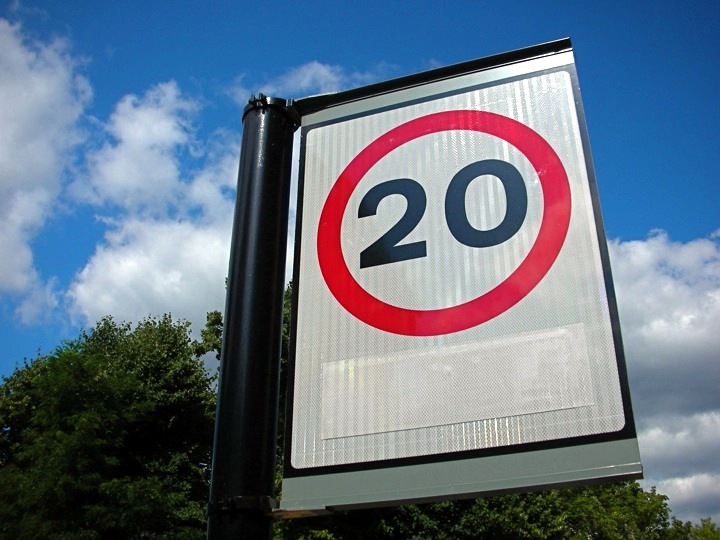

Fifteen schools in Wales are to have temporary 20mph zones outside the gates as part of a new £4.5 million Welsh Government programme to improve safety.
The schools in Powys will have a three-year speed limit imposed, mainly where they fall on trunk roads and have been identified as not having safe walking and cycling routes from homes to school.
The move comes as a result of a Welsh Government review of safety on walking and cycling routes to schools, with 56 schools being identified as needing improvements.
Earlier in the year the programme of flashing 20mph signs at key moments in the day was introduced at two schools in Powys, Newbridge on Wye CIW School and Llanelwedd CIW School, and they are now in the process of being made permanent.
Following the announcement, the speed limit will now be introduced at Banw CP School, Crickhowell CP School, Ysgol Bro Ddyfi, Ysgol Gynradd Carno, Llanfair Caereinion CP School, Machynlleth CP School, Buttington / Trewern CP School, Ysgol Glantwymyn, Irfon Valley CP School, Gungrog CIW Infant School, Llandrindod Wells CIW School Trefonnen, Archdeacon Griffiths CIW Primary, Caereinion High School, Builth Wells High School and Crossgates CP School.
Transport Minister Edwina Hart told North Wales News: “Evidence shows that 20mph speed limits can improve driver behaviour and reduce speeds around schools.
“However due to the nature of the trunk road network and some of the long distance journeys undertaken we need to balance the need of the drivers and that is where part-time 20mph speed limits can play a part.
“As well as improving safety and saving lives I hope this will enable more children and young people to walk or cycle to school.
“Where appropriate we have also identified engineering works to encourage active travel to schools. I am committed to improving safety on our trunk road network and for the communities that live nearby.”
In 2011 we reported how Road safety charity IAM said that two thirds of 4,000 people who responded to an online survey it conducted back the introduction of 20mph zones outside schools, but are less keen on physical measures such as cameras or speed bumps being implemented to enforce such a speed limit.
IAM supports the selective introduction of 20mph limits, but national cyclists’ organisation CTC disagrees, favouring it as the default speed limit in urban and residential locations.
Four in ten of those surveyed said that 20mph signs would be the best way to enforce the limit, while only one in five backed the introduction of speed cameras and a similar proportion supported a combination of cameras and road bumps to calm traffic.
Some 38 per cent of respondents said that 20mph zones should be introduced on roads with amenities such as parks and shops, but only one in four supported it being made the default speed limit in urban areas. And while 43 per cent would like to see such a speed limit on the road they live on, only slightly fewer – 39 per cent – opposed that.
And last year we reported how Leeds City Council plans to introduce 20mph zones in hundreds of streets flanking its proposed £29 million CityConnect segregated bike path linking the city with Bradford.
Leeds, which hosted the Grand Départ of the Tour de France last July and has devised the CityConnect scheme as part of its legacy from that, was to to consult with local residents in the areas concerned about implementing up to 40 new zones carrying the speed limit, reports the Yorkshire Post.
The route of what is being termed a “super cycleway,” being build with the help of £18 million from the government’s Cycle City Ambition fund, will run from East Leeds through the city centre and on then to Bradford via Wortley, Armley, Bramley, Pudsey and Thornbury.
In February last year, the council’s director of city development and director of public health delivered a report to its executive board following a meeting with the charity, 20s Plenty for Us.
The report noted that the council has “an overall aspiration for all residential streets in Leeds to have a 20 mph speed limit,” but that “securing public support is needed for the schemes to function most effectively.”












12 thoughts on “15 schools in Wales to have 20mph limits in new safety drive”
All the schools around where
All the schools around where i live and work have had 20 limits for a long long time now so why the delay elsewhere ???
Depends where you live. In
Depends where you live. In the main, these are in rural settings on A-roads, such as the A470 – the ‘main road’ through Wales. As such, the options for safe routes are maybe a bit more limited than say urban streets.
20mph speed limits are all
20mph speed limits are all well and good but nobody bothers to enforce them, so what’s the point?
“In 2011 we reported how Road safety charity IAM said that two thirds of 4,000 people who responded to an online survey it conducted back the introduction of 20mph zones outside schools, but are less keen on physical measures such as cameras or speed bumps being implemented to enforce such a speed limit.”….. No surprise there then. I would say however that I don’t agree with speed bumps on the principle that I’m not speeding, so why should I have to slow down even more to negotiate these safely on a push bike?
As the police allegedly, “cannot afford to enforce these limits”, due to tory spending cuts, the only answer is self funding camaras. As approximately 100% of motorists “allegedly” don’t adhere to these limits, there may even be a surplus of cash from such camaras.
tourdelound wrote:20mph speed
Not sure where that “allegation” comes from, but from what i’ve seen in the 20 areas around here there is significant majority of those that keep roughly to it and reduction in overall speeds in the rest. Enforcement and encouragement from cameras, road furniture etc may be useful too, but their absence doesn’t mean that everyone is belting around at 30+mph like they used to IME.
tourdelound – Speed bumps
tourdelound – Speed bumps with small gaps in between are the answer. It allows the likes of yourself as a cyclists to negotiate the bump whereas the axle’s on cars are to wide and as such they have to slow down.
Without the likes of speed bumps it would be impossible to enforce these limits as you have rightly pointed out there isn’t enough Police to do it. Even before all the cuts in numbers it still couldn’t be done.
I really feel that speed
I really feel that speed bumps are not the answer. A few years back, a narrow street, about half a mile from where I live, with a 30mph limit was made a 20mph zone due to complaints from residents that vehicles were speeding. The residents complained again, the 20mph limit wasn’t being adhered to. The local authority obliged, this time putting speed bumps in. This failed again, at great expense to the tax payer. The residents complained that their properties were being damaged by vibrations from large vehicles going over the bumps. The local authority removed the bumps and the speeding problem returned, and is to this day still a problem.
Earlier today I went for a ride. I happened to go through a 20mph limit, not the one mentioned above, and was travelling at roughly 18mph, according to my cycle computer. Not one motor vehicle remained behind me, all going past me much more than 2mph quicker and rapidly disappearing to the distance. As I mentioned in my previous post, 20mph all well and good IF the limits are enforced.
So people are by and large in
So people are by and large in favour of 20mph limits but not cameras, speed bumps and other measures to enforce them. This sounds like people want other drivers to drive at 20 but not themselves.
we’ve gone 20mph in loads of
we’ve gone 20mph in loads of roads and by and large I stick to it but I do think you find yourself looking at your speedometer more and more, then when you look up there is always some aggressive idiot sitting right up your chuffer, or they overtake…its nuts. None of these roads have schools on though
Bath has loads of 20mph
Bath has loads of 20mph roads, including outside some of the schools, but they’re pretty much ignored as far as I can tell.
Actually obeying the limit can be quite stressful, even with non-aggressive types infringing personal chuffer space.
We’ve had 20mph in my area
We’ve had 20mph in my area for almost a year now. All the points made above are valid and considered – especially the last two.
The issue of enforcement is really down to individuals. Once enough individuals decide to travel at close to 20mph then everyone else has to – or risk overtaking on a suburban road.
It can be stressful but eventually we will be left with calmer roads – ironically moving as quickly as cars can pull out more safely from side roads. There will always be the hard core of residents who ignore it as a curtailing of their right to do what they want regardless of everyone else but the Police are starting to fine them in my area and the message is slowly getting through.
When I first moved to London you could smoke on the Circle and District line. Hopefully speeding in residential roads will one day seem as ridiculous.
(A quick note on 20mph zones and areas. 20mph zones – with expensive and ineffective bumps are being phased out in favour of areas which have a blanket 20mph limit and is enforced by the drivers themselves. Check the ’20 is plenty’ website for more info. )
I find it amazing that people
I find it amazing that people say speed bumps don’t work ?
Obviously these people must have a disregard for their vehicles as well as going over speed bumps faster than 20mph is going to knack your car.
Unless the people of the north east are more amenable to sticking to the speed limits and not driving like knobs.
I live on a road with a
I live on a road with a school and a park on. We have had a 20mph for years speed bumps for over 5 years. The majority go over at +30mph I have also seen overtaking because some are just too impatient. That said I drive a lot and have found Southampton to some some of the worst driver attitudes.