



In an unavoidable collision involving a robotic driverless car, who should die? That’s the ethical question being pondered by automobile companies as they develop the new generation of cars.
Stanford University researchers are helping the industry to devise a new ethical code for life-and-death scenarios.
According to Autonews, Dieter Zetsche, the CEO of Daimler AG, asked at a conference: “if an accident is really unavoidable, when the only choice is a collision with a small car or a large truck, driving into a ditch or into a wall, or to risk sideswiping the mother with a stroller or the 80-year-old grandparent. These open questions are industry issues, and we have to solve them in a joint effort.”
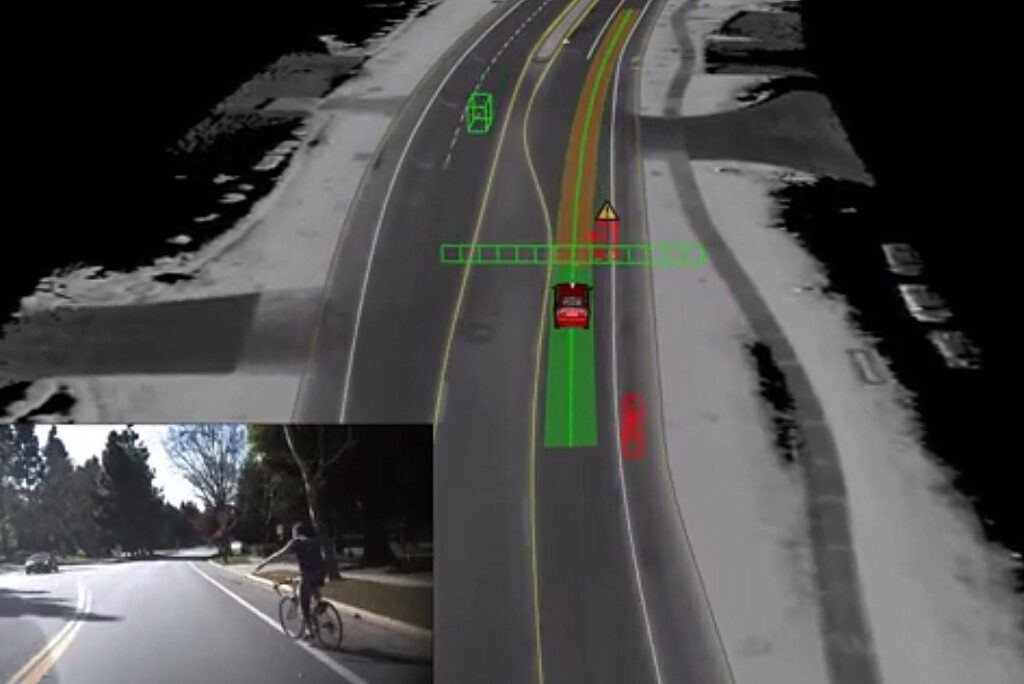
Google’s own self driving car gives cyclists extra space if it spots them in the lane, which theoretically puts the inhabitants of the car at greater risk of collision, but does it anyway. This is an ethical choice.
“Whenever you get on the road, you’re making a trade-off between mobility and safety,” Noah Goodall, a researcher at the University of Virginia.
“Driving always involves risk for various parties. And anytime you distribute risk among those parties, there’s an ethical decision there.”
Google is constantly making decisions based around information and safety risks, asking the following questions in a constant loop.
1. How much information would be gained by making this maneuver?
2. What’s the probability that something bad will happen?
3. How bad would that something be? In other words, what’s the “risk magnitude”?
In an example published in Google’s patent, says Autonews, “getting hit by the truck that’s blocking the self-driving car’s view has a risk magnitude of 5,000. Getting into a head-on crash with another car would be four times worse — the risk magnitude is 20,000. And hitting a pedestrian is deemed 25 times worse, with a risk magnitude of 100,000.
“Google was merely using these numbers for the purpose of demonstrating how its algorithm works. However, it’s easy to imagine a hierarchy in which pedestrians, cyclists, animals, cars and inanimate objects are explicitly protected differently.”
We recently reported how Google has released a new video showing how its self-driving car is being taught to cope with common road situations such as encounters with cyclists. We’d far rather share the road with a machine that’s this courteous and patient than a lot of human drivers.
We’ve all been there. You need to turn across the traffic, but you’re not quite sure where, so you’re a bit hesitant, perhaps signalling too early and then changing your mind before finally finding the right spot.
Do this in a car and other drivers just tut a little. Do it on a bike and some bozo will be on the horn instantly and shouting at you when he gets past because you’ve delayed him by three-tenths of a nanosecond.
But not if the car’s being controlled by Google’s self-driving system. As you can see in this video, the computer that steers Google’s car can recognise a cyclist and knows to hold back when it sees a hand signal, and even to wait if the rider behaves hesitantly.






69 thoughts on “The ethics of self-driving car collisions: whose life is more important?”
Its interesting that Google
Its interesting that Google is making formal decisions which are already made, but informally and not really acknowledged. I suspect that the resulting choice is made differently. I am coming to welcome these self driving cars.
felixcat wrote:Its
Indeed. And yet there are those ‘instinctive’ decisions that are invariably wrong. Slamming on the brakes when a cat/dog/fox/squirrel runs out, causing multiple collisions behind (P.S. don’t bother explaining about driving with adequate room to stop, etc, everyone does it).
Or being overtaken approaching a junction and something emerging from the right and the overtaking car swerving in (P.S. don’t bother explaining about how you still have to give way to the left when emerging left from a T junction, everyone does it. And yes, don’t overtake through a junction, but again, so many people do it).
I’m sure there are numerous other examples where the instinctive human response to a sudden, unforeseeable event is different from what a computer would decide.
racyrich wrote:
Indeed. And
Your point about everyone does it, what happens when you have a computer running to rules driving rather than a person ignoring the rules?
mrmo wrote:racyrich
Clearly, the computerised vehicle would check that the space in front of it was clear when pulling out of a side road.
Do people have no inkling of
Do people have no inkling of human nature? The moment driverless cars hit real streets people are going to play with them. Hapless passengers in the thing will be subjected to constant brake tests and wild swerving as its Asimovian predilections are tested to the limit. Despite the average road.cc users paranoia virtually all road users treat each other with at least some respect and consideration. How much respect does anyone have for a computer? So we’ll summarily pull out in front of it, box it in and often leave it in stationary electronic turmoil as it realises that ANY move it makes is to some extent risky. I can also foresee situations where it will be extremely loathe to overtake cyclists, not improving our public image one little bit.
sidesaddle wrote: I can also
Oh dear, that famous “public image” again.
If cars are less likely to be driven too close to cyclists, that’s a good thing.
ChairRDRF wrote:
Oh dear,
If you want public money to be spent on a pursuit which is mostly (and with some credibility) seen as a hobby for the moneyed middle classes, public image matters.
sidesaddle wrote:ChairRDRF
So you don’t see it as a way for kids to get around then? Or for those who choose not to/can’t afford a car?
mrmo wrote:sidesaddle
So you don’t see it as a way for kids to get around then? Or for those who choose not to/can’t afford a car?— ChairRDRF
Choosing not to own a car is in no way similar to not being able to afford one. A few years ago I was in the latter class, towing a trailer on my Ammoco and touting some of Aldi’s finest luggage (front basket highly commended, panniers less so). The very moment I could afford a car, I did. I’ll guarantee it cost vastly less than your bike. I’m afraid you’ve largely just underlined the point I made above.
sidesaddle wrote:
Choosing
And read the bit after the / can’t afford, i know this might come as a shock to some, but there are people about who don’t have the money, or who are not old enough, or don’t have driving licences. The are people for whom not having a car is not a life style choice but rather a circumstance that is imposed upon them.
Or do you believe that bikes are toys and can never be anything else?
mrmo wrote:
…
Or do you
When my bike was a small (micro?) goods vehicle it was virtually indispensible. When I was a kid, likewise. The two circumstances are connected by their use as a conduit for some other function. But anything which is used for the sake of using it, whether it’s a bike, a motorbike, a boat or an XBOX, is a toy. A bicycle has the saving grace of improving health of course, but you could do that by jogging.
sidesaddle wrote:mrmo
By your definition a car is then also a “toy”.
I mostly use my bike for short urban journeys cause I hate driving… “toy” or “not toy”?
sidesaddle wrote:ChairRDRF
No, I want it not to be seen as a hobby for the moneyed middle classes. I want it to be recognised that its a more space-efficient, healthier, and less dangerous way to get around. Ultimately I’d like all those I know who mostly use public transport to feel safe using a bike instead.
So your point is moot, rather.
sidesaddle wrote:I can also
You mean it might wait until it’s safe to overtake and give plenty of room?
Yeah, wouldn’t that just be bloody awful.
They should do it as
They should do it as configuration options for the owner when they buy the car.
or to risk sideswiping the
Erroneous assumptions that the car will be able to determine a persons age, determine there is a baby in the pushchair, be able to recognise non-moving things as people etc etc.
It’s more like: there’s a thing roughly person sized and it’s moving so try not to hit it.
Ps if you watch the video (which isn’t new), at 0:36 you can see road-workers in the bottom right video, but on the main screen – the cars interpretation, the car does not seem to recognise the workers as people, it doesn’t seem to distinguish them as being different from the traffic cones until quite late and even then the determination doesn’t stick.
Let’s face it an autonomous
Let’s face it an autonomous car is unlikely to be sold on performance, so that just leaves comfort, style and safety. One problem that I foresee is that whilst you can sell a car on it’s safety rating, most buyers would consider the safety of the ‘driver’ and passengers as having priority. Therefore if manufacturers are not tied down to a set of algorithms (and of course they will cheat, just like they do with MPG figures) then market forces are going to favour the cars that prioritise the passengers. Just wait until the accident stats start coming out, official or otherwise and see how quickly they affect people’s perception of which brands are the safest.
Don’t get me wrong, I can seriously contemplate a time when I own or use a driverless car, I just think that there is a mountain to climb in terms of legislation, bringing the legal codes up to date and defining the boundaries of product liability.
Quote:Therefore if
I think there will be a collaboration to agree a universal algorithm. Not to do so would leave each company open to be sued by one party or other every time there is an accident.
Also in an inevitable collision it would be important to ensure that each vehicle knows exactly what the other one is going to do. You don’t want to get a situation where both vehicles decide to take out the cyclists to avoid crashing with one another and everybody ends up being killed.
ooldbaker
There is already a universal protocol, called the Highway Code (plus various case laws). For all the bile the legal system actually solves these ethical problems pretty well (albeit it is sometimes spotty is in enforcing its own rules). Follow that and you have no lawsuit.
It’s entirely ethical for a company to design their product to avoid lawsuits, on the basis of trusting that the law is doing its job and that, therefore, it its product does not generate lawsuits it must not be misbehaving.
The implementation is up to each individual OEM, personally I’d rather have variety. If OEM #1’s implemenation doesn’t cover some edge case, I’d rather only one car on the road failed rather than all of them.
Mungecrundle wrote:Let’s face
You missed the single most important unique selling point of a driverless car; the one thing that is a game changer for the owner – and that is practicality.
* Out on your bike and suffer an unrepairable mechanical problem? Get out your iPhone and press the “Come get me” button on your Car App.
* Want to ride a non circular route? Drive to the start, get your bike out, and then send your car to the end to wait for you.
* Going to the pub? Get your car to pick you up when you’re drunk.
* Most families with two cars will likely be able to manage with only one, saving a huge amount of money.
There are so many new scenarios that are simply not possible without an autonomous car.
qwerky wrote:Mungecrundle
Exactly. Yet people still pick on tiny details and fringe cases whilst missing the point. Just look at some of the things people are banging on about here:
-What happens when a cyclist jumps out from behind a skip whilst a grandmother is on the pavement immediately near by
-The thought that these cars may (or may not) go really slow around pedestrians
-Three paragraphs on why the 2-second rule might not necessarily change
People just can’t see the wood for the trees.
And we haven’t even touched on things like you’ll be able to do things whilst you get driven around such as working/eating/communicating etc.
danthomascyclist wrote:
But…that’s how it is already!
Or did you miss out the word ‘safely’?
I still wonder though – how does this claim fit with the argument that the human driver will always be ready to over-ride the system if something unexpected happens?
* Nowhere to park you car
* Nowhere to park you car nearby? Send your car back home to park!!!!
Errrr :S
If you want public money to
If you want public money to be spent on a pursuit which is mostly (and with some credibility) seen as a hobby for the moneyed middle classes, public image matters. says sidesaddle
I would have thought, and indeed hope, that most posters and readers of road.cc don’t have this attitude.
Cycling throughout northern Europe is seen as a form of everyday transport, not a sport/leisure pursuit. If we are to deal with the problems of mass motorisation (noxious and greenhouse gas emissions, noise pollution, visual intrusion, danger to all other road users, degradation of the local environment, aggregate “external costs” – for those into conventional cost-benefit analysis, health problems for those going by motorised transport, loss of local community etc.) then we need to support cycling and walking properly. That’s everything from law enforcement and deterrent sentencing through the right kind of highway engineering and, if necessary, vehicle engineering which reduces the potential of drivers to endanger others – like cyclists.
I do know that for many cycling is a bit weird and done by a strange minority. But that doesn’t mean that we should go along with this kind of prejudice – in fact, we should oppose it.
@ NiallMcA Not. Obviously. A
@ NiallMcA Not. Obviously. A car can indeed be a toy, but not if it’s getting you to work/Tesco/holiday. It’s the use of something solely for the pleasure of using it that confers ‘toy’ status. Not that we don’t all enjoy playing occasionally…
sidesaddle wrote:
@ NiallMcA
What if you use it for both, getting to work during the week, and for the pleasure of using it on weekends? Does it then morph magically back and forth between toy and non-toy status?
What a ludicrous argument to make, indeed giving off a distinct troll smell.
Automatically driven cars are
Automatically driven cars are a game changer not because they will be owned privately but because they will potentially replace commercial vehicles.
del_boy13 wrote:Automatically
This is a good point. We can expect vociferous campaigns against them from cabbies in particular.
Bmblbzzz wrote:del_boy13
That’ll be entertaining at least. Joint protests from Uber and black cab-drivers?
Driverless vehicles will kill
Driverless vehicles will kill many times less people every year than human-driven vehicles. Everything else is irrelevant.
So many silly arguments. If
So many silly arguments. If you’re ever in a position where you have to choose between killing a cyclist, a grandmother, or the people in the car, it’s because you’ve fucked up royally somewhere. Autonomous vehicles simply won’t put themselves into these situations.
Sure, we might see a few deaths to begin with as a result of software issues and faults, naysayers will bask in their moment of glory, but these’ll be ironed out and deaths on the roads will drop to a tiny percentile of what they are now.
Imagine a fleet of motorists that always obey the rules, don’t take unneccessary risks, have unlimited patience, aren’t affected by emotions, drive super efficiently, and have 360 degree situational awareness. Sounds like bliss? That’s what autonomous motoring will be.
If you follow the rules of the road, ethics don’t really play a part. Not killing people isn’t hard.
danthomascyclist wrote:So
Not necessarily. Someone who doesn’t have priority might have just moved into the space in front of you and not given you time to stop. The rules of the road don’t say you have to drive slowly enough to allow that to happen safely at any time.
bdsl wrote:danthomascyclist
If you don’t have time to stop, you’re driving too close, passing too fast, or you’re not aware of what’s going on around you. If all vehicles were autonomous, they won’t do such silly things as pull out into another car’s path anyway. Besides, your point is completely moot, as an autonomous vehicle is going to react far quickly to such a bullshit scenario than a human driver.
Look at the statistics of the Google cars. Every single incident (all minor) have been caused by humans. Collectively they’ve driven 700,000 miles, (which is more than most people drive in a lifetime), without a single fault accident. They’re simply not having to make these “do I kill the granny or the cyclist” decisions, because they avert those situations. And this is with the fact that they are undoubtedly driving on roads with a lot of distracted people ogling at the Google vehicle.
danthomascyclist wrote:bdsl
If you don’t have time to stop, you’re driving too close, passing too fast, or you’re not aware of what’s going on around you.— danthomascyclist
Really? Even if someone in a different lane swerves into your path without warning and slams on their brakes? Or a pedestrian or cyclist moves out from the pavement just in front of you without warning? I think if we were to allow those sort of things to really be safe there would have to be large empty buffer zones between lanes anywhere that people drive at more than a few mph.
bdsl wrote:danthomascyclist
If you don’t have time to stop, you’re driving too close, passing too fast, or you’re not aware of what’s going on around you.— bdsl
Really? Even if someone in a different lane swerves into your path without warning and slams on their brakes? Or a pedestrian or cyclist moves out from the pavement just in front of you without warning? I think if we were to allow those sort of things to really be safe there would have to be large empty buffer zones between lanes anywhere that people drive at more than a few mph.— danthomascyclist
Correct. You’re giving scenarios that autonomous cars will be better equipped to deal with. An autonomous car will spot that pedestrian on the pavement a mile off and give a wide berth and appropriate speed. A human won’t. Even the Google car senses when cars in the lane next to it speed up to pull in front of it.
An autonomous vehicle won’t pull in front of another and slam on its brakes so that point is moot.
You’re talking about real fringe cases. We have something that will revolutionise the way that we travel. And you’re trying your best to find a situation involving a suicidal cyclist or pedestrian that might result in an injury. It’s a pointless stance to take, and this kind of crap thinking stifles innovation.
I stand by my point (which you’re not acknowledging, you’re picking the dregs of the discussion), these vehicles aren’t making these decisions of choosing who to kill. I mean, how often do humans even have to make that decision? Why is this now a big topic for debate? It’s a complete non-issue if you look at the whole picture. The autonomous vehicles will take the course of best evasive action, and on the rare occurrence of a collision with a total fool that runs out and throws themselves in front, people like you will come to the front with pitchforks saying “we told you so”, ignoring the 99% reduction in accidents.
I agree that these are
I agree that these are extremely rare situations. A good driver should expect to go through a lifetime of frequent driving without causing any serious injuries. And I think self driving cars will be significantly safer than human-driven cars.
At least initially, autonomous cars will need to co-exist with human driven cars on the roads, so they may need to take evasive action when a human suddenly creates a hazard.
I’m not sure what stance you think I’m taking. I think the reason this is being talked about, is that with humans we can just say these are rare events, almost anything a person decides to do in such a difficult situation would be reasonable, and leave it that. With computer controlled system the decision making process needs to be written down in advance, so there is a chance to debate whether or not it is the right process.
I agree it’s a not a big issue in the scheme of things.
I don’t feel the need to acknowledge everything you write – I’ve just replied to the bits that I had something to say about. If you inserted “almost certainly” before “because you’ve fucked up royally somewhere” then I would agree with that sentence.
bdsl wrote:I agree that these
Completely fair points, thank you and well said.
That last paragraph though, could you please outline a scenario where you need to choose between killing a cyclist, a grandmother, or the vehicle occupants where you haven’t royally fucked up? Just one scenario. If you can do this, I’ll edit my post to include the word “almost certainly”. I just can’t fathom how you can ever be in that situation.
danthomascyclist wrote:
That
Ok, that three way choice scenario is quite a challenge. I’ll try.
You’re driving on a straight two lane 40mph road at 30mph. A cyclist on the opposite lane riding towards you swerves right into your path to avoid a skip full of rubble on their lane. There is a grandmother (although I don’t know how you’d know she was a grandmother) walking along a pavement on your side of the road. You can go straight into the cyclist, right into the skip, or left into the grandmother.
bdsl wrote:danthomascyclist
Thank you for accepting my challenge 🙂 – chapeau!
I’m sorry but if you’re driving along and you see a skip with a cyclist heading towards it, it’s pretty obvious he isn’t going to cycle through the skip. You’ve fucked up if you can’t predict his change of path.
If you can’t see the cyclist because it’s a sharp bend and the skip is blocking the view, you proceed slowly and with caution. There’s no need to make a decision of who to kill.
Ok fair point. Let’s say the
Ok fair point. Let’s say the cyclist isn’t riding towards the skip, they are hiding stationary just behind it, facing sideways into the road. They are low enough that you can’t see them over the skip, and they ride out across your path a few meters ahead of you,
bdsl wrote:Ok fair point.
I think you’re clutching at straws here 😉
This scenario is no different to when you have driving lessons and you’re taught to drive slowly past parked cars – in case a child jumps out. If you don’t give a very wide berth and you’re travelling at a speed where you can’t react to something jumping out then you’ve fucked up.
If you can’t give a wide berth because the road isn’t wide enough, you go very slow.
Again, no need to be making decisions about who to kill.
Yes, but no matter how slowly
Yes, but no matter how slowly you drive past a line of parked cars, there always comes a point where there exists the potential for a child to run out before you can react.
At 40mph, that distance might be 40 metres away, at 10mph mph that point might only be 10 metres away. But even if you crawl along at 10mph every time you pass a parked car – a child might run out when you are only 5 metres away and you still don’t have time to react.
stulemanski wrote:Yes, but no
As I said… At some point it is simply the other person’s fault. That will be tragic in some cases, but no more or less tragic than times that person is killed by a human driver, and overall the improved safety will outweigh the handful of times that someone dies who would have died anywy.
bdsl wrote:Ok fair point.
There’s always the “suicidal third party” problem; when someone jumps in front of you, giving no time to avoid. There’s nothing you can really do about this with human or computer controlled cars, although computer controlled cars would in most cases fair better due to better reaction times and better vehicle control.
Lets take your example where someone jumps in front of you “a few metres ahead”.
A human driver would certainly hit the cyclist at 30mph. Human reaction time means they wouldn’t manage to press the brake pedal before the collision.
A driverless car would react in a fraction of a second and would immediately engage the brakes. The car would still probably collide with the cyclist, but at a slower speed, perhaps 20mph, which makes the crash an order of magnitude more survivable for the cyclist. Win!
bdsl wrote:I agree that these
Completely fair points, thank you and well said.
That last paragraph though, could you please outline a scenario where you need to choose between killing a cyclist, a grandmother, or the vehicle occupants where you haven’t royally fucked up? Just one scenario. If you can do this, I’ll edit my post to include the word “almost certainly”. I just can’t fathom how you can ever be in that situation.
danthomascyclist wrote: An
That’s a rather large assumption, would one of these cars crawl along the road at 15mph if there are people on the pavement? I doubt it, if these cars crawled around slowly then no-one would want one. And there is often no room for giving ‘a wide berth’ on Britain’s roads.
kie7077
If there’s no room for giving a wide berth, of course they’ll drive appropriately slow; as a human driver *should* be doing now. This is only really an issue in cities with lots of pedestrians near roads, where speed limits are low anyway. I don’t see the issue here, it’s not as though they have pavements running next to the motorway. If I’m driving down a country lane and I see a pedestrian, I slow down and drive wide if possible. I don’t carry on at 60mph, as many people would.
There will be times where these cars go slower than humans would in the same scenario. But to claim that overall journey times will be slower as a result is beyond stupid. And in those instances where they are slower? That’s brilliant, because nobody is fucking dead. There are so many areas where autonomy could completely blow human ability out of the water:
-How often do you sit at a red light when there’s no traffic around? Autonomy would mean you don’t even need traffic lights.
-How often do you slow down and stop to go over crossroads, roundabouts etc? Autonomy would give the power to map where the traffic is heading, set an appropriate speed, and cross straight over that roundabout / crossroads without need to slow down and check for traffic
-The “2 second” rule wouldn’t be needed. You could fit twice as many autonomous vehicles on the same journey.
-Speed limits could in theory increase in many areas where it’s appropriate, and it would be far easier to manage different speed limits based on what time of day it is.
There are just so many benefits. To suggest that nobody would want one because they’ll drive as slow as they *should* drive when near pedestrians is short-sighted and ignorant.
The “2 second” rule wouldn’t
I’ve looked closely at this, even autonomous cars would need to leave over a 1 second gap purely because of differences in braking distances, even the same model of the same car can have hugely different braking distances because of wear and tear and the amount of driving that day.
See how distances vary:
The Power to Stop – Car Comparison – Feature Article – Page 3
Now, because drivers already tailgate, you won’t see a particularly noticeable difference in the gaps between cars from those you see now. Note that most of the stopping distance of cars is in the braking distance – not the reaction time.
danthomascyclist wrote:
-The
I am not sure that twice as many cars is a recommendation.
I think people struggle to
I think people struggle to understand that self driving cars will drive the way we’re all supposed to, rather than driving a tiny bit better than all the rubbish drivers we see all day every day.
That and at some of these edge cases it will simply be the other person’s fault.
Presumably these cars won’t
Presumably these cars won’t break speed limits. That will be a big change in traffic behaviour, especially when there is more than a certain critical number of them.
Yes, but a few of these cars,
Yes, but a few of these cars, presumably the ones made on a Friday afternoon, will be plain nasty. They won’t much care for humans and will quietly plan the end of our species, one car crash at a time. This is definitely true, Russell Brand told me.
If there’s no room for giving
Most of the population here in the UK are in the cities, not out in the country, your argument seems to imply all city roads including most of the A and B-roads have their speed limits reduced to 15mph, because if you’re going over 15mph and someone runs from pavement to road and you’re going faster than 15mph then you won’t have enough time to stop – autonomous or otherwise.
This strange bit of road has a 40mph speed limit directly followed by ‘SLOW’ written on the road!! Since it has pavement, should the cars slow to 15mph if there is someone on the pavement? With a dog or child? Currently most traffic is going at the 40mph speed limit.
Example
Ignoreing the ethics, just
Ignoreing the ethics, just think of the fuel saving, no hard accerlerations, cars moving in convoy on streets so aerodynamic saving. Cities will become cleaner.
Better still there will be less or no need to own a car, so us cyclists won’t have to move around parked cars on every street, hopefully.
GREGJONES wrote:Ignoreing the
Cars will not move in convoys, there is nothing magical about autonomous vehicles that will allow them to do this, I wish people would stop saying this. Autonomous cars will not be able to drive closer to the car in front than people already do on average. If you don’t believe me then do a little research on braking distances and do the maths.
Autonomous vehicles could also use a lot more fuel than cars do today and cause more traffic. Today we do not have roads full of empty cars driving round, with autonomous cars that could change.
Upside of all of this is if autonomous cars really drive better around cyclists then cycling would become safer and more pleasant leading to a big uptake.
The existence of these
The existence of these ethical decisions in driving is nothing new. Human drivers have been making them since… well, since we started walking. The existence of a hierarchy of “things to hurt” is not new either, it’s just that up till now it has only existed in each individual’s mind.
Lots of people seem to be
Lots of people seem to be saying that it isn’t a case of choosing who to kill. I agree, but the point in the article seems to me to be about how to balance the risks you are exposing various others to. The choice of speed and road positioning will always be a trade off seeking to minimise risk to all other road (and pavement) users, while also seeking to make good progress on the journey. These trade-offs have to be made ethically and sometimes raise quite challenging questions that humans don’t even consciously bother to think about.
I expect Audi will still have the most aggressive software, as their target market will demand it! 😉
Although we are talking about
Although we are talking about rare events this is quite critical in the evolution of driverless cars. Here’s another scenario:
Driverless car is overtaking a cyclist on a dual carriageway. Car is in the offside lane when a truck comes through the central reservation. The car can avoid a collision with the truck by swerving through the cyclist or maintain its course and brake to reduce the severity of the collision with the truck (which will still be a massive and impact). There’s no right answer and that’s really the problem. Cars that squash people rather than put their passengers at risk will not be tolerated and nobody is going to buy a car that prioritises the safety of anyone other than its occupants.
It could only take one instance of a driverless car making the ‘wrong’ decision to set back the progress of the technology massively so however rare these examples might be the protocol needs to be nailed down.
These incredibly rare
These incredibly rare scenarios are reminiscent of the much discussed ‘trolley problem’ and its variants about manipulating runaway trolleys on train tracks, from the philosophy of ethics.
Another thought on this,
Another thought on this, should driverless cars put themselves in harm’s way to prevent injury to vulnerable parties? For instance placing itself between another vehicle and a pedestrian when a collision is deemed imminent.
Yeah these driverless cars
Yeah these driverless cars will be wonderful and safe, except when it’s raining and they can’t function correctly. Or when a fly, or moth, or Sahara dust blows onto the camera. In those cases you will be doomed, but otherwise nothing can go wrong can go wrong can go wrong can go wrong. ….. bzzzzzzt system reboot blue screen of death
Ramz wrote:Yeah these
You say this as though they’re releasing these cars into the wild tomorrow with known faults, or that the software won’t fail gracefully in the event of something untoward happening.
Ramz wrote:Yeah these
That’s what fail-safes and system planning are for, because things will go wrong and you try and mitigate the unwanted effects when they do. Personally, I think i’d probably favour a somewhat cautious autonomous vehicle over most of the idiots I see on the roads every day.
fukawitribe wrote:Ramz
My concern is not quite as extreme at Ramz’ but I wonder if the failsafes and cautious programming might b a downfall of these vehicles. This article has made me think back to a minor bump that I had in the car a few years ago. It was snowing heavily and the single-track road I was on was ice-rink slippery. two cars had previously lost control on a corner and crashed and I collided with one of them (although I was able to avoid hitting any of the people who were standing around the cars). I thought about what a self-driving car would have done differently in the same situation. I fear that the answer may be that it would have refused to make the journey in the first place or, worse, would have stopped at the point that it was unable to see/feel well enough to continue safely, leaving me stranded.
Oh yeah, another thing.
What
Oh yeah, another thing.
What happens when one of these cars is pulled over by the police for something like a lighting defect, bald tyre or lack of MOT? Is the person in the car responsible (if there is someone inside – lots of commenters predict them driving around empty)? What if the person inside is a child or perhaps heavily under the influence of drink (both suggested as legitimate ways for these vehicles to be used)?
I’m not opposed to the technology but the more I think about it the more I see pretty major barriers to it being used in the way many people predict. I can imagine cars coming with a sort of auto-pilot but progress beyond that is going to be a very long time coming.
Matt eaton wrote:Oh yeah,
How will the car know to pull over?
farrell wrote:Matt eaton
How will the car know to pull over?— Matt eaton
I kinda figured the car would identify an emergency vehicle with sirens and lights and pull over. That said I’ve got my doubts about it being smart enough to know whether it should be getting out of the way to let an ambulance past or stopping in a safe place for a chat with a police officer.
Matt eaton wrote:I kinda
Given that the car will need some sort of wireless uplink to communicate with other autonomous vehicles, it’s possible that the fire engine/ambulance/police car could communicate directly with it and say exactly what it is and what’s going on and what to do next.
vonhelmet wrote:
Given that
I’m not sure driverless cars will necessary communicate with each other in this way. I’d guess that they probably will but if they can cope with pedestrians, cyclists and drivers based only on what they ‘see’ they should be able to cope with each other too. Moreover, the first driverless cars on the roads will need to fit with the status quo. Our emergency services aren’t going roll out new technology to all their vehicles and train all of their staff in its use it it prior to driverless hitting the roads. Initially, at least, the cars will need to know how to respond to lights and sirens.