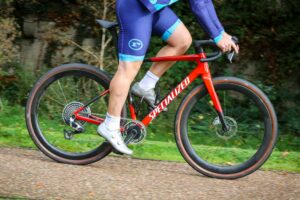


“The fastest gravel race bike ever made” is a bold claim and hard to quantify, but the Specialized Crux 5 S-Level is light, fast, hugely capable and now swallows some huge 55mm tyres.
Specialized Crux 5 S-Level: The ride
There is no denying that the Crux 5 is a race bike. It’s super stiff, weighs less than 8kg – which is impressive for a gravel bike – and the geometry is aggressive, resulting in some very quick handling.
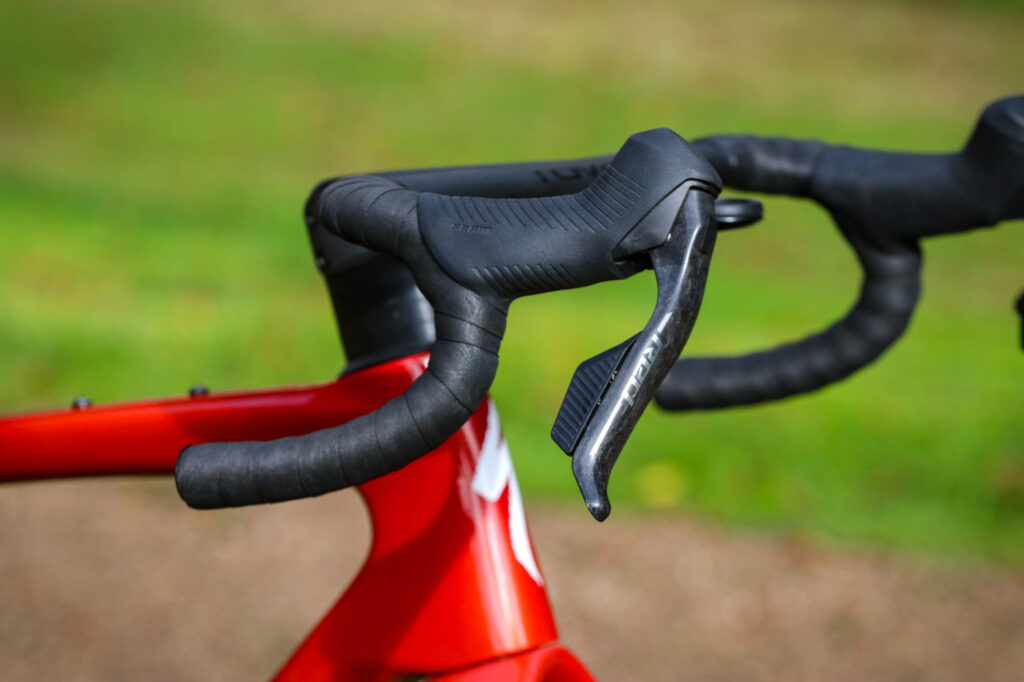
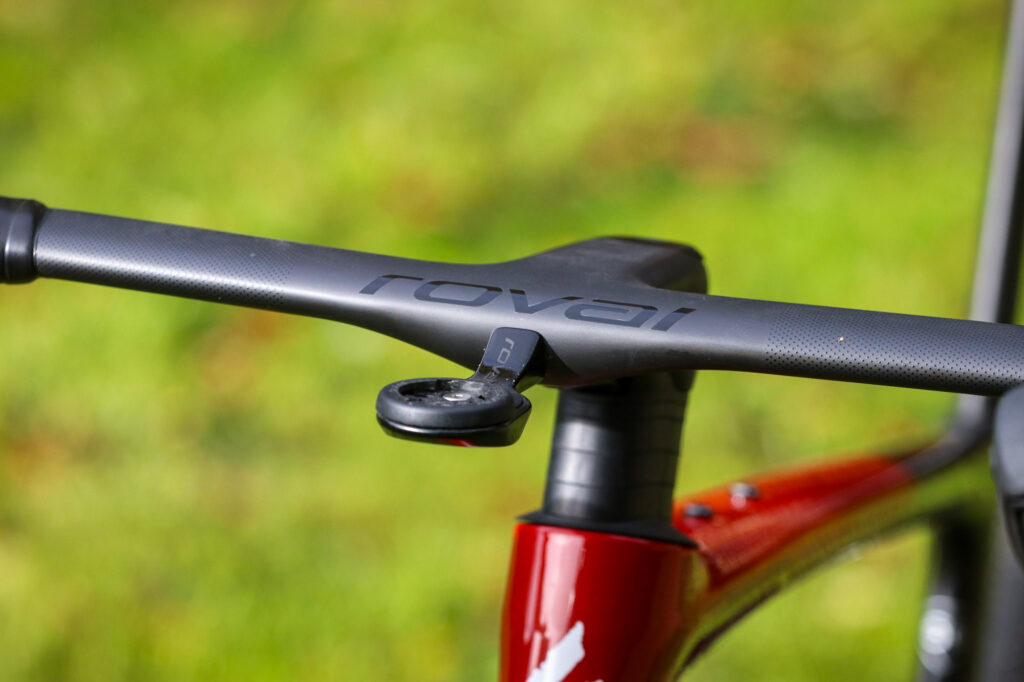
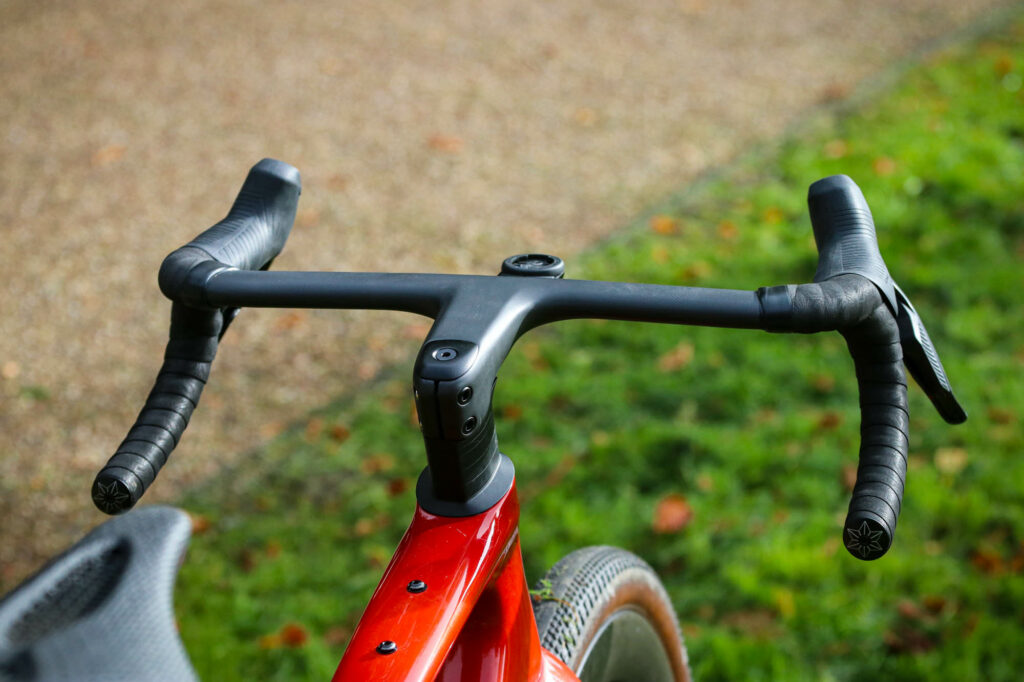
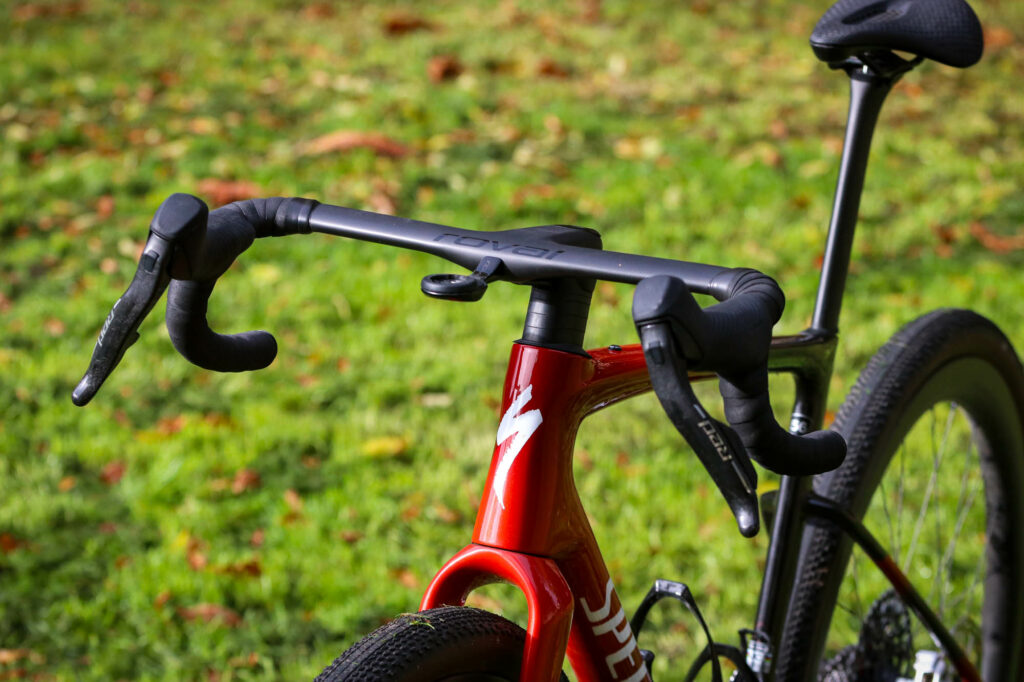
The main thing I noticed straight away though is that the overly stiff handlebar really affects the ride and control, especially on rough surfaces and at speed.
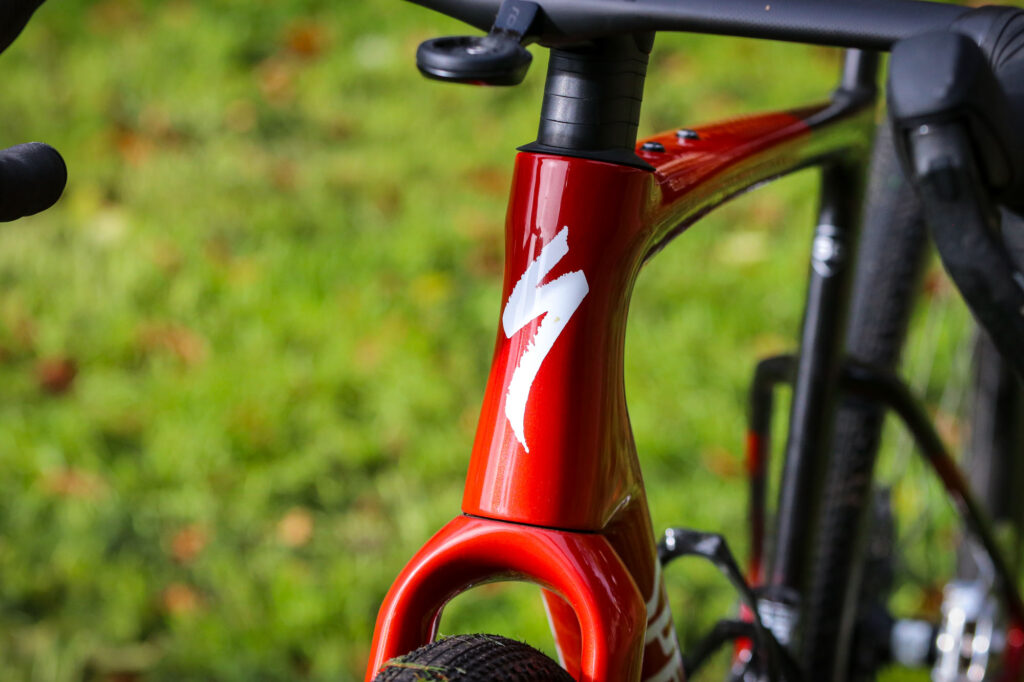
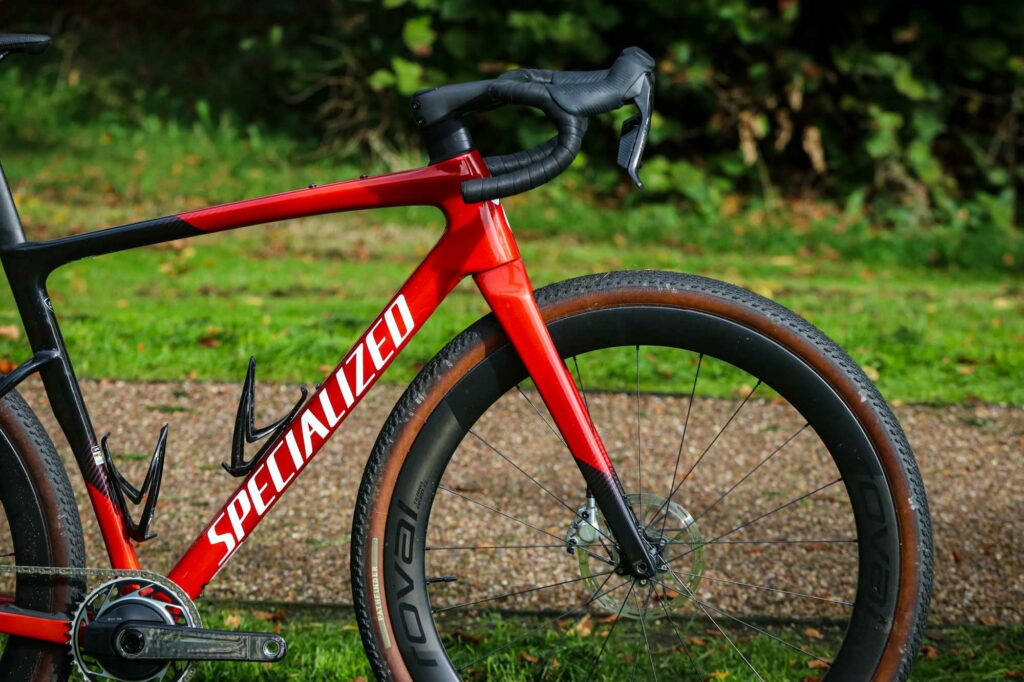
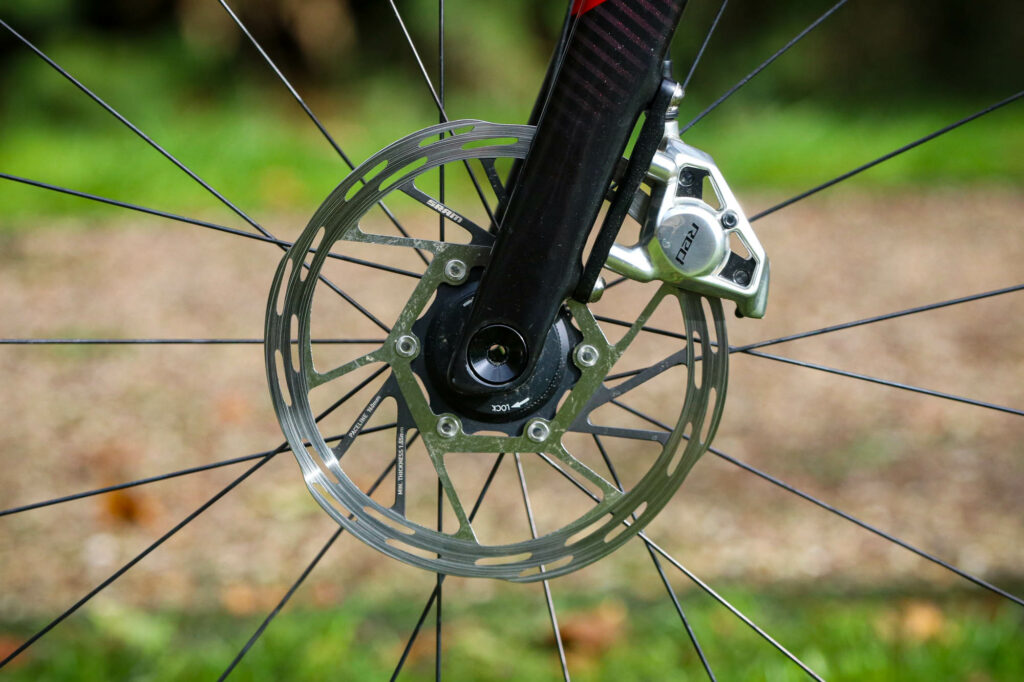
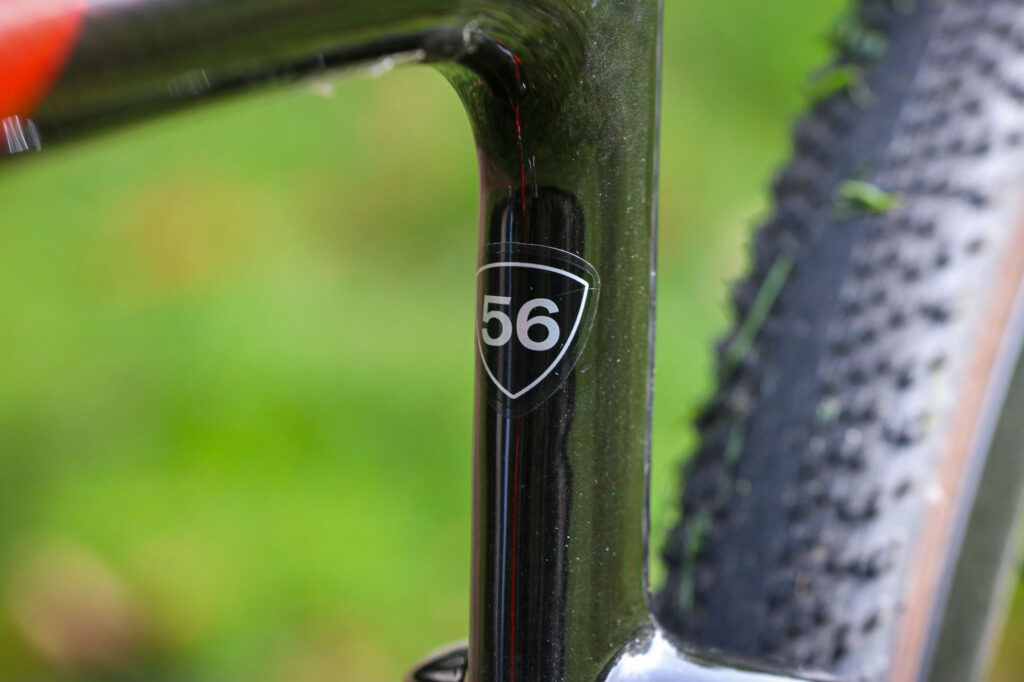
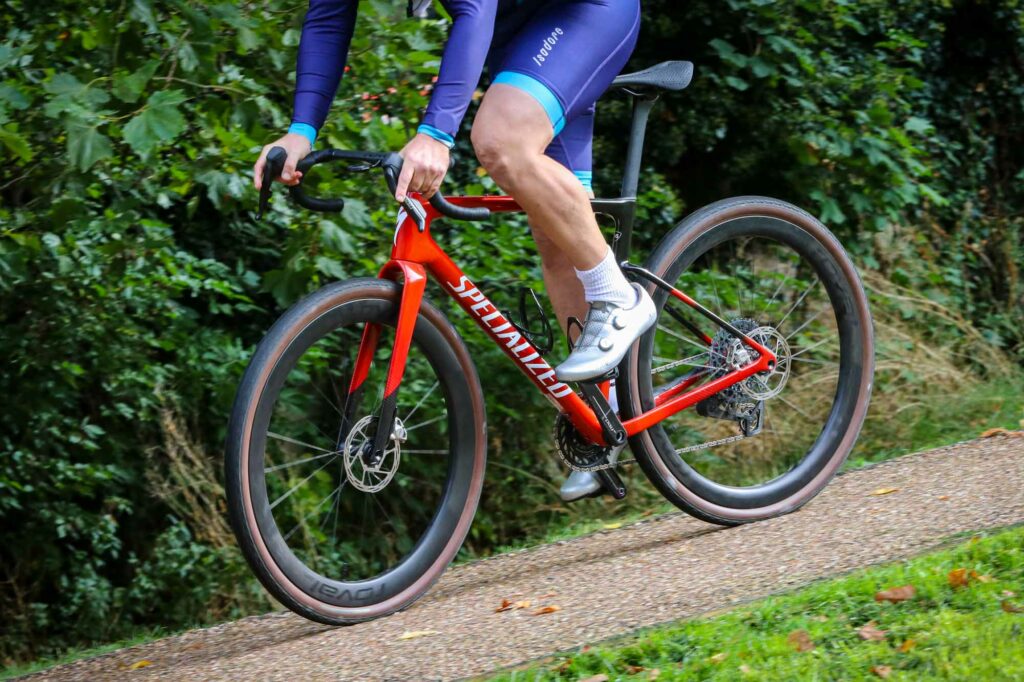
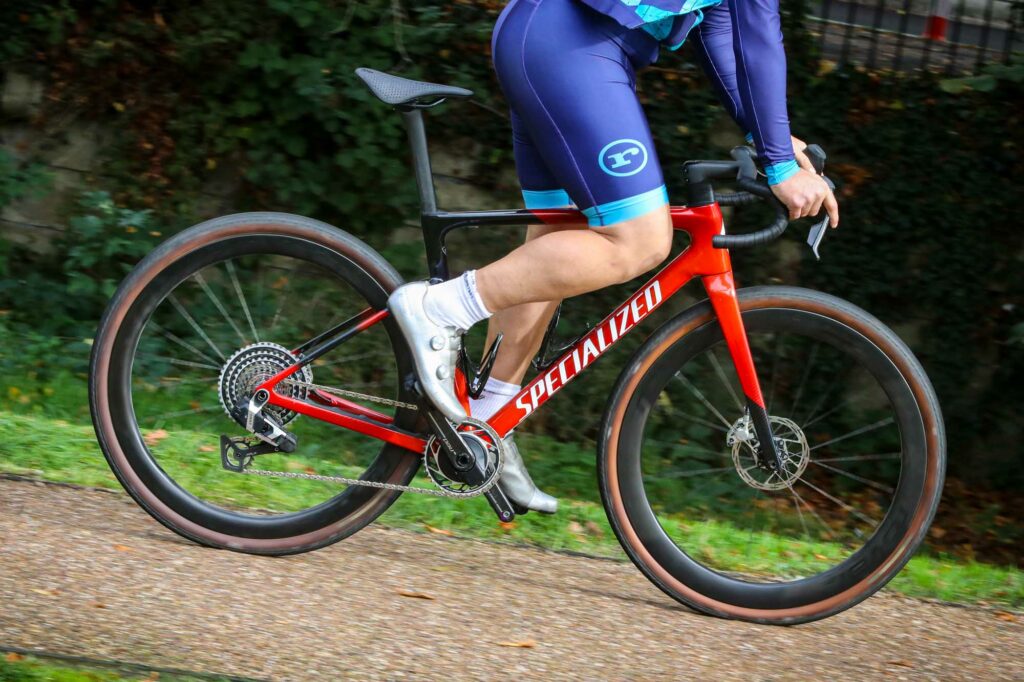
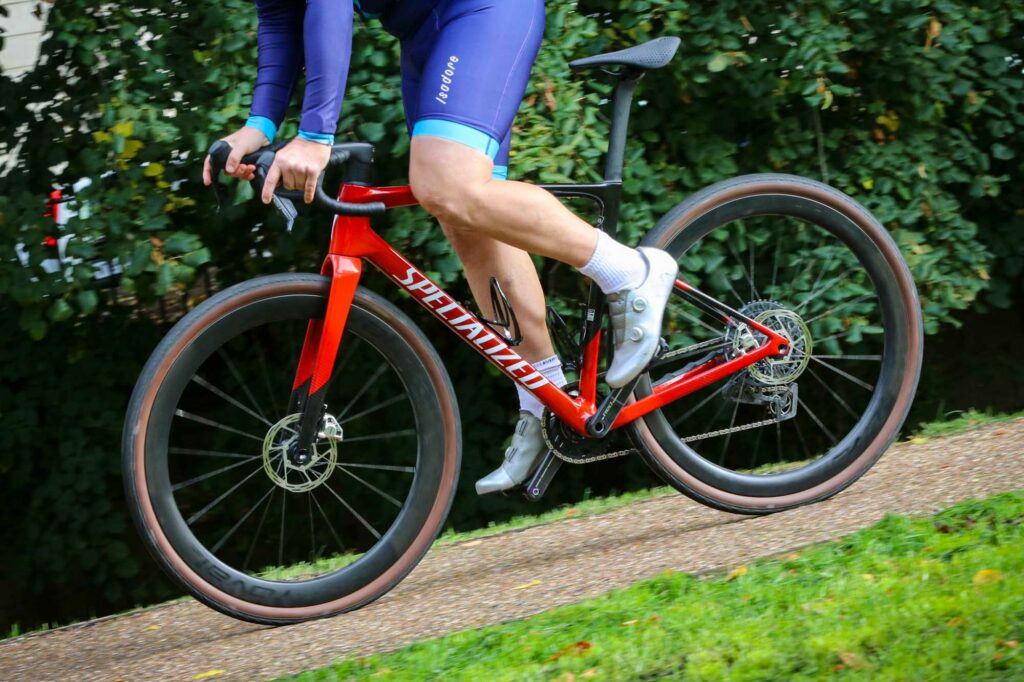
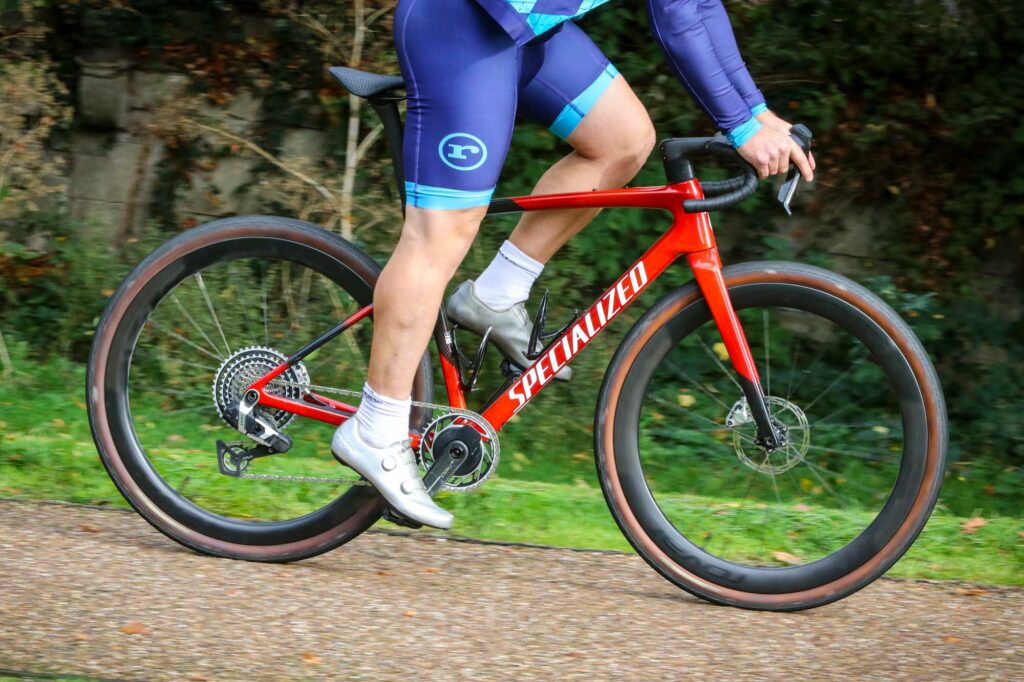
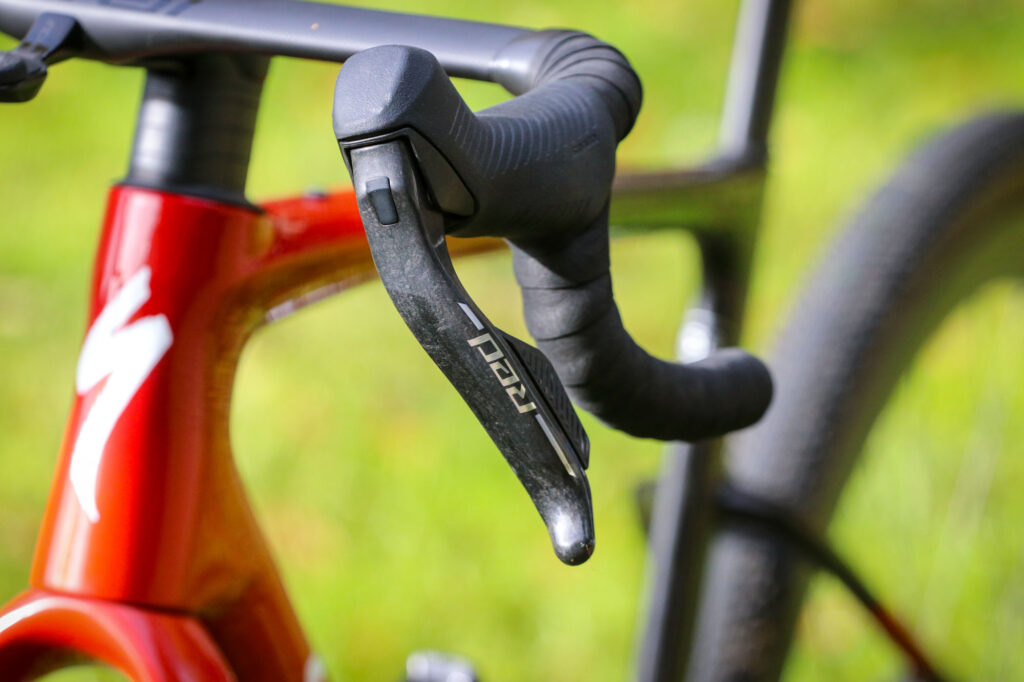
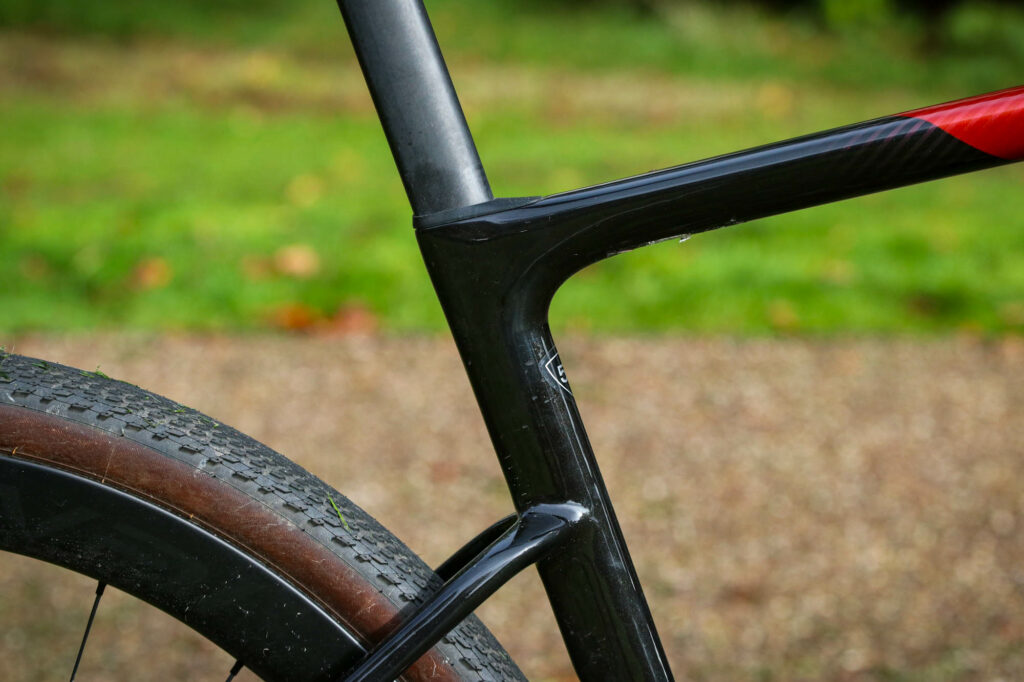
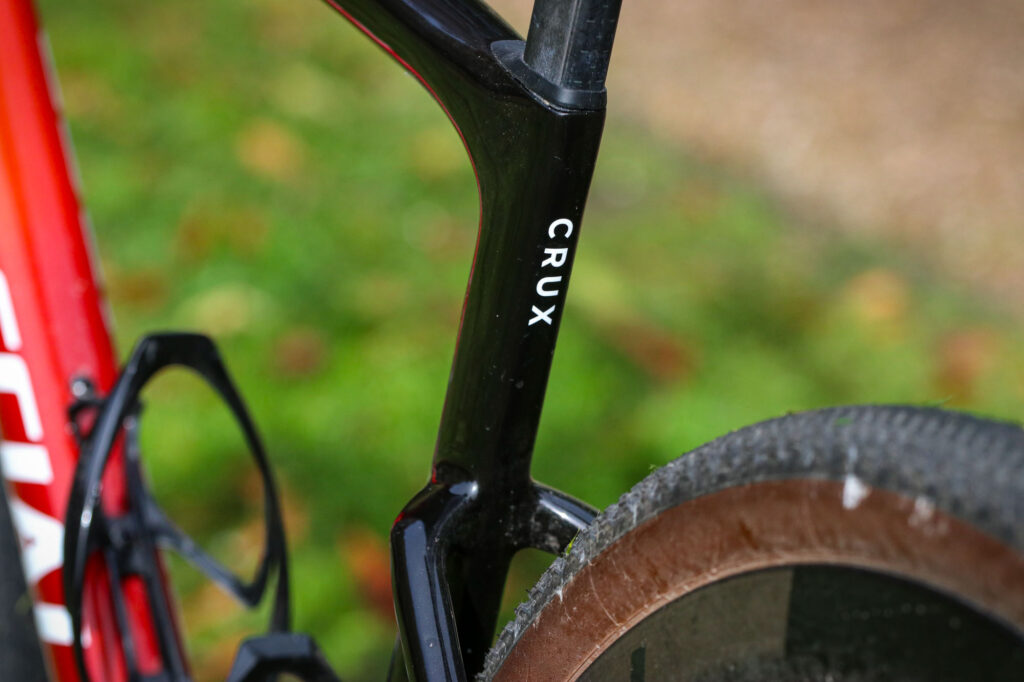
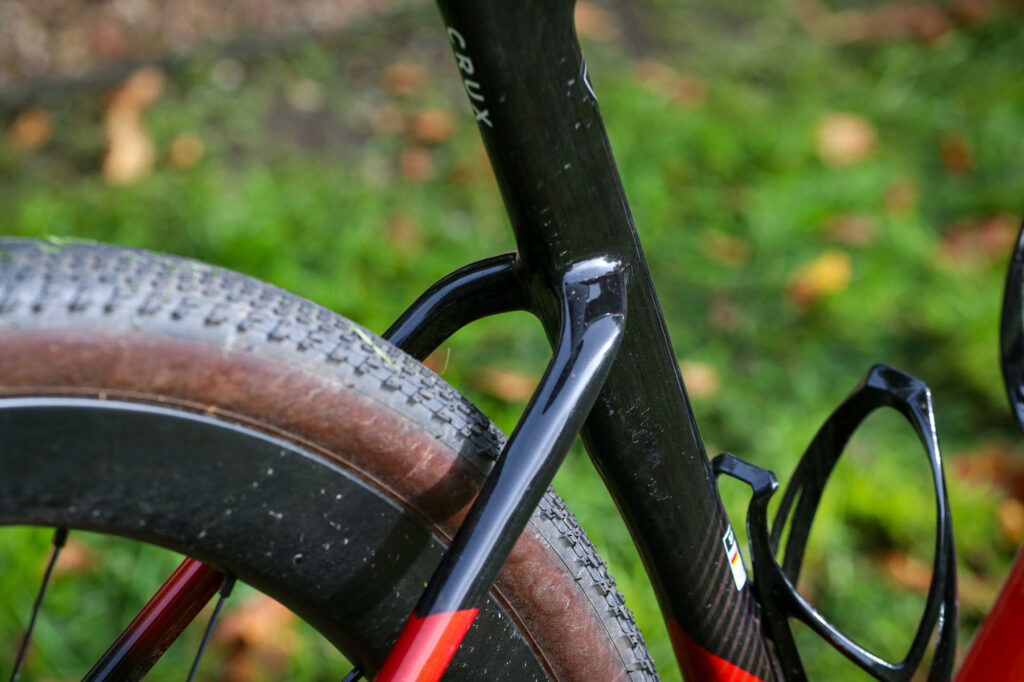
I’d say that the Crux 5 has been designed for the long, flowing fire roads used for gravel riding and racing in the USA. It makes sense, after all, as Specialized is a US brand. But, in the UK where our terrain is very different and constantly changing, you can’t rely on tyre pressures alone.
To put that into context, as I’ve mentioned before my test route for gravel bikes is a 33-mile loop skirting a military firing range. The surfaces range from asphalt to grass and take in chalk, woodland singletrack and of course gravel. Being the UK though, it’s not just one type of gravel. There is some big gravel, little gravel, loose gravel, hardpacked gravel and everything in between.
My usual plan is to set the tyre pressures up as a decent compromise for all of the conditions, and rely on a mixture of the tyre pressures, frame compliance and a small amount of handlebar flex to take out the worst out of the sting.
Let’s just say that the Crux 5 is the only gravel bike I’ve ridden where I’ve had to stick some mitts on for some padding.
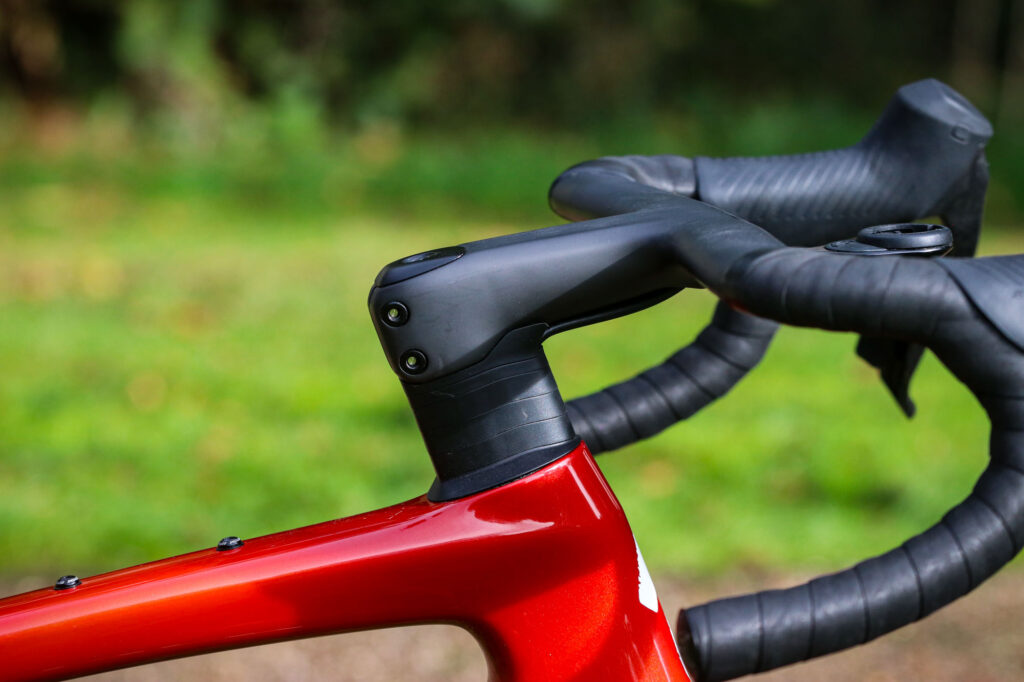
The integrated carbon cockpit is so rigid it just transmitted every vibration, bump and bang straight through the palms of my hands. A lot of the time I could keep a loose grip on the bar to mitigate things, but that’s not something I could do on technical descents, which is where my forearms and hands took the biggest beating.
Yes, you could argue that I could run even lower pressures, but I find that if you go too squishy then you lose the feedback and therefore connection with what the bike is up to. Plus, I haven’t had to do that with other bikes – some of which have cost less than a quarter of this S-Level, so why should I start now?
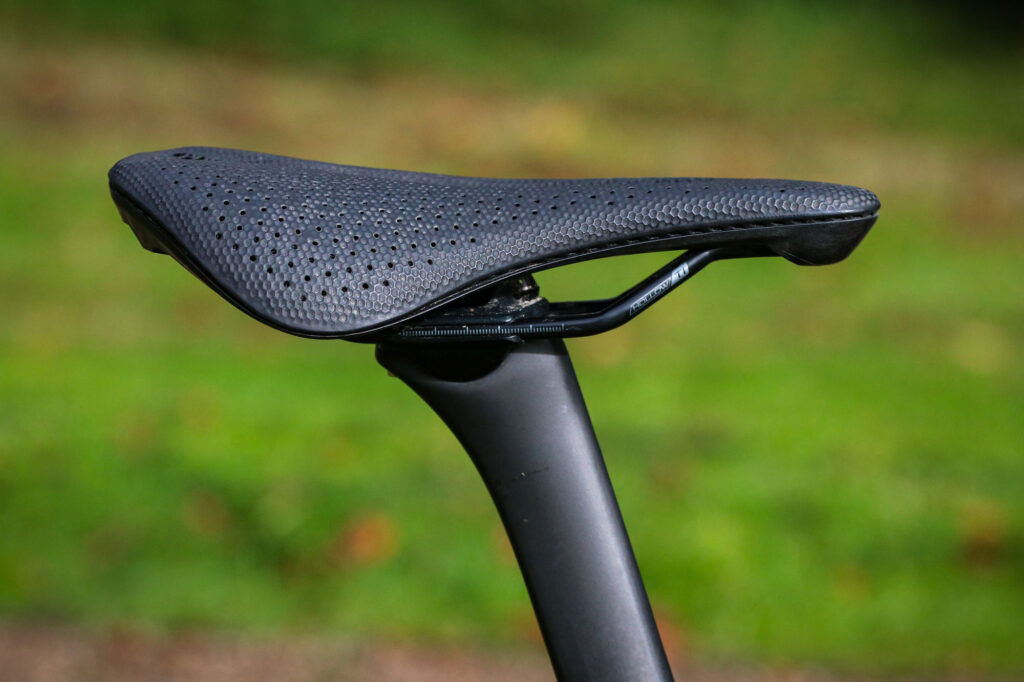
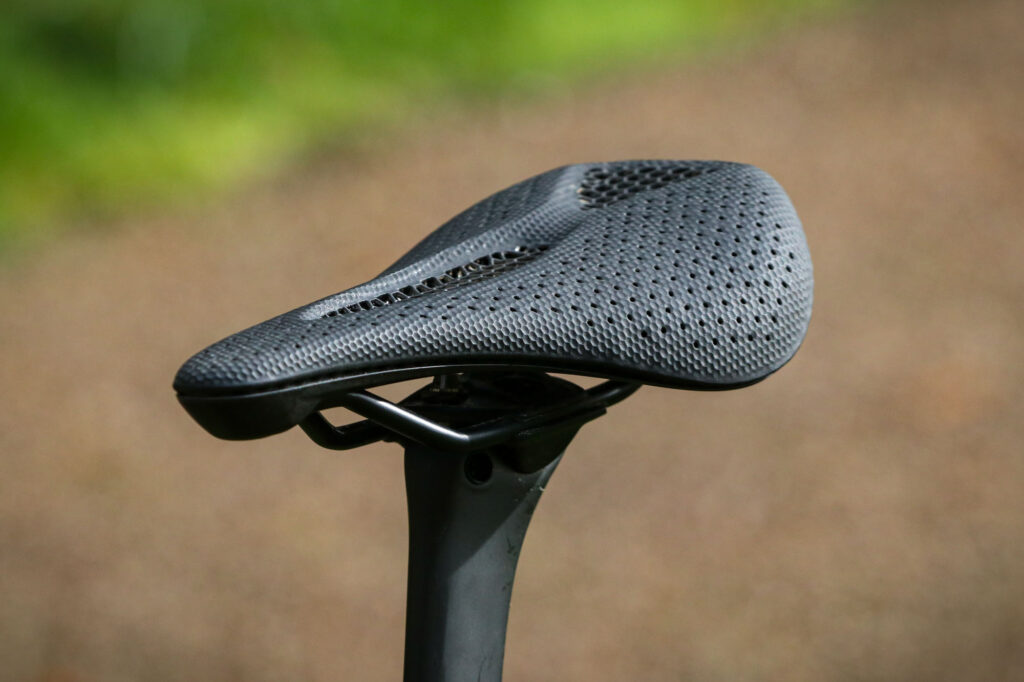
What makes the rigidity stand out even more is the fact that Specialized has managed to incorporate so much compliance and flex in the seatpost. The rear end feels soft and cossetting over the bumps while maintaining rear tyre feedback, yet the front end is smacking your joints about all over the place. It feels like two different bikes.
I get that the Crux 5 is a race bike, and if the ride or race was an hour long or so, I could put up with it for the performance gain, but many gravel events are on the long side. I really wouldn’t fancy doing something like the 200km route of the Dirty Reiver on it.
Now, if you do manage to appease Goldilocks and get the terrain/comfort balance just right, then you will notice that the Crux 5 is an absolute rocket ship.
The frame stiffness is excellent, and everything just feels so tight when you stamp on the pedals. Paired with the overall low weight, the Crux accelerates rapidly and makes light work of the climbs on my route, regardless of whether they are of the short and punchy style, or those that take a longer, less aggressive route to the top.
Its ‘long and low’ geometry design put me in a position where my weight felt balanced over the bike, bringing confidence in the corners, while the steep seat tube angle put me in the perfect position for banging the power out.
It’s a bike where I felt really relaxed cornering at speed, as while the steering is quick, it’s balanced to the point that if adjustments were needed mid-bend, it reacted well to my input without feeling twitchy and a handful.
Feedback through the frame and fork is well managed too. I felt that the Specialized gave clear information on what was going on with the tyres, which helped me control any slide on loose surfaces, before accelerating hard out of the apex.
I love that feeling of being just teetering on the edge of control with the tyres scrabbling about and the Crux was a laugh letting me do this. Obviously, a couple of times this drifted over to the out-of-control side of things, but when that did happen it didn’t snap or bite me, it kind of drifted into squeaky bum territory, so most times I could bring it back without too much drama.
On flat, smoother sections, the geometry and stiff nature of the frame allowed me to really get a lick on. This is a seriously fast bike, and while the aero claims are difficult to back up, in the real world it is definitely efficient.
So, in a nutshell, how and where you ride your gravel is going to make a massive difference to your relationship with the Crux 5 and whether or not it works out.
If you are a racer, or fast rider, and the only thing you care about is speed, then fill your boots – you’ll love it. If you want a versatile gravel machine that you can ride flat out sometimes, but with the option of kicking back and enjoying a bit more comfort at other times, then you’re probably better off with something like Specialized’s Diverge instead.
Specialized Crux 5 S-Level: Frame and fork
Specialized says that the improvements to the Crux aren’t caused by any particular individual change; instead it’s down to a collaboration of them all. Saying that though, there has been a large focus on its aerodynamics, drawing directly from what was learned from the Tarmac SL8 road bike.
The fork legs, down tube, seat tube, seatstays and head tube have all been tweaked, and of course there is some data gathered from Specialized’s own wind tunnel and ‘moving-leg mannequin’. This found that compared to the previous model, this Crux 5 requires 15.2W less to be ridden at 45km/h.
As I’ve stated above, the Crux 5 is a very fast and efficient bike, but I’ve never ridden any of the previous versions, so I can’t say how much improvement has been made.
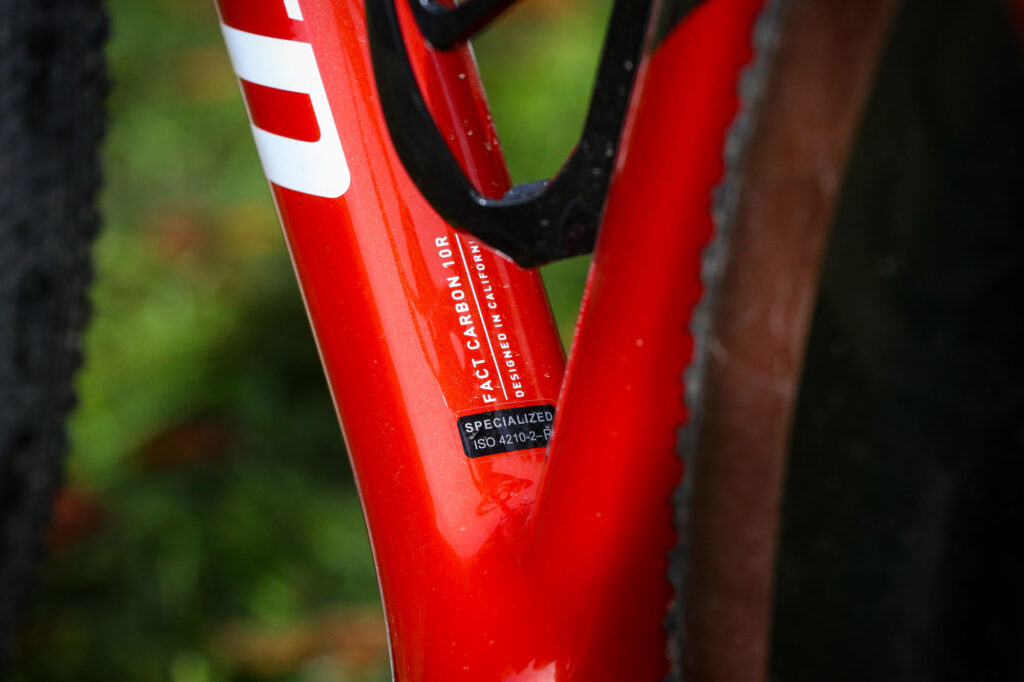
Like a lot of bike brands, Specialized offers its models in a range of frame grades. The top-level S-Works ones use the FACT 12r carbon fibre, while this S-Level version uses its 10r grade. The main difference is that the 12r uses a higher proportion of high modulus carbon fibre, so generally offers the same levels of stiffness but for less weight. In terms of compliance and comfort though, there is little between the two.
We’re not talking much in terms of weight though, mind. Spesh claims 789g for the S-Works, and 897g for this 10r.
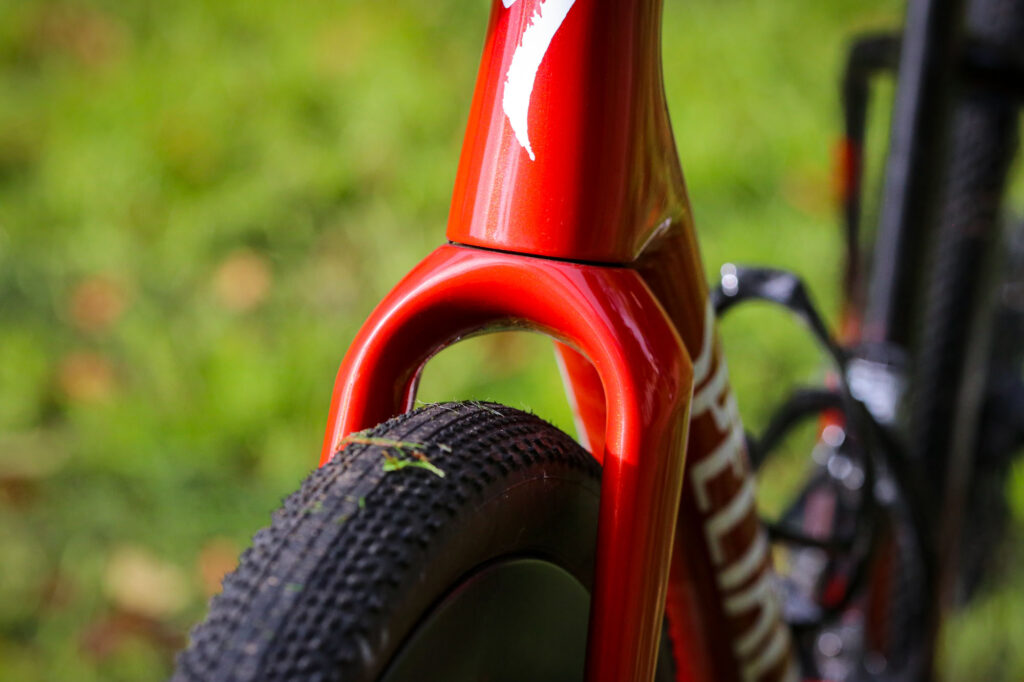
Tyre clearance is constantly evolving on gravel bikes, and it wasn’t so long ago that 45mm was considered large, but the Crux 5 is capable of running up to 55mm rubber. This puts it up there with some of the roomiest, especially away from the adventure side of things.
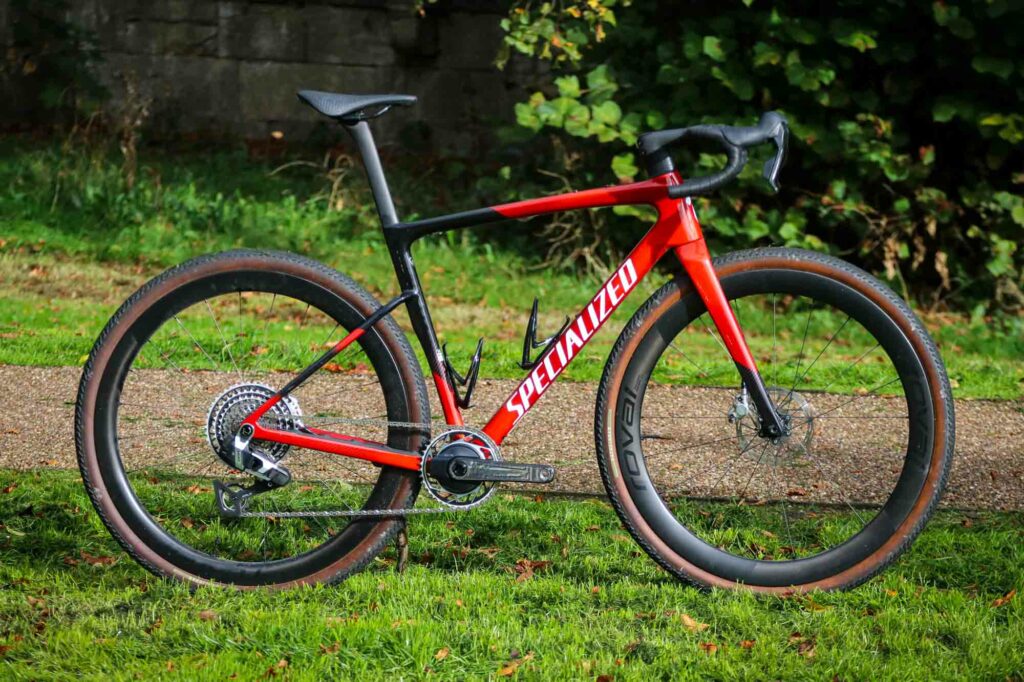
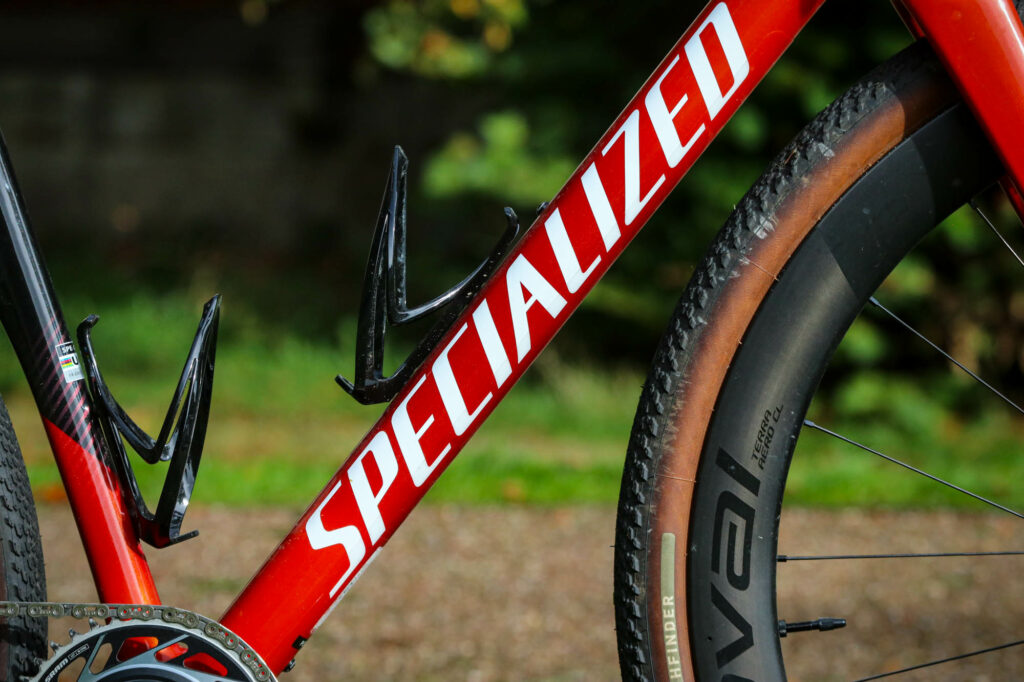
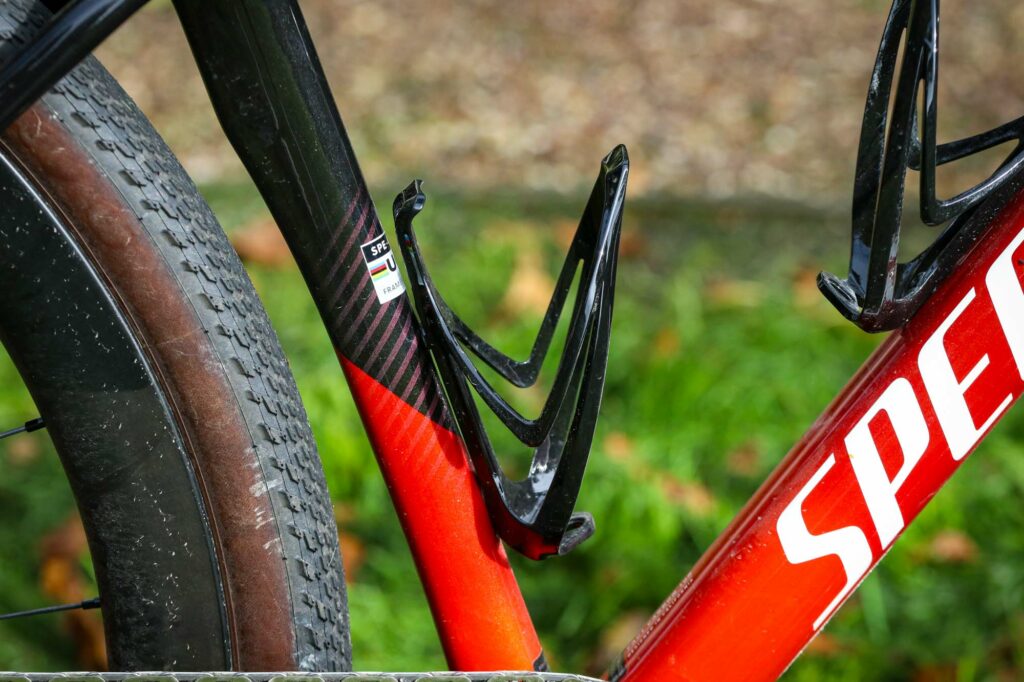
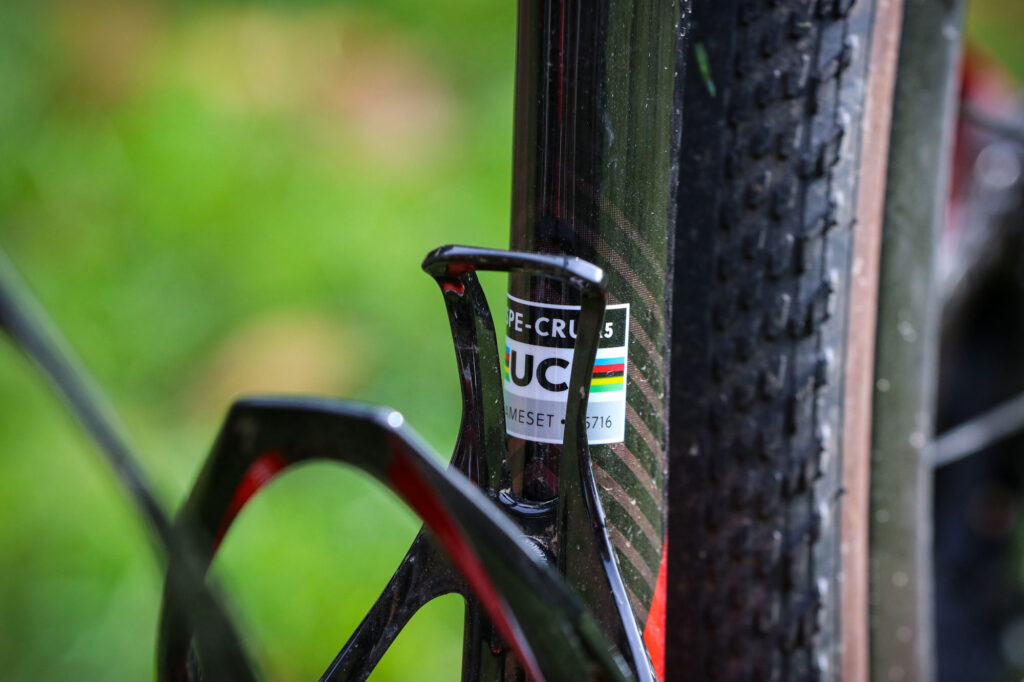
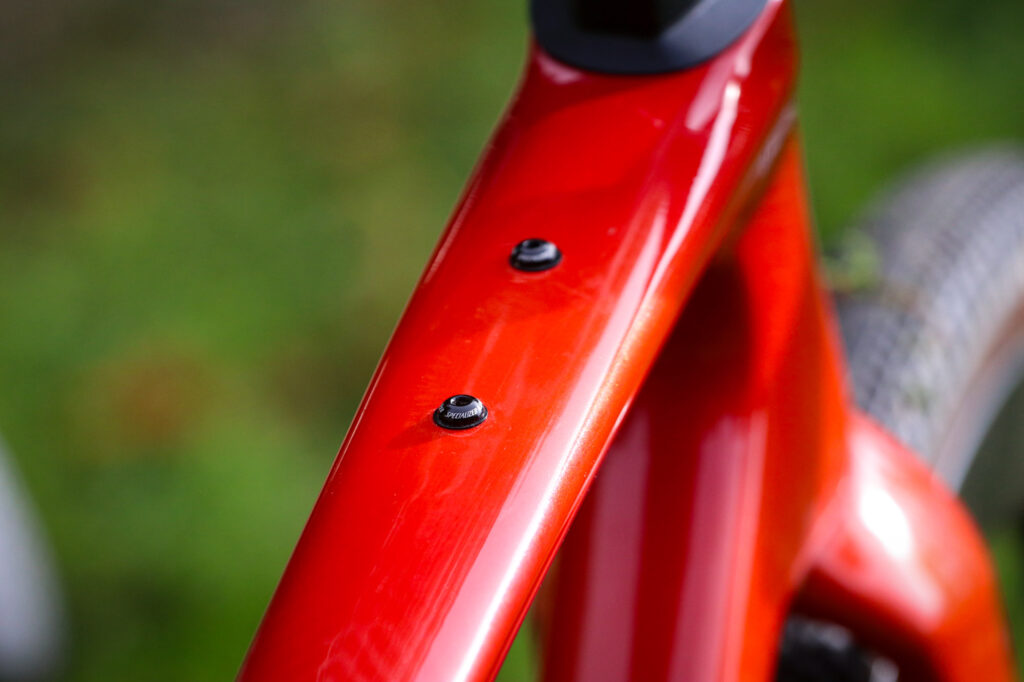
You also get plenty of mounting options with triple bottle mounting positions, and a couple of mounting points on the upper face of the top tube.
As expected, with it being a race bike, there are no mounts on the fork legs and mudguards or racks aren’t catered for either. Unlike its Diverge, there is no internal frame storage either.
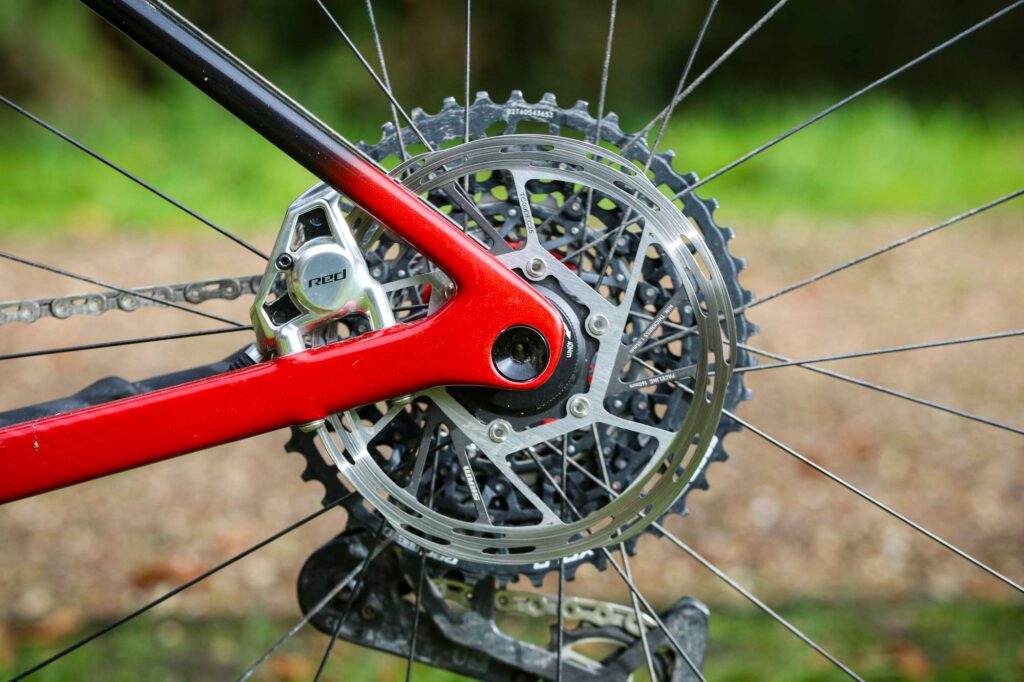
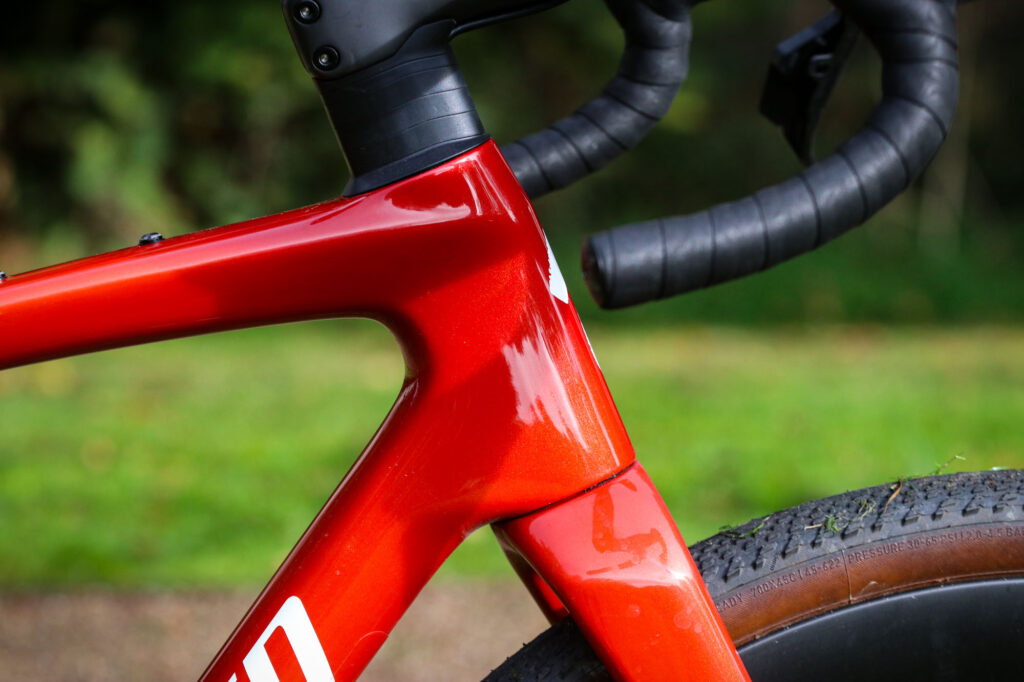
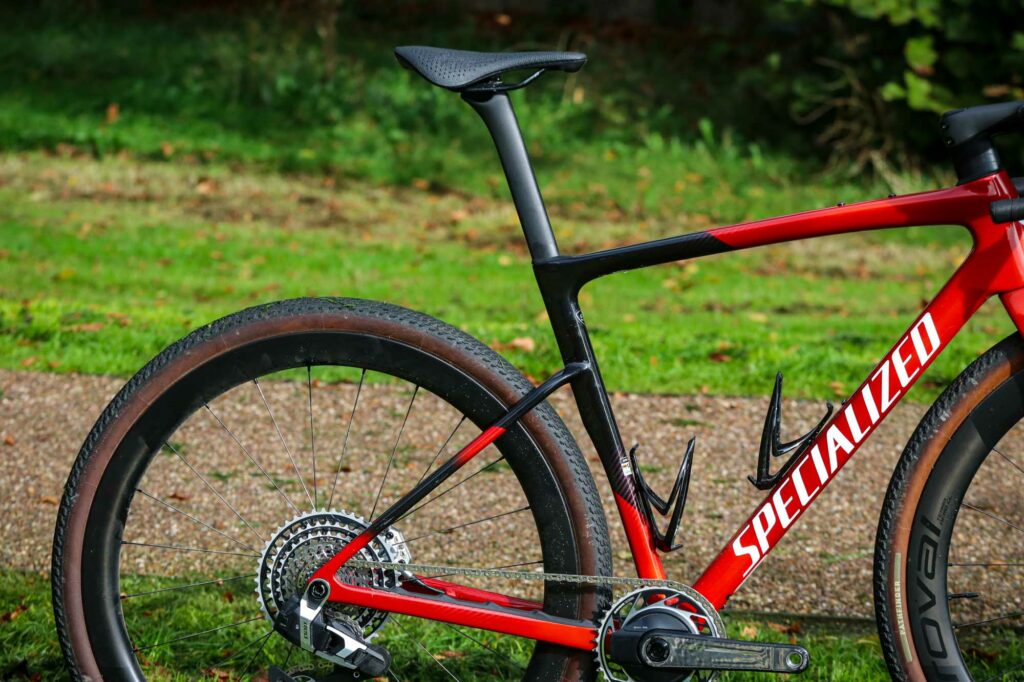
Everything looks very clean with full internal cable routing and an internal seatpost clamp. The frame also uses a threaded bottom bracket, and you’ll find a universal derailleur hanger at the rear dropouts.
From a sizing point of view, Specialized offers six Crux 5 options from 49 to 61. Those equate to horizontal top tube lengths of 512mm to 603mm.
The bike tested here is the 56, which has a top tube of 566mm and a head tube measuring 142mm which sits at 71.5 degrees. These give stack and reach figures of 578mm and 400mm respectively.
The wheelbase is 1,036mm, while the chainstays make up 425mm. It’s actually a longer bike than I was expecting after riding it, but the geometry of the front end and sub-8kg weight keep the nimbleness and flickability required for a gravel race bike.
Other measurements, should you wish to know them, are a 74 degree seat angle, a 497mm seat tube length and a bottom bracket drop of 78mm.
When it comes to the fork, the rake is a fairly typical 51mm while the length to the crown is 401mm.
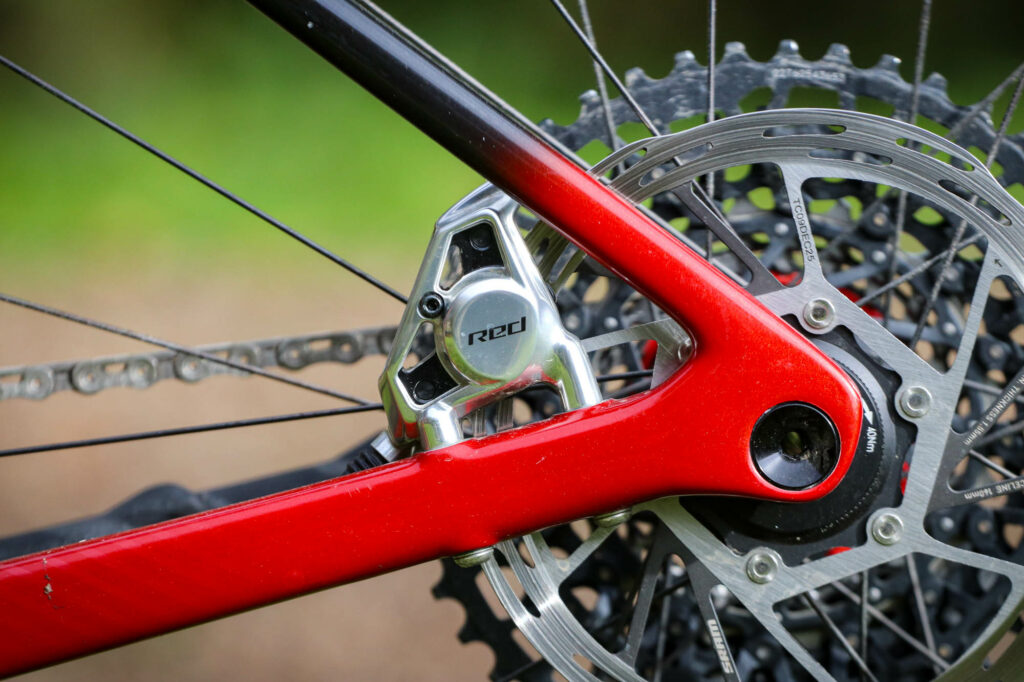
Overall, it’s a high quality looking frame, and the red to black fade paintjob looks very ‘S-Works-esque,’ which is part of the point of the S-Level.
Specialized Crux 5 S-Level: Finishing kit and pricing
As I mentioned above, the Crux lineup (and most others in the Specialized range) is split between the S-Works bikes and the standard ones. The S-Works models tend to get the blingiest kit on the market – we’re talking SRAM Red, Dura Ace, GRX Di2 etc – while the standard bikes normally top out around the second tier groupsets: Force, Ultegra and the like and then dropping a stage lower for each step on the pricing ladder.
With the Crux 5, there is one S-Works model (we’ll ignore the LTD as it was a limited run of 55 bikes which have all been sold) and it gets SRAM’s RED XPLR groupset, a Roval Terra Aero CLX wheelset, the Rova Terra Integrated cockpit and an S-Works 3D printed Mirror saddle for £11,999.
Below this you’d normally get the Crux 5 Pro model, but Specialized has ditched that and released this S-Level build instead.
For £8,749, you get that 10r frame, a drop to the Terra CL wheels from the CLX and a non-S-Works 3D printed Mirror saddle.
The things that they share though are the 12r fork, the Terra cockpit and the full SRAM RED XPLR groupset – the idea being that you can get the cheaper frame, but with the same high end finishing kit.
What will the weight penalty be for going with the S-Level over the S-Works? A mere 600g according to Specialized’s claimed weights.
Below the S-Level sits the Expert (Force XPLR, £5,999), the Comp (Rival XPLR, £3,999) and the Sport, which uses a mechanical GRX groupset and costs £3,249. An S-Works frameset is also available for £5,249.
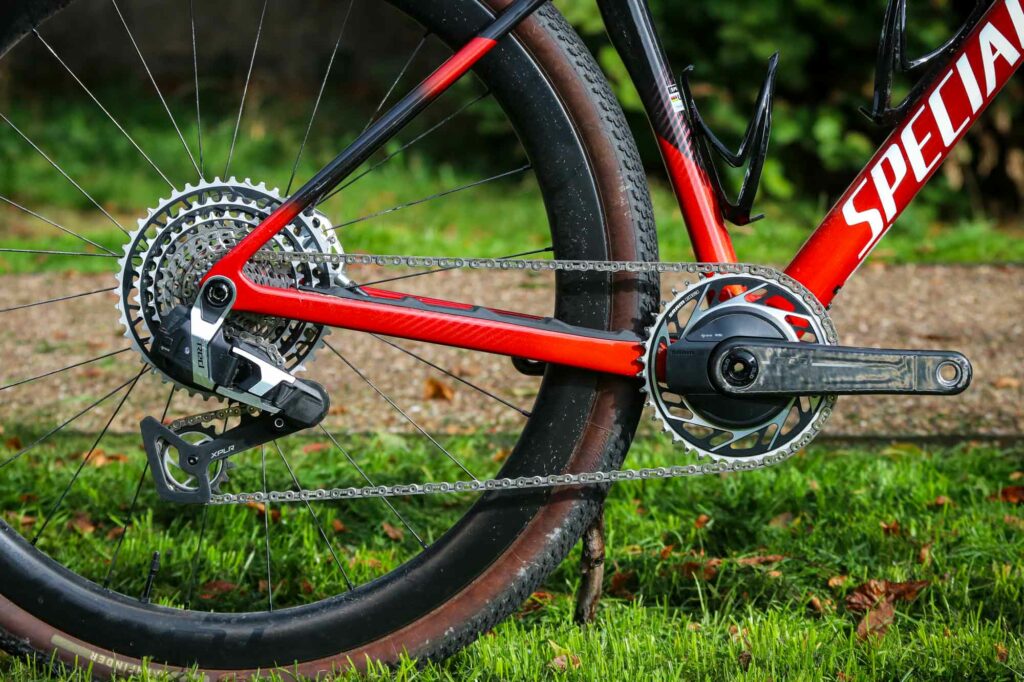
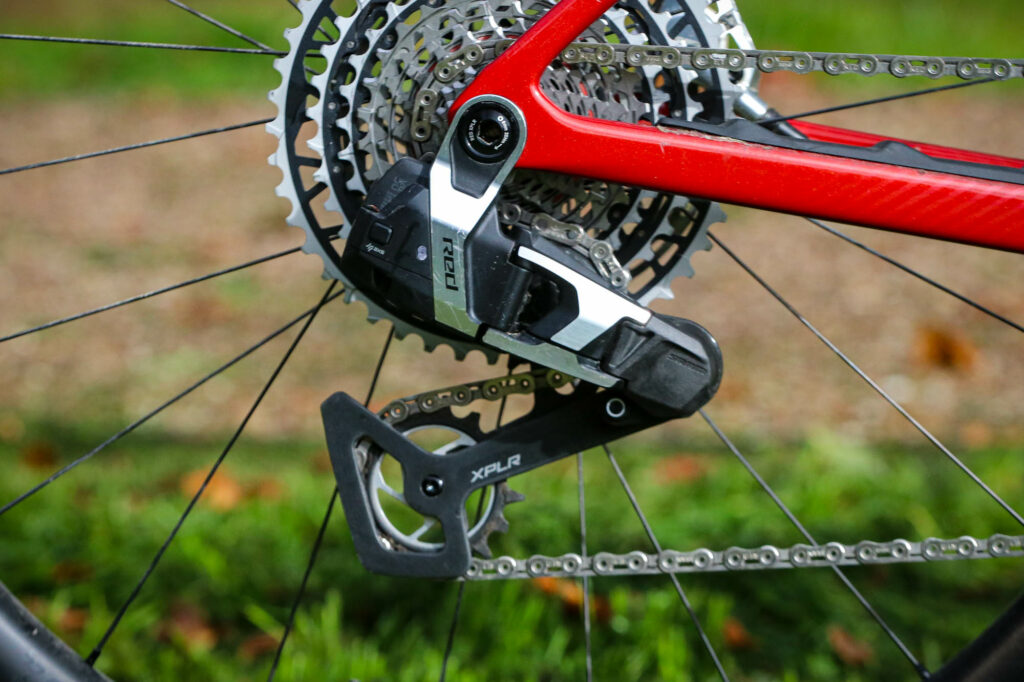
SRAM’s RED XPLR groupset is a very impressive setup. It takes a few bits and pieces from the roadgoing RED, but the majority of the components have been designed specifically with gravel in mind.
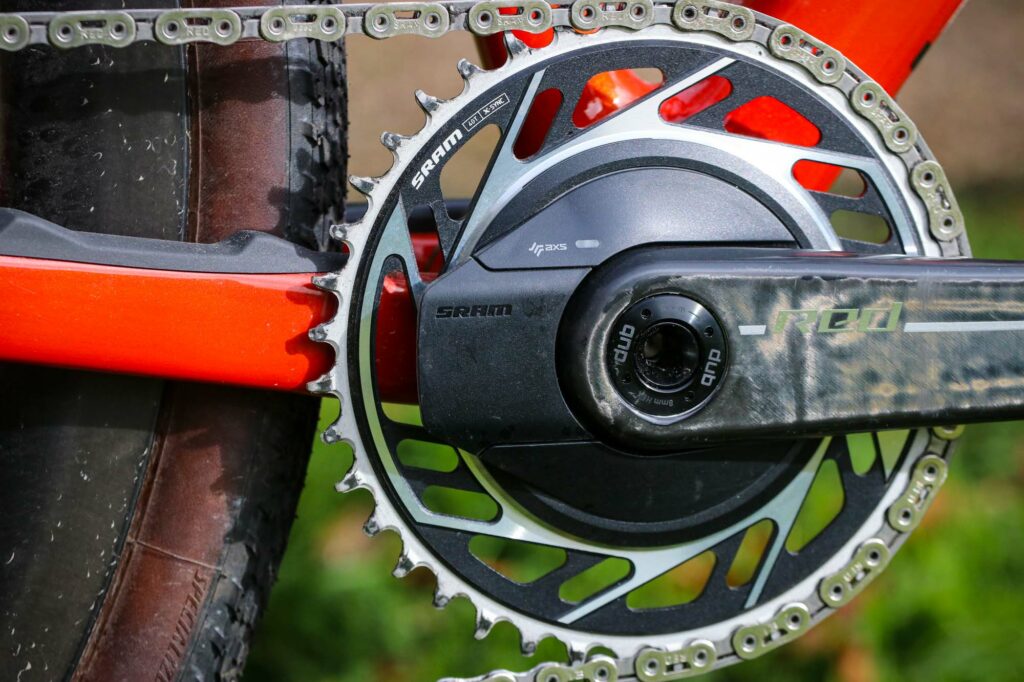
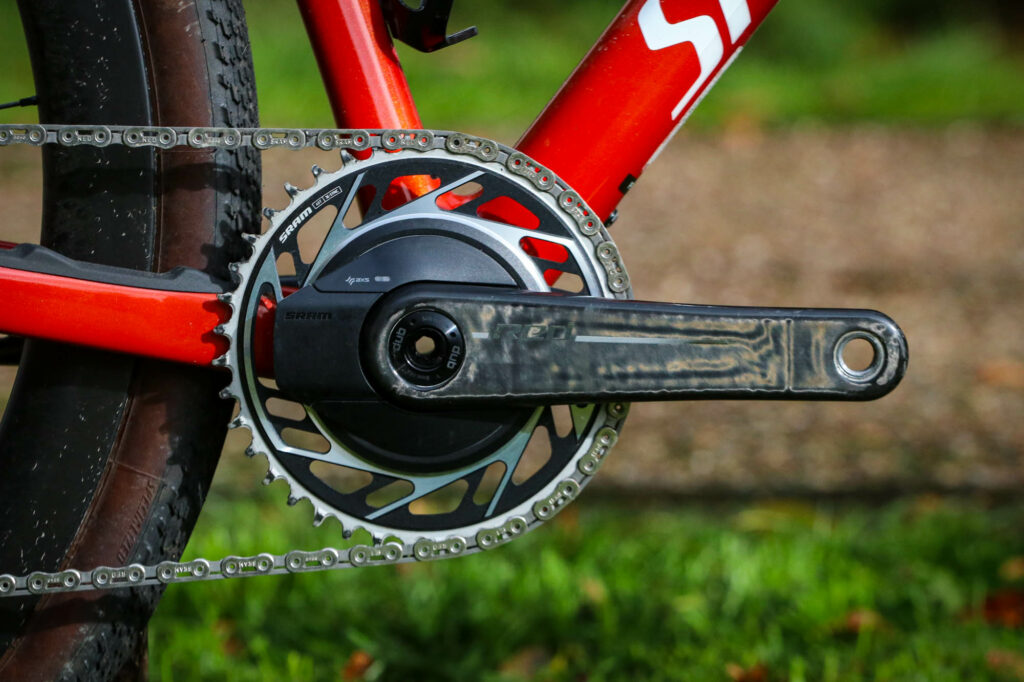
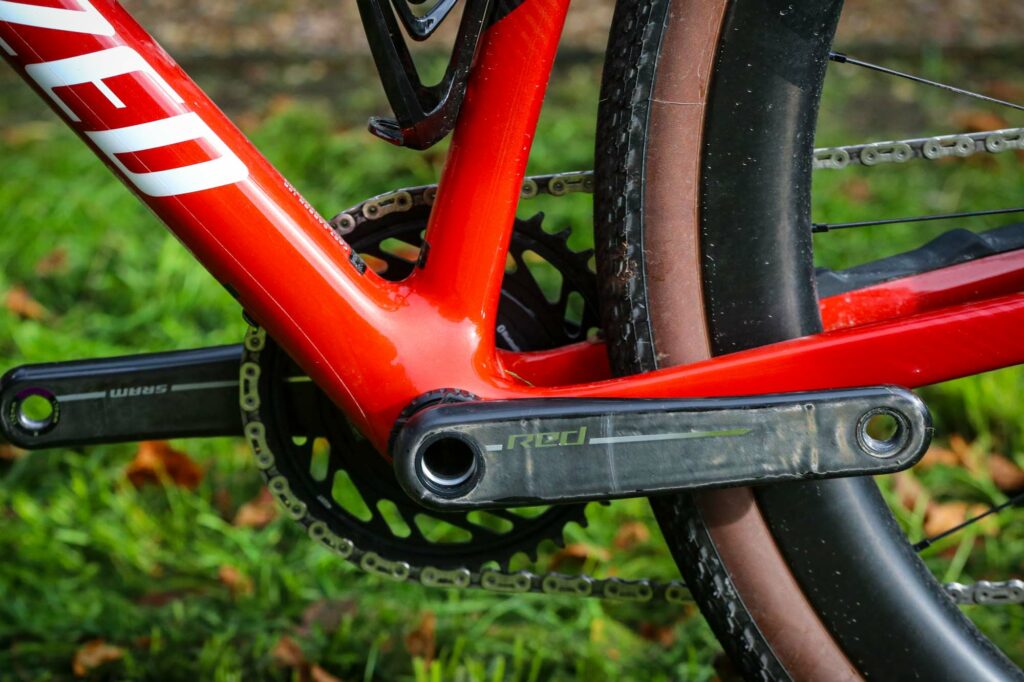
It’s a 1x system which uses a carbon crankset with a 40t chainring with a Quarq power meter included. This is mated to a 13-speed wide-ranging cassette running sprockets from 10t to 46t, a range that the rear mech smoothly pushes and pulls the chain between regardless of the size of the gaps.
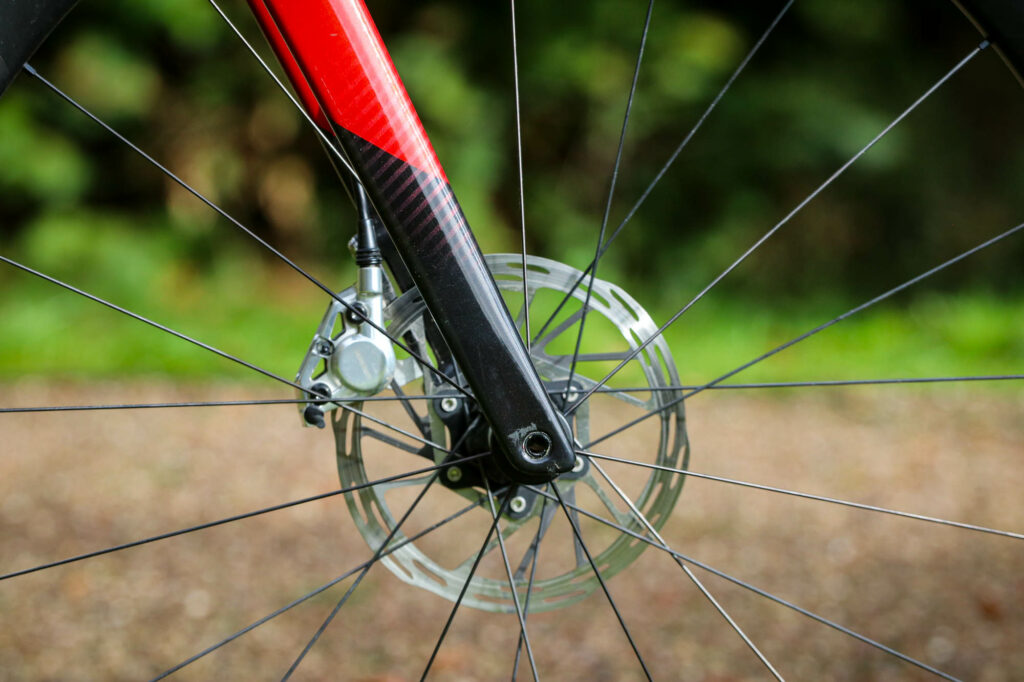
When SRAM released its latest drop bar groupsets, it redesigned the inner layout of the shifters, which means that full braking power can be achieved with just two fingers, even from the hoods – something that I have achieved countless times and it’s amazing how much control it gives you.
Everything about it is top notch, and if you want the full details then you can head to our full review here.
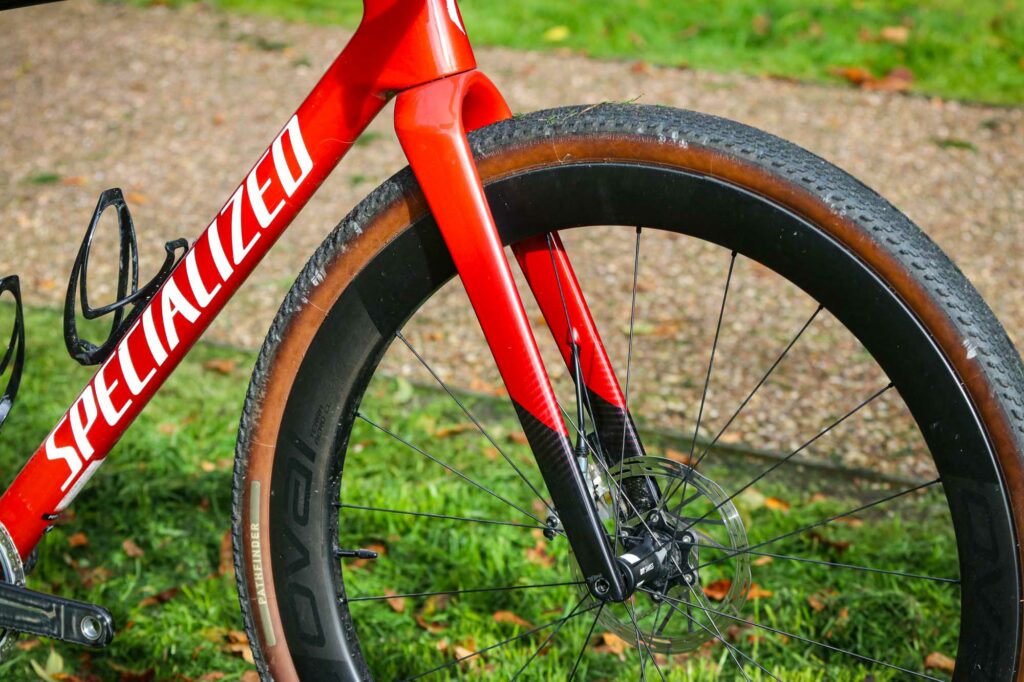
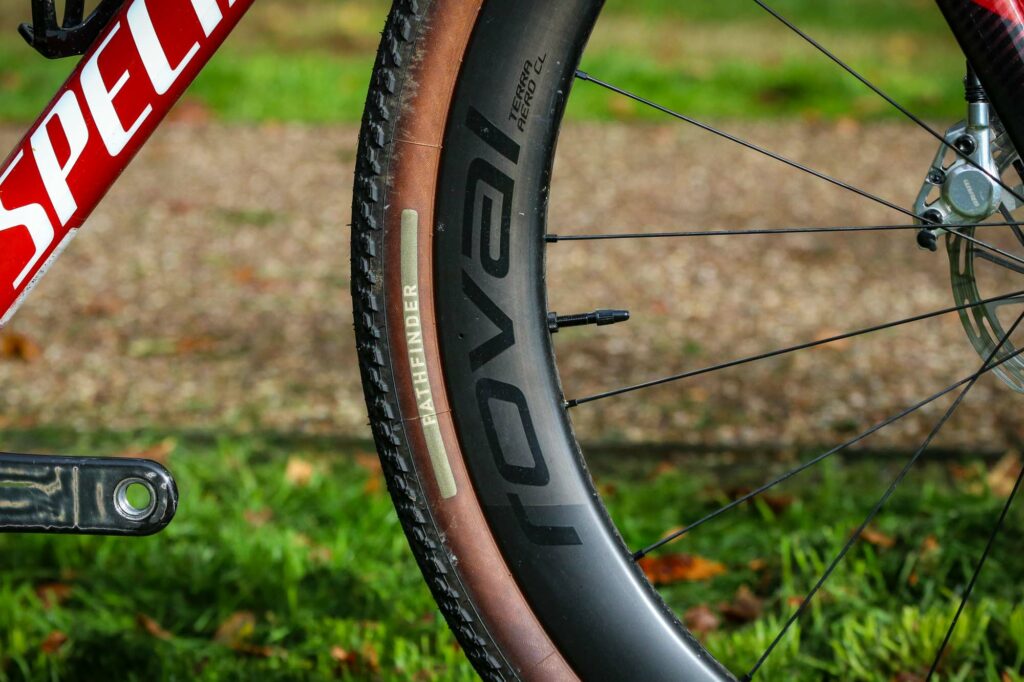
While the Crux 5 can take up to 55mm tyres, Specialized has specced it with 45mm Pathfinder tyres from its own catalogue.
They’re decent tyres with a supple ride feel and I found them reliable over the review period. The subtle tread only really works on hardpacked and dry surfaces though, so for autumn and winter you will definitely need to go for something more aggressive.
On loose gravel climbs I found that they didn’t offer any grip at all unless I remained seated to keep my weight over the rear wheel. Thankfully, that largest 46t sprocket provides a good bailout gear.
Specialized doesn’t set them up tubeless straight out of the box, instead supplying the S-Level with inner tubes.
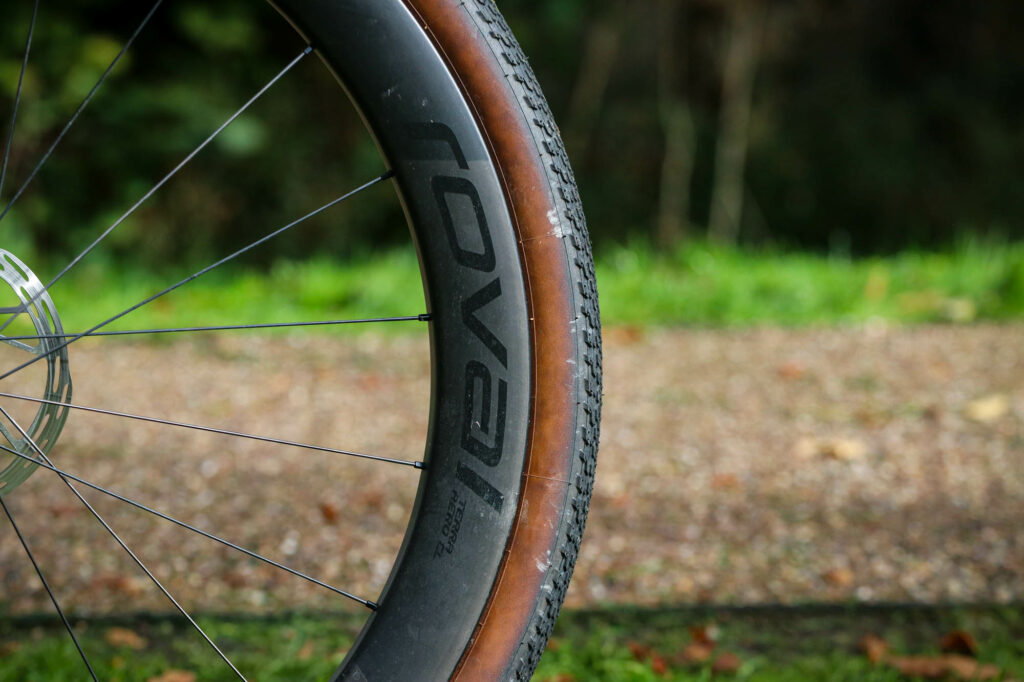
The Terra Aero CL wheels have an internal width of 27mm, making them perfectly capable of running the maximum tyre widths that the Crux 5 can handle, and with 45mm/50mm deep rims front and rear, you get a bit of an aero advantage. An external width of 38.5mm ensures a smooth transition from gravel tyre to rim too.
Specialized has specified DT Swiss’ components for the build with the reliable DT 350 hub and Competition spokes – 21 on the front wheel and 24 on the rear.
They use a hooked design for tyre retention, and Specialized claims an overall weight of 1,608g including tubeless tape and valves. In terms of reliability, I had absolutely no issues with them in terms of trueness, and lateral stiffness was spot on.
With regards to the other components, I found the Power Pro Mirror saddle to be very comfortable and shock absorbing, helped along by that highly compliant S-Works Tarmac SL8 carbon seatpost.
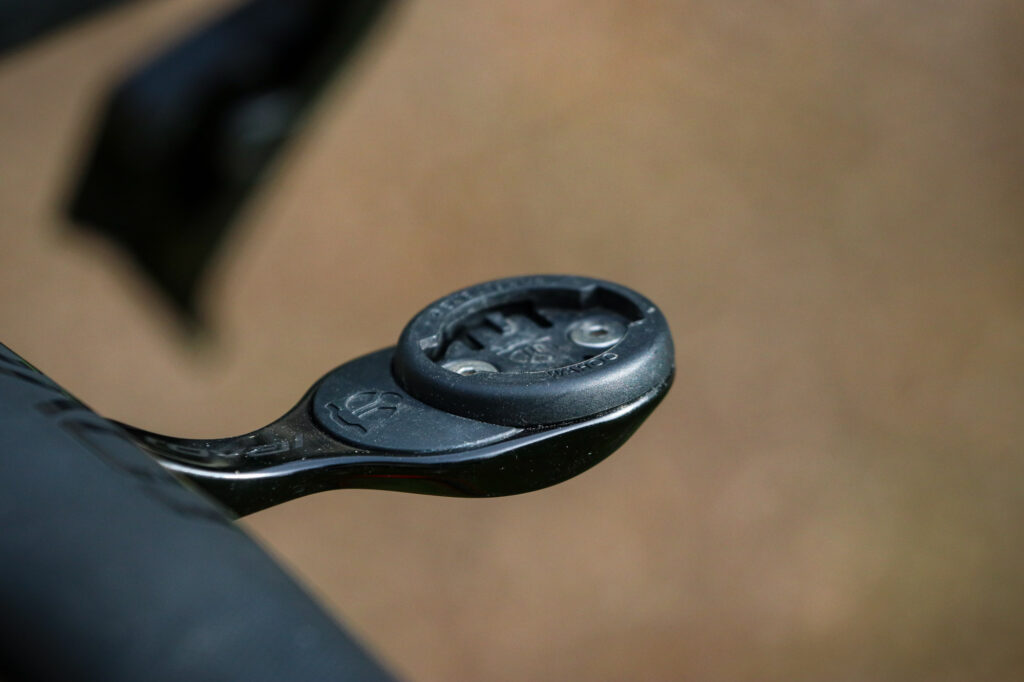
As I mentioned at the start of the review though, I do have issues with how stiff the Roval Terra cockpit is, but in terms of shape and available hand positions, I can’t really fault it.
This 56 sized bike gets a 400mm wide handlebar and a 100mm stem length.
On the drops and hood area, you get Supacaz’s Super Sticky Kush bar tape, which is one of my favourites to use. It wasn’t ‘kush’ enough though to offset the bar’s stiffness.
Specialized Crux 5 S-Level: Conclusion
Overall, the Crux 5 is a very good bike – especially if you can get on with the stiffness of that handlebar – but the best way to gauge its merits is to look at what else is out there.
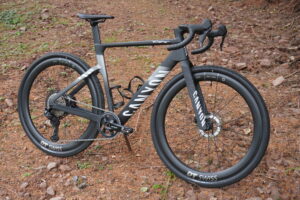
Matt has just reviewed the Canyon Grail CFR Di2 gravel racer and describes it as a fast, capable gravel race bike with excellent handling and tyre clearance – allthough he did say that the specification leaves room for improvement.
That model with Shimano’s GRX Di2 fitted costs £6,200, with the SRAM RED XPLR equivalent model, the CFR AXS, priced at £7,600.
That includes the same groupset as this S-Level, including the power meter, a set of 50mm deep DT Swiss GRC 1100 carbon wheels, a full carbon integrated cockpit and 57mm of tyre clearance.
It’s also worth bearing in mind that this uses Canyon’s flagship CFR frame, unlike the S-Level which is using Specialized’s second tier option. Canyon doesn’t offer its second tier CF SLX range with RED, but with Force XPLR, a carbon cockpit and DT Swiss deep section wheels it’ll set you back £4,799. That’s very competitive compared to the Crux 5 Expert, given a similar build for that is priced at just under six grand.
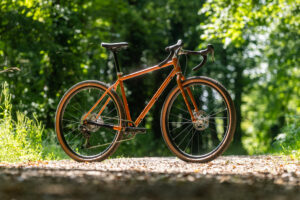
Vielo’s V+1 Race Edition is a bike that has impressed me multiple times. It’s an incredibly efficient gravel racer with comfort and handling that allow it to be used as a long-distance adventure machine.
With a SRAM RED XPLR build and Zipp’s 303s XLPR wheelset, the latest 2.1 edition comes in more expensive than the S-Level at £9,999 – but again this is Vielo’s top-end frame and so more of a direct comparison to Specialized’s S-Works Crux.
Dropping to a Force XPLR groupset with a power meter and those same Zipp wheels sees the price drop to ‘just’ £6,834, which I’d argue gives you the same performance as the S-Level, but with more comfort and capability. If you don’t mind a small amount of brake hose on show, then Vielo offers a cheaper V+1 alternative.
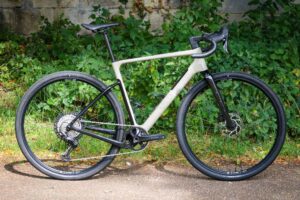
Scott has recently announced a reinvention of the Addict Gravel with two frame options available. The HMX is the lightweight performance model, while the HMF frame is the second-tier option.
I have one of the Scotts on order for review, but for now I can only tell you how the stats compare. The Addict Gravel Premium uses the HMX frame, which weighs just 794g and has 57mm of tyre clearance. The finishing kit includes a full carbon cockpit, SRAM RED XPLR groupset, including the powermeter, and Fulcrum Sharq GR Cult Carbon wheels, all for £7,999.
Summing it all up, there are some really fast, very comfortable bikes out there to challenge the S-Level and for me the stiffness of the Crux’s handlebar would probably see me look elsewhere. That’s a shame as the Crux 5 is a brilliant bike, but personally I would never buy this model due to the price associated with the RED XPLR groupset.
As great as it is – and it is very impressive – putting RED on this level of bike just bumps the price up too much. That’s not to mention the high cost of replacing parts when they wear out – the cassette alone is nearly £600!
I’d drop down to a Force XPLR build for 95 per cent of the performance of RED, but then I’d probably choose the Vielo V+1 Race Edition for a bit of extra cash.
You can’t look past that flagship Canyon Grail with the RED build for nearly £800 cheaper than the S-Level though.
Test Report
What does the manufacturer say about this product?:
The Crux 5 S-Level was born from the fastest gravel race bike ever made. Not just because it’s the lightest. Not just because it’s our most aero. Not just because it handles dirt like a Tarmac handles pavement. But because it delivers the lowest real-world Time to Finish of any gravel bike ever made. Crux 5 turns more of your effort into pure speed — validated for real race courses, real terrain, and real riders. When the goal is the top step, nothing in gravel gets you there faster.
Tell us some more about the technical aspects of this product:
Use: Gravel Racing
Frame: FACT 10r Carbon: 897 grams
Wheels: Roval Terra Aero CL
Cockpit: Roval Terra Integrated
Drivetrain: SRAM RED XPLR
How does the price compare to that of similar products in the market, including ones recently tested?:
Many brands offer their top tier frames with range topping groupsets for less than Specialized is charging for this bike and its second tier frameset.
List the components used to build up the bike:
Brakes: SRAM RED E1, hydraulic disc
Shift Levers: SRAM RED AXS E1, hydraulic disc
Rear Derailleur: SRAM RED AXS XPLR E1, 13-speed
Cassette: SRAM RED XPLR E1, 13-speed, 10-46t
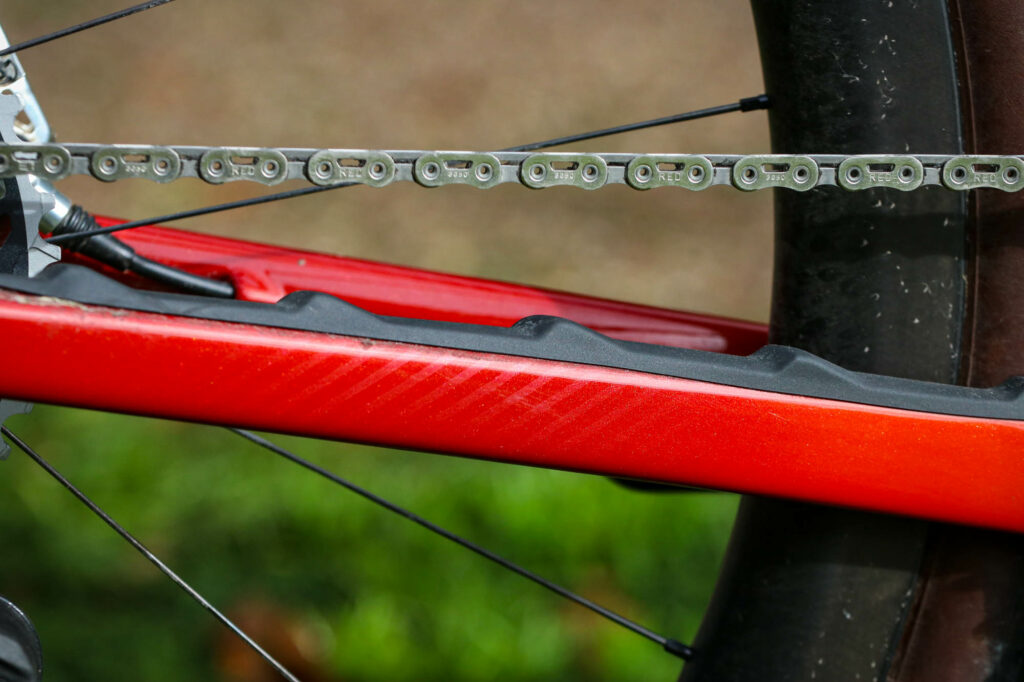
Chain: SRAM RED E1 Flattop 12-speed
Crankset: SRAM RED XPLR E1, Quarq power meter, 40t
Bottom Bracket: SRAM DUB BSA 68 Wide
Tyres: Pathfinder 700×45, Tubeless Ready
Wheels: Roval Terra Aero CL, 27mm internal width, tubeless ready, 50mm depth, 21h, DT 350 hub, Centerlock disc, DT Swiss Competition spokes
Inner Tubes: 700×32-50mm, 60mm Presta valve
Handlebar: Roval Terra Cockpit, Integrated Bar/Stem
Tape: Supacaz Super Sticky Kush
Saddle: Power Pro Mirror, hollow Ti rails
Seatpost: S-Works Tarmac SL8 Carbon seat post, FACT Carbon, 15mm offset
Seat Binder: Integrated Wedge
Tell us what the bike is for and who it’s aimed at. What do the manufacturers say about it?:
Specialized says: “The Crux 5 S-Level was born from the fastest gravel race bike ever made. Not just because it’s the lightest. Not just because it’s our most aero. Not just because it handles dirt like a Tarmac handles pavement. But because it delivers the lowest real-world Time to Finish of any gravel bike ever made. Crux 5 turns more of your effort into pure speed — validated for real race courses, real terrain, and real riders. When the goal is the top step, nothing in gravel gets you there faster.”
Where does this model sit in the range? Tell us briefly about the cheaper options and the more expensive options:
This build sits below the S-Works model, but tops out the Crux line-up of bikes that use the second tier 10r frames. Sitting below are the Expert, Comp and Sport models, which get cheaper as the spec gets lower.
Tell us about the build quality and finish of the frame and fork:
A well made frame that is finished to a high standard.
Tell us about the materials used in the frame and fork:
Frame: Crux 5 FACT 10r Carbon
Fork: S-Works FACT 12r Carbon
Tell us about the geometry of the frame and fork:
The geometry is quite aggressive as this is a pure gravel race bike.
How was the bike in terms of stack and reach? How did it compare to other bikes of the same stated size?:
The stack and reach measurements reflect the racy nature of the bike, and aren’t out of the ordinary for a bike of this size and style.
Was the bike comfortable to ride? Tell us how you felt about the ride quality:
The frame and fork ride quality is good, but the handlebar is overly firm.
Did the bike feel stiff in the right places? Did any part of the bike feel too stiff or too flexible?:
There is loads of stiffness around the bottom bracket area and the fork was stiff enough to handle high cornering and braking loads.
Was there any toe overlap with the front wheel? If so, was it a problem?:
No.
How would you describe the steering? Was it lively, neutral or unresponsive?:
Quick.
Tell us some more about the handling. How did the bike feel overall? Did it do particular things well or badly?:
The Crux has fast handling like a race bike should, but it has a balanced nature to it which means I found it easy to control and it’s responsive too.
Which components had the most effect (good or bad) on the bike’s performance? Would you recommend any changes?:
The deep section carbon wheels brought an aero advantage and on hardpacked surfaces the tyres roll quickly and have decent grip.
Any issues with drivetrain durability?:
No.
Tell us some more about the drivetrain. Anything you particularly did or didn’t like? Any components which didn’t work well together?:
SRAM’s RED is a top level groupset with performance to match. Replacement parts are very expensive though.
Any issues with wheel durability?:
No.
Tell us some more about the wheels. Did they work well in the conditions you encountered? Would you change the wheels? If so, what for?:
The wheels performed well throughout testing thanks to good durability and the aero advantage was noticeable.
Tell us some more about the tyres. Did they work well in the conditions you encountered? Would you change the tyres? If so, what for?:
Great for dry and hardpacked surfaces, but you’ll need something with more tread for the majority of UK conditions.
Any issues with brake durability?:
No.
Tell us some more about the brakes. Did they work well in the conditions you encountered? Would you change anything? If so, why?:
The brakes are very powerful with loads of modulation even when braking from high speed with just two fingers.
Any issues with controls durability?:
No.
Tell us some more about the controls. Any particularly good or bad components? How would the controls work for larger or smaller riders?:
The stiff handlebar skews the score here, but I found it really impacted the ride comfort on rough terrain.
Did you enjoy using the product?
Overall, yes.
Would you consider buying the product?
not this model as RED makes it too expensive.
Would you recommend the product to a friend? Possibly.
Use this box to explain your overall score
The overall score doesn’t relate to the Crux range on the whole, as I think the frameset and the way it rides and handles is very good, especially if you can put up with the stiff handlebar. I think this model is almost a bit niche, speccing such a high level, expensive groupset on a second tier frame and I wouldn’t be able to justify the cost for a minimal boost in performance.