



Velofollies is a bike show that takes place over three days in Kortrijk, Belgium, just over the border from the French cities of Lille and Roubaix (yes, that Roubaix, while Decathlon and its Van Rysel brand are based in Lille). We’re up to the 18th edition now and it’s getting bigger in terms of popularity and influence. There were nearly 40,000 visitors last year. That compares with just over 60,000 for Eurobike, the big show in Germany.
Van Rysel: FTP^2 concept bike

As mentioned, Velofollies is just down the road from Van Rysel’s Lille HQ (the name Van Rysel means “from Lille” in Flemish), and the brand tends to do something special at the show every year. This time, it is showing off the FTP^2 concept bike, which it says is its “most complex and demanding project ever”, involving about 40 people. A purpose-designed helmet, shoe, and skinsuit complete the system.
“Designed and developed over several years in collaboration with key partners such as Swiss Side, the FTP^2 concept bike is built around the idea of doubling your FTP, hence the name FTP^2,” says Van Rysel.
Maybe FTPx2 would be a better name, then – but that’s their business (when speaking about it, Van Rysel call it the FTP 2).
FTP is your functional threshold power. How could a bike double your FTP? Even the most aero of aero bikes doesn’t affect your FTP – you just get more speed for the power you put in.
> What is FTP? 7 key facts to learn about functional threshold power, a major training metric

Ah, well, the Van Rysel FTP^2 has a small trick up its sleeve in the shape of a Mahle M40 e-bike motor that has been specifically developed for this project. It multiplies rider input and removes conventional speed limits. Van Rysel reckons that riders can hit over 100km/h on this bike – and they do have two working versions, made completely in Lille (including the carbon-fibre frame).

There are some really unexpected features, such as integrated shoe tightening (there’s a motor in a gap above the sole) and custom lighting. The shoes don’t have traditional fasteners at all; everything is controlled wirelessly from the cockpit. This helps improve aerodynamics by eliminating all mechanical elements from the shoe’s upper.
The shoes attach directly to the cranks – there’s no separate pedal – although you could fit a standard pedal and shoe system if the idea of not being able to clip out terrifies you. As mentioned, Van Rysel has focused purely on speed rather than practicality here.

The clothing contains Armaurto abrasion-resistant padding, to cope with any crashes that do occur at high speed.

The helmet combines an EU-certified base with a custom aerodynamic carbon shell co-developed with Swiss Side, which clips directly onto a standard inner helmet. Van Rysel reckons that this construction will work to protect against rotational impacts (a little like Mips) and could come to market in the next two or three years.

The Van Rysel FTP^2 isn’t available to the public, but it looks like a lot of fun.
Hunt to release new Limitless wheels

Hunt is preparing to launch a new Limitless range of wheels later in the year, and it says that it is very excited by the results. In fact, it reckons the wheels are a significant step above anything else out there.

The wheels will come in four different depths with 15 spokes per wheel – 10 going to one side of the hub and five to the other. The spoke nipples are hidden away.
Hunt says it has added an extra layer to its development process: as well as CFD (computational fluid dynamics) and wind tunnel testing (in Germany and the UK), it has added aero testing in the real world, working with fellow British brand Aerosensor. It reckons it can achieve a very high level of accuracy and repeatability here, working at the Dunsfold Park test track in Surrey.

The wheels pictured here aren’t quite the final version – but they’re getting there. The launch is expected in April.
Eddy Merckx introduces two titanium models

Eddy Merckx Bicycles launched two new titanium models this week and Velofollies was the first chance to see them: the Corsa Pévèle Ti (above) and the Corsa Strasbourg Ti (below).
These bikes add to the existing Corsa range, which includes steel all-road and gravel models. The titanium bikes retain the same geometry.

The frames are made in Italy using Columbus Hyperion titanium tubing, with final assembly taking place at the HQ of Belgian Cycling Factory – owners of Eddy Merckx Bicycles and Ridley, among other brands – in Belgium. Both models feature 3D-printed UDH dropouts for compatibility with modern drivetrains.
> What is UDH and is it the future of all bikes? SRAM’s Universal Derailleur Hanger explained
The Corsa Pévèle Ti is an all-road bike with a bottom bracket that’s slightly lower than that of a traditional road bike – designed to improve stability and control.

You get space for 40mm tyres with a 1x drivetrain and 38mm with a 2x setup, and mounting points on the top tube as well as mounts for mudguards.

The Corsa Strasbourg Ti is designed for gravel. You get space for 50mm tyres with this one, and multiple mounting points on the frame and fork for carrying bags and accessories.
Each of the titanium models is available through the online Eddy Merckx configurator, so you can tailor the bike according to your preferences. You can choose the colour of the down tube and head tube logos, for example, and Wolf Tooth small parts.
Mason x Barco Exposure Primitiva

Mason had a couple of very interesting bikes at Velofollies, including the Mason x Barco Exposure Primitiva that recently won the Highlight of the Show award at the DT Swiss Craft Days, an annual industry event in Germany.
Cicli Barco is a highly respected, family-run Italian workshop known for making bespoke, high-performance frames. This is a one-off frame based on Mason’s Exposure gravel adventure platform and made with Dedacciai steel tubing.

The gravel-specific DT Swiss F 132 ONE fork – with 40mm of suspension and integrated routing – was first used by Canyon, and Mason is the first other brand to fit it.

Dom Mason says he isn’t fully convinced of the need for suspension on gravel bikes, but he has experimented with a new geometry to accommodate it here, along with integrated routing.

Mason also showed its Definition Integrale over on the Deda stand, made with Dedacciai 7000 Series aluminium tubing. Designed for wireless electronic groupsets only, there are none of the usual cable/hose ports other than an exit on the chainstay for the rear brake hose.

This one is built up with Deda’s new Allroad wheels, 35mm tyres, and a Campagnolo groupset.

We like the brass head badge very much.
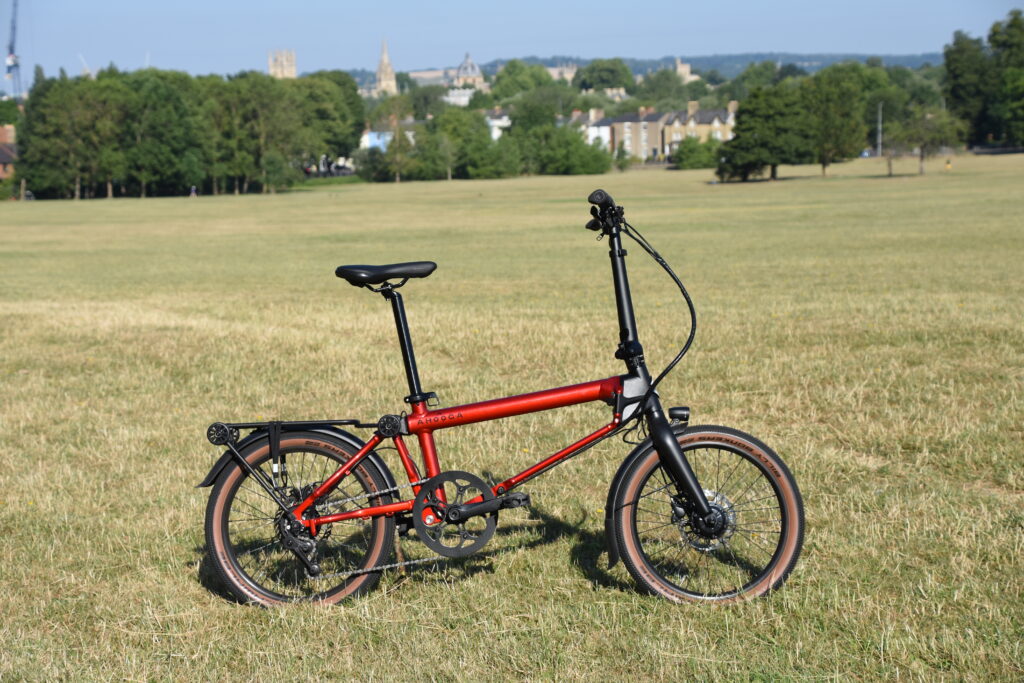
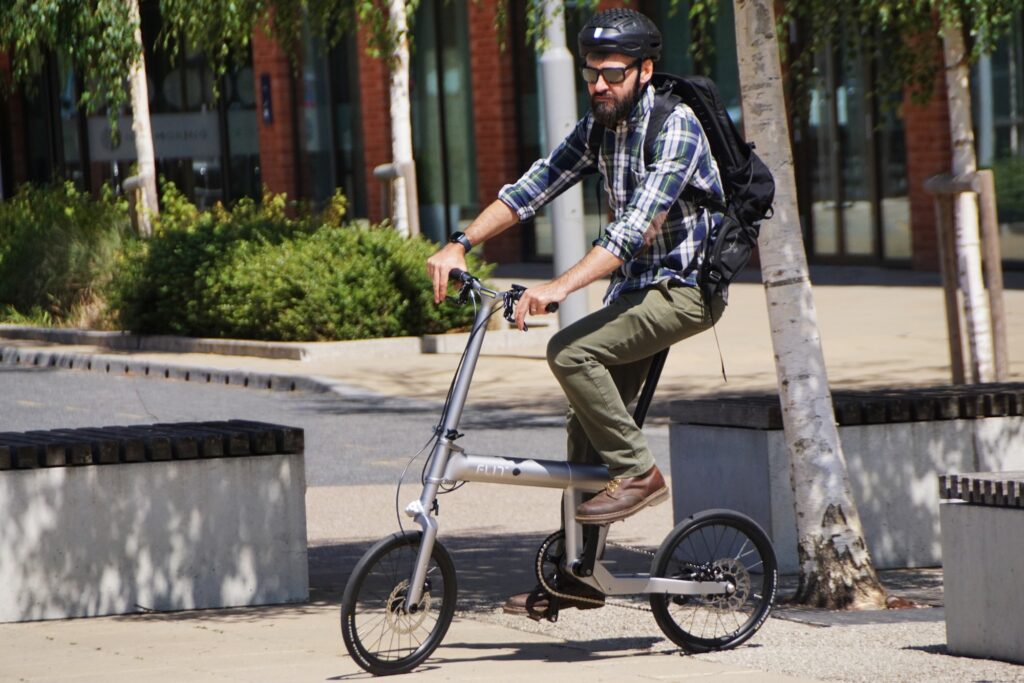
Ahooga launches four new lightweight folding bikes

Belgian brand Ahooga has introduced four new folding bikes for 2026 – and when we say ‘Belgian’, the bikes are designed, engineered and built in Belgium. Two of the bikes are electric, two are non-electric (traditional, manual, analogue, acoustic, or whatever term we’re using this week). All models fold down to 72 × 69 × 37cm, which Ahooga reckons is the smallest fold for any 20-inch bike on the market.
Ahooga says that the aluminium frames are inspired by BMX geometry and designed for “precise handling and an agile, playful ride feel rarely found in folding bikes”.
> Who are Ahooga? Belgian folding e-bike specialists raise millions for investment
The bikes are available with either derailleur or Alfine 8 internal hub gearing. The e-bikes have claimed weights of 17-18kg and prices of €2,999-3,499, while their non-electric counterparts are 13-14kg and €1,799-1,999.
Ahooga is also introducing a custom programme. You can choose from 20 frame colours (and have different colours for the main frame and rear frame), choose the size and colour of the logo, and add your own text to the frame.
Deda’s new Allroad Carbon wheels

Deda is showing off its new tubeless-ready Allroad Carbon wheels, which are designed for both road and gravel.
The rims are high-modulus carbon fibre – 36mm deep with a 33mm external width, 27mm internal width – and filament wound, the idea being to offer more impact resistance than traditional carbon rims. The width is designed for tyres form 35mm to 71mm.

The new Allroad hubs are equipped with a dual 40-tooth ratchet system for the freewheel engagement, and you can choose between Shimano and SRAM XDR freehubs. The claimed all-up weight is 1,430g per wheelset (with an XDR freehub).

We don’t yet have a UK price but we know that the Deda Allroad Carbon wheels will retail for €1,350.
Ridley Noah goes electric

Ridley announced the electric version of its Noah aero bike – called the E-Noah, fittingly enough – earlier in the week. The Belgian brand describes this as its “first aero e-race bike”, although we’re not sure where you’ll be racing an e-bike – not unless you’re really sneaky.

You get a TQ HPR40 system at the heart of things, giving you 40 Nm of torque and 200W of power, customisable via the TQ app. The battery is 292Wh (with an optional 160Wh range extender) and there’s no display on the cockpit, allowing you to fly under the radar.

Ridley claims a complete bike weight of under 11kg and prices for the E-Noah start at £6,399 for a complete bike with a Shimano 105 Di2 groupset.
Ursus unveils new wheel range
Italy’s Ursus wheel brand debuted new models at Velofollies ahead of their appearance in the Tour Down Under with Picnic-PostNL. The new wheels are structured into three collections: Arya, Proxima and Pura.

The Arya wheels are lightweight and all about speed and responsiveness. The Arya R is available in 35mm and 50mm rim depths and comes with Vonoa carbon spokes.

Ursus Proxima wheels are intended to balance aerodynamics, stiffness and comfort. The new Proxima R features a uni-directional carbon construction, tubeless-ready design and (like the Arya R, above) is available in 35mm and 50mm rim depths. The external rim width is 32mm
The Proxima G is an endurance-gravel wheel. Ursus says the wide profile is designed to reduce vibrations and increase comfort over fast gravel and cobbles – if you have many of those around your way.

Ursus Pura wheels are intended for everyday riding and they’re designed for consistency, dependability… you know the kind of thing. There’s a Pura R for the road and a Pura G for gravel.
The hubs are Ursus’s own, made entirely in Italy.
Silca unveils Ultimate Tubeless Valves and Ultimate Tubeless Rim Tape

Silca launched its Ultimate Tubeless Valves and Ultimate Tubeless Rim Tape a few days ago to work alongside its Ultimate Sealant in road, gravel, and mountain bike applications.
The Ultimate Tubeless Valves feature a large internal bore diameter that’s intended to allow high airflow – always welcome when you’re trying to get a tubeless tyre to seat.

Silca says the valves are fully compatible with tyre inserts, and you get a built-in valve core remover in the aluminium valve cap. Other brands already do this, and it’s a feature we like. The valves come in 50mm and 70mm lengths and are sold in packs of two.
The new Ultimate Tubeless Rim Tape is triple-ply, made from a multi-layer composite of PET, PU, and a proprietary abrasion-resistant top film. It comes in two widths (27mm and 32mm) and you get 10m per roll – enough to wrap four 700c wheels with a single layer. Silca promises “exceptional durability while conforming precisely to modern rim beds” – although that’s not surprising.
SRAM introduces new aero disc brakes and expanded crankarm selection, including Jonas Vingegaard’s favourite 150mm cranks

SRAM this week announced new and updated products, including shorter crankarm options and an expanded brake range.
The Red Aero Disc Brake, for example, features a textured carbon brake lever and reach adjustment.
With loads of riders moving to shorter crankarms these days, SRAM has responded to the market by now offering its top-level Red cranks in 150mm and 155mm lengths. Other options up to 175mm remain in the range.
BBB introduces Arc Flux glasses

Dutch brand BBB has introduced new Arc Flux eyewear. It offers a similar lens to the BBB Valor Flux we reviewed last year, but in a sleeker package because the Valor Flux is too large for some. The Arc Flux has less height from the nosepiece upwards, so it’s less likely to interfere with the front of your bike helmet.
The Arc Flux frame is made from bio-based Rilsan, a plastic that’s derived from castor oil; BBB is big on sustainability. The high-contrast Flux lens is designed to enhance definition and contrast across a wide range of light conditions, and comes with anti-fog and oleophobic (repellent to oil) coatings to keep things clear. There’s a photochromic lens option.
You also get a second clear lens for low-light conditions.
BBB Arc Flux glasses are priced at £109.99.

BBB will also introduce a Karma helmet in the next couple of months.

It’ll come with Mips Air Node tech, and the aim is for a light and well-vented feel. BBB claims a weight of 250g and says the cost will be €179 (we don’t have a UK price yet). Five colour options will be available.
Gobik adds new Grit cargo bib tights to the range

Spanish cycle clothing brand Gobik has introduced adventure-orientated Grit 2.0 cargo bib tights, with storage capacity and a new seatpad that it says is developed to tackle more than 12 hours in the saddle. That’s going some. The seatpad in question is the G10 developed exclusively for Gobik by Elastic Interface.

The storage comes courtesy of both side and rear pockets.
Miche unveils Deva Rd: “The most aerodynamic and lightweight Miche wheels yet”
Miche says that its new Deva Rd wheels are its most aero and lightweight yet, and its first with carbon spokes. What is that weight, then? A claimed 1,305g for the wheelset with 52mm-deep rims. A version with 62mm-deep rims is available too.

As mentioned, Miche is really bigging up the Deva Rd’s aero credentials, having spent a lot of time on CFD simulations and wind tunnel testing during the development stage.

The rims are made from T700, T800, and T1000 carbon and you get a 23mm tubeless ready internal width. In both rim depths, the front is a little wider than the rear – 33mm versus 31mm in the case of the 52mm rim, and 31mm versus 30mm in the case of the 62mm rim.
The wider front profile is designed to maximise aero efficiency while the slimmer rear saves a little weight. We’ve seen a similar approach from brands like Hunt.

The carbon spokes come in a 4x1mm cross-section profile and the nipples are hidden away, integrated directly into the rim, to reduce turbulence.
The hubs are machined from Ergal 7075 T6 billet, and Miche has adopted double-sealed ceramic bearings in collaboration with CeramicSpeed.
We don’t have UK prices yet but the Deva Rd wheels are €3,200.
New CPC saddles from Prologo
Prologo is adding new CPC saddles to its range – CPC (Connect Power Control) being 3D conical polymer that sits on top of the cover. Prologo says that it “increases the absorption of vibrations and shocks, while ensuring maximum stability on the saddle and eliminating slipping in all weather conditions”.

CPC is added to the Nago R4 – both the PAS version with a central cutout and the closed version – and a new Dimension R2 CPC is also introduced.
Fizik adds three superlight saddles

Italy’s Fizik is introducing three new saddles – superlight models in its R1 Light range. Each saddle is said to be about 17% lighter than its predecessor in the R1 range. How has Fizik cut the weight? It just uses “a minimal carbon structure with a bare EVA foam layer”.
Each of the saddles is available in two widths.
The Vento Argo R1 Light comes in 140mm (149g claimed weight) and 150mm (154g) widths.
The Vento Antares R1 Light comes in 140mm (122g) and 150mm (128g) widths too, while the Tempo Aliante R1 Light is available in 145mm (144g) and 155mm (148g) versions.
All are priced at £199.99.



21 thoughts on “A wild concept bike, the next generation of fancy carbon wheels, Ridley’s Noah goes electric, SRAM’s 150mm cranks + more from Velofollies 2026”
i hope whoever experiences
i hope whoever experiences the first failure on those 15-spoke hunt wheels isn’t seriously injured — and that they get it on video.
And hookless too, for the
And hookless too, for the dedicated Banzai!! rider
lose 1 radial spoke, commence
lose 1 radial spoke, commence pringle wobble, tyre burps, etc.
Van Rysel wrote:
Umm – who’s going to tell them…?
mdavidford wrote:
Umm – who’s going to tell them…?— Van Rysel
i briefly wondered what areal FTP would be calculated for.
road.cc wrote:
I do like the webbed pockets
I do like the webbed pockets on those Gobiks.
“(the name Van Rysel means
“(the name Van Rysel means “from Lille” in Flemish),”
Rijsel is the name of the city in Dutch, the language spoken in Vlaanderen and the Netherlands (and the Flemish generally speak better Dutch than the Hollanders and Nederlanders 😉 – and I’m not Flemish). Rysel is an archaic spelling, but I guess more friendly to English readers.
Both French and Dutch names comes from the same Latin root, ‘Ad Insulum’ -> “ter IJsel” / “a L’Ille” -> “by the Isle”.
Paul J wrote:
It’s actually the current spelling in the west Flemish dialect that is most widespread in Belgium and French Flanders, i.e. the Flemish speaking areas closest to Lille. It’s pretty common in west Flemish to replace the Dutch ij with a y.
West Vlaams accent/dialect is
West Vlaams accent/dialect is really really strong, and very very difficult, as a spoken dialect, to understand for Hollands speakers and I imagine even other Vlaams (Brabants, Limburgs dialects of Dutch speakers) – I know Belgian/Vlaams telly have done stuff about West-Vlaams, and they’ve put subtitles on it ;).
I was unaware there was any formal, distinct setting down of the spelling of West-Vlaams. I can’t see anything about that in NL wikipedia either. Can you give a source for this? It’s unusual for accents/dialects to have their own spelling (beyond ad-hoc measures that writers might use to highlight an accent in literature, e.g. like Irvine Welsh does with Scots English).
English Wiki has a good
English Wiki has a good article on West Flemish, see the phonology section for the ij/y change.
https://en.wikipedia.org/wiki/West_Flemish
There is a dictionary of WF available, which argues that it does have a distinct lexicography:
https://www.amazon.co.uk/Westvlaamsch-Idioticon-Leonard-Lodewijk-Bo/dp/1020465743
That’s “Phonology”. Also,
That’s “Phonology”. Also, that’s English wikipedia too. There are fun books and websites with Scots words too. I’m not sure 1 self-published book about West-Vlaams says too much. It definitely is a very strong regional accent – but still more of an accent than a dialect (AFAICT).
I mean, with subtitles, I can understand West-Vlaams and there’s generally a direct correspondence (in my limited sampling). Possibly more so than something like Gronings and (even more so) Fries. I can’t understand Gronings either. 😉 I would struggle to decipher much of written Gronings I think. There are a lot of /very strong/ regional accents / dialects within the old Netherlands.
And yes, the Vlaams still preserve the old form of i-grek a lot more, in names (people, places, etc.) than in NL – and preserve other older bits of Dutch grammar and words. It’s something I love about Vlaams dutch. But.. IJ is the spelling of i-grek on both sides of the (modern) border between the Dutch speaking regions.
(NB: I hate the tendency of some to try sow division between BE and NL Dutch… 😉 ).
“a shprakh iz a dyalekt mit
“a shprakh iz a dyalekt mit an armey un flot”… ?
Then there are languages divided (largely) by orthography – Hindi vs Urdu, and Croat vs Serbian come to mind (though apparently latin letters are growing in popularity in the latter, and like much in those parts much is disputed).
I’m a native Dutch speaker.
I’m a native Dutch speaker. Historically, the sound that is now written as a combination of the vowel ‘i’ and consonant ‘j’ (so ‘ij’) was reproduced in writing as ‘y’ or sometimes ‘ÿ’. There’s a third phoneme which is very close and written as ‘ei’.
It’s very difficult/impossible to hear a difference between ‘ei’ and ‘ij’. E.g. ‘ijs’ (meaning ‘ice’ in EN) and ‘eis’ (‘demand’ in EN) are indistinguishable. When writing, you simply need to know by heart what is what.
I’m not a linguist but to me it looks plausible the ‘Rijssel’ was historically written ‘Rysel’, also because French doesn’t know the ‘i+j’ phoneme but ‘y’ comes closest. To my knowledge, there is no codification of West-Flemish dialect which indeed is hard to comprehend for other Dutch speakers.
Excellent information!!
Excellent information!!
The Belgian folder looks
The Belgian folder looks interesting.
Yes. But I don’t think the
Yes. But I don’t think the riding position (modelled) would suit me.
Anyway…how do you pronounce
Anyway…how do you pronounce Dedacciai?
pockstone wrote:
Slightly confusing because the separate-but-part-of-the-same-group parts manufacurer Deda is pronounced day-dah but the frame manufacturer is dead-ah-chai.
Thanks Rendel, and special
Thanks Rendel, and special thanks for not resorting to the International Phonetic Alphabet…its use always leaves me more confused than enlightened. I did wonder if it was a portmanteau of Deda and the Italian for steel.
pockstone wrote:
It is, almost. The original company was called Dedalo, the Italian for Dedaelus, then they added accai for steel.