



The Gaciron CETUS-1700 Underneath Mounted Bike Light is a compact and powerful front light, of the ‘see by’ variety – as opposed to the less potent ‘be seen’ type. It is designed to hang beneath a GPS mount via a standard GoPro fixture, freeing up handlebar space and reducing clutter. It offers some interesting features, plenty of power, and a beam shape as specified by the German StVZO lighting standard. Battery life and daytime modes are only average, however.
Gaciron is a Chinese brand specialising in bike lights, and we’ve reviewed several of its models before, generally finding them to offer quite a lot of bang for not all that much buck.


Design, mounting and fit
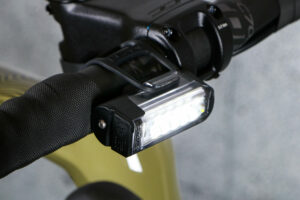
The CETUS-1700 is a short, squat unit designed to sit underneath your GPS mount. It ships with a chunky plastic handlebar bracket featuring a standard Garmin quarter-turn interface on top and a GoPro-style clevis underneath. The Garmin interface can be rotated through 90 degrees to suit Wahoo computers.
The bracket stayed firmly in place on the bar (despite Gaciron’s oddly specific tightening torque recommendation of 1.2Nm, which I ignored), although tightening the GoPro fixing screw enough to hold the light completely steady underneath took some effort – we’ll talk about why next. The light itself slides into a channel beneath the mount and is retained by a spring-loaded catch; the fit is fairly tight, so it’s worth checking that it’s fully engaged before riding. Thanks to the GoPro clevis, you can adjust the angle of the light independently of your GPS, which is useful for fine-tuning beam height.
Screw it
Weirdly, the screw supplied to tighten the GoPro clevis has a five-sided head. I’ve never seen one of those before, and the engineer in me wanted to understand why you’d choose that rather than a normal four- or six-sided head. The only explanation I could come up with is that it makes it purposely difficult to get a spanner on it, which it certainly does. You could, of course, easily replace it with a different screw, so it’s not a big deal.
If you’re not a fan of the standard bracket, Gaciron offers a much sleeker aluminium mount for an extra $30, and of course the use of standard Garmin and GoPro interfaces means you can choose from a wide range of third-party options too.
Aerodynamics
Gaciron makes some aerodynamic claims for the CETUS-1700, including a gif suggesting it has done some wind-tunnel testing and a quoted drag coefficient advantage over ‘traditional lights’. I’m not convinced about these claims, or that most buyers of this light will be looking to save a few watts.
That said, mounting a light centrally beneath the stem is probably marginally more aerodynamic than sticking one above the bar and off to the side, just not by an amount that’s going to make any difference to real-world riding.
Beam shape and optics
The most interesting and distinctive feature of the CETUS-1700 is its beam pattern. Six chip-on-board LEDs are arranged in a tight 3×2 array behind a bulbous lens, producing a sharply defined trapezoidal beam with a hard cut-off on all sides. It’s basically aligned with the StVZO-mandated beam shape used in Germany, designed to illuminate the road ahead without dazzling oncoming road users.
If you’re used to a conventional torch-style beam – broadly round, brightest in the centre and fading towards the edges – this feels really different. Initially, the CETUS produced a remarkably uniform beam, with very consistent brightness across its width. We didn’t perform lux testing, so there’s no beam graph, but subjectively it felt almost constant. Well, it did.
Our original review unit began running unusually warm and delivering significantly less battery life than claimed. Gaciron replaced it, and the new unit arrived with a revised lens. According to Gaciron, this was done ‘to improve central illumination’. The version currently on sale uses this newer lens, which introduces a noticeably brighter centre section. I marginally preferred the original, more even beam, but you will likely only encounter the revised version.
The sharply controlled beam allows you to run a fairly high output without blinding oncoming road users, which works very well in some situations. On shared paths like the Bristol-to-Bath cycle path, for example, the cutoff keeps you on good terms with other riders while still giving you plenty of forward illumination.
The downside of that hard cutoff is, well, the hard cutoff. On a few occasions this lack of spill caught me out. In one instance, a pedestrian in dark clothing began crossing the road when I was still perhaps 50 metres away. Entirely outside the illuminated area, they only appeared suddenly as they entered the beam. With more conventional lights, there’s usually enough peripheral spill to flag up that sort of hazard earlier.
I also sometimes wished for more light to the sides when cornering, where the tightly defined beam can feel a little restrictive.
Modes and runtime
Operation is straightforward: a long press turns the light on or off, and short presses cycle through modes. The light powers back up in the last-used mode.
There are four main steady modes: Low beam, low power; Low beam, high power; Full beam, low power; Full beam, high power.
Gaciron claims runtimes of between 3.5 and 7 hours for these modes, with outputs ranging from 300 to 900 lumens. Although our first unit had some issues with battery life, the second one delivered on these runtimes. A double-press from any mode activates an ultra-high steady mode, claimed at 1700 lumens, with a runtime of around two hours. This mode kicks out a lot of light, illuminating a long way down the road (it’s using all six LEDs so is effectively the ‘full beam’ shape).
The difference in shape between low beam and full beam is fairly subtle: full beam extends higher, but it’s not a dramatic transformation in the way a car’s dipped and full beams differ. Personally, I’d have liked a much wider ‘full beam’ option for empty, unlit roads.
Daytime modes
In addition to the steady modes, there are two ‘hidden’ daytime modes: a gentle breathing mode and a more aggressive daytime flash. These are accessed by holding the button for two seconds, which is slightly awkward as it’s longer than the press required to turn the light off – meaning you have a brief period with the light fully extinguished while switching.
The claimed runtimes here are much longer (20 and 24 hours respectively), but neither mode really cut it for me. For dusk or night-time urban riding, I’d prefer a constant mid-brightness output with superimposed flashes, which I’ve found to be more effective at attracting attention. The daytime flash here is off more time than it’s on, and I worried it could easily be missed by a driver who only glances briefly in your direction.
Remote control
A wireless remote is included, which is attached to the bars by a Velcro strap and mirrors the functions of the button on the light itself. I’d previously been unconvinced by the need for remotes, but with the CETUS tucked under the GPS mount and its control button relatively small and awkward to reach, I found myself using the remote almost exclusively while riding.
Charging, indicators and extras
Charging is via a USB-C port on the underside, protected by a well-made rubber bung. Gaciron claims a two-hour charge time, which proved accurate with a 2A charger; the light doesn’t like higher-power phone chargers.
The power button doubles as a state-of-charge indicator: blue above 61%, yellow in the middle, and flashing red below 20%. You can charge the light while it’s on, though it drops to the lowest steady mode when doing so. It’s worth noting that because of how the light mounts and where this button is located, it’s really not visible when riding unless you lean around to look at it. When the battery reaches a critical level, the light drops into the breathing mode for around 30 minutes before powering down completely.
There’s also an auto-off feature that switches the light off after two minutes of inactivity, and a lock mode to prevent accidental activation during transport.
Other details
The button on the remote control glows in the dark, if it’s recently been exposed to light. It also lights up either blue or red when pushed, which indicates the state of the coin cell battery inside. The ‘double click for full power’ mode is the closest to how you’d use a car’s full-beam, and I found the full-fat 1700 lumens enough to barrel along, with a single jab of the remote enough to return it to whatever mode I was on before. The only downside is that the full power mode uses a lot of juice. If you don’t use this mode, you have to cycle through the other four steady modes, which isn’t as simple if you need to quickly swap to dipped beam.
Value
Some caution is warranted when reading Gaciron’s marketing. Describing this as having an ‘Ultra-Wide Light Effect’ is quite misleading, I’d say, and while the battery is described as ‘large capacity’, it’s a fairly average 4200mAh – understandable given the compact size, but hardly exceptional.
Side illumination is minimal, both because of the lens design and because the light is largely obscured by your handlebar drops when mounted on a road bike. It’s best paired with a rear light offering good lateral visibility and some decent reflective kit.
The CETUS-1700 is sold direct from Gaciron or via AliExpress, with no UK distributor at present. Shipping from Gaciron is DDU, meaning any import duties or VAT are the buyer’s responsibility. At the time of writing it costs just over £70, which is a little cheaper than broadly comparable lights from the lieks of Moon and Magicshine.
The Moon Rigel Max costs £79.99 while the Magicshine Allty 1500 is a tenner dearer again at £89.99.
Lights with similar outputs from the likes of Cateye, Exposure or Lezyne will typically be priced north – or even well north – of £100.
The Cateye AMPP1700 costs £139.99 and the Lezyne Super Drive 1800+ is yours for £150.
Check out our best front lights buyer’s guide for more choices.
Conclusion
The Gaciron CETUS-1700 is a compact, powerful front light at a very competitive price. The under-slung mounting makes for a clean, uncluttered cockpit, and in the right conditions the tightly controlled beam shape allows you to see well without dazzling others. Other conditions may leave you wanting for a less severe cut-off. There are some interesting features here, though I’d happily trade a few of them for improved daytime modes and longer runtimes.
Verdict
Powerful light for a great price – tightly defined beam shape works really well in the right conditions
All the deals displayed on our review pages are pulled from a constantly updating database feed of the best affiliate deals available. The criteria for deciding on what are the best deals is who is offering the lowest, delivered price. In most cases we will be showing the very best deal available online, but sometimes you may be able to find an item cheaper. If you can please feel free to post a link in the comments box below. To find out more about affiliate links on road.cc click here.
road.cc test report
Make and model: Gaciron CETUS-1700 Underneath Mounted Bike Light
Size tested: 1700 Lumens
Tell us what the light is for, and who it’s aimed at. What do the manufacturers say about it? How does that compare to your own feelings about it?
Gaciron says: “Professional-grade high and low beam design ensures clear visibility in both lit streets and unlit roads, allowing seamless switching between urban and off-road cycling.
“No blind spots when cornering at high speed. The light’s visual range width reaches up to 30 metres, ensuring a daylight-clear vision for night cycling.”
I think it’s a light for road-cyclists, best suited if you need to ensure you’re not blinding oncoming traffic. Despite what Gaciron says, I don’t think it’s well-suited for off-road use. This is a high-output light, though, and suitable for unlit lanes.
Tell us some more about the technical aspects of the light?
1700 lumens claimed
262g (with the bracket)
IPX6 rated for waterproofing
4200mAh battery
It feels really solid and well-made. However, given that our first unit had battery issues, this leaves a bit of a question mark over quality, especially given that it’s not sold by a local outlet, meaning that getting a replacement would be more of a faff.
Neat design with fairly simple use. The mounting makes for a really tidy cockpit
Clamp holds the light firmly, as long as it’s clicked in place.
No issues, as you’d expect from a light with an IPX6 rating (resisting jets of water from any direction).
Battery life is good on the lower power modes, but the full 1700 lumens will drain the battery in two hours. It recharges in two hours, which is pretty quick.
A very tightly controlled beam means the Cetus can kick out lots of light but can be angled so as to avoid dazzling others. For some environments this is ideal, but the lack of any spill means you might not see things outside the beam.
The battery was the only issue experienced, and the second light had no obvious weak points.
A lot of output for a modest price.
How does the price compare to that of similar products in the market, including ones recently tested on road.cc?
The price is similar to other lights of this type from Chinese brands – though it costs less than equivalently powered lights from mainstream brands.
Tell us how the light performed overall when used for its designed purpose
In the right circumstances, it is really good – allowing you to precisely aim its output and avoid annoying others. For less predictable environments and in a busy urban night-time scenario, it wouldn’t be my first choice.
Tell us what you particularly liked about the light
The super-neat mounting and the ability to avoid dazzling other road users.
Tell us what you particularly disliked about the light
There were times when I felt the beam cut-off prevented me from seeing things that I needed to see.
Did you enjoy using the light? Yes
Would you consider buying the light? Yes
Would you recommend the light to a friend? Yes
Use this box to explain your overall score
I’m scoring this 8 as I think it is a very good option for some use cases – and you certainly can’t argue with that price.
About the tester
Age: 47 Height: 188cm Weight: 83kg
I usually ride: On-one Bish Bash Bosh My best bike is: Rose X-Lite CRS
I’ve been riding for: Over 20 years I ride: Most days I would class myself as: Expert
I regularly do the following types of riding: road racing, time trialling, cyclo cross, commuting, touring, club rides, sportives, general fitness riding, fixed/singlespeed, mtb,

10 thoughts on “Gaciron CETUS-1700 Underneath Mounted Bike Light”
Just to clarify: does “a beam
Just to clarify: “a beam shape as specified by the German StVZO lighting standard” does not mean the light is actually StVZO-certified. It only means it has a trapezoid shape.
I do realize you did not claim that explicitly, but that sentence could have been interpreted in this way.
BTW every lamp actually approved by StVZO has a K-mark on it and the lux rating is clearly stated in the product’s specification. There is no obvious need for re-testing its output by road.cc, then.
tomlew wrote:
I would have said it is fairly obvious that the writer was deliberately avoiding saying the light is StVZO certified. However, it is more ambiguous whether the light, or even just the beam shape, is actually in line with StVZO requirements, or just a somewhat similar trapezoidal shape.
The lux rating specified on StVZO lights is a single value that is pretty much directly in front of the bike, where as road.cc’s testing looks at how the lux measurement changes with horizontal distance away from the centre line. So road.cc’s testing does offer more value than the single quoted lux rating, particularly when comparing across lights with different beam shapes.
All the search engine text
All the search engine text for their pages implies that it does meet the standard, but when you actually click through, those claims seem to have been removed from the text on the actual pages – make of that what you will…
I wouldn’t really trust
I wouldn’t really trust Alibaba with product specifications 🙂
It seems to be just nice wordplay to suggest compliance without making a specific claim. Exactly what bro scientists and food supplement manufacturers do.
I am absolutely sure if the lamp was actually StVZO-approved, the manufacturer would’ve taken pride at the certification, as it is a significant investment.
With that said, I can’t exactly say Road.cc did a good job here.
As onyerbike has inferred –
As onyerbike has inferred – we didn’t say it was StVZO-certified for a good reason. Can confirm there is no K mark on it – just a CE mark. As far as I understand the rules, it does conform to the requirements for a sharp cutoff and the minimum lux requirements that StVZO mandates. Hth.
It does a bit, thanks.
It does a bit, thanks.
However I still do think it should have been stated more clearly. “a beam shape as specified by the German StVZO lighting standard” – this statement is simply unjustified and could easily be misinterpreted. Not every trapezoid is StVZO-compliant and you have no proof that this one actually is.
Sorry for being so picky, but it does make a difference.
I’d be quite interested to read the spec of what sort of beam shape *is* compliant. Do you have a link? Cheers
Here you go – simple as anything. 😉
https://swhs.home.xs4all.nl/fiets/tests/verlichting_analyse/verkeersregels/de_stvzo/index_en.html#koplamp-richten
Blimey. It is incredible to me that they go into that level of detail specifying something which is fitted to a round bar and hence could be sat at any angle.
I just bought this light and it is very clever the high and low beam https://www.youtube.com/watch?v=_74inmIJR-Y