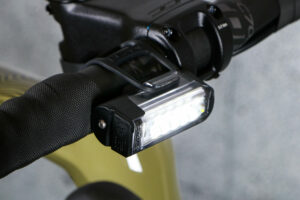
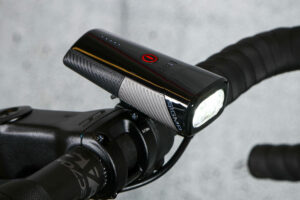
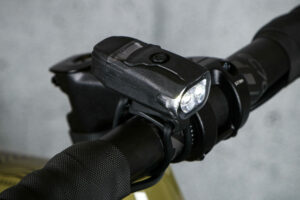
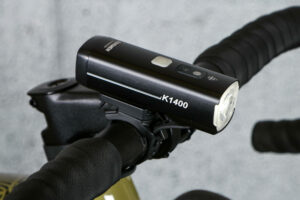
Claimed to be capable of emitting a maximum of 100 lumens, the Cateye Nano F is designed to increase your visibility in the day and at night rather than illuminating unlit lanes. Given its modest price and weight, it is a good lighting choice to leave on your bike or to carry in your pocket or bag as a backup.
Measuring 30 x 32 x 30mm and weighing 27g including the rubber strap, the Nano F is cube-shaped, contains a single LED and recharges via USB-C from flat to full battery in about three hours.
Its IPX4 waterproof rating isn’t the highest, but I didn’t notice any water ingress after downpours and bike washes.


Cateye says the rubber strap fits handlebars between 22mm and 35mm in diameter, so on standard, round road handlebars and aero bars with a round clamping area it fits well. However, I couldn’t get the strap to stretch around the flat tops of an integrated cockpit. What’s more, you can’t clip the light underneath a computer mount.
The single button turns the light on and off; gives a colour coded indication of battery life; and skips through the six lighting modes.
On the opposite side, a secure plastic tab covers the USB-C charging port.
You get three daytime flash modes emitting 100, 80 and 20 lumens, a 100-lumen High mode, a five-lumen Low mode and a 10-lumen night flash setting. I corroborated Cateye’s claimed 1h15m run time for the High mode.
The Nano F’s narrow, cylindrical beam cuts off abruptly either side, so it doesn’t cast much light in front of you. You could however use it on a well-lit street or cycle path to avoid dazzling oncoming people with your flash, or as an emergency back-up to your main light.
Since this is a safety light, its daytime flash modes, which are visible from hundreds of metres away – especially in the 100- and 80-lumen settings – will probably be more useful to you. Cateye claims the Nano F does offer side visibility, but its square shape isn’t very effective at this.
Conclusion
This front light lives up to the ‘Nano’ part of its name, with a competitive 26g weight for a 100-lumen headlight.
The Nano F also has several useful modes, mounts securely to round handlebars and seems sufficiently weatherproof for winter riding.
As a result, it’s an attractive option if you want a diminutive, visible daytime light or back-up illumination after dark.
For UK time trialists, the Nano F is a bright, aero and light way to comply with front-light rules. But look elsewhere if your bike has an integrated cockpit or aero handlebars without a round clamping area.
Trek claims its £34.99 Ion 100 R has a longer two-hour run-time in its top 100-lumen mode and it has battery-level LEDs.
And if you need a light to see at night, you’ll need something more powerful.
The similarly priced Cateye AMPP200, for example, offers twice the output at twice the weight. To triple the maximum brightness for a comparable outlay, you could buy the Giant Recon HL 350.
Verdict
A lightweight and simple ‘be seen’ front light with respectable run time and output for its size
All the deals displayed on our review pages are pulled from a constantly updating database feed of the best affiliate deals available. The criteria for deciding on what are the best deals is who is offering the lowest, delivered price. In most cases we will be showing the very best deal available online, but sometimes you may be able to find an item cheaper. If you can please feel free to post a link in the comments box below. To find out more about affiliate links on road.cc click here.
road.cc test report
Make and model: Cateye Nano F //stock due 29th Oct//
Size tested: 100 lumens
Tell us what the light is for, and who it’s aimed at. What do the manufacturers say about it? How does that compare to your own feelings about it?
The Cateye Nano F is a 100-lumen front light designed to boost your visibility during the day and for short spells after dark while adding minimal weight to your bike. In testing, the light lived up to this billing.
Tell us some more about the technical aspects of the light?
It has a 1.25hr run time in its 100-lumen brightest setting, which is powered by a single LED.
The rubber strap is secure and stretches well but only works on round handlebars.
IPX4 isn’t the highest protection but it’s still working after several rainy rides.
It lasts for 1.25 hours in its brightest mode and recharges in three hours, as per Cateye’s claims. In more economical flash settings, it will run for weeks.
It’s bright enough, but the side visibility is disappointing for a safety light.
Seems like it should last a long time.
It’s more expensive than several 100-lumen front lights. For example, the Cateye AMPP100 is still on sale for half as much.
How does the price compare to that of similar products in the market, including ones recently tested on road.cc?
The £34.99 Trek Ion 100 R Front has a similar design and spec but is claimed to last twice as long in its highest setting. The £24.99 Cateye AMPP200 is twice as powerful and the £34.99 Giant Recon HL 350 is three times as powerful.
Tell us how the light performed overall when used for its designed purpose
It works very well as a long-running and lightweight daytime visibility light, as Cateye intends. Plus, it probably isn’t very detrimentalal to your bike’s aerodynamics.
Tell us what you particularly liked about the light
Its brightness relative to its compact size.
Tell us what you particularly disliked about the light
Its square shape doesn’t emit much light sideways.
Did you enjoy using the light? It was fine
Would you consider buying the light? I prefer something cheaper or something brighter and pricier
Would you recommend the light to a friend? If low weight and small size were priorities, yes
Use this box to explain your overall score
The Cateye Nano F majors on its lumen-to-weight ratio not maximum output, meaning more powerful front lights exist for a similar price. Unless weight saving is really important for you, a higher output and heavier headlight will be a better purchase at this price point.
About the tester
Age: 31 Height: 190cm Weight: 76kg
I usually ride: Fairlight Strael 3.0 My best bike is: Canyon Ultimate CF SLX (2016, rim brake)
I’ve been riding for: 10-20 years I ride: Most days I would class myself as: Experienced
I regularly do the following types of riding: time trialling, cyclo cross, touring, club rides, Gravel