



[This article was originally published November, 2015 and updated November, 2019]
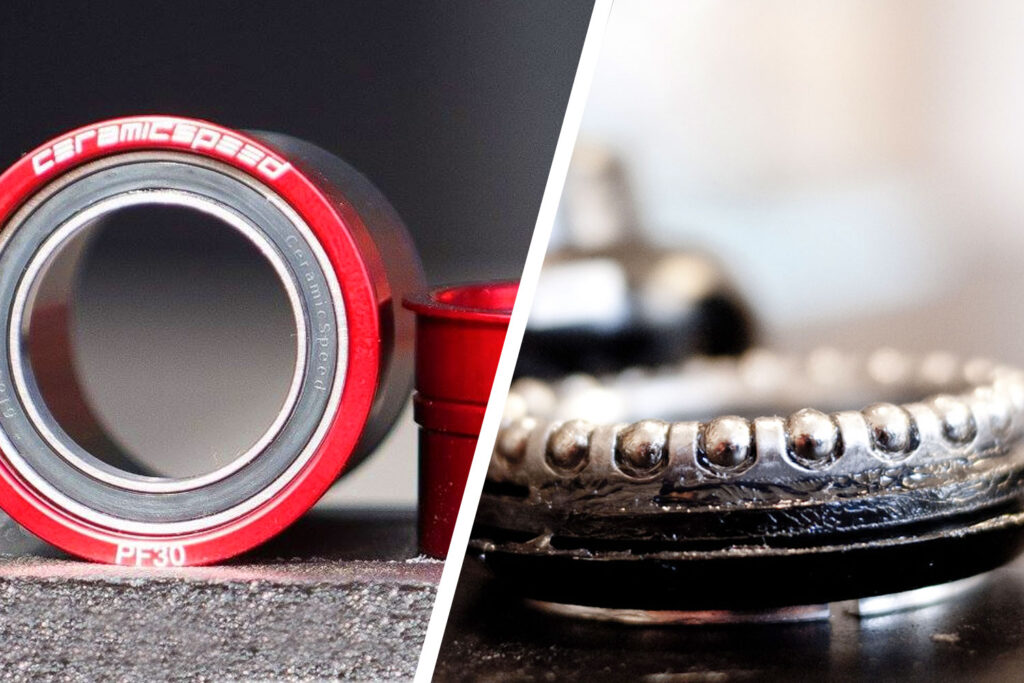
Despite the latest advances in road bike design and technology, your bicycle still relies on the humble ball bearing to ensure it all runs smoothly. There are bearings in the wheel hubs, the headset, bottom bracket, pedals and jockey wheels, and they’re commonly made from steel. There has been a lot of hype about ceramic bearings in recent years and many people claim they offer a performance upgrade. But what are ceramic bearings and what are the pros and cons?
While regular bearings are made from stainless steel, ceramic bearings are made from ceramic silicon nitride (Si2N4). Rolling resistance is the key trump card promoted by ceramic bearing fans. Because ceramic bearings are rounder with a smoother surface and more uniform size, friction is reduced and that can contribute to a less energy required to turn the cranks or spin the wheels. A ceramic bearing is also harder than steel bearings (up to 30%), which improves durability, and they also don’t rust so less maintenance should be required.
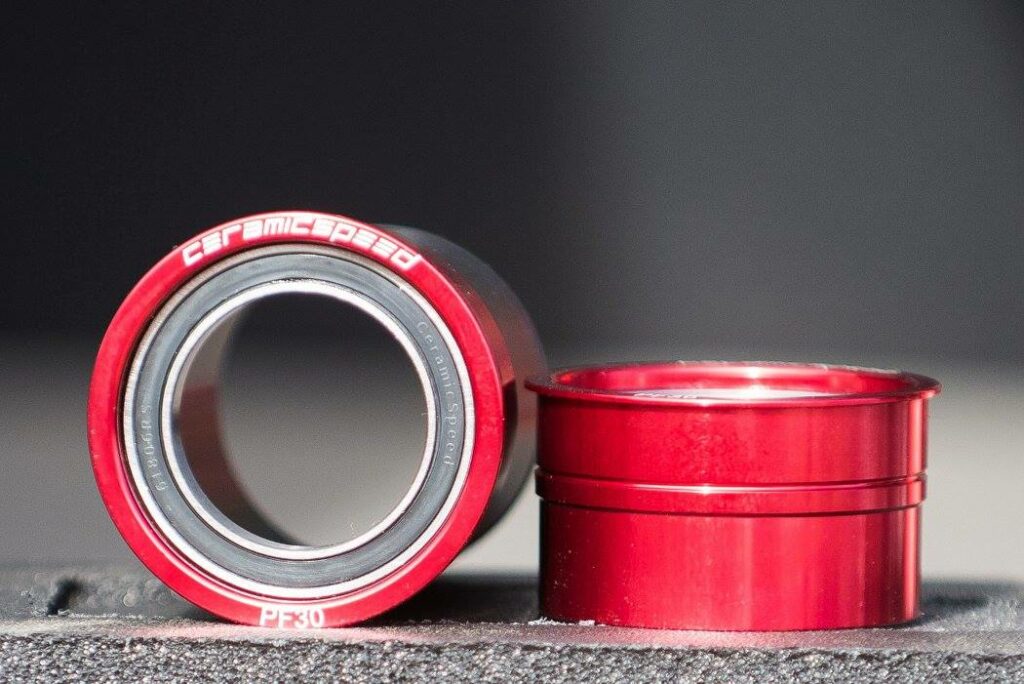
Most sealed ceramic bearings are actually hybrid ceramic bearings, which combine a steel race with ceramic ball bearings. Full ceramic bearings use ceramic races, which can be lighter and provide the lowest friction, but come at a durability cost. Unsealed ceramic bearings can be used to upgrade components that don’t use cartridge type bearings, like cup and cone hubs.
It’s in the professional peloton, a place obsessed with marginal gains, that ceramic bearings have become popular in the past couple of years. And naturally, where pros lead, amateur racers and sportive cyclists follow, keen to take advantage. Should you be following in the footsteps of the pro racers then, and upgrading your bike with ceramic bearings?
CeramicSpeed is a Danish company, founded in 2007, that specialises in supplying high-quality ceramic bearings to the cycling industry, and is a favourite of many professional cycling teams – you don’t have to look far to spot the telltale company sticker on any frame or hub fitted with the bearings. It’s seen a massive shift in the last two years with more customers keen to take up the ceramic advantage. The advantage, according to the company, is a saving of up to 9 watts with CeramicSpeed bearings in the hubs, jockey wheels and bottom brackets compared to a set of standard bearings
“The main advantages with CeramicSpeed bearings over regular bearings are two-fold,” explains CeramicSpeed Managing Director Martin Banke. “Longevity of a well-built high-quality ceramic bearing, in many cases, can be up to 10 times longer than commonly used stock bearings. The ‘rule of thumb’, as we like to call it when built well, and of high-quality materials, a ceramic bearing should always be able to outlast and outperform a steel bearing.
“The second advantage of ceramic bearings over stock steel bearings is their performance under load in reducing drag. Performance cyclists are performance driven and all data shows that the best performing bearings for reducing drag are ceramic bearings.”

That, in theory, should mean less energy is required to turn the wheels or cranks. Add the lower weight and improved durability, and why wouldn’t you run ceramic bearings? But are all ceramic bearings the same? Of course not, CeramicSpeed is keen to point out that not all ceramic bearings are made equal, and it tells us that a ceramic bearing built poorly with low-quality materials will deliver very poor longevity.
“A lot of bearings can spin well in the hand but that by itself is not enough,” says Banke. “It is really about the performance of a bearing under load, both drag reducing performance and lifetime performance. We are now starting to see a ‘shift in the seas’, a common understanding that ceramic does last and is very advantageous if of a high enough quality.”
When the benefits sound that good, you’d think all component manufacturers would be embracing ceramic bearings, right? Highly regarded British component manufacturer Hope Technology reckons the efficiency savings are simply too negligible to make them worth the increase in cost.
“We have looked at ceramic bearings in the past and talked them over with our bearing suppliers,” explains Hope’s Alan Weatherill. “They do run with less friction, which offers a significant advantage in industrial applications running at 20,000 rpm. A tiny percentage reduction in friction here can equate to a worthwhile power saving, but when you’re only turning at 300 rpm, as you do on a bicycle a small percentage increase in efficiency will make a negligible change to your power output. Certainly not worth the significant increase in cost.”

Leading industry wheel dynamics expert and CEO of Edco Wheels , Paul Lew, backs this up and reckons it makes ceramic bearings a poor choice for hubs and headsets, also adding that they offer no weight savings and are only beneficial in environments where high rpm (revolutions per minute) are required.
“For bottom bracket applications, the maximum sustained rpm may be 130,” explains Lew. “For wheel hub applications, the maximum rpm may be 500 – 600 revolutions per kilometer (depends on wheel/tyre diameter). The maximum rpm values in cycling are far below the typical ideal rating for ceramic bearings which is 10,000 rpm+.”
It’s clear that Alan and Paul agree that the factors that make a ceramic bearing well-suited to industrial and medical equipment applications, and high-altitude operating drone motors (Paul does a lot of work designing drones) where the rpm is high, the load is low and the operating conditions are clean, are factors that mean they’re not suited to cycling.
“Ceramic bearings are beneficial in environments not requiring grease lubrication,” says Lew. But a bicycle is expected to cope with a vast range of conditions, rain and dirt, and where maintenance schedules may be less than optimal, and the last thing you want is to ride bearings without grease. It’s this requirement to cope with the conditions common to cyclists that offset the promised lower rolling resistance of a ceramic bearing, according to Paul Lew.
“The rolling resistance of a ceramic bearing compared to an ABEC 3, 5 or 7 steel ball bearing is offset by the resistance of the grease,” he says. “In order for a ceramic ball bearing to out-perform a steel ball bearing, grease is not an option. Does this mean I should run my ceramic ball bearings dry or with light oil? Yes, but you won’t like the result in an environment where the bearings can become contaminated. If you run your bearings dry they will feel gritty and rough.”

Hope’s Alan Weatherill concurs with Paul Lew’s conclusion that ceramic bearings are not suited to the demands of cycling and says their suitability to industrial machinery doesn’t necessarily provide the performance benefit for cyclists that many people and companies claim they do.
“Another issue with using them [ceramic bearings] on bicycles is their hardness,” says Weatherill. “While this again is an advantage in many industrial applications, it’s a major drawback on bikes. The shocks from hitting potholes and other road blemishes impact the hard ceramic balls into the softer steel races commonly used. This dent in the race is then felt when the bearing is rotated, giving you rough bearings.”
The less polite stance
Weatherilll and Lew are measured in their scepticism about the overall benefits of ceramic bearings. Rather more forthright is Sachin Hambini of Hambini Engineering. An aerospace engineer who has built up a cult following for his scathing criticism of the quality of manufacturing in the bike industry, especially where press-fit bottom brackets are concerned.
Here’s what he has to say about ceramic bearings. Warning: adult language.
How much?
Then there is the fact that ceramic bearings aren’t cheap. CeramicSpeed’s BSA Road external bottom bracket for threaded frames costs £298. A Shimano Dura-Ace 9000 bottom bracket cost £39.99, much less if you shop around. A CeramicSpeed bearing upgrade kit for Campagnolo and Fulcrum wheels will set you back £120, and Zipp charges £194 for a CeramicSpeed bearing kit for its wheels. That makes upgrading to ceramic bearings a serious investment, fine for a professional cycling team, less so for a privateer racer.

The premium for ceramic bearings is high then, and their advantages, while looking promising in an ideal world, appear to stack up much less in the demanding environment that a bicycle is expected to perform and survive in. So should you choose ceramic bearings? We’ll let Paul Lew have the last word.
“Although the re-selling markup/ margin for ceramic bearings is significant for manufacturers such as Reynolds, and they could represent a profit-center for the brand, we choose not to offer them because they don’t improve performance, and they represent a consumer cost that we can’t justify, and that’s contrary to our value system,” he concludes.












80 thoughts on “Should you buy ceramic bearings? Expert opinions polled”
Hey – I thought Road.CC was
Hey – I thought Road.CC was all about taking advertiser’s cash, pushing marketing hype and obligatory 4-star reviews?
Damn. We’re gonna need a better conspiracy theory.
KiwiMike wrote:
I think you have them mixed up with BikeRadar.
Road.cc accused of pushing
Road.cc accused of pushing marketing hype by readers.
Road.cc publishes article downplaying marketing hype.
Regular road.cc contributor promptly comments on how this disproves the “conspiracy theory” that road.cc pushes marketing hype.
Hmm.
I dunno, it’s not exactly Operation Jade Helm, is it?
Toro Toro wrote:
HaHa! You fell for the oldest trick in the book (apart from not getting involved in a land war in South-East Asia): Now that you’ve caught me out, we are free to continue our nefarious plans to have Wiggle buy EVERYONE and do EVERYTHING bike-related in a nifty pastel block print / green anodised finish / 30mm width / disc-braked.
[drums fingers] Excellent.
C’mon guys, this isn’t
C’mon guys, this isn’t BikeRadar…
I thought that was an
I thought that was an excellent article that explained things and tried to keep things balanced without pushing one way or the other. Cheers.
+1 for ceramic bearings.
+1 for ceramic bearings.
However, I’ve had noticeable results from cleaning bearings, sticking an airline on them, getting them up to speed and dropping a tad of Shimano Mineral Oil on them.
I then put the outer seals on (leaving the inners off) and press back into place.
With this combo, you get quicker spool up from reduced drag, lower energy needed to push the wheels round and a reasonable amount of sealing for the British roads.
Obviously, I wouldn’t do this on my training wheels but it’s certainly worthwhile on your good set & cheaper than a set of ceramics to boot.
interesting that Paul Lew
interesting that Paul Lew says the extra hard ceramics put dents in steel races… ummm, so do normal steel balls ! if they didn’t then they’d break. ( ellisblackman) -Flushing out heavy grease in steel bearings is fine if you are doing a short race on the track like a sprint or kilo, but on the road the hubs get really hot because there is no heat dissaption from grease ( ceramics naturally absorb the heat). i’ve seen hubs completely disintegrate due to this, with slightly catastrophic results . What i do know is that CeramicSpeed quality ceramics accelerate better, as all of the balls are exactly the same size, as all of them make contact with the races, so the BB is up to 30% stiffer. I believe Lew doesn’t offer them because he wants to keep his wheels in a price band – not because they don’t make a difference. I’ve seen SRM and Powertap data that says 10-15 watts difference – same day, same bike, CeramicSpeed bearings.
djbambina wrote:
I emailed Reynolds Composites about ceramic bearing well before Paul was employeed by them. Remember he had his own company called Lew I think and he brought the wheel he made to Reynolds and called it the RZR. When I asked Reynolds about ceramic bearing they said back then that did not think there was any benefit. The guy I spoke to said sometimes for short races he ran his steel bearings without seals and got the improvement offered by ceramics but without the cost. I think they just genuinely don’t rate them. If they did they could always offer an option.
djbambina wrote:
I’ve never seen him espouse such an opinion. Got a link for that?
djbambina wrote:
I for one love Ceramspeed BB bearings, definitley spin alot easier, then the fact they have a longer life makes it alot more appealing. I can destroy my shimano press fits in a cpl of months, but these feel as new after 6 months (with a little more labour of course, regreasing).
I wint go for their jockey wheels though, I never have a problem with standard ones and the gains just not worth the cost.
interesting that Paul Lew
[quote=djbambina]
“interesting that Paul Lew says the extra hard ceramics put dents in steel races… ummm, so do normal steel balls ! if they didn’t then they’d break. ( ellisblackman) -Flushing out heavy grease in steel bearings is fine if you are doing a short race on the track like a sprint or kilo, but on the road the hubs get really hot because there is no heat dissaption from grease ( ceramics naturally absorb the heat). i’ve seen hubs completely disintegrate due to this, with slightly catastrophic results . What i do know is that CeramicSpeed quality ceramics accelerate better, as all of the balls are exactly the same size, as all of them make contact with the races, so the BB is up to 30% stiffer. I believe Lew doesn’t offer them because he wants to keep his wheels in a price band – not because they don’t make a difference. I’ve seen SRM and Powertap data that says 10-15 watts difference – same day, same bike, CeramicSpeed bearings.”
Unless you are running seized bearings, no bicycle hub has to deal with the heat ceramics are designed for, i.e. hundreds of degrees. Dry bearings of course are likely to gall and then seize. Even if one could reliably detect the slight theoretical gains from ceramic bearings, one is never going to sense a greater acceleration, period. No BB will magically gain a “30% increase in stiffness”, however that would be measured, from the compressive differentials between say a 5/32″ steel and ceramic bearing, because that would represent having to compress the steel ones to about 1/2 to 1/4 their normal diameter to generate even a few degrees of deflection, beyond the power producing abilities of a human leg by a factor of some thousands.
I destroyed the races of a Campy Record hub, perfectly greased and set up, in a few hundred miles with Enduro loose bearings, which also failed. This I have never experienced with even thirdhand junker bikes in over fifty years of wrenching, so perhaps grease and steel just are more functional not to mention cost-effective. But, I’m sure your local bike shop loves to see you come in to assuage your power generating insecurities on a regular basis.
That was a good blog. I
That was a good blog. I thought very well balanced. Personally I’ve never had success with ceramic bearings. I couldn’t notice a difference when they were running in my hubs, but I certainly noticed they didn’t have the longevity I would expect for the price (they were installed as part of the new wheel purchase). Two techs I spoke with at major bike manufacturers said they would recommend staying well away from them in future.
If I had my own pro mechanic and cost was not a consideration, I would go ceramic. Since I’m not blessed with a mechanic and cost is a factor, its steel for me 😉
So… apart from the typical
So… apart from the typical “up to …. watts savings” (in the extreme scenario) marketing bs, are they any INDEPENDENT studies proving the claimed benefits for a typical non-competing rider?
BBB wrote:
The answer to that is NO.
Is there any independent studies that demonstrate a reduced wattage at cycling speeds on a real bikes
NO.
As said, ceramics are designed for high speed low load. A bit of light oil in a clean race is fine, but at BB speeds the difference is not measurable, and is probably negative after the first bit of rain (& ingress of grit). At wheel speeds it’s still not going to be measurable but might be appropriate on a track.
Claims of 10-15 watts ignore the error in the instruments and measuring protocol. Not supportable in any independent test.
BBB wrote:
Friction Facts.
What about titanium beerings?
What about titanium beerings?
So… steel bearings are
So… steel bearings are probably better. Hmm. Can you get the sticker on its own? 🙂
[quota]
The correct one is Si3N4…..
Bought some Ceramic bearings
Bought some Ceramic bearings for my BB from one of the main competitors to Ceramic Speed (similar major cost). Initially impressed with them dry (straight out the box in my hand) but by the time the supplied grease was added and the seals were on there was no difference to the old quality steel bearings.
I certainly didn’t see my watt output increase. I have two bikes with identical drive trains apart from the ceramic bearings and swapping between them provides no measurable difference on an indoor trainer with power measurement (Kickr).
I would say save your money and spend some of it on quality steel bearings. Get ones with the highest ABEC rating – it doesn’t guarantee the material quality only the roundness, but at least it is something
macrophotofly wrote:
I think you’re a bit confused there, because nothing you do to your bike whether aero, ceramic, carbon, lower rolling resistance tyres or any other upgrade, will affect your power. Your power meter or your trainer is only measuring the effort you yourself are making.
So if you’re riding at say 200w, on your commuting bike with a rusty chain and half flat tyres and your powermeter says 200w, and you’re doing say 15mph, and then you put your carbon super dooper wheels on that same bike with ceramic bearings and race tyres , and ride at the same 200w, you should notice some SPEED improvement at the same given power output -maybe you can see 20mph on your speedo. So the fast stuff you added allowed you to reduce drag/friction/weight or whatever and therefor go a bit quicker, it didn’t affect in any way your fitness/strength/power output in watts
Thats the result of this formula : SPEED= sum(expensiveness+looks)x weight savings= total awesomeness.
Bob Smythe wrote:
It won’t affect the power output by his legs, but it will affect the power reading given by a trainer as it measures power at the rear hub, therefore includes drivetrain losses.
Obviously, Vectors won’t care what bearings you have in your BB.
srchar wrote:
It won’t affect the power his legs put out, but it WILL affect the power at the rear hub, which is where the KICKR measures power.
If he was talking about power at the crank, you’d be right, but hes not.
Either way, its not exactly scentific as he is only measuring difference time to time. Obviously this doesnt factor other variables. To measure it, you’d need to measure the difference between the power at the crank and the power at the hub, to see what gains (if any) are made.
The problem is, the KICKR is only accurate to within +-5%. Ceraamic bearings dont give anywhere near that benifit, so you would need super accurate equipment to measure it. I suspect the benifit is so small, its not actaually measurable in a reporducable way. Thats probably why no one has published the results.
macrophotofly wrote:
I think you’re a bit confused there, because nothing you do to your bike whether aero, ceramic, carbon, lower rolling resistance tyres or any other upgrade, will affect your power. Your power meter or your trainer is only measuring the effort you yourself are making.
So if you’re riding at say 200w, on your commuting bike with a rusty chain and half flat tyres and your powermeter says 200w, and you’re doing say 15mph, and then you put your carbon super dooper wheels on that same bike with ceramic bearings and race tyres , and ride at the same 200w, you should notice some SPEED improvement at the same given power output -maybe you can see 20mph on your speedo. So the fast stuff you added allowed you to reduce drag/friction/weight or whatever and therefor go a bit quicker, it didn’t affect in any way your fitness/strength/power output in watts
Thats the result of this formula : SPEED= sum(expensiveness+looks)x weight savings= total awesomeness.
Bob Smythe wrote:
To be fair, he did say that it was measured by a kickr, so it’s after drivetrain losses, which would be affected by bb and jockey wheel friction
we used to fit ceramic speed
we used to fit ceramic speed bearings to all the S-Works custom builds in our workshop because they came supplied with the frame
the poor BB design (OSBB) with the press fitted nylon cups which tended to ‘walk’ under load actually caused the bearings to fail long before any wattage savings could be experienced
we’d replace them with regular BB30 steel bearings and those nylon cups bonded with DP420 epoxy, and riders said there was no difference in feel at crank?
I know in mountain biking we would not use ceramic bearings due to constant impacts / shock loads, can’t see it being any different in road cycling due to the state of our highways
I’ve replaced all my Campag
I’ve replaced all my Campag Ultra-Torque orginal bearings with Boca Bearings’ ‘Yellow Seal’ ceramics. Not so much for reduced friction but for far greater durability than afforded by the rubbish that come fitted. Have never seen the alleged pitting issues.
Huw Watkins wrote:
On what do you base your opinion? I have several bikes with Campagnolo Ultra-Torque and my experience is that after twenty or thirty thousand km of hard cycling tthere is no play, they turn smoothly as are just as light as when new.
Huw Watkins wrote:
Campagnolo original bearings not good? What have you been smoking?
When it comes to wheel
When it comes to wheel bearings your best bet is to replace the cheap chinese bearings that come in the majority of sub £500 wheels these days
Rather than pay out loads for ceramics try a nice set of japanese skf or nsk bearings from your local bearing supplier, these will outlast any chinese bearing, will cost around £10 more per bearing than the chinese equvilant but no way near as much as a ceramic one would be
These bearings are used in industrial machinery and in manufacturing process lines, conveyor bets, rollers etc.. so are hard wearing and smooth rolling, designed to last
kev-s wrote:
SKF = swedish (Svenska Kullager Fabriken)
Ezo = japanese
kev-s wrote:
SKF is Sweedish. I know because I work for them. And yes, when my endro bearings that come on my bottom bracket or wheels give out, I switch them to SKF bearings.
As for the denting Paul Lew is talking about, that is called brinelling. It also happens to standard bearings as the ballset is typically the hardest object in your bearing, although there is still some compression experienced in steel ballsets. There will be slightly less in ceramic which may lend itself to being more prone to brinelling.
asmallsol wrote:
SKF is indeed a Swedish company but they do manufacture bearings all over the world. I have bought SKF bearings made in Japan, Italy, France.
Mebbe worth adding that there
Mebbe worth adding that there’s been a big market in counterfeit bearings for the last handful or years or more. Tbh I dunno how you’d descriminate, but google is your friend.
As for ceramic bearings or buggerall lube – the no of watts you’d save is down in the noise..
@kev-s
@kev-s
you make a very good point about cheap bearings. Its something I saw in mountain biking full suspension frames some years back, they used to come fitted with quality bearings on the pivots, and then they started turning up with unbranded generic bearings that would cr*p out after 2-3 months of riding, or actually feel graunchy from new!
Obviously a massive cost saving for the frame manufacturer if saving $40 on a set of bearings and selling 30,000 frames a year!
We used to refit the frames with quality Japanese or German bearings sourced by an industrial bearing supplier in Park Royal, and these would last several seasons without issue. Well worth the £5-6 each bearing cost.
I think I’ll go back to an
I think I’ll go back to an internal bb next time, for my lightweight commuter bike.
My thinking is, smaller spindle, less stiff (in theory), bigger bearings, much longer lasting (in reality).
The external bearing design is great but only for the first 1000 miles or so.
Interesting article.
Interesting article.
I would definitely use if I was a professional racer.
For someone who just enjoys riding, keeping the price realistic and reliability: I’ll stick to steel bearings and grease.
Plenty of opinions on
Plenty of opinions on bearings (backed up by years of research) from Keith Bontrager in this fascinating Velocast interview. Well worth a listen:
http://velocastcc.squarespace.com/tech5/2016/4/23/episode-34-keith-bontrager.html
Latest related review on the
Latest related review on the Tacx ceramic bearing jockey wheels is here: http://road.cc/content/review/199145-tacx-t4035-jockey-wheels
I’ve been using a ceramic hob
I’ve been using a ceramic hob for years but its not improved my cycling at all.
Much like the ‘science’ of
Much like the ‘science’ of nutrition or tyre sealant people spin things (pun intended) any way they want. Adding to this most user info is purely emperical.
I did appreciate though that Martin Banke talks about the performance benefits under load:
“The second advantage of ceramic bearings over stock steel bearings is their performance under load in reducing drag. “
That’s what I wonder about. Seeing the demos of the little bearing spinning forever appears pointless to me. I want to know what difference is there under load? Really it’s not just about ceramics, but what about as bearing start to wear and you notice a bit of a grit.. or anything less than perfect. Say I hand spin the wheel and it comes to a stop sooner than when the bearings are new; what does that really mean when I’m riding? No differnece? Or 10 watts? more?
But I can’t imagine this isn’t easy to figure out. I see so many aerodynamic windtunnel tests; why not tests with bearings under load. All you’d have to do is take virtually anyone’s bike that’s been on the road for a few month and test it out. Then replace the bearings, either with new ceramic, or steel, and do the same test, and see if there really is an improvement. Compare the new steal to the new ceramic, and different manufactures, and provide some real evidence. Don’t just spin a little bearing in your hand and pretend it’s proof!
My guess is there is some marginal differnce. But marginal, as a racer, can be huge! And I suppose it’s impossible for tests to quantify the psychological gains you get too. If my chain runs dry my bike feels slow. If I lube it up in the middle of a ride I feel much faster. I sincerely believe that a lubed chain vs a dry chain is like 10 or 20 watts faster. Is that real? Is it purely psychological? Or both?
I was checking this article out though because of another issue; brake pad drag. I went up the Combe Lane climb near London on Sunday and I was one full minute slower than my last time up a few months ago. I was carrying a couple extra things on the bike, but my weight is more or less the same. Did I miss my morning coffee? Was it the extra hours spend on the bike during the week? The garmin popped up with the segment an I could see the seconds I was falling back to my PR with every pedal stroke. Yet I didn’t feel that weak: I didn’t feel like I should be a minute slower!
C’est la vie! But I was in the garage last night and making some adjustments when I hand spun the rear wheel, and there was some brake pad drag (disk brakes). I estimate the wheel came to a stop within 10 revolutions rather than maybe 30. Did that make a wattage differece? Under load would it be more? Then I spun the front one and wow, that came to a stop within 3 revolutions! There was a ton of drag there! But is it really a significan difference under load on a slow climb? Will that account for my full 60 second difference on a 5min climb?? (I hope and wish!)
This happens all the time with MTB disk brakes. Most often not as bad as my bike is now but the brake pads can easily be hitting the rotor and causing a minor drag. But even that small drag is probaby way more significant than the difference between the average ceramic vs steel bearings. I really wonder how much all this makes a difference though, under load?
I build my wheels and tried a
I build my wheels and tried a set of hybrid ceramic bearings. They lasted me about a month. My best set of wheels has SKF ABEC 5 steel bearings. They are my everyday wheels and are going for 2 years now.
fabriciomrtnz wrote:
I’ve been using SKF since around 1990, campag used to have them in their bottom brackets and even some other lesser known names like THUN. it was one of these THUN BBs 9with the same half moon interface on the cups) that is amongst the smoothest and with least resistance BBs i’ve ever come across. I got a semi ceramic (most Si3N4 aren’t a full ceramic bearing but a coating on a steel ball) BB inclyded with an FSA K-Force light a few years ago, honestly it was garbage, it had had maybe 50-100 miles tops but so much drag compared to even the octalink BB on my daily.
There’s a bloody good reason that shimano hubs do so well longevity wise and indeed the campag hubs of yesteryear, I have an ofmega hubset from the early 80s on some mavics for my 50s bike that are sweet as a nut and still running an early 90s sansin (AKA sunshine) sealed hub on an MA2 that has seen 20k
Marginal gains in some instances maybe but for most it really isn’t worth it.
BehindTheBikesheds wrote:
Yesteryear ? just dont buy inferiour fabric wheel – The Record hub still has steel bearing and races.
Campagnolo (fulcrum) is kind of interresting in this way, the more you pay for your wheel the less sound construction you’d get. But hey, marketing works.
Cost / marketing rating:
1) Shamal – ceramic bearing and aluminum spoke
2) Eurus – steel bearing and aluminum spoke
3) Zonda – steel bearing and sss spokes
Sound construction rating:
1) Zonda – steel bearing and ss spokes
2) Eurus – steel bearing and aluminum spoke
3) Shamal – ceramic bearing and aluminum spoke
reg the ceramic USB bearing yoou can upgrade them to the best steel balls on the market in 5 minuttes with the sparepart HB-RE023
The cult bearing – you’d need the record cups and cones as well: HB-RE124 & HB-RE022 (and an expensive Cyclex tool to press in the cups. 30 minuttes)
But hey we beeing bombed with advertising infomercials written by journalist with abseloutely no engernering background for 15 years som everyone assumes that a ceramic bearing is better for bicycles. Unfortunately only few manufaturs maufactures their steel bearings with the higst grade steel bearings. Campagnolo still does in their entire range (except for products with USB/Cult), Shimano does but only in their Durecae/XTR range, DT & CK does , – assume small manufctures like Hope and White does too (otherwise they die).
Compare the factory shipped bearings in a cheap Cmapagnolo wheel to a Shimano or Mavic wheel. The cheap nonseries shimano wheels are horible, the Ultegra evel are OK but does not compare to any Campy hub (or dureace).
The Rovel CLX 40 Disc wheels
The Rovel CLX 40 Disc wheels from my S-Works Roubiax are in the LBS this week having the Ceramic Speed bearings changed out to decent steel ones. The front ones only lasted about 5,000 miles before they felt like rocks going round.
Ceramic Speed want £400+ for a new 5 bearing set, a set of good quality steel ones is less than £100
At the moment I’ve left the BB and headset ones in place as they seem ok.
If hard bearings dent the
If hard bearings dent the races on bumpy terrain does that mean a frameset with an integrated headset is going to be ruined by a rough road or two?
I just fitted some ceramic
I just fitted some ceramic bearing tacx t4025 jockey wheels to my commuter, £25.50 from ebay, more for longevity, the last tacx jockey wheels were the steel bearing ones, which seized up long before the teeth had started wearing. My first set wore the teeth.
The alloy ceramics on the good bike have lasted a very long time, so I thought I might as well. Was tempted by the stainless ones, but she’s worth it.
The light colour helps to show me the filth and that it needs a clean.
ktache wrote:
I have some of those. They are very good for the money, Friction Facts tested them and found them to be second only to Ceramic Speed for about a tenth the price. Had them a few years and one has got a bit gritty.
SKF bearings are probably the
SKF bearings are probably the best out there. High quality, no hype, no BS.
Boss Hogg wrote:
My dad works for SKF (has done for about 40 years so slightly biased view), a lot of their bearings are actually made in the UK. I asked him about ceramic bearings for bikes and his face was a bit of a picture, apparently they test different materials quite frequently and while yes the ceramic bearings they’ve compared against do offer less friction than steel, the difference isn’t linear, at anything under a few thousand rpm apparently it really is negligible (admittedly I don’t think these were cycling specific ones but I don’t think there can be that much difference as the basic design is similar)
If you’ve got the cash to spend then fair enough I guess, but I could upgrade all of the bearings on my bike to high grade steel ones for less than the cost of ceramic ones in one area. As much as I like free speed, I really can’t justify the cost vs my performance, I’d rather put the money towards a coach if I was that bothered.
SKF also supply bearings to almost all the formula 1 teams and only a few of those are ceramics in the highest speed applications (inside engines etc I believe).
Hi nice article road.cc! I
Hi nice article road.cc! I also saw this video: https://www.youtube.com/watch?v=vPWgtscgfa0 both of which seem to suggest ceramics bearings don’t work as well as claimed? Maybe the gig is up for ceramics? bw Maria
Good article with some
Good article with some relevant contributions from people with proper subject knowledge (Hope and Reynolds). Their comments are spot on.
The single biggest issue when specifying bearings for bikes is the trade-off between sealing efficiency and low drag. Generally you can’t have both.
Use quality replacement steel bearings from one of the four major global brands SKF, FAG, NSK or NTN and choose the seal type depending on intended use. So for example an indoor track bike could use shielded bearings (metal shields with no rubbing contact, often referred to as ZZ type). For a MTB that you wash down with a pressure washer you will want full contact rubber seals (2RS, LLU, DDU etc). Consider removing the inboard seal to reduce drag.
The majority of ceramic bearings manufactured globally are hybrids; metal rings with ceramic balls. These are typically used in high speed, low load applications such as machine tool spindles. As ceramic has a lower mass than steel the centrifugal forces generated by ceramic balls at very high speeds are significantly lower than for steel balls. As a result ceramic hybrids runs cooler with less drag. However these effects are not measureable at speeds associated with cycling.
For example I have some DT hubs with 6902 bearings (15x28x7mm). These steel bearings are rated for speeds up to 16,000rpm with full contact rubber seals or 24,000rpm with metal shields by the manufacturer. At 50kmh my wheel would only be rotating around 400rpm !
Also with a cartridge bearing you should never need to remove the seals to wash it out and re-grease it. Basically if dirt or water has got past the seals then it is already too late and time to replace it.
Pheasant Plucker wrote:
+1 THIS ^^
Also I’d add to anyone who has never span a decent steel bearing between their fingers without grease, give it a go, it’s not dissimilar to the ceramic ones without grease we are told are so much better’er.
One of my sons bought an
One of my sons bought an overpriced (at least I thought at the time) fidget spinner on holiday recently. It seems a feat of engineering to my unengineery mind. If you so much as look at it it will spin for 3 days. It is not your common garden fidget spinner, and my son loves it.
I’m fighting an internal battle daily to keep it as the toy he loves and not hack it into my collection of Pieces of Stupid Shit I Don’t Properly Understand And Shouldn’t Have Starteds currently on my garage worktop.
When they suggest ceramic
When they suggest ceramic bearings for headsets then you know something is wrong.
An interesting (if your a bit
An interesting (if your a bit of a boring geek like me) compromise between steel bearings and ceramics would be to have a DLC (diamond like coating) applied to steel bearings, I’ve had this done for motorsport applictaions in the past and it’s much cheaper than switching to ceramics which can cost £4K a corner for race car wheel bearings!
I have ceramic BB bearings
I have ceramic BB bearings from c-bear, not because they’re ceramic, but because 386evo shells are a pain.
Needed something that would accommodate my Shimano cranks with no adapters, there’s a little less friction but I honestly don’t notice while riding.
thanks for the honesty re:
thanks for the honesty re: ceramic bearings
saves me some cash, and peace of mind. too…..
Hmmm, how come the mention of
Hmmm, how come the mention of aerozine and other affordable ceramic bottom brackets did not rate a mention. The current option of $58 usd on ebay has to be a reasonable option..not to mention a Taiwanese option for
Very true. The set I’ve just
Very true. The set I’ve just fitted to my Hunt winter wheels said made in Italy on the packet.
A couple of weeks ago I put
A couple of weeks ago I put in a 29 year old Campag Croce d’Aune (second tier) bottom bracket in a classic bike I’m building up.
Once adjusted, it spun longer than even a brand new set of Ultratorque or Hollowtech II bottom bracket bearings. Without the chain on, the cranks just spun and spun. Not as stiff, but a lot smoother. ‘Sweet as a nut’ as someone said above.
Could it be because there’s more lever advantage over a smaller diameter bearing? Heavier cranks giving more angular momentum when spun?
I don’t know if its been
I don’t know if its been linked before but if you’re remotely interested in splashing the cash on ceramic bearings watch this first: https://www.youtube.com/watch?v=o7iZVfSDbiA
(Spoiler Japanese steel bearings were better but I can’t remember why…)
I *think* this video is an explanation of someone else’s internet paper….
Paul Lew’s articles are no
Paul Lew’s articles are no longer available on Reynolds web site. They were a good informative read. Maybe he can publish them again somewhere.
I have S-Works venge 2019 just found out today by contacting ceramic speed service on wheel bearings 1000km to 1500km so about every 2 weeks . R S Hope hubs on wheelsmith wheels over 2 year still spin very free ceramic bearings gritty when wheel held.
No, unless you’re a washing
No, unless you’re a washing machine.
Why is this article dated 7th
Why is this article dated 7th Nov 2019 … but the comments are up to 3 years old?
Sorry to be the one who
Sorry to be the one who breaks this to you but… you’ve been in a coma since 2016
Nick T wrote:
Careful! You have to break it to him gently.
This article’s so old, that
This article’s so old, that hairstyle is back in fashion again.
This article’s so old, that
This article’s so old, that hairstyle is back in fashion again.
Should add ceramic bearings
Should add ceramic bearings to that cycling snake oil article you put up a few days ago.
Since my washing machine
Since my washing machine quote 8 months ago, I’ve acquired a Factor 02 which has Ceramicspeed bearings (BB and wheels) fitted as standard. I can’t notice the difference over my other bikes – all of are 15+ years old and either Chris King / Shimano Ultegra or Chorus / Chorus, and Record / Record….
One more thing the bike
One more thing the bike industry told us was better and we should spend money and then it turns out it is not even AS GOOD as what we alreay have…
High end bikes have become status purchases and ceramic bearing were just one more way to extract money. Those stupid oversized pulleys are the same thing.
20-30 years ago, people
20-30 years ago, people griped that the bike industry was trying to stop us buying good old 531-framed bikes. Why would anyone want to pay so much extra for soulless aluminium?
I remember arguments that nobody needs a stupid status purchase like clipless pedals or an 8-speed cassette; after all, Eddy Merckx won the TDF without such fripperies.
Technology changes and the Luddites move along with it, keeping one pace behind. 🙂
I’m going to protest too much
I’m going to protest too much and say that my Factor came with these bearings as standard and it doesn’t have the stupid oversized pulleys (though they probably add more efficiency to pedalling than ceramic bearings)….
I’ve had it 9 months or so now and still can’t tell the difference – but that said all the bearings on my bikes are high end. Chris King bearings are a pain in the arse and need servicing regularly. Could have bought some DT Swiss 240s for the money….
If, and it seems it is from
If, and it seems it is from the above, the main argument against CB is the cost then they’re worth it if available cheaper.
My race wheels on my race bike are lightweight Chinese 1360gram aluminium
ones. They have factory supplied CBs. I have had the same set without
CBs. The CBs roll smoother for longer and feel faster = worth it for me for race only wheels.
One the same bike I’ve fitted higher end (but still not expensive) CB BB and pulley wheels. As above – faster for longer.
As this bike only sees say 25 mostly dry races a year I see these bearings lasting a few years.
Its pretty easy to get
Its pretty easy to get commodity ceramic bearings from a bearing factor for only a small uplift.
For example – full set of 4 replacement bearings for Hunt Sprint hubs £25 (from Hunt). Full set of ceramic ones from Random online bearing store £37.
That’s a massive 48% extra
That’s a massive 48% extra though.
I have a mate with an
I have a mate with an embarrassingly expensive handmade Titanium bike and he got it fitted with all sorts of exotic parts. It had a ceramic bearing BB that never worked even at the cost of over £200. It kept coming undone. The tightening instructions didn’t work, and it would tighten up to being seized. Pointed out how many sets of bearings he could throw away for the price of his troublesome supposedly last forever BB.
Then the ceramic wheel bearings in the super-lightweight hubs went as rough as a badger’s proverbial – he spoke to several bearing suppliers and they all explained that the ceramic bearings were too hard – fine for a pro and a single use time trial, useless for on the road where the mismatch in hardness caused the steel surface to pit.
So now he’s spent another small fortune to downgrade all the super parts.
He reckons the most reliable bike he ever bought was his Giant Defy Advanced Pro from about 2015 which cost him about 25% of his handhbuilt exotica grief machine.
Hi Performance Bikes are like
Hi Performance Bikes are like High performance cars…. a maintainance nightmare. Decent commodity stuff just works.