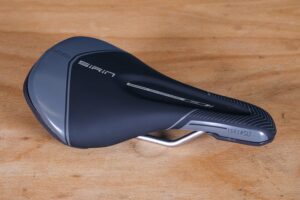
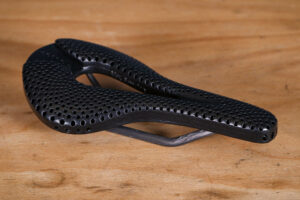
The Posedla Joyseat 3.0 Pro is a lightweight 3D printed saddle that’s custom made for your personal riding style and physiology. Odds are it’ll prove more comfortable than your current saddle, but there’s a limit to what can be achieved, and that means the improvements might not be proportional to the price.
3D printed saddles have been around for a few years now, but custom printed ones are still rare. We’ve previously tested the £500 Fizik One-to-One custom 3D-printed saddle, and the Posedla 3.0 promises to deliver something similar, just a little more accessibly. Relatively speaking.
This version is the Pro, which sits above the Plus and below the Ultra, and combines a twill carbon shell with thermoplastic polyurethane (TPU) padding.


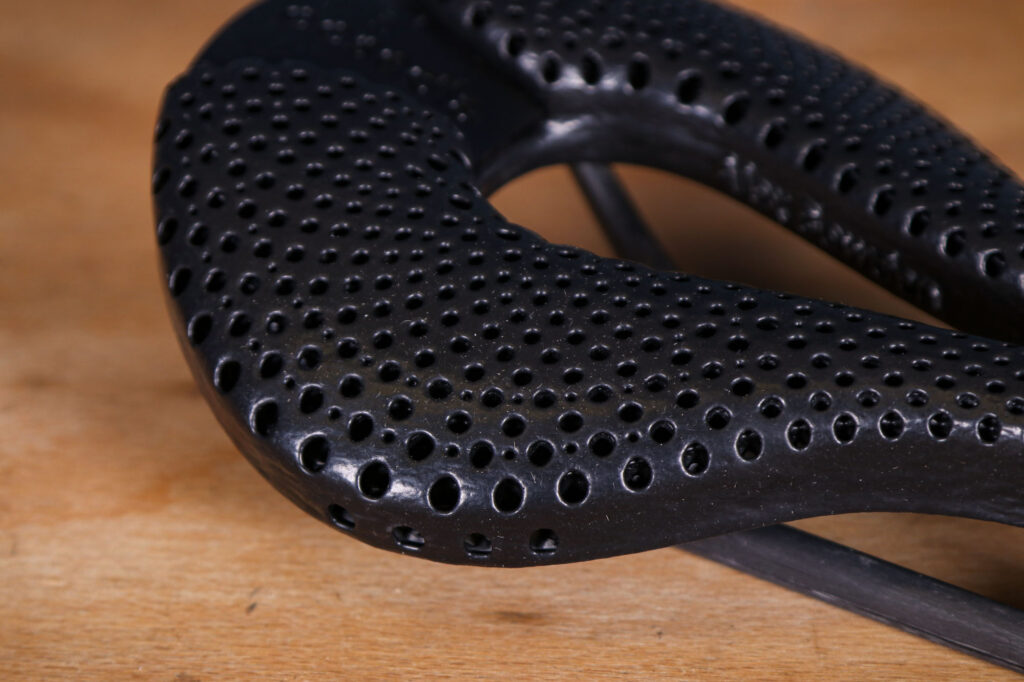

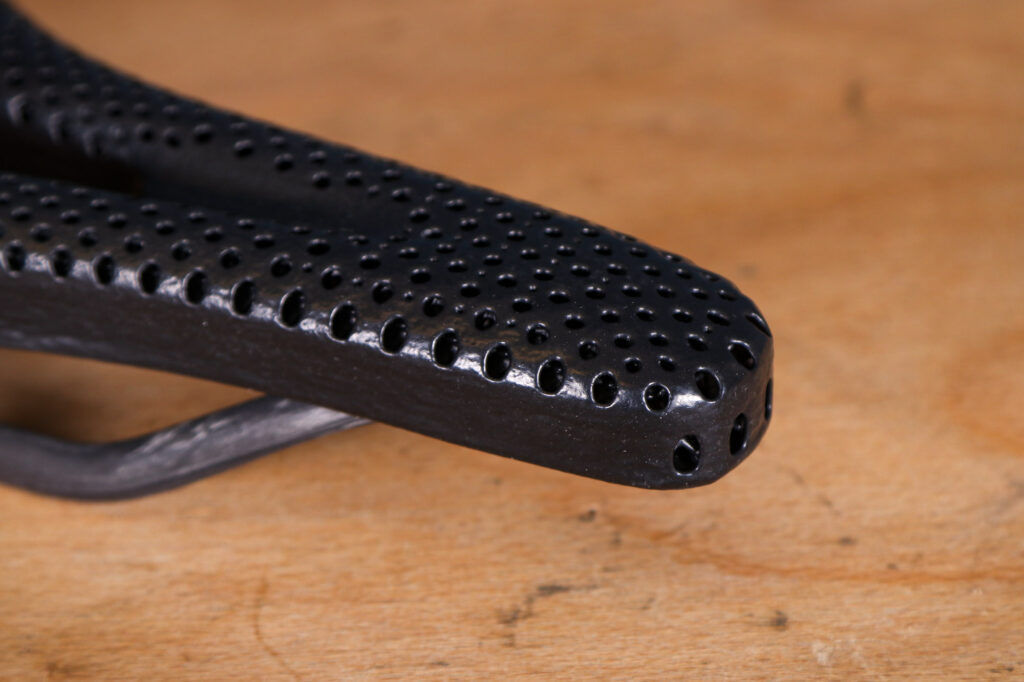


It’s worth noting that it employs 7×9mm oval carbon rails, same as the £469 reinforced UD carbon option, the Ultra. In contrast, the £299 Joyseat 3.0 Plus, which Liam reviewed for off.road.cc, comes with 7×7mm round steel rails.
In all three cases, the process begins with a box of foam with a name like a cowboy invented by AI.
Smiling Butt Kit
If you want that Fizik saddle I mentioned, you have to visit an authorised dealer to get your ‘personal pressure profile’ mapped while riding under the guidance of an expert. At the moment, there are only half a dozen of these places in the UK.
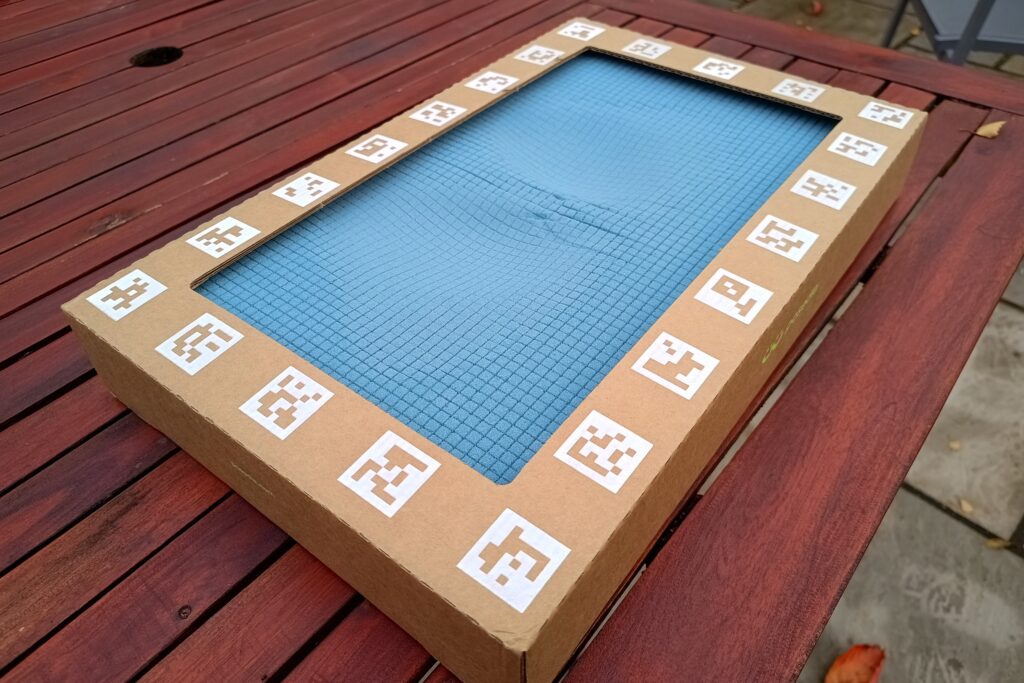
Posedla instead seeks to complete this step remotely: it sends you a box of foam to sit on, then asks you a load of questions about your riding.
The ‘Smiling Butt Kit’ is not hard to use – all you have to do is sit down – but it is a bit nerve-wracking because you only get one go. The instructions are clear though, as are the warnings.
“The foam inside is extremely fragile! Handle with care. Touch the foam only with your butt.”
I spooked myself a little by accidentally jabbing my thumb into the surface while unboxing it. This, combined with the above warning, gave me the false impression that the substance was very soft indeed and I was therefore a little tentative when I, erm, made my impression.
With images of it squishing to nothingness, I didn’t especially pull myself down into the foam the way the instructional video suggests. Upon standing and surveying my work, I rather wished I’d had.
Behold my shallow arse! It’s not smiling now.
Fortunately, Posedla is unperturbed by such an outcome. Some imprints are bigger than others, as The Smiths didn’t quite sing, and even lighter dents apparently deliver all the information they need.
You are asked to photograph your indentation, in natural light, from multiple angles, and upload the images to the Posedla website. If there are any issues with what you provide, they’ll let you know.
You then complete a lengthy questionnaire that supplements this information and presumably helps map the pressure points to your cycling position. This spans stuff such as annual mileage, average ride length, your position on the bike (recreational, performance or aggressive), gender, age, height and weight.
It also asks how flexible you are, based on how far you can reach towards your toes while keeping your back straight: extremely, very, moderately, slightly or not at all (I was quietly impressed with myself for achieving ‘slightly’). I presume Posedla has data on how each element is likely to affect the way saddle pressure is distributed.
After that you pick a colour for the exposed bit of base, and you can also have text added (you could go with something a lot funnier if you aren’t having yours photographed by your employer…) Posedla can also note your hip and thigh circumference too, if you feel they’re at all likely to be significant.
The quoted delivery time for your saddle is 4-5 weeks. Mine arrived within a month.
For Your Arse Only
I immediately whacked this saddle on my Frankenbike, an ageing endurance frame garnished with a mish-mash of componentry that I entrust with all the less glamorous cycling jobs. I assume this more than doubled the bike’s value at a stroke.
One of its roles is turbo training. With the bike motionless beneath me, I’ve always found that indoor riding highlights saddle pressure massively more quickly, so I consider this, in its way, one of the sternest tests.
Without making any effort to either fine-tune height nor position it just-so fore and aft, the Joyseat Pro was immediately, noticeably comfier. I have long had a rotating cast of saddles for turbo training, and am forever chopping and changing in the belief that one of the others must always be better, but this is unequivocally the best I’ve tried.
None of us is perfectly symmetrical and my own most common point of discomfort is consistently on the right side, but I felt very planted and even on the Joyseat. I couldn’t really tell you whether this recurring hot spot is down to friction, pressure or some peculiarity of my pedalling action, but I know exactly where it manifests. I also know this saddle significantly reduces it relative to others.
The road is a slightly different test. While the natural movement of the bike dissipates pressure, the hours are of course significantly longer. (I’d said my typical ride length was 2-4hrs in the questionnaire.)
I was probably a little optimistic in how this would go, envisaging some hitherto unimagined level of blissful comfort. The truth is that, while the saddle did feel balanced and well-shaped, I still became progressively more aware of it as each ride wore on, much the same as with any other saddle.
The difference, I suppose, is that while the Joyseat compensates for my asymmetry, that’s not generally been so much of a problem outdoors, and the improvement therefore only goes so far.
Mitigating acute pressure should prove hugely valuable towards the end of a long ride – how can you help but benefit? – but it’s not a cure-all. Even at £400 and shaped specifically for my posterior, the saddle is still for me the most difficult contact point to ignore when I’m a few hours in.
Value
There aren’t too many saddles more expensive than this, but there are a handful, and they aren’t necessarily custom-made.
The £409.99 Selle Italia SLR 3D Carbon is the Italian outfit’s new range-topper. At 146g it’s the lightest 3D printed saddle we’ve tested, but then my Joyseat 3.0 Pro is hardly a heavyweight at 164g on the road.cc scales.
For a little less you’ve got the likes of the Cadex Amp 3D and the Specialized S-Works Power with Mirror, which are £349.99 and £350 respectively.
None of these is custom made, and you might argue that process adds value. Many riders will get a clearer sense of what sort of saddle suits their riding from having a Posedla Joyseat made for them.
That’s thanks to the included pressure analysis report – labelled a ‘birth certificate’ – detailing your sit bone width and saddle width. It shows how far apart your ‘touch points’ are based on how those elements combine with your flexibility and riding style, and details your saddle’s stiffness, thickness and curvature. This information could easily prove useful if you find yourself shopping for yet more saddles.
You would get similar information, and presumably to a higher quality, from the in-person service of Fizik’s One-to-One custom 3D-printed saddle, but at £499 it would also cost you another £100.
Overall
You have to make a dual investment with the Joyseat 3.0 Pro – both money and time – but you end up with both an excellent saddle and also a clearer idea what to look for next time you need another. Whether that’s enough to justify the £400 outlay is up for debate, but if nothing else there’s a certain peace of mind in knowing you haven’t splashed out on something that’s totally the wrong size and shape.
Test Report
What does the manufacturer say about this product?:
Posedla says:
Fully custom 3D-printed saddle
Custom size, shape & stiffness — built for you
Patented 3D lattice for long-ride comfort
Rated 4.7/5 by riders in 50+ countries
Trusted by world-class athletes & bike fitters
Includes free MyVeloFit digital bike fitting
Tell us some more about the technical aspects of this product:
Posedla says:
Discipline: road, gravel, MTB, TT
Rails: 7×9 mm
Load limit: 100 kg
Weight: from 165 g
Materials: twill carbon shell, UD carbon rails, 100% custom TPU padding
How does the price compare to that of similar products in the market, including ones recently tested?:
The most obvious rival is £100 more expensive.
Did you enjoy using the product? Yes
Would you consider buying the product? Yes
Would you recommend the product to a friend? Yes
Use this box to explain your overall score
An excellent saddle with the steep price partly justified by the insight you gain – the pressure analysis report can help you decide which other saddles might suit your physiology.
About the tester
Age: 47Height: 185cmWeight: 77kg
I usually ride: Giant Defy Advanced Pro 3My best bike is:
I’ve been riding for: 10-20 yearsI ride: A few times a weekI would class myself as: Experienced
I regularly do the following types of riding: Fitness riding