



The Decathlon Bike Floor Pump 900 is a great value track pump offering mostly metal construction, a really clear dial and a neat pump head for sensible money.
We’ve been all about the battery inflators here on road.cc lately, it seems like. But maybe there are some cyclists out there unconvinced by the need to use such modern technology to do a job that can be done just as well (and – in fact – as quickly) by hand. Or maybe you’re just starting out and you don’t really want to spend £100 if you can spend less than £30 for something you never need to recharge.
Generally, for someone starting out riding, I would always recommend a good track pump as one of the things you should get – using a pocket pump at home is simply making life harder than it need be. (Although as the price of battery pumps comes down, it’s increasingly possible to argue that you could simply buy one of those for use both at home and out on the road.)


A good track pump makes inflating a tyre massively less tiresome than using a pocket pump, and should last you half a lifetime, if you choose well. You can pay anywhere from about a tenner up to over £500 for one, with the upper end of that scale being addressed, inevitably, by Silca.
A long way down it is this, the Floor Pump 900, from European sporting behemoth, Decathlon. I have to admit to having a big soft spot for Decathlon, as they tend to offer thoughtfully designed products at prices that will appeal to those starting out in a sport or without large reserves of cash to throw at a hobby, and I think that’s something the industry needs.
At £27.99, this pump is actually towards the upper end of Decathlon’s range of track pumps, which starts at a barely believable £8.99 for an all-plastic affair with no pressure gauge. The 900 model is a much more solid pump, made primarily from painted steel.
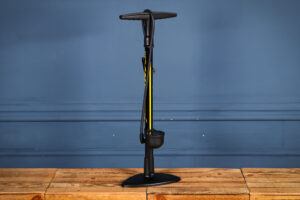
The pressed-steel base is easy to get one or two feet onto to hold it steady while you’re pumping and is really stable in use – as good as much more expensive track pumps I’ve used. The handle is plastic, and is comfortable and stiff. Some track pumps have the gauge higher up to make it easier to see. Here it’s at ground level, but it’s clear and a lovely large diameter (100mm) that I had no problem reading from six feet away.
The gauge shows PSI and bar, and has a little mint-green indicator that slides around the edge, allowing you to mark what you’re aiming at. The hose is 88cm long, with a clip on the top of the barrel to hold it in place when you’re not using it. The effective stroke of the pump is 55cm and it’s rated up to a pressure of 160psi, although I didn’t have any tyres which could take that much pressure, so I didn’t test this.
We still have one bike in the garage running 25mm tyres, so I emptied one and put 100psi in it, which took 21 strokes. That’s about what I’d expect given the diameter of the barrel, and certainly felt pretty easy. The majority of our bikes are now running about half of that pressure, and if that’s the case for you, then I’d suggest the high-volume version of this pump could be a better option.
Whereas the road version we tested has a 32mm cylinder, the “MTB/Gravel” high-volume version (currently £2 more) has a chunkier 40mm diameter, meaning that each stroke puts more air into the tyre. It’s only rated to 87psi (if that sounds like an odd number, it’s also 6 bar), but that covers the typical pressures needed for modern road bike tyres. You’d be putting over 50 per cent more air in each stroke than with this road bike version. That would mean fewer strokes to get your tyres to pressure, but would also improve your chances of seating tubeless tyres.
What of the pump head? Well, it’s Decathlon’s take on the classic dual Presta/Schrader head, with a lever that locks onto the valve. The lever action feels robust and durable, and – something I’ve not seen before – there are little indicators to remove any doubt about which way you’re supposed to push the lever to lock it onto the valve. One says “pump” and one says, erm, “plug”. I found it worked flawlessly with Presta, Schrader and Clik valves.
Whereas some pumps have replaceable rubber seals available for their heads, it doesn’t appear you can take this one apart. However, the whole head is available as a replacement part, for just £5.99. I’m sure I’ve spent at least that just buying rubber seals for my SKS track pump.
Any reservations? Nothing major, to be honest. I’d have liked the hose a bit longer, to make it a bit easier to reach the tyres of the bike at the back of the pile. There’s a bit of slop evident in the sliding action of the pump, presumably because the bearings are a bit more basic than in more expensive pumps, but this didn’t really have an effect on the function, it’s just a bit of an indicator of quality.
> Best bike pumps 2026 — from hand to floor pumps, inflate your tyres with ease and precision
Compared to competitor products, the Floor Pump 900 is keen value. We tested the Topeak Joeblow Roadie EX a couple of years ago, and found it to work fine, but it’s a few pounds more and you get a plastic base and a smaller dial. Halfords has a good range of pumps at the lower end of the scale, but again, the cheaper ones typically have much smaller (plastic) bases, and hence less stability, and smaller dials. Their Advanced Track Pump is a bit more like this one – although at £35 it’s a few quid more.
This is a well-made, attractive and dependable pump. Decathlon offers a range of spare parts for it, so repairs are possible, and I’d expect it to last for years. If I had 30 quid to spend on a pump, this is what I’d buy. Or rather, I’d buy the high volume version given that I almost never pump any tyres to over 80psi these days.
Test Report
What does the manufacturer say about this product?:
Decathlon says: “This pump’s architecture and stability make it easy to inflate your tyres. The 100mm diameter pressure gauge provides a reading accuracy of 1 PSI or 0.2 BAR.”
Tell us some more about the technical aspects of this product:
Mostly made from steel. Rated to a lofty 160psi which is probably more than any road rider should ever be putting in their tyres.
Any further comments on performance?:
Much nicer to use than any other cheap pump I’ve used. 160psi is an irrelevance to me and most other cyclists though – the “MTB/Gravel” model is better suited to my needs.
How does the price compare to that of similar products in the market, including ones recently tested?:
This is among the cheapest track pumps we’ve tested in recent years.
Did you enjoy using the product? Yes
Would you consider buying the product?
If I needed a track pump I think this is what I’d buy
Would you recommend the product to a friend?
I already have
Use this box to explain your overall score
This performs very well, but is priced in the value end of the scale. It’s a great option for anyone short of a pro workshop who’d want something a bit more heavy-duty.
About the tester
Age: 47Height: 188cmWeight: 85kg
I usually ride: On-One BishBashBoshMy best bike is: Cervélo Caledonia-5
I’ve been riding for: Over 20 yearsI ride: Most daysI would class myself as: Expert
I regularly do the following types of riding: Gravel riding, Commuting, Touring, Club riding, Audax, Leisure riding

25 thoughts on “Decathlon Bike Floor Pump 900”
The hose is way too short.
Seriously? Can you describe a use case for an average home user in which more than 88cm of hose would be required? Pumping the tyres on a penny farthing without bothering to spin the valve down to ground level, perhaps?
If you have a small wheeled kids bike in a workstand it can be a bit short however too long a hose can also be a disadvantage. I’ve used an SKS pump where the air travels from the bottom of the pump to the gauge at the top then into a long hose and at higher pressures you can feel a lot of effort compressing the volume of air in the hose before you feel the valve release and let it into the tyre. The Decathlon one feels much more direct.
I also agree about the high volume version being more useful to most people nowadays, with the large gauge only going up to 6 bar it’s much easier to read small differences in pressure.
Most of the time I would only need the lower pressure, but if I wanted to charge my turbibooster X I would need the higher pressure. But not now I’ve got a Bosch electric thingy to be lazy, both of which I must charge now as it’s tyre changing time.
Sorry, lost me there, what can you tell about the seating of the tyre doing it on a work stand to doing it on the ground? And if there is such an advantage, you could just drop the stand until the bottom of the wheel is 70 cm above the ground (probably about the height you have it anyway) and you can inflate with an 88cm hose easily.
At some point you’ll be taking the bike off the work stand, won’t you? And there was a point before it went on the stand? Do the tyres then! My road bike is stored about five feet off the ground, I don’t need a five foot hose on my track pump, I just do the tyres when I take it down.
I had Dutch father-in-law’s e-bike in the work stand today. New rear tire time (that’s a painful job on a Dutch city bike). Have to refit the rear wheel with tire deflated to get the axle into the forward facing dropouts. Then inflate the tire while the bike is in the work stand to make sure that Marathon Plus is properly seated (yes…my thumbs are very sore after fitting that). Maybe not a typical use case, but an essential one for me as the family bike mechanic.
@KDee: As a Dutch bike mechanic, I can attest that Dutch bikes are a pain in the ass to work on, period.
All the extra stuff – mudguards, chain guard, kickstand, chain tensioners, dynamo hub light cables, yada yada yada – takes extra work to get out of the way, and install again.
Give a nice mechanical derailleur bike any time of the day.
(Blasted comment system) @Sredlums I agree, I’ve been creeping towards “full Dutch” on one of the bikes over the years and it sure makes the rear wheel harder to access.
OTOH on the current iteration I expect to rarely need to. Barring severe puncture of course (small one, I just pull the inner tube out and patch).
That’s the trade-off currently – for a transport bike I ride almost every day: I don’t need to keep cleaning the gears (they’re inside the hub) or cleaning / replacing chain (it’s a belt). Compared my old hack I reckon I’m already a few hours ahead in cleaning and basic maintenance alone!
I wouldn’t mind if someone could gather and synthesise all the maintenance ergonomic improvements for “utility bikes” though. Workcycles (out of Amsterdam) had an “escape hatch” (you could unscrew a whole section of the rear triangle – dunno what the “failsafe” was on that though). I’ve vertical drop-outs (good) and an eccentric BB (not ideal) on my Cube Travel Exc, but another Cube (I think) I saw had vertical drop-outs but which could slide a small distance (too many parts there?)
Then there’s Mike Burrows “Gordon” (single-sided axle support on the wheels)…
Shurely if you need extra reach vertically you just turn the pump upside-down, stand on the handle and pump with the base?
Having said that if your workspace is constricted perhaps extra reach is convenient?
With the rebranding of its cycling offer under Van Rysel, VR for short, Decathlon has been quietly increasing its pricing or decreasing the quality of items. For instance, the entry-level anti-theft lock still sells for 6 euros but it’s now 40 cm shorter. This means I can no longer secure both wheels with a single anti-theft device.
That’s the lock that’s only for accessories like bag and helmet and is specifically marked “Security level rating: 2/10. Not designed to protect your bike from theft”? Why would you be trying to secure your bike with that anyway?
In the UK the price has come down from £3.50 for the old model to £2.99 for the new.
Has anyone ever done a comparison test on pumps to show how accurate they are? I have an electronic TPG which I use to check the actual pressure compared to what my track pump says. Question is, should I need to?
Great if a pump can inflate a tyre in seconds or if its built to last but my biggest question for any pump with a gauge on it is – How accurate is it? Not a single mention in this review.
I have one set of hookless rims, pressure limits are pretty low on them. I want to know my pump isn’t overinflating. But even if you don’t own hookless, tyre width, pressure, rolling resistance is scrutinised more now than ever. A pump that might have a vague gauge accuracy is of no use to me.
Absolute numbers don’t really make a difference, as you usually use the same pump repeatedly.
What does matter is the consistency of a given pump’s readings so that you know you’re getting the same pressure each time.
If you dont know the baseline how can it be consistent? And after prolonged use how do you know that isnt effected? It might degrade over time so what you thought was within 5-10 psi may not be.
Your baseline is your preference. Starting from there, it could be 7 bar or 12 on your gauge, doesn’t matter at all. Plain and simple.
And if I don’t know what pressure is going on accurately what is the point of the dual in the first place? Would you pump up your car tyres on a pump which you didn’t know the accuracy of?
Why are you so obsessed with an absolute number?
Would you wear size-8 shoes just because that’s always been your size, even if the ones you are trying on were breaking your toes?
The point of the dial is exactly what I said before: it’s consistency that matters, not the absolute number. First you check empirically what works for you, then you stick with that number – no matter what it is. I’d say even more, you wouldn’t even need any number at all, it could be a colour or a letter just as well and it would still work!
Oh, and by the way. If I trusted the pump and I knew it was consistent, then yes, I would absolutely pump my car tires as well.
What’s more, if I knew what value was right for me (i.e. I would know the exact magnitude of the error), I would absolutely use that even if the number itself was “wrong”.
What’s the point of a gauge with numbers on it if they are not accurate? Why even bother having so many small increments. Why not just go to the heart 10psi if that’s the case? See have ridiculous your arguments is?
And people want accuracy. People – maybe not you but plenty, want their tyres are a specific pressure. Why do you think sites like Silcas tyre pressure calculator exist? Why do electronic TPGs exist? And when ETRTO have a definite limit they for hookless rims – accuracy matters.
120 psi or 10 psi on the gauge, that makes no difference as long as the reading is consistent.
In the same way it makes no difference whether you say it’s 100F or 36C outside: if it’s the same reading on two days, you know the temperature is the same. The number itself is irrelevant.
The optimal pressure depends on a number of factors (including weight distribution front vs rear, which renders the Silca calculator useless as the ultimate tool). And if a rider is so stupid that they blindly follow a number spat out by a website without adjusting it for feel, maybe they should have their tyres inflated by a mechanic.
Also with broken rims there exists no way of proving what pressure was applied before the rim failed. And the optimal (comfortable+safe) pressure for 99,9% of riders is within the constraints anyway – and they have to be due to norms like EN or general consumer safety regulations.
Those who still exceed the limit are exactly those who blindly follow a number without any reflection on ride quality or comfort – which proves the opposite of what you wanted to prove: that blindly following numbers makes people stupid, not more knowledgeable.
What utter drivel.
I’m so glad you referred to each new argument I brought. That always adds value to what you say.