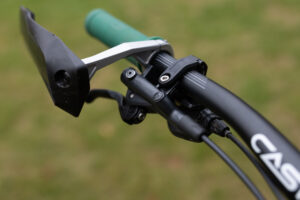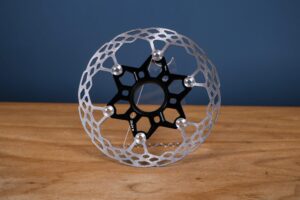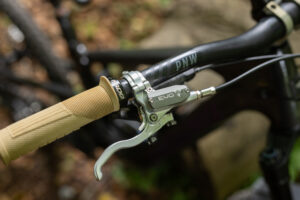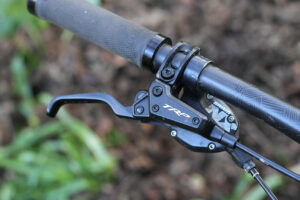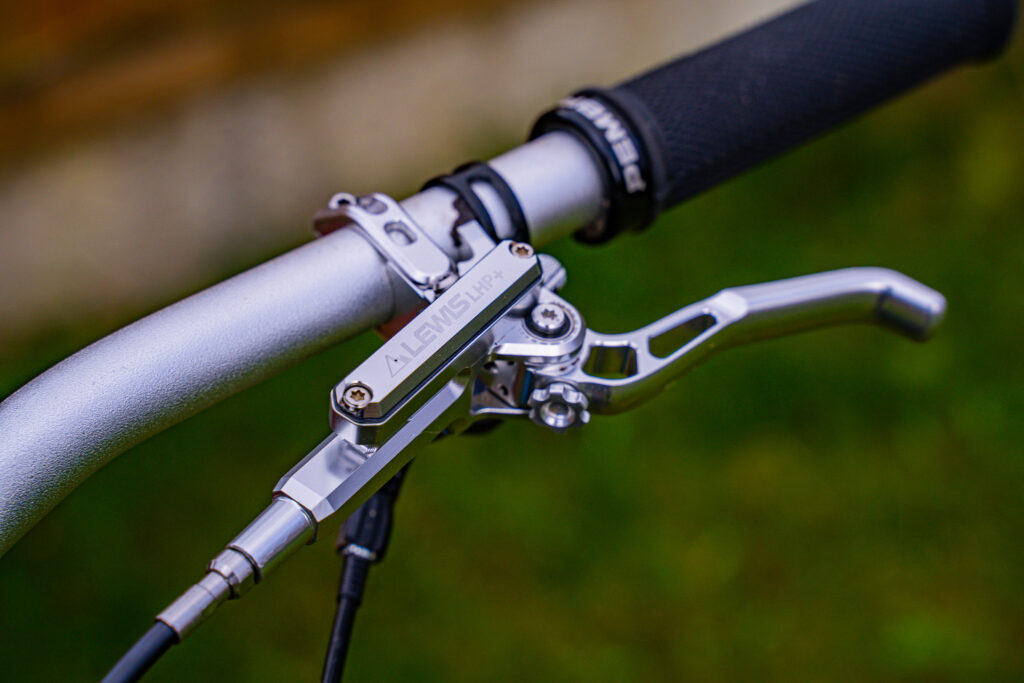

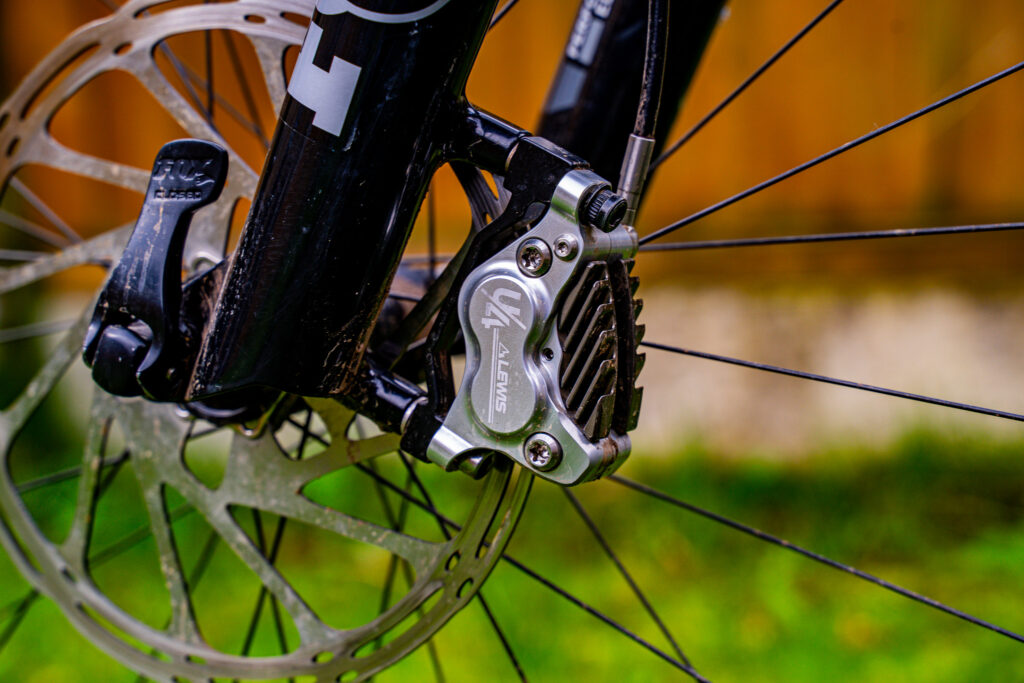
Lewis’ beautifully CNC-machined LHP+ U4 brake system certainly looks the part. In fact, the name alone deserves a moment of appreciation: Lewis LHP+ U4 Axial Cylinder four-piston hydraulic disc brake with cooling fins. That’s one heck of a mouthful, clearly designed with SEO in mind, and while it might not roll off the tongue, it’s at least accurate.
Lewis LHP+ U4 brake – Technical details
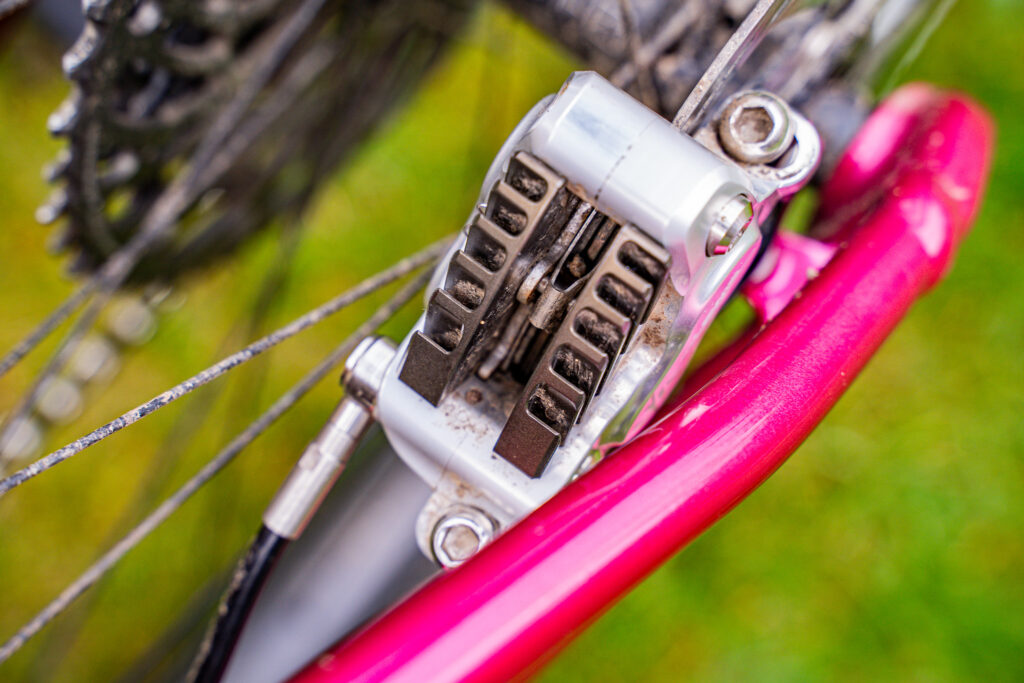
The LHP refers to the lever, and the U4 is the caliper. As the name suggests, you get a four-piston hydraulic disc brake with cooling fins, though not the usual fins integrated into the pads. Instead, Lewis uses separate, non-integrated cooling fins that the pads sit on, which I actually like quite a bit. It means Lewis can spend more time designing a fin that looks good and lasts, rather than cheapening it, knowing it’ll be thrown away with every pad change. It also means less waste and, in theory, cheaper replacement pads. Good, good, good.
The U4 caliper is CNC-machined from 7075-T6 aluminium and uses stainless steel insulated pistons. Lewis lists the piston setup as either 4×17mm or a staggered arrangement of 2×18mm and 2×20 mm, and I believe the latter is the correct configuration. The caliper is a two-piece design, bolted together with stainless steel hardware, and comes in several finishes, including black, golden jade, nebula, and, seen here, silver.
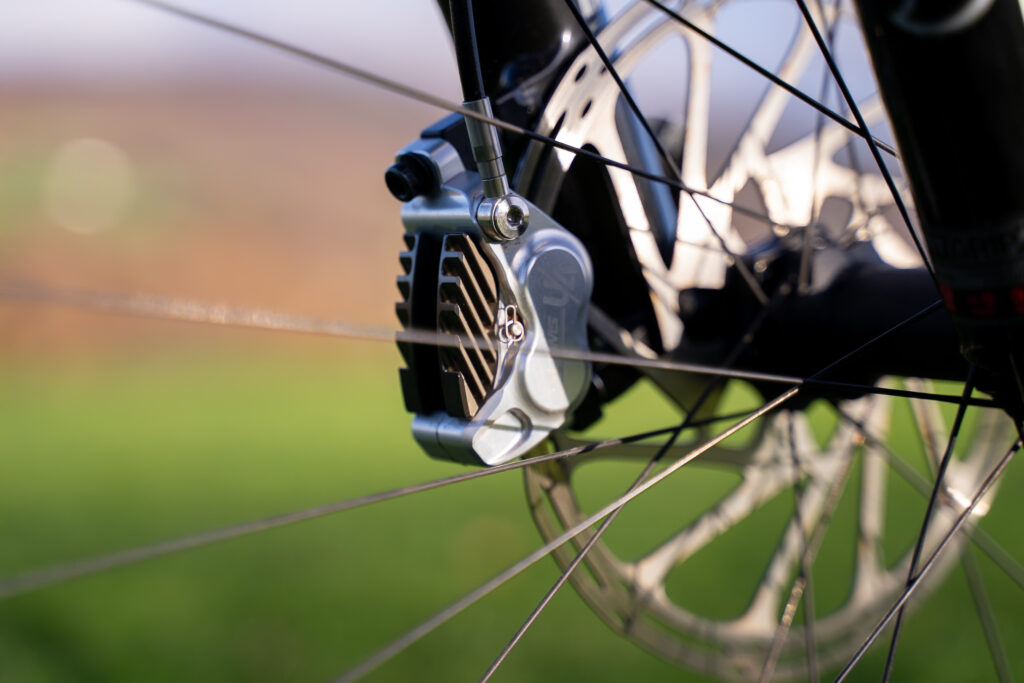
At the lever end, things get even prettier. The LHP lever is a beautifully machined alloy unit with lovely detailing and a super clean finish. It looks fantastic and has attracted comments and compliments on pretty much every ride. It’s also packed with adjustments such as bite point adjustment, lever reach adjustment and leverage-ratio adjustment. The leverage ratio works by adjusting a cam on the lever pivot to change the brake’s feel. At first glance, both the leverage ratio and reach adjustments appear tool-free, which is exciting… until you start fiddling.
Only the reach adjustment is truly tool-free. The bite-point adjustment requires a tiny Allen key supplied by Lewis, and due to its size, it’s incredibly easy to lose. It looks like it belongs to the lever but doesn’t, meaning the moment you put it down on the workbench, it vanishes into another dimension.
The leverage-ratio adjustment is also less straightforward than it first appears. That large knurled knob looks like it’s designed for quick on-trail tweaking, but before you can use it, you have to unlock it with two countersunk 2mm grub screws. So… not quite the trail-side adjustment it appears to be.
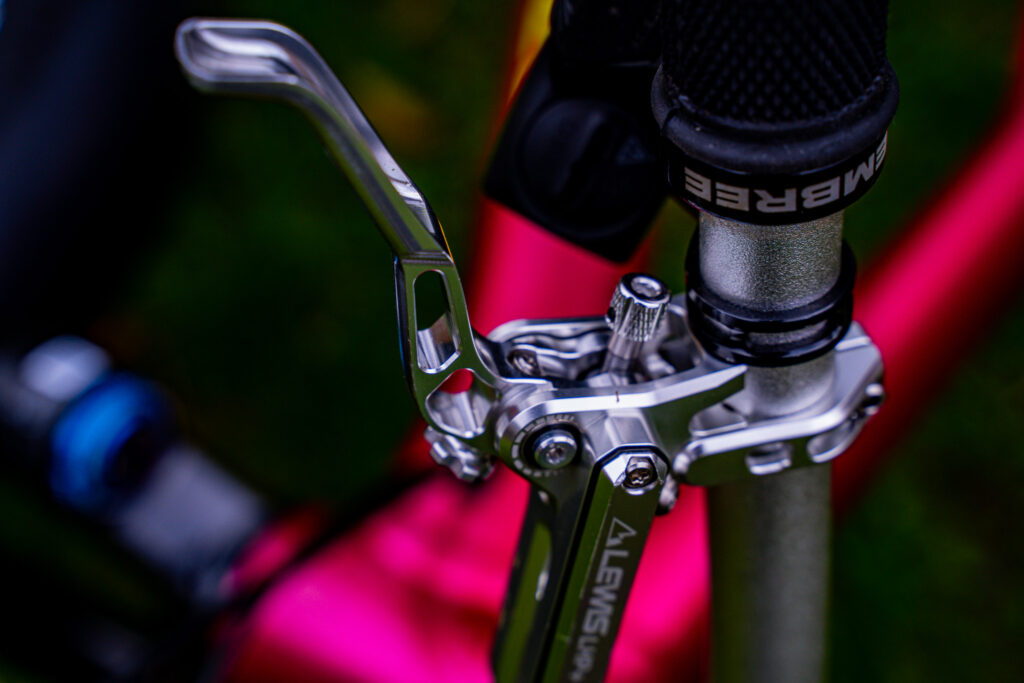
One thing I do genuinely like is the braided hoses supplied as standard, along with Lewis’s reusable screw-in olive and barb design. That’s a nice touch.
I also like the fact that Lewis uses cardboard and reusable bags for the packaging. Rather than disposable zip-lock bags, you get small draw-string bags, which are quite useful for keeping spare bolts, pads, and other tiny items safe.
Lewis LHP+ U4 brake – Performance
I may well get lynched by my editor, but I will save some of you a little time. If you want powerful brakes that are easy to set up and easy to service, these are not for you. There are plenty of fit-and-almost-forget brakes from Hayes, Hope, Shimano and SRAM that just work straight out of the box and are a breeze to bleed. That is where most riders should probably be looking. However… if you enjoy fiddling, tinkering, and spending what feels like an eternity setting up your brakes, and you want something that will have riders stopping to ask “what are those?”, then the Lewis LHP+ U4 could be worth a look.
Despite the multiple adjustments, getting the lever feel where I wanted it took a lot of faffing. Lewis claims the adjustments do not affect each other, but I did not find that to be the case. After chatting with a Lewis-sponsored rider, the recommended setup process was to wind the bite-point adjustment all the way in, effectively removing it, then adjust the lever reach, and finally adjust the leverage ratio to dial in the feel.
Once I understood that process, I spent a lot of time experimenting, trying to replicate the feel of the Hayes Dominion A4 brakes I had just removed from my bike. For those unfamiliar with Dominion A4s, they are among the best-feeling brakes on the market with smooth action, minimal lever travel and easy setup with the lever close to the bar. Getting the Lewis levers to feel the same proved impossible. I eventually had to compromise and run the levers further from the bar than I wanted to get the shorter lever throw I prefer without the lever contacting the bar.
Installation also revealed an odd quirk with the U4 caliper. On my Privateer 121 (no, that isn’t a typo), the brakes mounted perfectly with no rotor rub. When I moved them to my Specialized Chisel FS, however, I could not eliminate rubbing, no matter how carefully I aligned the caliper. The culprit turned out to be a slightly raised ridge around the caliper mounting bolt area. When the caliper was shifted too far left or right, the bolt head would contact this ridge during tightening and twist the caliper slightly, causing the pads to rub. Apparently, I am not the only one to encounter this.
My solution was simple. I did what any normal mountain biker would do and took a file to the caliper and removed the ridge entirely. Problem solved.
Now let us talk about bleeding. I will try not to mince my words. This is the most difficult brake bleed I have ever had to do.
Out of the box, the brakes clearly had air trapped in them and would pump up quickly and become unusable even on short descents. I re-bled them. Same result. I replaced all the fluid with Shimano mineral oil and followed Lewis’ YouTube bleed procedure. Same result. I read online that removing the levers and rotating them during the bleed helped. It did release more air, but they were still not right.
Then I discovered both O-rings in the hose connectors were damaged, so I replaced them and tried again. After weeks of faffing, my final solution was to hang the bike by the front wheel for a day or two so the levers were at the highest point. Without moving the bike, I then performed a quick lever-only bubble bleed with a syringe, but not following Lewis’ official procedure. And finally. Yes. They worked.
So once you have finally got all the trapped air out of the system and you have set the various adjustments where you like them, just how good are they on the trail? Well, they have plenty of power. Perhaps not quite the full, outright power of a set of SRAM Maven or Hayes Dominion A4 brakes, but still more than enough for fast trail riding, enduro riding and even EMTB use.
The modulation is good too, though not quite as good as Hope or a still-to-be-released bright red brake from a certain Italian brake powerhouse (cough, Brembo). That said, they are not lacking in this department either. They simply are not setting new standards or doing anything that plenty of other, easier-to-live-with brakes do not already do. What they do avoid is the classic on-off feel that Shimano XT brakes are known for. Thanks to the adjustable cam design on the lever, you can tailor the feel to be harder or softer depending on your preference. The harder you set the cam, however, the more fatiguing the lever becomes on rougher terrain and longer descents.
Though the lever feel can be adjusted, you still have to live with the lever design Lewis provides. The lever blade itself is quite long, which obviously gives you more leverage and contributes to the brake’s overall power.
The downside to a longer lever is that you often need to run the brakes further inboard on the handlebar to get a comfortable one-finger setup. This is not really an issue on a full-width 800 mm handlebar, but if you run narrower bars, or bars with unusual profiles such as OneUp Components’ carbon and aluminium handlebars, you might run into some issues with the clamping area.
My biggest gripe with the lever, though, is just how smooth and polished it is. Yes, it looks great, but it provides almost no grip. That can be worrying in tight technical terrain. There is a decent-sized lip on the end of the lever to help keep your finger in place, but the lack of texture meant I lost my finger position more often on the Lewis than with any other brake I have ridden recently.
One concern I had going into testing was whether the separate heat shields and pads would cause extra movement or rattling when riding. Thankfully, that has not been the case. There is no unwanted noise from the Lewis brakes, either as a rattle or as pad squeal.
Those vented cooling fins also appear to do their job. I did not experience any fade on longer descents, and once the brakes were finally bled, the lever feel remained consistent throughout testing.
Lewis LHP+ U4 – Verdict
So, would I recommend them? Nah. Not really.
They look absolutely stunning, and once they’re set up properly, they perform very well. But personally, I want brakes that work and are easy to work on. The Hayes Dominion A4 is easier to set up, more powerful, and has a better lever feel. SRAM Maven—same. Hope—same.
Lewis has clearly set out to build a high-performance brake, and in many ways, it has succeeded. I just struggle to understand why someone would choose these over brakes from other brands that perform similarly while being much easier to live with. That said, I do think Lewis is onto something. If the brand could simplify the adjustment system, improve the bleed procedure, sort out the caliper issue, and keep the stunning looks at a competitive price, the brand could have a real winner on its hands. These ones, though? I think I’ll give them a miss.
Test Report
What does the manufacturer say about this product?:
Lewis says, “The LHP brake lever adopts a newly upgraded leverage ratio adjustment system, which has a better adjustment experience.”
Tell us some more about the technical aspects of this product:
Leverage ratio adjustment, four piston caliper, stainless steel piston, cnc 7075T6 aluminium, tool-free lever reach, and adjustable bite point.
Any further comments on quality?:
Machining is really good, but it had two split o-rings out of the box.
Any further comments on performance?:
Not as powerful as Mavens or Saints, and they’re a pain to set up.
How does the price compare to that of similar products in the market, including ones recently tested?:
Similar to the Dominion A4 and Maven, but performance doesn’t stack up.
Did you enjoy using the product? No
Would you consider buying the product? No
Would you recommend the product to a friend? No
Use this box to explain your overall score
Really good-looking brakes, but performance and setup leave much to be desired.
About the tester
Age: 43 Height: cmWeight: kg
I usually ride: Specialized Chisel My best bike is: Specialized Chisel
I’ve been riding for: 30 years I ride: A few times a week I would class myself as: Experienced
I regularly do the following types of riding: Mountain bike Enduro