


- This topic has 26 replies, 16 voices, and was last updated 5 years, 1 month ago by
 Owd Big 'Ead.
-
CreatorTopic
-
August 5, 2021 at 9:13 pm #31714
ianking
Hi,
I have a cycling friend who is on the heavy side (210 Kilos) and as you might expect, he is having serious problems withe spokes breaking and coming loose on his road bike. He thought graveI bike wheels might be better, I suggested tandem wheels might be the answer but don’t know enough to advise.
Can anyone suggest what wheels might support someone this heavy which would fit on a road bike?
Thanks,
Ian
-
CreatorTopic
-
AuthorReplies
-
Owd Big 'Ead
While not as heavy as your
While not as heavy as your friend I was very much a “big lad” a few years ago, the wrong side of 150kg and closer to 160kg or 25st.
The wheelset that came supplied with the bike I bought as I started my weight loss journey were lightweight to the extreme. I replaced them with a pair of Hope 20five’s with 32 spokes front and rear, which were punished day in, day out, yet stayed almost true throughout my weight loss. The only thing I did was get a local wheelbuilder to true them up every 4 weeks or so at first and every 3-4 months thereafter as the lbs fell off.
These are very much an affordable off the shelf option that worked for me, less than £300 all in iirc.
As others have said, spoke count is important in increasing the load carryin ability, but then again so is the rim profile, rim width, tyre size, how many times the spokes cross each other and the tension of them being kept true.
I think a decent wheelbuilder with the correct information regarding rider weight and type of cycling requirements would be able to build a wheelset for far less money than some of the option stated throughout these comments that wouldn’t neccessarily cost the earth, it’s then just a case of ensuring the wheelset is kept in good order over a period of time rather than paying a large amount upfront.
wtjs
It may be of some interest
It may be of some interest here that I have now sent back to Chain Reaction the wheel I described in the ‘collapsing rim’ topic. I didn’t notice this when I first observed the failure of this WTB i23 rim, but ALL of the cracks occur at the drive side spoke holes. Some of them are huge. It is no doubt indicative of considerably higher tension in these ‘steeper spokes’ when it’s a machine built wheel. There aren’t any nipples coming through to the inner rim. Interestingly, I kept riding on it for a couple of weeks and it didn’t get worse or go more out of trueRendel Harris
Thought of this the other day
Thought of this the other day but forgot to post: a spoke tension gauge (about £20) might help – over- and under-tensioned spokes are much more likely to snap so if he keeps a check on them and ensures they’re all well balanced at the correct tension that could reduce some of the problems.
Thanks to everyone who has
Thanks to everyone who has suggested possible solutions for my friend. I suspect he may be unable to afford some of the more expensive options, but then again constantly breaking spokes (or worse) is also expensive. I’ve passed on your suggestions, but although the spoke and wheel loading discussion has been interesting for me, it probably will not be much help for him. I’ll post when I hear what he has bought and how it has performed.
Ian
zornitta
48 spokes, Ryde Andra 40 rim,
48 spokes, Ryde Andra 40 rim, 2.3-1.8-2.0 spokes, 3X lacing, brass nipples, will do, standard road hubs maybe, tires will not.He will need more robust (urban/cargo) tires. Schwalbe specs tire load.
NPlus1Bikelights
Road bike? Start on a MTB
Road bike? Start on a MTB with fat tyres.
HoarseMann
I was going to suggest a
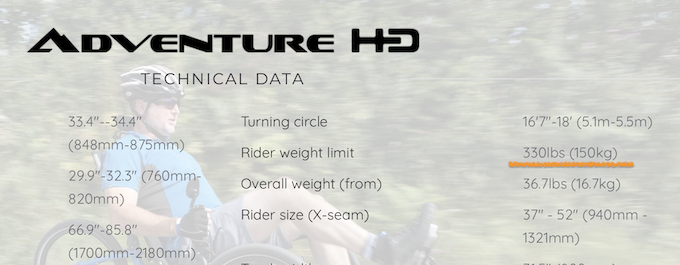
I was going to suggest a recumbent trike, as the weight is spread over three smaller (stronger) wheels and you often see bigger riders on them.
However, I’ve looked at ICE trikes and their burliest model has a weight limit of 150kg.
I think a specialist supplier, like zezebikes as Tom_77 suggested is the safest option. But a recumbent trike is going to be a better place to be if you do get a frame/fork failure (you’re not likely to go over the bars).
Chris Hayes
Hmmm…..there are some
Hmmm…..there are some pretty good rainy day articles on how wheels spread load and the consensus seems to be that it is borne by the upper spokes as the wheels turn which suspends the rim – which requires a very high tensile strength – and, of course, a well-built rim. This why tensioning is key: if it is unevenly distributed and one spoke bears more stress than its neighbours, they will break.
I’d be surprised if anyone
I’d be surprised if anyone would warrant their wheels up to 210kg, certainly nothing factory made. And you might get a raised eyebrow from the frame and component manufacturers too. I wouldn’t want to discourage your friend, we all start somewhere and starting is the main thing. But consider the possibility that he’d be better served riding another bike until he sheds some weight – even a sturdy e-bike. If he buys a good one he could always sell it later on….
Sam3
Bontrager Paradigm Elite 25
Bontrager Paradigm Elite 25 wheels are specified as having “no rider weight limit”. These are aluminium wheels with fairly wide rims: 25mm internal/30mm external, so the load is spread out. They are available on the Bontrager website:
Worth contacting them to confirm that even 210 kg is not an issue.
hirsute wrote:I did just wonder about the seat post. Hit a pothole or uneven ridge and it could be nasty.Quite possible. I’m a heavier rider (100kg) and have broken 3 saddles on the mountain bike and bent an alloy seat post. The bike shop suggested a stronger and longer seat post to replace it, which just ended up cracking the frame!
This is my concern too. I’d
This is my concern too. I’d take the broken spokes as a warning that the whole bike is unsuitable for the rider’s weight.
edit:
From a quick google, most road bikes have a rider weight limit around 125kg. Mountain bikes a bit more at 135kg.
Hirsute
I did just wonder about the
I did just wonder about the seat post. Hit a pothole or uneven ridge and it could be nasty.
OnYerBike
Tandem wheels are probably
Tandem wheels are probably stronger than gravel wheels.
I would be inclined to contact a wheel builder or bike shop (ideally one with a focus on touring/tandem bikes) and ask for their advice – I don’t think there are many “off-the-shelf” wheels aimed at riders with that weight.
SJS Cycles or The Cycle Clinic spring to mind as places that have a focus on reliable, no-nonsense bikes, although I’m sure any reputable bike shop/wheel builder would be able to help.
 hawkinspeter
After a little bit of
After a little bit of googling, it appears that 48 spoke rims are probably going to be the best bet (they’re usually marketed as tandem/touring rims). Find a local recommended wheel builder and let them build up a pair of super-strong wheels. Touring tandems are often built to support two people and a heavy bike-packing load, so it should be quite feasible to get sufficiently strong wheels.
-
AuthorReplies
- You must be logged in to reply to this topic.