


- This topic has 50 replies, 24 voices, and was last updated 3 years, 8 months ago by
 Judge dreadful.
-
CreatorTopic
-
December 29, 2022 at 5:36 pm #32383
kil0ran
I recently swapped my Defy Advanced (carbon) for an aluminium Domane (because winter). The bike fit is almost identical on the Domane, and I’m rather foolishly still running summer wheels/rubber (Fulcrum DB4s with exposed bearings, GP4000s tyres) – same combo as I had on the Defy. There’s not a huge amount in it weight-wise and yet the Domane just feels so damn slow compared to the Defy. This is borne out by Strava times on my regular routes.
So what it is that makes a bike dull, slow, and lifeless? Or is it all in the mind and body of the fool pedalling it? Granted I’ve been off the bike for most of the month due to a virus but I wouldn’t expect to be over 2mph average slower on routes I’ve ridden for years. It just feels like the Domane needs more coals piling on constantly and doesn’t respond to increased effort in the way the Defy did.
-
CreatorTopic
-
AuthorReplies
-
 hawkinspeter
Interesting video – shows
Interesting video – shows nicely the stored energy in the frame. It does show that the same effect happens in stiffer frames too, so it doesn’t work to differentiate the efficiency of stiff vs flexy frames, and I’d argue that the stiff frame test demonstrates more stored/released energy in that particular setup which exaggerates the forces applied whilst riding.
However, it is thermodynamically impossible for a frame to flex and not waste energy/heat up and I’m not convinced by your explanation of energy going into the rider’s body (whether stiff or flexy, the energy is still going to be stored/released in the same manner).
Anonymous
The last bit has been shown
The last bit has been shown in experiments.
Some springs like those of suspension forks have a damper that works by converting energy into heat thus absorbing it. The bike frame however acts like an undampened spring, the energy stored is completely returned into the drivetrain (there are videos that show how this works: https://youtu.be/BH_AL4rxrp8 ). The metal/frame material doesn’t absorb any energy that could heat it up.
This smoothes out the power output, helping the rider put out more energy, or get less tired with the same energy output.
What happens with stiffer frames is that the energy is transmitted into the riders body, where it is dampened in the body tissue, by being transformed into friction and ultimately fatigue.Where the sweetspot for this lies and thus the ideal frame stiffness will depend on your power output. A professional rider putting out 300W on average will need a stiffer frame than a cyclotourist putting out 150.
The crazy thing was when in the 90s and 00s cycling magazines (especially German ones, but elsewhere as well) were trying to convince average leisure riders they needed professional level stiff frames to be “faster”. Luckily this has been shown to be complete myth.
Here they show how the energy
Here they show how the energy gets stored and is returned into the drivetrain: https://youtu.be/BH_AL4rxrp8CyclingInGawler
What will make a bike “dull,
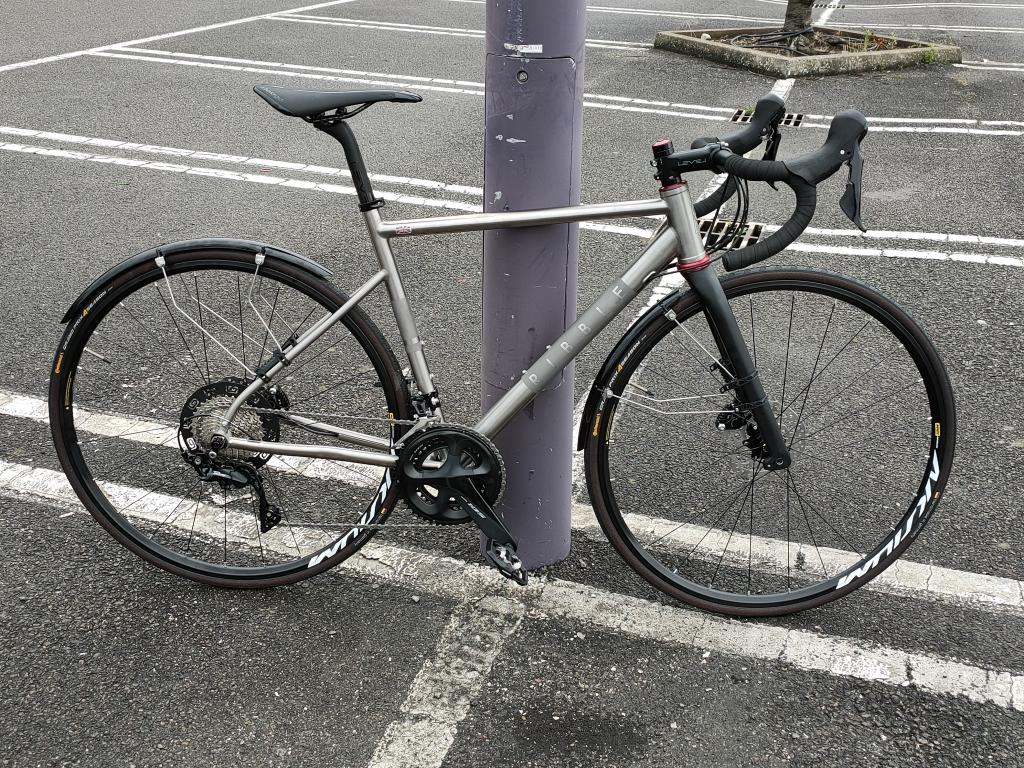
What will make a bike “dull, slow, and lifeless?”. Well, from past experience, adding around 30 kg of camping gear to the racks on your 531c-framed “fast tourer” will have that effect.
But…..The change in feel and performance when you get to drop that 30 kg. at the campsite and just ride around the local hills without it is just awesome! Particularly if you happen to be riding just south of Dublin in August 1987, when you too can dream (however fancifully) of winning the TdF :).
 Steve K
perce wrote:
perce wrote:Me too. I’ve noticed everyone on the internet rides faster than me.
I can ride as fast as anyone else on the Internet. It’s on the road that I’m slower.
BBB
“…Granted I’ve been off the
“…Granted I’ve been off the bike for most of the month due to a virus but I wouldn’t expect to be over 2mph average slower on routes I’ve ridden for years…”
Only that would make a difference of 2mph in this scenario.
hawkinspeter
Thanks for that.
Thanks for that.
Their choice of categories based on frame flex implies to me that it’s just a case of more flex leads to more comfort and less flex leads to a faster ride.
There’s some other considerations about flexy frames. Generally, stiffer frames use more material and are heavier (for the same frame material), so there’s a trade-off there with carbon frames designed to have beefed up areas that you’d want to be as stiff as possible. There’s also a correlation between lateral stiffness and vertical stiffness although there are tricks to getting vertical compliance (good) without horizontal complaince (bad) such as arranging carbon fibres in certain directions.
What I have trouble with is the idea that ‘lively’ frames are faster due to them acting like a spring and returning some energy back to the rider. Springs do absorb energy when flexing (they get warmer), so isn’t it more efficient for there to be minimal flexing?
jaysa
Thanks for the podcast! They
Thanks for the podcast! They mention a table of frame stiffness here by the way …
‘How much frame compliance
‘How much frame compliance provides the maximum benefit?’
The French magazine Le Cycle tests bikes for lateral movement at the headtube, pedal box and rear dropouts, leading to advice on what type of rider the bike would suit. For example:
Headtube @ 196 Newtons:
BMC Roadmachine 01: 5mm
CMT GT2 (Titanium): 11mm
Kuota Kobalt (entry level carbon): 7.4mmPedal box @ 392 Newtons:
BMC Roadmachine 01: 1.3mm
CMT GT2: 1mm
Kuota Kobalt: 1mmRear dropouts @ 192 Newtons:
BMC Roadmachine 01: 5.4mm
CMT GT2: 5.7mm
Kuota Kobalt 3.4mmTheir observations:
Roadmachine is super-stiff, for strong men. Unforgiving – must drop gears when tired or on steep hills.
CMT GT2: For sportives: very supple for a heavy rider, just right if lightweight. If you sprint hard, you will rapidly reach its limits. Easy to live with when the going is hard.
Kuota Kobalt: all rounder: feels supple for heavier or more powerful riders.
Thanks and apologies to Le Cycle for quoting their copy, from 2016.
chrisonabike
“The problem with this bike

“The problem with this bike is me”
Massive scope for lighter weight / more aero / power gains there, were I more fussed.
perce
Me too. I’ve noticed everyone
Me too. I’ve noticed everyone on the internet rides faster than me.
hawkinspeter
I’m sceptical about huge
I’m sceptical about huge differences between frame materials. Ultimately, flexing is going to absorb energy which is good for road bumps, but bad for transmitting forces from the pedals to the back wheel. I can see maybe better comfort for the rider if the frame is more compliant, but unless your tyres are super hard, then they’ll be providing the majority of the shock absorption.
What makes me really sceptical is the lack of numbers. How much frame compliance provides the maximum benefit? If the frame is really flexy, then it becomes unrideable, so somewhere between unrideable and super stiff is the supposed sweet spot of compliance, but I’m not aware of frame builders showing figures except for a vertical compliance.
Also, considering that the power gets transmitted from the foot to the pedal, through the cranks, chainwheel, chain and ultimately back wheel, then which part do you want the compliance and in which direction?
 Kapelmuur
I wonder how much is
I wonder how much is psychological, I have 2 bikes of about the same weight but I like one more than the other.
The one I like more is 1 to 2 mph faster on average. The preferred one is newer and my speed on the other one only reduced after I got it.
 Backladder
I’ve heard the theory about
I’ve heard the theory about frames being too stiff and not returning the energy of flexing several times but none of the proponents seem to be able to explain how the energy gets transferred back into forward motion, I think it is more likely that too stiff a frame is like a tyre with too much pressure, it does not even out the bumps and therefore slows you down. So yes, frames can be too stiff but not for the reasons they give.
 Cugel
Cugel
The engine (you) and its
The engine (you) and its condition make big differences over time. Being off the bike for 2 months will have a small effect but being off with a bad virus infection will make a much bigger difference. A virus can degrade many of your body’s functions moreso than just resting for too long.
The bike frame can have a large effect on how well the bike transmits your pedalling effort to the thrust from the rear tyre patch on to the road. Have a read of this for details:
The core point of the article is that a frame can be “tuned” to a rider – their weight, power output and riding style – such that a tuned frame will flex but return most of the energy that does the flexing to the road-thrust (forward propulsion) whilst an untuned frame will either flex and absorb the flex-energy or be too stiff, losing energy in bouncing the rider and bike up and down.
-
AuthorReplies

- You must be logged in to reply to this topic.