


- This topic has 15 replies, 7 voices, and was last updated 1 year, 3 months ago by
 hawkinspeter.
-
CreatorTopic
-
October 2, 2023 at 8:05 am #32709hawkinspeter

New research efforts are only just beginning to reveal the impact of near-invisible tire and brake dust. A report from the Pew Charitable Trust found that 78 percent of ocean microplastics are from synthetic tire rubber. These toxic particles often end up ingested by marine animals, where they can cause neurological effects, behavioral changes, and abnormal growth.
-
CreatorTopic
-
AuthorReplies
-
bikes
Can you buy ‘green’ bike
Can you buy ‘green’ bike tyres that won’t break down into micro plastics?I got my last set from the local bike charity workshop which has huge piles of used tyres. Cheaper and at least a bit better than buying new.
hawkinspeter
bikes wrote:
bikes wrote:Can you buy ‘green’ bike tyres that aren’t full of micro plastics? I got my last set from the local bike charity workshop which has huge piles of used tyres which have plenty of life left in them.There’s an article about some alternatives here: https://road.cc/content/feature/how-green-are-your-bike-tyres-281121
From a quick search, there’s this company: https://www.retyre.eco/
 andystow
essexian wrote:Thanks for the figures but 60 000 miles life for a car tyre? I have never got that much use out of a set of tyres. Indeed, my current EV has done 11 000 miles and has 4mm of tread left meaning I’ll need to change it within the year, or less than 15 000 miles.
andystow
essexian wrote:Thanks for the figures but 60 000 miles life for a car tyre? I have never got that much use out of a set of tyres. Indeed, my current EV has done 11 000 miles and has 4mm of tread left meaning I’ll need to change it within the year, or less than 15 000 miles.I know EV’s are hard on tyres, but surely not that bad when compared with tyres on ICE cars?
That tyre comes with a 6 year/60,000 mile treadwear warranty in the U.S. It’s not a performance tyre, it’s a decent quality, utilitarian tyre with a 700 treadwear rating.
Some EVs eat tyres as it’s so easy to accelerate at the tyre’s limit, and they weigh nearly double the equivalent petrol car. Still, 15,000 miles is pretty ridiculous if you have a good alignment, rotate appropriately, and are driving it sanely. I used to get over 25,000 miles from performance tyres on my turbo Forester, driven by my teenage sons, and even doing the occasional track day.
hawkinspeter
essexian wrote:Thanks for the figures but 60 000 miles life for a car tyre? I have never got that much use out of a set of tyres. Indeed, my current EV has done 11 000 miles and has 4mm of tread left meaning I’ll need to change it within the year, or less than 15 000 miles.I know EV’s are hard on tyres, but surely not that bad when compared with tyres on ICE cars?
I’ve seen various reports of EVs wearing through tyres quicker, but there doesn’t seem to be an accepted amount. I think the difference in wear is likely due to how “smooth” someone drives and lots of acceleration/braking/cornering would put a lot more wear on the tyres which is the same with ICE vehicles, but the increased torque available with EVs increases the wear. I’ve also heard that Teslas are initially fitted with very soft tyres which would wear very quickly.
essexian
Thanks for the figures but 60
Thanks for the figures but 60 000 miles life for a car tyre? I have never got that much use out of a set of tyres. Indeed, my current EV has done 11 000 miles and has 4mm of tread left meaning I’ll need to change it within the year, or less than 15 000 miles.
I know EV’s are hard on tyres, but surely not that bad when compared with tyres on ICE cars?
hawkinspeter
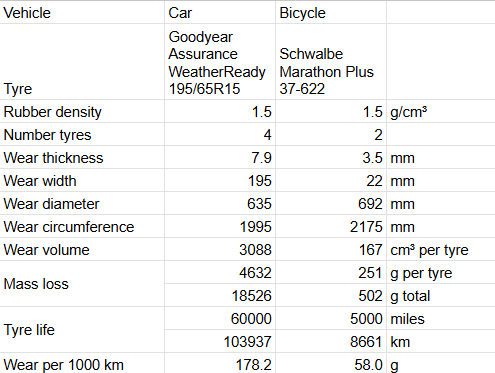
andystow wrote:I may have posted this previously, but I estimated a few years ago that bicycles lose about 1/3 the rubber per mile or km compared to basic cars. If anyone has any better numbers for any of these, I can put them in, or I can share the Google sheet and you can play with it.Intuitively, it seems like it should be more like a tenth than a third.
The relatively high number for bikes is likely due to the rubber being softer. I now want to see the numbers for pedestrians’ shoes.
andystow
I may have posted this
I may have posted this previously, but I estimated a few years ago that bicycles lose about 1/3 the rubber per mile or km compared to basic cars. If anyone has any better numbers for any of these, I can put them in, or I can share the Google sheet and you can play with it.
Intuitively, it seems like it should be more like a tenth than a third.
AstlinllAlec
Thank you for bringing
Thank you for bringing attention to this important and often overlooked issue. It’s eye-opening to learn that something as common as tire and brake dust contributes so significantly to ocean microplastics.
stylochrisonabike
Just wait ’till you heear
Just wait ’till you hear about other overlooked externalities of motoring eg. road noise…
https://www.eea.europa.eu/en/analysis/indicators/health-impacts-of-exposure-to-1
levestane
I guess you mean Jevons. Yes,
I guess you mean Jevons. Yes, this is not about ‘save the planet’ (which will be fine) but about minimising pain to Human society in a changing ecosphere. It looks like we will take the ‘no pain – no gain’ path.
Sadly… meh. I’m wondering
Sadly… meh. I’m wondering if someone’s already named some kind of effect whereby any technological change (and the pace of change is possibly still accellerating) must quickly come to use more resources and energy than previously. Even if a driver for it happening was avoiding issues with the previous one (we used up all suitable fuel) or it succeeds because it’s more efficient.
We also seem to be “and” rather than “or” e.g. cars AND electric bikes.
Perhaps we should be optimistic (but not for humans and many other current lifeforms) – the vast conversion of other materials into plastics and the extensive geoengineering of humans will almost certainly provide opportunies for other lifeforms, although they may not be particularly “cuddly” e.g. bacteria or fungal forms. Perhaps enhanced by the mutagenic effects of the chemicals and/or radiation we’re producing.
hawkinspeter
…and not just the oceans,
…and not just the oceans, but our rivers too
Also, linked to in that article is some analysis of how tyre pollution dwarfs exhaust pollution
Cycling should reduce this
Cycling should reduce this provided folk are not driving to cycle. I wonder how the increase in the use of plastics and electonics in bikes will impact future environmental issues.
I see global crude oil demand is at an all time high, not much sign of net zero!
hawkinspeter
levestane wrote:Thanks for adding those links. That’s some scary evidence that we’re indiscriminately poisoning the oceans.
Obviously bike tyres aren’t subject to the same kinds of forces, but I’m now starting to think whether we’ve got some of the same chemicals used in bicycle tyres and whether there’s “cleaner” manufacturers that we can purchase from to at least vote with our money. From the first link, Continental has experimented with some dandelion based tyres, but I don’t know if they for sale.
-
AuthorReplies
- You must be logged in to reply to this topic.