


- This topic has 62 replies, 22 voices, and was last updated 5 years, 5 months ago by
 Captain Badger.
-
CreatorTopic
-
May 13, 2021 at 11:25 am #31598
andy james
why do the majority of road cyclists wear black or other dark-coloured clothing?
Motorists are more likely to hit them, or pedestrians step in front of them!
-
CreatorTopic
-
AuthorReplies
-
Captain Badger
hawkinspeter wrote:andy james wrote:Be practical. Its the cyclist who gets killed or injured regardless of who you consider to be at fault. Shouldn’t they at least try to reduce the risk?
Most (non-sporting) road cyclists do NOT have reflectors on their clothing.
A practical attitude to risk assessment and reduction is to be commended.
Usually, organisations try to implement a hierarchy of hazard control:
-
Elimination. In simple terms, this means that safety hazards should be eliminated from the workplace whenever possible. For example, if employees are working at heights, businesses should evaluate whether any activities can be done on the ground instead.
-
Substitution. Can a hazardous substance or piece of equipment be replaced with something less dangerous?
-
Engineering controls. These controls don’t get rid of the hazard but they aim to isolate workers from the risk. These controls mitigate events that could cause harm by, for example, putting workers behind guardrails or on elevating work platforms.
-
Administrative controls. These include employee training, placing warning labels on products and posting signs in work areas that alert people to possible hazards.
-
Personal protective equipment (PPE). PPE includes items such as safety glasses, hard hats and respirators. This is the last point at which harm can be mitigated.
Now, high visibility clothing would fall under PPE so that’s literally the last thing to be looking at to increase road safety.
By concentrating on the victim of the hazard (e.g. “it’s the cyclist who gets killed or injured”) you’re inverting the hierarchy and it’s really not an effective approach. Imagine if a building site didn’t worry about builders dropping tools etc from heights because they concentrated instead on people wearing hard hats?
So in terms of road safety, the first step would be elimination which is not really possible outside of lockdowns. Next would be substitution – could we substitute lots of private cars with public transport (or drivers with cyclists)? Then we get to engineering controls which would most likely involve separate cycling infrastructure – we already separate foot and motorised traffic, so it would seem a logical step. Afterwards we get to administrative controls which would be things like road signage and driver education and training. Finally we get to PPE which is not a popular option as can be evidenced by the lack of pedestrians wearing helmets, gloves and knee/elbow pads.
I would also note that by putting the onus (and presumably restrictions) onto everyday cyclists it would act as a “barrier” to people wanting to occasionally substitute their drive with a cycle instead – that would thwart the substitution principle and possibly increase the hazard (more cars, less cyclists and drivers having less exposure to cyclists on the roads).
Pssst you forgot Reduction – tell im about reduction!
Captain Badger
andy james wrote:Be practical. Its the cyclist who gets killed or injured regardless of who you consider to be at fault. Shouldn’t they at least try to reduce the risk?Most (non-sporting) road cyclists do NOT have reflectors on their clothing.
Unless it’s teh pedestrian of course….
Fact is I can see someone cos they contrast with their background – if I look. As the background is rarely black I can see them – as long as I look
If I don’t look, they can be wearing what they like and I’ll still hit them.
As a driver, it’s my fault if I don’t see them. I can even see people dressed in black at night, especially when they are in town and streetlit – as long as I look.
A driver who is not looking will hit someone, regardless of what they are wearing. Perhaps let’s stop questioning what the victim was wearing, and look at the perpetrator and their actions – afterall we are slowly starting to do that for other crimes…..
 mdavidford
andy james wrote:Be practical. Its the cyclist who gets killed or injured regardless of
mdavidford
andy james wrote:Be practical. Its the cyclist who gets killed or injured regardless ofwho you consider to be at faultwhat they’re wearing. Shouldn’ttheythe people not paying attention at least try to reduce the risk?Hirsute
I have had comments that my
I have had comments that my retro-reflective ankle bands are the most visible part of me – presumably because of the constant movement that the eye is drawn too.
I also have different rear light patterns which I hope also draws a motorist’s eye. Incidentally, I think this is why escooters are more vulnerable because there is so little movement that would indicate to a driver that something is ahead.
I’ll also throw in those ridiculous 100,000 lumen headlights coming the otherway completely obscure any cyclist or pedestrian.
Cycloid
As a cyclist you are always
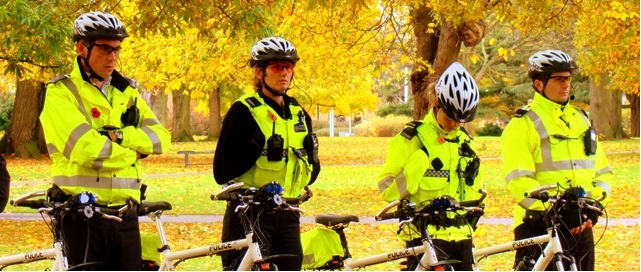
As a cyclist you are always competing with the background and other vehicles to be seen. Four ways to get noticed, Colour, Lights, Reflectors, Road position – use them all.
Hi viz yellow is not always good, for example riding past a field of oil seed rape.
Black is not always bad, for example riding through a white village on the Costa del Sol.
No matter what you do you will not be seen if the driver does not look
Shades
Probably no clear winner on
Probably no clear winner on whether dark or brighter clothing makes you more visible; I’d say for commuting in busy traffic then high-viz is better, especially as the drivers are just hell bent on getting home/to work and aren’t paying attention. Wouldn’t say dark clothing without reflectives at night is a great move as all you can see are the bike lights; reflectives make you stand out in car headlights. Not a huge fan of the black gear, black bike, deep-section wheeled robocop look; my wife calls it ‘aggressively roadie’.
 hawkinspeter
andy james wrote:Be practical. Its the cyclist who gets killed or injured regardless of who you consider to be at fault. Shouldn’t they at least try to reduce the risk?
hawkinspeter
andy james wrote:Be practical. Its the cyclist who gets killed or injured regardless of who you consider to be at fault. Shouldn’t they at least try to reduce the risk?Most (non-sporting) road cyclists do NOT have reflectors on their clothing.
A practical attitude to risk assessment and reduction is to be commended.
Usually, organisations try to implement a hierarchy of hazard control:
-
Elimination. In simple terms, this means that safety hazards should be eliminated from the workplace whenever possible. For example, if employees are working at heights, businesses should evaluate whether any activities can be done on the ground instead.
-
Substitution. Can a hazardous substance or piece of equipment be replaced with something less dangerous?
-
Engineering controls. These controls don’t get rid of the hazard but they aim to isolate workers from the risk. These controls mitigate events that could cause harm by, for example, putting workers behind guardrails or on elevating work platforms.
-
Administrative controls. These include employee training, placing warning labels on products and posting signs in work areas that alert people to possible hazards.
-
Personal protective equipment (PPE). PPE includes items such as safety glasses, hard hats and respirators. This is the last point at which harm can be mitigated.
Now, high visibility clothing would fall under PPE so that’s literally the last thing to be looking at to increase road safety.
By concentrating on the victim of the hazard (e.g. “it’s the cyclist who gets killed or injured”) you’re inverting the hierarchy and it’s really not an effective approach. Imagine if a building site didn’t worry about builders dropping tools etc from heights because they concentrated instead on people wearing hard hats?
So in terms of road safety, the first step would be elimination which is not really possible outside of lockdowns. Next would be substitution – could we substitute lots of private cars with public transport (or drivers with cyclists)? Then we get to engineering controls which would most likely involve separate cycling infrastructure – we already separate foot and motorised traffic, so it would seem a logical step. Afterwards we get to administrative controls which would be things like road signage and driver education and training. Finally we get to PPE which is not a popular option as can be evidenced by the lack of pedestrians wearing helmets, gloves and knee/elbow pads.
I would also note that by putting the onus (and presumably restrictions) onto everyday cyclists it would act as a “barrier” to people wanting to occasionally substitute their drive with a cycle instead – that would thwart the substitution principle and possibly increase the hazard (more cars, less cyclists and drivers having less exposure to cyclists on the roads).
 Mungecrundle
Presumed liability and
Presumed liability and automatic loss of driving licence, unless exonerated from fault, in any serious collision would, I feel, be a far more practical remedy to making the roads a safer place for all users.brooksby
Quote:
Motorists are more likely to hit them, or pedestrians step in front of them!And yet, motorists are always able to see them (mainly so they can complain that the person was wearing black).
You can reduce the risk
You can reduce the risk further by not cycling or banning cars or improving infrastructure.
Why are you going straight to the bottom of the hierarchy of risk control pyramid ?
Not sure what a non-sporting cyclist is. I’d have thought they were more likely to have reflectors on pedals, handlebars, rear, wheels unlike ‘sporting’ cyclists plus a lot of ‘normal’ coats have some form of small reflectives on them.
Anonymous
Cuz wearing black is ninja
Cuz wearing black is ninja
Compact Corned Beef
You say be practical, but you
You say be practical, but you’ll find the aspirations of many on this site, as far as ‘utility’ cycling is concerned, is for cycling to be normalised to the point where lycra and hi-viz become unnecessary – you wouldn’t expect anyone saying ‘pedestrians should wear hi-viz because sometimes they are killed by cars’ to gain realistic traction (the whole ‘worth it if it saves just one life’ approach) likewise you’ll gain no traction telling drivers to wear motorsport helmets, despite data suggesting that would make them safer (‘worth it if it saves just one life’…)
Now, my commuting backpack is hi-viz and reflective. I also wear a bright pink helmet. This is my choice, and helps me feel confident. But the more you load responsibility for risk onto cyclists, especially if it’s through legislation, the more you de-load responsibilty from those road users doing harm and disincentivise people who might be thinking about taking up cycling generally.
Mungecrundle
Depending on the background,
Depending on the background, black can be a high contrast / visible colour whilst the flouro greens and yellows favoured by many cyclists can become effective camouflage under a well lit spring canopy of overhanging trees.However, the overwhelming problem in the driver v cycle and even motorcycle SMIDSY scenario is that the driver does not look. Or if they do, they somehow misjudge speed and distance, become target fixated, are unable to imagine potential “what might happen if?” or simply don’t have the self control to slow down and drive with the necessary caution.
As for pedestrians, same goes for cycling in close proximity, except that they have the ability to turn on a dime and change direction. They are also often distracted. What I would suggest though, if you are concerned about the risk posed by cyclists to pedestrians is to look up reports of pedestrian / traffic collisions, maybe on the news stories in your local paper. See how many you can find, amongst the daily reports of car collisions resulting in death and injury, that involve a cyclist seriously maiming a pedestrian.
wtjs
Another example of accepting
Another example of accepting the motorist’s usual omni-excuse as truth: I didn’t see you. All the near misses we see on here were performed by people who did see the cyclist, but didn’t care how close they came. I was hit by someone driving on the wrong side of the road, while I was stationary with a very bright flashing light on my helmet- people like this are only interested in large 4-wheel vehicles like the one they’re in.
0-0
Because we’re cool as f**k ?
Because we’re cool as f**k ?Pedestrians will step out in front of anyone, giving the chance.
They just use their ears to tell if it’s safe to cross the road. Moving their head and being spatially aware seems difficult for most people.
I’m surprised there aren’t more incidents with electric vehicles and pedestrians. -
-
AuthorReplies
- You must be logged in to reply to this topic.