- This topic has 34 replies, 9 voices, and was last updated 4 years, 2 months ago by
IanMSpencer.
-
CreatorTopic
-
March 26, 2022 at 7:16 pm #32017
IanMSpencer
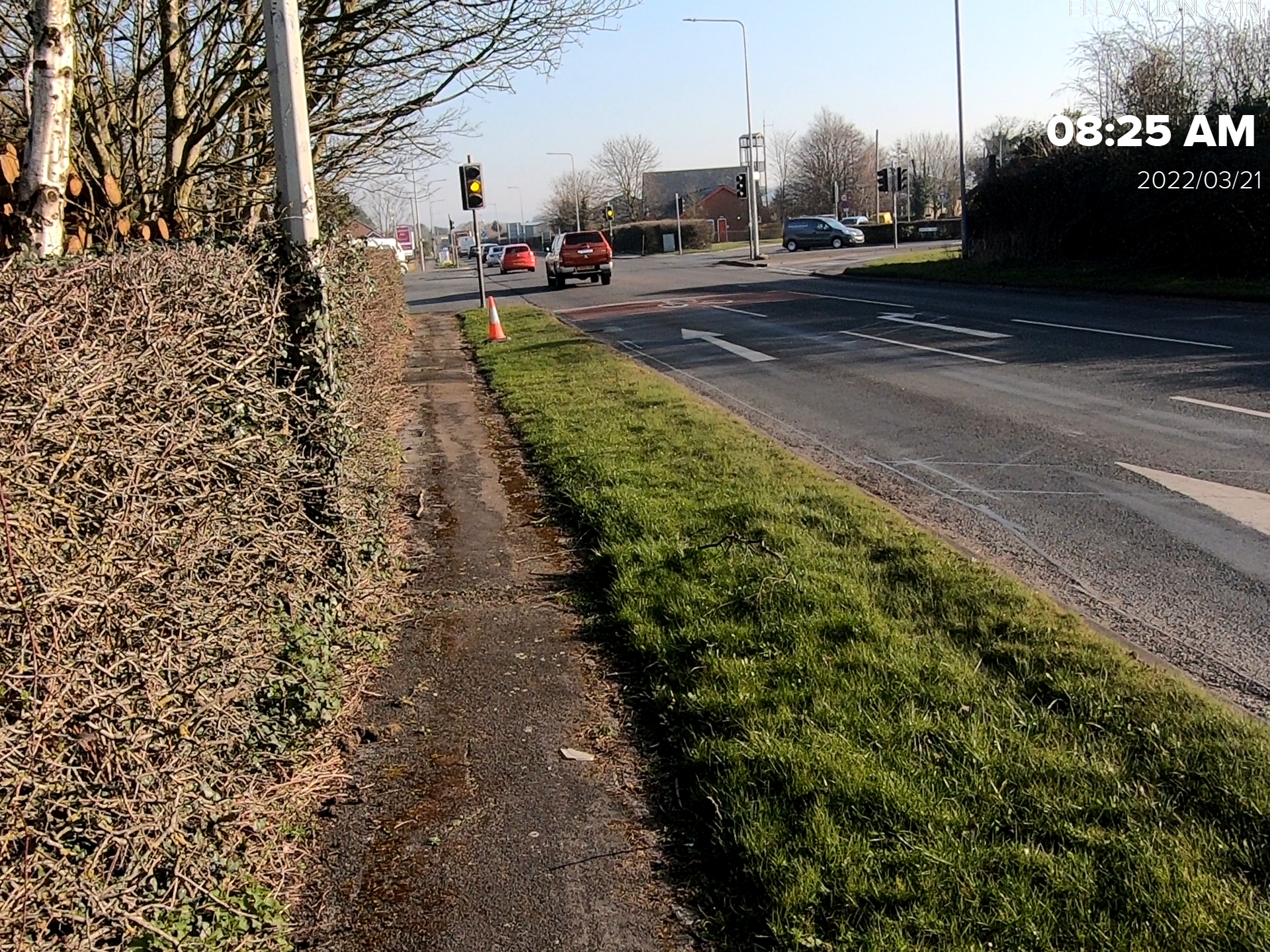
I mentioned I was a bit miffed at this bit of driving. We’ve all had worse, but the aggressive pass at the end combined with the unsettling left turn signal next to me while closing was enough that I thought this driver had crossed a threshold.
This is how Warwickshire Police analysed it:
“Thank you for the above submission to Operation Snap. It has been reviewed and there will be no further action taken. The rationale for this decision is the initial pass appears to provide sufficient safety room and is conducted at low speed. The only aggravating factor being the junction was relatively close by and the sensible option would have been to wait until after the junction to pass. The subject vehicle indicates to let you know it is turning left the cyclist behind you appears to recognise this and brakes accordingly. You continue passed the subject vehicle and at this point you are within 1.5 metres but the vehicle is almost stationary so the risk of harm is very low. The final pass was conducted at speed but it is not possible to verify what speed that was. The cyclist beside you senses the the subject vehicle and moves to the nearside and the pass ultimately provides sufficient safety room. The emission of black smoke is normal for some vehicles when they accelerate and whether this occurred to annoy or assault you or others can’t be proven.”
While we are aware of the standard that the police appear work to, I would have thought that it was an display of driving below the standard of a competent and careful driver – I wonder how low their bar is?
For reference, my speed was about 16mph, slowing to about 9mph for the corners.
-
CreatorTopic
-
AuthorReplies
-
IanMSpencer
It’s a difficult one. In my
It’s a difficult one. In my (not much) younger days I got stopped by the police a couple of times for some significant speeding, and neither time I got ticketed, but I got a talking to and I made sure they saw I was shaken up by the experience during it. The second time I took myself off onto an advanced driving course which finally made the difference because I recognised I was taking too many risks, I’m by no means perfect, but I’ve got rid of my list of excuses that we all have used to justify ourselves.
These letters do go on the police intellegence file for the driver, so what it does do is that if they get noticed again, it increases the chance of action. My hope though is that it has the chance that they think, yes, I was a bit silly and I’ve been let off, perhaps I need to be more careful.
There is an element where points and fines create that sense of injustice, whereas the warning letter has a lower level of antagonism. However, I do think we are seeing a split in behaviour generally, where a good number of people want to be well-behaved, but a minority feel that being constrained in their behaviour just isn’t right anymore and they aren’t going to respond well to any sanction, warning, or even the withdrawal of their licence (though that is more in the criminal fraternity than the neo-entitlement brigade).
A wider point is with the increasing prevalence of cameras, does it become more like average speed cameras, where people really aren’t confident they will get away with speeding (after all, nobody knows whether they are switched on yet the compliance is very high), that people start to think that they might always get caught on someone’s camera? The more driving nonsense is captured and noted, the more drivers (and cyclists!) will feel that they are risking an offence being captured.
In the end, we need a culture change, and the culture change in part comes by example – if you drive at 30mph in a 30mph, the majority of cars behind quietly accept it. Do it often enough, it becomes the habitual speed for more and more people. Drive at 40, and people tend to follow and pick up the sense that that is the local speed, Demonstrate passing cyclists safely, more people get used to the idea that the consensus is to pass safely, take risks, and people follow the example.
wtjs
What difference is a letter
What difference is a letter in the post going to make these types of people ?
None, unless it comes in handy if there’s another pandemic and toilet paper crisis. You can’t even be sure that a warning letter goes ‘on their police record’ to stop them getting a series of them to no effect- when the authorities are vague about this, I suspect that no record of warning letters is kept. On the other hand, the points on the licence system is also failing when the real villains retain their licences for ‘hardship’, so what’s the alternative? In Lancashire the joke driving course is even more of a joke because it’s online- or was, the last time I looked into it.
stonojnr
My issue with warning letters
My issue with warning letters as an outcome is I don’t see what positive impact they have, they arent decreasing the levels of close passes, or creating a sense that cyclists with cameras are just as effective as speed cameras or traffic police at nabbing bad driving behavior.Even with prosecutions we saw yesterday with CyclingMikeys latest mobile catch, the driver doesn’t think they did anything wrong and blames “Batman” for getting caught, but at least they get financially penalised for it.
What difference is a letter in the post going to make these types of people ?
IanMSpencer
I know it is frustrating, but
I know it is frustrating, but there is currently a new opportunity with the change to the HWC that means that your lorry complaints should be held to a higher standard, as well as the cycling issues we are concerned about.
Some of my personal campaigns have taken years, and sometimes it is getting the right contact or the right reply, an enthusiastic councillor wanting to make their name. However, in the local area, I can see the marks of my doings, a footbridge that didn’t exist, or a change to a cycle lane and so on.
You could also try a few other tactics, like getting a friend to make a submission – perhaps it has become too personal between you and the police – after all there aren’t likely to be that many – are they being unprofessional and treating it as a game with you? I know I got too aggressive in frustration with Solihull Highways and they’ve gone from being cojouled into helpful responses into non-cooperation.
Also, perhaps we should do more to enlist the help of the campaigning organisations to sort out standards around the UK, which in part we do by gathering the evidence of differing standards, which requires cooperation across the country.
quiff
Well yes, that does put a
Well yes, that does put a slightly different complexion on it!
wtjs
the point they’re trying to
the point they’re trying to make in this case is that if the first stop line was passed on amber (and there was not time to stop safely – a judgement question) there is no offence
An entertaining, but incorrect, attempt to adapt Aesop’s Tortoise and Hare to distort Rules 175 and 178 by ignoring the If the amber light appears you may go on only if you have already crossed the stop line or are so close to it that to stop might cause a collision bit, and converting it to a more offender-patatable accelerate as rapidly as possible so that you can say you were unable to stop if the light turns red. This was the situation when the light turned amber

quiff
That’s a great outcome. It’s
That’s a great outcome. It’s clear that some forces just have a better attitude to challenge and learning, but I think it’s also definitely an art to present incidents and complaints to them in a way that engages, rather than entrenches them, so kudos for that. I always try to be as dispassionate and objective as possible when reporting an incident to seem reasonable. It is a balance though – I realised from discussion with someone on here that simply referring to the law and what happened dispassionately risks losing some of the victim impact – e.g. not saying how a close pass made me feel.
quiff
That’s a dreadfully worded
That’s a dreadfully worded explanation but presumably the point they’re trying to make in this case is that if the first stop line was passed on amber (and there was not time to stop safely – a judgement question) there is no offence. I recognise you can point to a whole catalogue of these and other failings, just taking this one example on its merits.
wtjs
All this has been done, years
All this has been done, years ago!
IanMSpencer
Perhaps a carefully
Perhaps a carefully constructed letter to your MP might help. Raise it as a general issue with simple examples (these are MPs we are talking about) and form something that the MP can use to write to the Home Office and get a reply from a minion to add to the file. Ideally, if you have something that is not actually cycling related (indeed many of your copious posts are not), the health and safety issue of non-MOT’d lorries sounds ideal, to avoid any problems with the anti-cycling lobby.
If that lorry firm has a poor reputation, then the local press might sniff a story, which in turn gives the police the embarrassment of having to explain why they haven’t enforced a complaint about an unsafe vehicle.
It would be interesting to gather information about the varying standards around the country, and perhaps the end target should be enough evidence that updated guidance is produced to apply to all police forces.
wtjs
How are you responding?
It appears that, even after all this time, people are reluctant to believe how bad and how bent Lancashire Constabulary is. Their main tactic is to simply refuse to respond.
This is from the manager of the laughably named Lancashire Safer Roads Unit at 1pm on Thursday 24th March, copied to the Sgt. in charge of day to day running of OpSnapLancs and to the Inspector who seems to be actually in charge:
Insp Jones will be responding to you; he is currently on rest days but will be in touch.
A week later, and he still seems to be on ‘rest days’ and has not been in touch. Neither has anyone else. I will write again today, and will receive no reply until the 14 day period has expired. This is a simple case, easily solved by HC Rule 178: If your vehicle has proceeded over the first white line at the time that the signal goes red, you should stop as soon as possible and MUST stop at the second white line.
Dealing with passive resistance like this is difficult- there is essentially no Professional Standards Department and the Office of the Lancashire PCC is a comic-opera council do-nothing operation which simply advises complainers to seek independent legal advice. There is no supervision of Lancashire Constabulary, and no oversight. Almost all complaints to OpSnapLancs result in no action with the routine letter that ‘action is not in the public interest’. Even the action letters are deliberately evasively written (even they are not that accidentally incompetent) to include the possibility that they might decide to do nothing at all or give ‘words of advice’. However, I just keep collecting the evidence.
IanMSpencer
How are you responding? Are
How are you responding? Are you getting into a debate with the assessing officer or are you using a formal complaint which forces another person to look?When you got that response, for example, did you respond with reference to the law to point out that they were wrong?
Do you give up when you get a response like that? What I would do is wait for a howler like that and then provide a pseudo-legalistic breakdown point by point that no reasonable person could argue with.
If you’d like to chat off line, you can email me at my Gmail account which is remarkably easy to construct from my username.
IanMSpencer
One of the unfortunate things
One of the unfortunate things about the submissions system is limited space.At the start, I decided the approach was to make the case for the assessor but to fit in the form I had to cut it back too much. My complaint built a case based on about 10 points of driving structured around their response.
I also was lucky that Warwickshire has an effective complaints system. If you’ve tried complaining as much as I have you get to learn which organisations are serious about complaints. For example, I made a formal complaint to Solihull council about their bike lane which simply disappeared into a black hole, and the BBC system is designed to fend off criticism rather than to learn.
I also made it clear what I wanted and why. It was easier for a reasonable person to accept than reject! It was also a significant effort, and I have the time and motivation.
I think it’s also recognising that like with CyclingMickey, you have to learn what works. I’ve not submitted many obvious infractions because it is not possible to tell whether they were malicious – I suspect that many incompetent passes frighten the drivers as much as us as they realise how stupid they’ve been and we have to be realistic about the capacity of the police to deal with incidents.
This incident triggered me because of the yobbish aspect to the driving, a hint of temper, sustained over a couple of minutes.
Bungle_52
Just like to say thanks to
Just like to say thanks to Ian for all his efforts on our behalf.
I know some people think warning letters are a waste of time but I disagree and it is probably a necessary step on the road to more serious sanctions for repeat offenders. It also seems to me to show that trainng of officers is more likely to be the issue rather than laziness or a hatred of cyclists. I will take it as a sign that things are improving, even if progress is slow and patchy, and hope that one day I will be able to set off on a bike without a camera and just enjoy my ride.
I think it’s a pity that Cycling UK, British Cycling and even road.cc haven’t been fighting for us like this given all the evidence that has built up in NMOTD over the years.
Thanks again Ian.
HoarseMann
Fair play to Warwickshire
Fair play to Warwickshire Police and thank you Ian for challenging their initial response.
Interesting that a large proportion of video submissions are from cyclists. Given the low percentage of road traffic that cyclists account for, that really does highlight the scale of the issue.
The decision making process for inconsiderate/careless is far more subjective than for a speeding offence or holding a mobile phone. It’s good they’re evolving their process with this feedback.
wtjs just needs some help now up in Lancs!
-
AuthorReplies
- You must be logged in to reply to this topic.