


- This topic has 25 replies, 18 voices, and was last updated 5 years, 3 months ago by
 Steve K.
-
CreatorTopic
-
June 23, 2021 at 10:51 am #31661
 road
road
Let’s talk speed and the read-out giving by any bike computer attached to the wheel measuring wheel circumference, and tube size …
It’s false get real… like speedometers in cars …they measure the rate or spin of wheels..
They don’t account for bad roads, bad weather,
Bad bike handling…front wind…
Back wind etc etc etc…. -
CreatorTopic
-
AuthorReplies
-
Steve K
GPS based speed readings are
GPS based speed readings are entirely accurate, as shown by my top speed last night.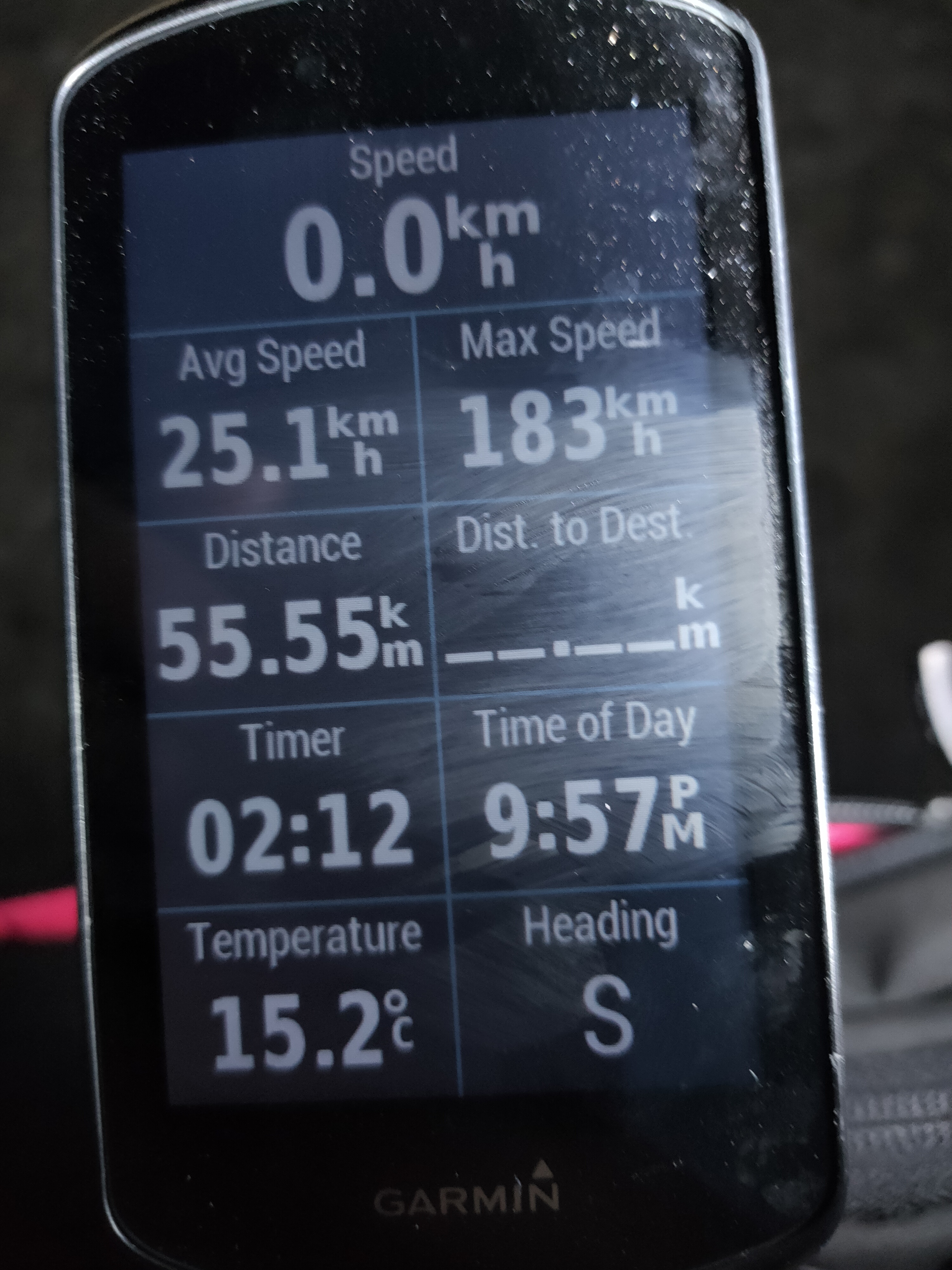
 mdavidford
PRSboy wrote:Maybe cyclists should measure airspeed and groundspeed, like aircraft?
mdavidford
PRSboy wrote:Maybe cyclists should measure airspeed and groundspeed, like aircraft?I’ve switched mine to measure solspeed. It looks much more impressive. And I never have to mess around with autopause.
werics
I feel obliged to point out
I feel obliged to point out that the assumptions of constant diameter and constant slip ratio are both wrong. They’re also pretty good anyway. Pilot Pete
wycombewheeler wrote:PRSboy wrote:Maybe cyclists should measure airspeed and groundspeed, like aircraft?
Pilot Pete
wycombewheeler wrote:PRSboy wrote:Maybe cyclists should measure airspeed and groundspeed, like aircraft?But what happens when you start drafting someone? or a van?
Your airspeed may drop, but your ground speed should increase!
You’re welcome,
Pete, the Pilot

TheBillder
dave atkinson wrote:
dave atkinson wrote:I’ve not had a great day, truth be told. But this has cheered me right up.
Which is often what I experience. Perhaps you should come here more often – you professionals write some lovely stuff but some of the comments are utterly inspired.
 dave atkinson
I’ve not had a great day,
I’ve not had a great day, truth be told. But this has cheered me right up.
wycombewheeler
PRSboy wrote:Maybe cyclists should measure airspeed and groundspeed, like aircraft?But what happens when you start drafting someone? or a van?
Cycloid
VTHEJK is right in what he
VTHEJK is right in what he says
We have two common ways to calculate bicycle speed. 1) Use a relatively simple electronic device to measure the rotation speed of a wheel of known size, or 2) launch a series of satellites encircling the globe and do timed triangulations between three or more of them.
The second method always seems like overkill to me, but there are one or two other benefits that can be obtained.
Regarding accuracy, bicycle computers rely on knowing the precise wheel circumference. I calibrate mine by pumping my tyres up to the standard pressure then riding round the local 10mile TT course. The local TT association have a device that measures the number of wheel revolutions along a set route. They calibrate this device by riding it along a Measured Mile. So the absolute accuracy depends on how well the local surveyors have marked out the measured mile, and how well the rider can ride in a straight line etc.
I find that I ride slower than I should do because I’m thinking about all this rubish instead of concentration to the job in hand.
Daveyraveygravey wrote:Elco wrote:World record run’s happen indoor … On a track if it’s about distance … Without wind …on wood … I’d use strava ..it has gps ..or connection..and it keeps track of training so …at a desktop you coul’d see data of the training. _after training”Strava’s not infallible. I hit 109 mph on Titsey Hill a few years ago, according to Strava

gps can be a bit glitchy so max speeds are always questionable. Short segment times can also be distorted
PRSboy
Maybe cyclists should measure
Maybe cyclists should measure airspeed and groundspeed, like aircraft?
I’ve no time for these
I’ve no time for these fandangled sensors and space satellite thingummies, as you say, riddled with inaccuracy. I prefer to rely on trailing a rope off the back of the bike and count the number of knots which pass through my hand.
 Jetmans Dad
Elco wrote:
Elco wrote:World record run’s happen indoor …Yes they do … but you are failing to factor in that (a) runners feet are not continuously in contact with the floor, and (b) runners do not run with series of objectively identical length strides.
Weather, wind, road conditions etc. make no difference to the circumference of your wheel, so you will travel the same distance with each revolution regardless, and measuring the number of revolutions per minute will allow calculation of speed.
If a headwind caused your wheel to shrink (as it does the stride length of a runner) then you would have a point … but it doesn’t.
vthejk
I’ll try not to condescend or
I’ll try not to condescend or come across as rude, Elco, but maybe an actual explanation of how speed sensors work might help…
Most sensors (in my experience, correct me if I’m wrong regulars!) ask you to input some parameters when you set them up – usually wheel diameter with the correct size of tires on. I can only assume that this calculation helps the bike computer calculate the circumference of the wheel, using the formula Pi x Diameter. Other sensors I’ve used ask for the actual diameter value, which is easy enough to obtain online or simply calculate using the above formula.
The thinking behind this is that the computer can then know the distance a wheel travels per rotation (the circumference of the wheel being the length of the circular outer edge of the wheel). The speed sensor can then track, through accelerometers or whatever sensors it contains, the number of rotations the wheel makes in a given time frame, multiply that value by the circumference, and thus calculate the distance.
For example: If the circumference is 2105mm (for a 700x25c tire and wheel combination, as shown on the Wahoo website)
Distance travelled per rotation: 2105mm, or 2.105m
Distance travelled per minute, if the wheel spins at say 50 rotations per minute:
2.105 x 50 = 105.25 metres
Therefore we arrive at the speed in metres per hour = 105.25×60 (minutes per hour) = 6,315 metres
Or in kilometres per hour = 6,315 / 1000 (the number of metres per kilometre) = 6.315 kph
Based on this maths then, the sensor isn’t really going to track wrongly unless, for some reason, the wheel and tire size, diameter or circumference changes mid-ride (clearly impossible) or the calibration was wrong in the first place. Headwinds, rain, bad weather etc are going to have no bearing on this. I can imagine that wheelspin in poor weather COULD skew data for, like, a second or two, but can’t see that being any particular significance.
You are right in pointing out that GPS can measure speed wrong at times, but this is because GPS relies on satellite data of how fast you travel between two given points on a virtual map. If, say, you experience a satellite drop-out for a second or two, then it could go off (not an expert on the subject). However, speed sensors are usually constantly transmitting and rely only on the system of wheel, sensor and bike computer.
I’ve tried explaining it and am now bracing for a Year 9 student response of ‘I don’t get it’
Sriracha
Strava always claims I have
Strava always claims I have gone higher and slower than Komoot, both recording the same ride on my phone. I guess it makes sense, more climbing = less speed, but even so.Daveyraveygravey
Elco wrote:
Elco wrote:World record run’s happen indoor … On a track if it’s about distance … Without wind …on wood … I’d use strava ..it has gps ..or connection..and it keeps track of training so …at a desktop you coul’d see data of the training. _after training”Strava’s not infallible. I hit 109 mph on Titsey Hill a few years ago, according to Strava
-
AuthorReplies


- You must be logged in to reply to this topic.