


- This topic has 67 replies, 22 voices, and was last updated 4 years, 10 months ago by
Rich_cb.
-
CreatorTopic
-
December 5, 2021 at 8:54 am #31879
 David9694
Anyone noticed??
(The Times 4/12/21)
-
CreatorTopic
-
AuthorReplies
-
wycombewheeler
Captain Badger wrote:wycombewheeler wrote:Philh68 wrote:Same here in Australia, complaining about the cost of fuel. Yet our government recently published this which shows different. I have a different measure, when I stop hearing some 18yo lad destroying another set of tyres at 2am in the sports ground carpark then I’ll know fuel has become too expensive.https://www.accc.gov.au/media-release/australian-petrol-prices-in-2020-21-were-lowest-in-22-years
fuel in the uk is about 70% more than in australia
And it’s not enough. The cost to health and environment and cost and to the economy of burning petrol and diesel is subsidised by the tax payer to a staggering amount (and those that don’t pay tax – for example the price paid by urban kids in particular, in terms of permanent damage to developing lungs)
I don’t disagree with that, fossil fuel is far to cheap which is why everyuone uses it, and of course all the argument is about how we can have as much energy from green sources for the same price, rather than how can we reduce our energy usage.
chrisonabike
Amen to your other reply. I
Amen to your other reply. I do think that – although overall “road safety” has improved* – there is a greater volume of traffic than when we were yoof (I’m of a similar vintage and was also travelling on my bike lots because cycling was cooler than walking as a kid).
I think plenty of vehicle sellers are already embracing the “transport as a service” model whether that’s just hire-purchase or full on car club. It’ll be interesting to see how that pans out. (Obviously in the UK ATM it would probably mean immunity from prosecution as we seem to be totally foxed when we need to identify drivers…). It seems in some cities this is really very convenient now:
https://www.youtube.com/watch?v=OObwqreAJ48
(8:53 for a map showing some of the hire locations)
* Lots of factors but making it safer *inside* cars and further reducing numbers of pedestrians and cyclists on the road are a couple.
kil0ran
I think we need to change the
I think we need to change the mindset to see “transport” as a utilty/tax in the same way as we do electric/gas/water/council tax/internet. You don’t see people bragging about whether they’re with nPower rather than Ovo. Ending ownership might help with that and there are moves afoot with personal contract hire. A lot of car makers starting to direct sell over the ‘net with the intention of using their dealer network for service and providing local test drives. Transport-as-a-Service if you will, just like your broadband contract. Personally I’d love a means to have shared ownership/use of an EV because with both of us permanently WFH there’s little point in having it sat on the drive.
We’re just one example but
We’re just one example but with decent infra we’d cut our fossil fuel use by 8,000 miles per year. The only thing preventing it is fear of allowing my son to mix with tippers and heavy traffic all doing 50mph.
A kid in his class started cycling to school about a month ago, he lasted two weeks before he’d been scared off the road.
When I were a lad (early/mid 80s) we all cycled to school – about 3 miles – in all weathers. Didn’t think twice about it, or consider the safety aspect. And that was cycling on the road, mixing it with rush hour traffic. I honestly can’t recall a near miss in 7 years of doing that. It was just second nature, I’d even ride my bike to my mate’s house 500 yards away just to go in and play computer games/watch telly. We need to get back to enabling that level of normalcy.
Cars and all the changes you
Cars and all the changes you mention go hand in hand. Carlton Reid has some excellent stuff on the history and the images are amazing – far more people going about their business on bikes than in the infra porn from The Netherlands today.
As you’ve mentioned in your other post there are powerful reasons for keeping on driving. And kids taking it up – even though it’s chunks of money. “Sunk costs”, cultural norms / pressures / desire to increase your status or at least not be seen as inferior, as well as the psychological (“freedom”). Well put on that.
It will take more than just “nudges” to really shift things. I’m hopeful (not wildly so…) that a conbination of different pushes and pulls can make a difference. But I agree that unless there are alternatives to driving – which need to address some of the reasons we like cars – just trying to bring down the ban hammer isn’t going to get far. That’s why I’m a bore about decent infrastructure and mass cycling. Cycling is an alternative to private motorcars for many journeys which also has the imporant aspects of freedom / convenience / go anywhere you want / private transport which we like in cars.
We’re expecting to stay in
We’re expecting to stay in this house now for the rest of our days so we’ll be going full solar, heat pump (ground source), battery storage, etc over the next couple of years. Big capital investment but at current prices we’d see about a 4% annual return – negligible but it will also put a few quid on the value of the house.
Increasingly I think we’ll see this as a desirable tick box when house hunting, much like good broadband or strong 4G signal is today. Just need planning regs to be updated to allow front garden solar installs (yeah, good luck with that)
 Captain Badger
wycombewheeler wrote:Philh68 wrote:Same here in Australia, complaining about the cost of fuel. Yet our government recently published this which shows different. I have a different measure, when I stop hearing some 18yo lad destroying another set of tyres at 2am in the sports ground carpark then I’ll know fuel has become too expensive.
Captain Badger
wycombewheeler wrote:Philh68 wrote:Same here in Australia, complaining about the cost of fuel. Yet our government recently published this which shows different. I have a different measure, when I stop hearing some 18yo lad destroying another set of tyres at 2am in the sports ground carpark then I’ll know fuel has become too expensive.https://www.accc.gov.au/media-release/australian-petrol-prices-in-2020-21-were-lowest-in-22-years
fuel in the uk is about 70% more than in australia
And it’s not enough. The cost to health and environment and cost and to the economy of burning petrol and diesel is subsidised by the tax payer to a staggering amount (and those that don’t pay tax – for example the price paid by urban kids in particular, in terms of permanent damage to developing lungs)
Philh68 wrote:Same here in Australia, complaining about the cost of fuel. Yet our government recently published this which shows different. I have a different measure, when I stop hearing some 18yo lad destroying another set of tyres at 2am in the sports ground carpark then I’ll know fuel has become too expensive.https://www.accc.gov.au/media-release/australian-petrol-prices-in-2020-21-were-lowest-in-22-years
fuel in the uk is about 70% more than in australia
Jimmy Ray Will wrote:And that’s not forgetting that these fuel price increases are not part of some greater drive for sustainability, rather the simple drive for greater profits from big corporates. I’m surprised that so many are seemingly so OK for the big guys to rinse us with impunity so long as it negatively effects people you don’t ‘like’.o please, deisel and petrol prices now are barely more than they were in 2014
kil0ran wrote:… If everyone buys an EV and charges it overnight from grid power it’s no longer cheap capacity is it?Even with that, I don’t think overnight electricity will go up much, renewables (except solar) will continue to generate overnight and it’s useful for that electricity to have somewhere to go when offices, factories and shops are closed and people are asleep.
It’s a good point about the
It’s a good point about the tank fill thing. I allocate one tank of fuel to my Volvo 940 (25mpg if I’m lucky) per month. Costs over £100 to fill up now. When its gone its gone. Undoubtedly with the recent rises it crossed a psychological barrier but it would have to double to make me change that behaviour.
I’m just about old enough to remember the impact of the ’70s oil crisis, it does need that level of shock to make a change in ownership behaviour. I remember my uncle buying a Jag E-Type for buttons, and then a Rover P6 – no-one wanted them, people started swapping to small family hatchbacks. We’ll be there with used EVs in a couple of years I think. 6 months ago you could buy an 8yo used Leaf with good battery/history for around £6k – nearer £7.5k now.
60 years ago most people
60 years ago most people commuted by public transport or bike/motorcycle. It’s a recent affectation in this country, driven by inner city decline, out of town shopping, and a general flight to the suburbs. Oh and marketing of course, and keeping up with the Joneses.
I find it very strange that our friends with teenagers have followed the path we did – pass test at 17/18, first car at 18. Two of the lads are paying almost £2k for insurance. Others are paying £250 a month for a brand new car on contract hire.
Simon E wrote:
Fuel price is only part of it. Genuinely poor people struggle to afford to buy a single car and pay for VED and insurance, never mind the fuel and cost of servicing/repairs.kil0ran wrote:For the urban or rural poor none of this is really an option, and that’s why petrol prices are a barrier to social mobilityIf I was in your position I would seriously consider an EV and do my utmost to avoid a petrol or diesel vehicle.
A serious suggestion: leave the car near the school during the day and use a bike to get around in the meantime. It would halve the mileage.
When I was proper poor I still ran a car. Bangernomics and being handy with the spanners helps. Alternative was £100 for a travelcard and 2 hours on the bus every day. Admittedly this was when petrol was much, much cheaper.
We’ll almost certainly go EV – just waiting on Scottish Power to confirm the overnight rate. Even if it ends up being a little more expensive than the dismal (financially) it will be great for
virtue-signallingreducing our carbon footprint.Thanks for the suggestion about leaving the car at school for the day, that’s complete genius! I’m more than happy to cycle home and then back again for pickup, barely warmed up in 7/8 flat miles. Will be like going back to commuting.
 andystow
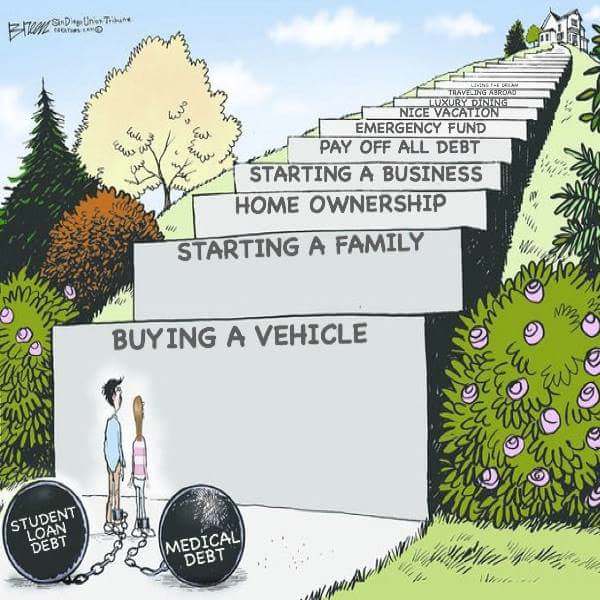
Cartoon from the US, but look
Cartoon from the US, but look what they’ve put as the first “step” in this. It doesn’t have to be this way, even without the medical and student debt that are not such a problem in the UK.
 Simon E wrote:
Fuel price is only part of it. Genuinely poor people struggle to afford to buy a single car and pay for VED and insurance, never mind the fuel and cost of servicing/repairs.kil0ran wrote:For the urban or rural poor none of this is really an option, and that’s why petrol prices are a barrier to social mobilitySaid shorter – being poor is a barrier to social mobility. Where you can afford to live determines many of your options – and that may depend upon where you can find work etc.
In many places jobs are lacking or employment options poor, ameneties scarce, cheaper housing a long way from all of the above and the public transport required to reach these (or any option other than driving) is very limited.
As always it’s bigger than just “can’t afford to run the car”. It seems we need to change from a system based around the private car and driving. Change is always hard and this is a major change. We may need to alter (more or less) a pattern which we’ve followed for decades. We’re partly here because – while expensive for the poorest – cars and driving are relatively cheap. There are a wide range of subsidies. It also appears cheaper overall because we choose not to count some of the costs on the balance sheet (e.g. health and mobility impacts). And as always the richer folks will find this easier and the poorest more difficult.
-
AuthorReplies
- You must be logged in to reply to this topic.