


- This topic has 39 replies, 23 voices, and was last updated 4 years, 6 months ago by
 David9694.
-
CreatorTopic
-
March 3, 2022 at 2:38 pm #31977David9694
Village Facebook noticing that our local garage is now charging £1.60 / ltr and saying it’s 8p less in town (10 mile round trip to save £3, anyone?) Someone saying it’ll be £2 by the end of the month.
I reacted cautiously to the “shortage” of fuel in September – a lot more desperate scratting about for supplies and not concentrating was my take.
I don’t wish financial hardship on anyone, but there’s the energy cap change and the increase in NI all coming down the track. The best ways to economise on fuel are to drive less, drive smaller, stick at 55 mph, check tyre pressures, drive like you’re a cyclist – keep a steady momentum.
I wonder what we’ll see on the roads and at the pumps in the coming weeks?
-
CreatorTopic
-
AuthorReplies
-
matlockmark
Spangly Shiny wrote:As I recall at the time of London Olympics the cost of Brent Crude was north o $130 a barrel yet the pump price was £1.32 (I still have the till runs). How is it that with a Brent crude price of $119 a barrel today the pump price is ove £1.50?Since brexit the value of the pound against the dollar has dropped by about 30%. Oil is priced in dollars, so this accounts for most of the difference you are seeing.
Chris Hayes
I drove beyond Cambridge at
I’d disagree that fuel efficiency has nothing to do with the engine, but I take your point. I drove beyond Cambridge at 55mph, so a fair stretch: cruise control on empty roads with no braking; Cambridge to Grantham at 60mph and the rest – as far as was possible – at 70mph, but by this time traffic has picked up and there was some light braking.
My understanding of aerodynamics is that circa 50% of fuel is expended overcoming wind resistance at speeds above 50mph… but the difference between 55 and 70 is negligible – 2-3mpg according to my fuel utilisation data anyway. I wish it were otherwise.
 mdavidford
kinderje wrote:I found out today that different refineries are set up to process specific types of crude oil. So, a refinery cannot start to process Saudi oil if it was originally set up for Russian supplies.
mdavidford
kinderje wrote:I found out today that different refineries are set up to process specific types of crude oil. So, a refinery cannot start to process Saudi oil if it was originally set up for Russian supplies.Also apparently different blends produced for summer and winter markets.
A bit like Pimms.
Troon
Chris Hayes wrote:
Chris Hayes wrote:The speed limit was lowered when engines were normally aspirated and cars were generally inefficient….ICE cars are still hugely inefficient. The best you’ll get from a diesel engine is about 40% thermodynamic efficiency, and that peak efficiency comes at relatively high load. This masks the aerodynamic effect to a degree — in electric cars and on bicycles it is clear. Aero drag goes up with the square of the speed.
 TriTaxMan
OldRidgeback wrote:It’s not to do with the engine, it’s to do with the aerodynamics. Your vehicle uses considerably less fuel at 55mph than at 70mph because air displacement is less of an issue at lower speeds. The energy required to contend with air displacement increases exponentially the faster you go. While cars are admittedly more aerodynamic than they were in the 1970s, the improvement has been that great that it brings such a benefit. Try making the whole motorway journey at 55mph and then at 70mph and you will see a significant difference. Bear in mind that the stop/go traffic you contend with at either end will burn a lot of fuel. Bear in mind also that to make you fuel go further, slow acceleration will make a big saving too.
TriTaxMan
OldRidgeback wrote:It’s not to do with the engine, it’s to do with the aerodynamics. Your vehicle uses considerably less fuel at 55mph than at 70mph because air displacement is less of an issue at lower speeds. The energy required to contend with air displacement increases exponentially the faster you go. While cars are admittedly more aerodynamic than they were in the 1970s, the improvement has been that great that it brings such a benefit. Try making the whole motorway journey at 55mph and then at 70mph and you will see a significant difference. Bear in mind that the stop/go traffic you contend with at either end will burn a lot of fuel. Bear in mind also that to make you fuel go further, slow acceleration will make a big saving too.I agree. I did just that in my previous car, if I was driving on a motorway at 70mph I would average around 50mpg (calculated from fill to fill), but I had been away visiting friends in Central Scotland and was driving back to Southern Scotland around 9pm on a Sunday evening. I wasn’t in a hurry and needed fuel so I filled the car up, reset the fuel consumption computer as I set off from my friends and I basically sat with the cruise control on at 50mph for the 90miles of driving on motorways and quiet A Roads, by the end of the journey the the car was displaying 65mpg average for the journey….. when I refilled the car the following morning and it came back at 62mpg.
That basically ties in with the estimates that fuel consumption is increased by around 20% for an increase of 15-20mph about 50mph. Apparently however for electric cars the difference is bigger. Estimates put that at 50mph a Tesla would use 220Wh per mile travelled but by 70mph that is increased to 300Wh per mile so that seems to be about 35% less efficent
OldRidgeback
It’s not to do with the
It’s not to do with the engine, it’s to do with the aerodynamics. Your vehicle uses considerably less fuel at 55mph than at 70mph because air displacement is less of an issue at lower speeds. The energy required to contend with air displacement increases exponentially the faster you go. While cars are admittedly more aerodynamic than they were in the 1970s, the improvement has been that great that it brings such a benefit. Try making the whole motorway journey at 55mph and then at 70mph and you will see a significant difference. Bear in mind that the stop/go traffic you contend with at either end will burn a lot of fuel. Bear in mind also that to make you fuel go further, slow acceleration will make a big saving too.
I’d question whether driving
I’d question whether driving at 55mph (as opposed to the speed limt) saves much on modern engines. I had to drive to Yorkshire yesterday from my home in London to see my ailing mother and, as usual, set off at 0430 to avoid traffic and get there intime to have breakfast with her.
As I wasn’t in a rush I drove at 55mph to test this, then 60mph, then 70mph. The difference in fuel consumption according to the trip computer between 55 and 70 mpg was less that that required to get up the gradient on the M11 just outside the M25….
The speed limit was lowered when engines were normally aspirated and cars were generally inefficient….
Prosper0
Every day I still see drivers
Every day I still see drivers parked up, idling their engines, so clearly fuel is still too cheap..
David9694
Diesel at over £2/ litre in
Diesel at over £2/ litre in Kent.
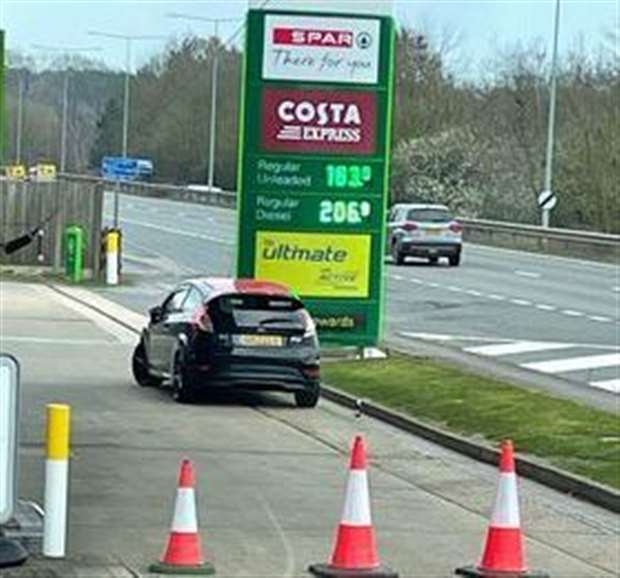
kinderje
I found out today that
I found out today that different refineries are set up to process specific types of crude oil. So, a refinery cannot start to process Saudi oil if it was originally set up for Russian supplies.
wycombewheeler
“Energy prices are set to
“Energy prices are set to double again by the end of the year, which will bring mileage costs up to 9p a mile – but that’s assuming that the cheaper night charging tariffs remain.”
But with oil prices also increasing it will always be cheaper per mile. If electric goes from 4p/mile to 8p/mile but diesel goes from 16p/mile to 20p/mile there is still the same p/mile saving which still funds the more expensive capital cost.
Jem PT
Simon E wrote:That has always been the case but people are so blasé about the cost. Far easier to moan about fuel being £1.60/litre than doing something constructive about the amount of it they use.As witnessed by the number of drivers who leave their engines idling when they are parked to keep the car warm/cool when the weather is cold/hot. This alone proves that car fuel is too cheap.
How many years is it now that the car fuel price escalator that used to ratchet up the cost of petrol/diesel every budget has been zero?
David9694
not so far noticing less or
not so far noticing less or better driving – you have to wonder what it would take for this to happen and when/how the effects will be felt individually.
It’s a crude, regressive rise, affecting the poorest folk first and presumably leaves the richest able to carry on, perhaps with even more road space to tear up. Do the poorer people just not travel, or do they go by other means?
Do you pay your £55 to fill up from one-quarter and go ouch “then” or does it hit (mentally) at month-end? Or what? What other (discretionary) spend is curtailed?
David9694
it’s not about convenient
it’s not about convenient personal travel, this.
I was in Shropshire in late September ’21 – the petrol queues and the angst all seemed to be mainly coming from super-connected London and the south-east.
things seemed pretty chilled in rural Shropshire, considering you could get genuinely stuck around there if there was a real fuel shortage.
 Simon E
There is also a suspicion
There is also a suspicion that companies are making up for the loss of revenue when prices were low during the pandemic.
-
AuthorReplies
- You must be logged in to reply to this topic.