


- This topic has 34 replies, 19 voices, and was last updated 3 years, 5 months ago by
 Cugel.
-
CreatorTopic
-
April 15, 2023 at 9:55 am #32527
zedthegreat
Morning
I run clinchers/tubes at the moment but on tubeless compatible wheels so considering giving it a go when I need to replace my tyres. A couple of basic questions I have – interested in actual experiances.
1) For various reasons I often end up not riding one or other of my road bikes for a few weeks at a time. I beleive for extended periods of non-use that the official line is to remove sealant, but how long can a tyre sit and still be useable? Does the sealant leak, clog, become useless etc?
2) When you pump a tyre and a little air escapes (from the tyre, not me!) do you get covered in sealant every time?
Basic I know!!
Cheers
-
CreatorTopic
-
AuthorReplies
-
Cugel
mike the bike wrote:At my age life is too short for buying special gloop, special valves, special tape, special pump, special tyres, special topper-uppers and then getting covered in the gloop? Not to mention the cleaning out of the special gloop when it dries, the throwing away of the special gloop when it proves to be bloody useless and the very regular pumping of both tyres. Now, apparently, we have to listen to our tyres in case the special gloop has turned crusty.
Mmm, now let me think …..
Perhaps you yourself have become ossified to a far greater degree than the tyre gloop ever is? I yam quite ancient myself but enjoy the invigorating effects of learning to use a new technology, especially if it provides a means to avoid having to deal with punctures when far from home with the olde joints getting a bit creak.
That ossification of the attitudes can soon morph into worserer conditions, tha knows! You may find yourself out on the bike with no idea of why you went or where you are!! Or even who you once were!!!
 mark1a
I’ll put you down as a no
I’ll put you down as a no then…
 mike the bike
At my age life is too short
At my age life is too short for buying special gloop, special valves, special tape, special pump, special tyres, special topper-uppers and then getting covered in the gloop? Not to mention the cleaning out of the special gloop when it dries, the throwing away of the special gloop when it proves to be bloody useless and the very regular pumping of both tyres. Now, apparently, we have to listen to our tyres in case the special gloop has turned crusty.
Mmm, now let me think …..
vthejk
It seems to depend on the
It seems to depend on the tire and sealant. I have run WTBs with Joe’s No Flats eco sealant a lot in the past year and they are prone to a lot of sidewall sealant seepage in the initial week or so of installing the tire (most notably on their non-reinforced casing with tan walls). After that period, I needed to top the sealant up once; however, this then didn’t occur again until the tire was used up. I got around 5,000km out of my last pair of WTB Byways in 584-47mm and they still had a healthy pool of liquid sealant in after they were removed.
Worth noting as well that the tires sealed up perfectly well when punctured throughout their working life, with only one larger hole needing to be plugged.
JMcL_Ireland
I’ve been running tubeless
I’ve been running tubeless for about a year on the “good bike”. It’s had a couple of periods of sitting for extended periods in that time – I took my other bike to France in the summer (about 1 month all told) as it lends itself to rougher surfaces, I was off the bike for about 6 weeks after getting hit by Covid in late autumn, and it didn’t get out very often from November to early March as I was mostly on the turbo (not on that bike). I’ve never had issues with the sealant leaking or spraying (sometimes get a miniscule amount spraying out of the valve when detaching the pump)
I’ve topped it up once (tardily – I probably should aim to add a bit every 3-4 months) and – fingers crossed – have yet to get a flat. Following advice on another forum, I’m going to not remove the old stuff until the tires have worn out. I’m probably 1/3 the way there on that though I’m planning more time on the road this year so would probably be looking at replacing at least the rear early next year (I usually rotate front to back as it’s had less wear)
mark1a
Ah I see, thanks. Seems a bit
Ah I see, thanks. Seems a bit steep doesn’t it? Although I guess anyone who is competent enough to change a tyre, fix a puncture, etc themselves should be able to stay on top of this at home. £16 for a bottle of Stans with enough for 8 wheels works out at £2 a wheel plus some time.
 NotNigel
It’s what the bike shop from
It’s what the bike shop from the Instagram link was charging.
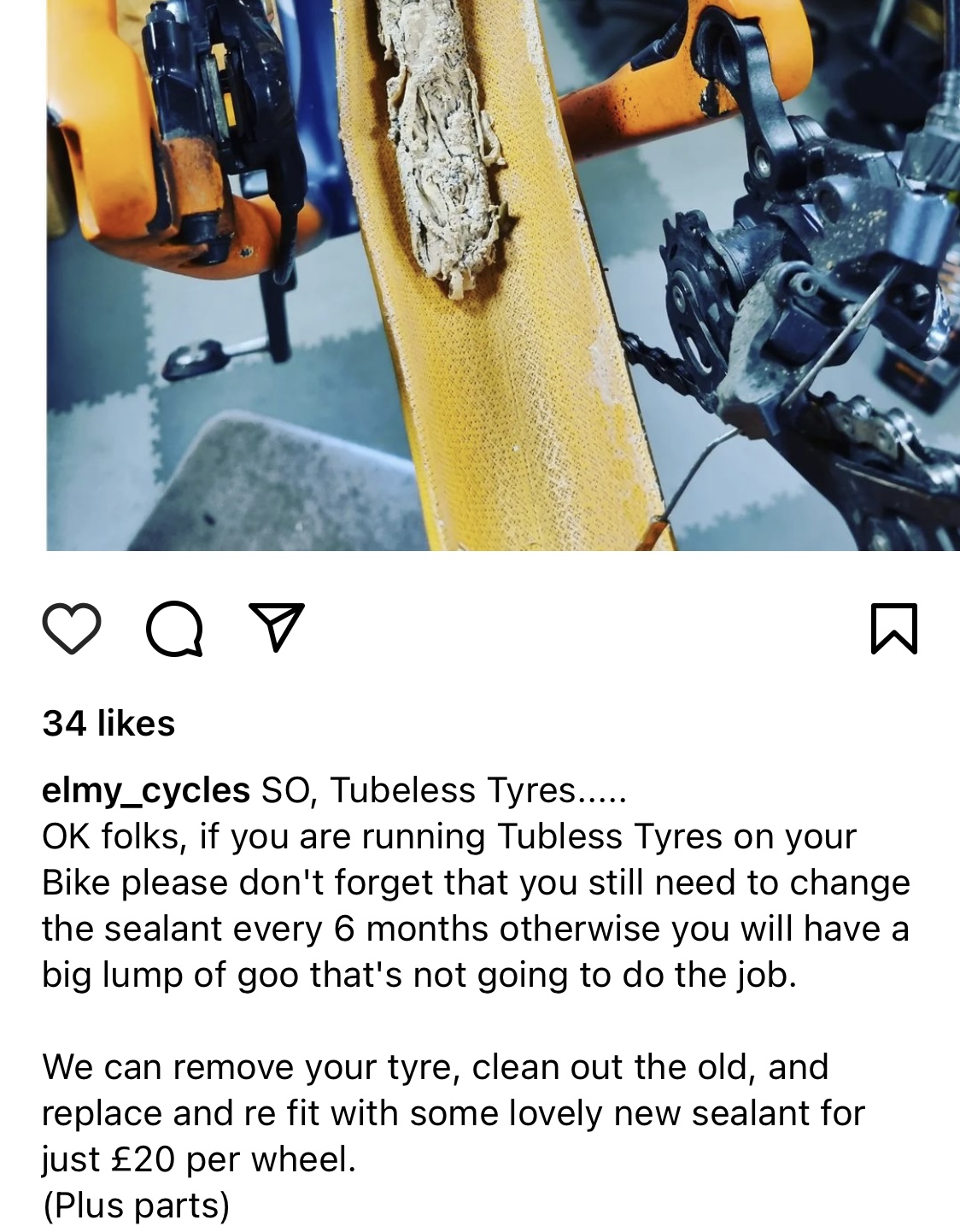 mark1a
wtjs wrote:Local bike shop posted this picture of how tubeless tyre sealant can go
mark1a
wtjs wrote:Local bike shop posted this picture of how tubeless tyre sealant can goWonderful! I just can’t wait to sign up for £20 per wheel every 6 months
Where do you get £20 per wheel every 6 months from?
duncanap
I found this Hunt Wheels
I found this Hunt Wheels guide really useful when I started using tubeless tyres –
https://help.huntbikewheels.com/support/solutions/articles/43000456128-tubeless-tyre-setup
I have been running tubeless
I have been running tubeless for about 5 years. I don’t commute but do ride a fair bit (strava shows 2500km so far this year). I use two main bikes, depending on type of ride and weather (one has mudguard points). I use schwalbe ones or continental GP5000s, nearly always 28mm. I invested in a miltag kit which means I can suck old sealent out with a syringe and add new without taking the tyres off. I am pretty lazy. I woudl say I only take out old sealent to avoid making a mess when a tyre is dead and needs replacing. I add sealent (about 15-20 ml per tyre) if the bike has sat for more than three months, or if I feel like it has dried out – you can actually hear the sealent moving if you move the wheels while in a stand in a quiet place.
The only problems I have had have been cuts on sidewalls whenI have hit sharp rocks descending. A lot of the hills near me have tarmac roads but they are not open to cars or have very light traffic as they are in a nature reserve (I know – I am super lucky). Worst I had was a 10mm cut on front tyre at speed, which resulted in three broken ribs and a trip to hospital. But I am pretty sure that would have destroyed almost any tyre. The cut was on a newish conti, right across the tread, from a very sharp shard of glass. Other issues have been sidewall cuts. Always made it home with a spare tube and cereal bar wrapper.
I have done a couple of Haute Route 7 day events and seen plenty of people stuck – opten with pinch/snakebite punctures from potholes. I have never had that with tubeless, you can in extreme situations make them burp sealent, but as long as you add some more later you should be fine. I bought a really nice plugkit but never used it. I have sometimes patched the inside of tyres if I have noticed a larger puncture, more out of paranoia as the descents near me are fast, and I have used my hospital pass already….patching is just like fixing an inner tube with a slightly thicker patch and appropriate glue direct to inside of tyre. Never noticed an issue with valves sealing up. If I do take a tyre off I just wash it out with water and start again. Note CO2 is not supposed to play well with tubeless sealents, ok to get you home but you should empty out the CO2 and reinflate with air when you can. I don’t use CO2 myself, but have heard this from many others so beleive it.
So for me it is a really useful technology. I am lazy but like to fiddle. Ride in a rural setting but in remote areas where I can often be outside mobile phone signal areas. I always carry plugs, tubes, and tools. But I would in any case. I have often given my tubes to other riders – hopefully the karma helps me and them.
Last point – if I fly with my
Last point – if I fly with my bike I do drop the pressure a bit, normal riding pressure for me is 70-80psi, I woudl drop it to 30-40 psi for flying. Enough to keep the tyre sealed, but allow some expansion for reduction in pressure. Again this might be superstition but it seems to work pretty well.
wtjs
Local bike shop posted this
Local bike shop posted this picture of how tubeless tyre sealant can go
Wonderful! I just can’t wait to sign up for £20 per wheel every 6 months
Oldfatgit
I have 2 sets of wheels –
I have 2 sets of wheels – tubeless for gravel and traditional for commute.
Essentially, the tubeless are on for one ride a week; my bike was broken in February and they spent the whole month in an unheated metal shed (in central Scotland) with no detrimental effects.The only thing I have happened in use, was this weekend when a puncture had made the tyre go ‘wallowing’ soft; the sealant had clogged the valve sufficiently to blow the ‘o’ ring from my CO2 cannister injector (makes a big bang, BTW), and rendered the injector useless (‘o’ Ring is interruptance fit, and won’t go back in the detent ring without the correct tooling).
stonojnr
Local bike shop posted this
Local bike shop posted this picture of how tubeless tyre sealant can go, i think that bike is less than a year old.
https://www.instagram.com/p/Cp4mr_Yo7-y/?igshid=YmMyMTA2M2Y= hawkinspeter
The longevity of tubeless
The longevity of tubeless sealant probably depends on the tyres. If they’re “tubeless-ready” then the sealant will likely dry out quicker and may need topping up every couple of months. It can be a good idea to check every couple of months or so as you might not have noticed a sealed puncture or two that reduced the amount of sealant.
-
AuthorReplies
- You must be logged in to reply to this topic.