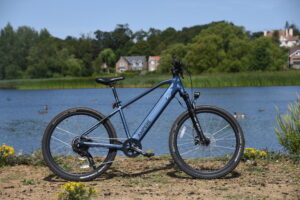
The Oxygen S-Cross MTB MKII is a leisure e-MTB from South Yorkshire based Oxygen. The firm also offers the S-Cross ST MKII (a low step over commuter model with pannier rack, lights and mudguards), the S-Cross CB MKII (a step over version of the latter) and an e-folder, the Oxygen Go.
Oxygen offer a two year warranty that includes all the electrical components of the bike and five years on the frame, providing that the bicycle has been registered within 14 days of the purchase date.
S-Cross MTB MKII first impressions
The sporty, funky-looking frame comes in one size (designated 19 inches) but the seatpost will drop right into the frame and also has plenty of height, so in terms of pedal reach it should suit a wide range of heights.

Reach is a bit more of an issue due to the length and flat angle of the handlebar stem and those much shorter than my 5ft8in might be stretching uncomfortably to reach the bars. If you are outside averagish height, a test ride is definitely recommended to see if the sporty riding position suits you.
The top tube dips just before the seat – not enough to make it unnecessary to swing a leg over the seat but helpful as and when you need to comfortably straddle the bike, for example if opening and shutting bridleway gates without dismounting.

The semi-integrated battery blends nicely into the top of the downtube and removes easily at the turn of a key and a lever – one of easiest systems for frame integrated batteries I’ve come across
Bike weight on our Park Tool digital scales was 23.26kg (20.16kg plus 3.1kg battery) – that’s pretty good for an e-MTB that doesn’t feature premium lightweight components and has a large capacity 576Wh battery – as our test bike did – plus three front chainrings.

There are also smaller capacity 374Wh and 468Wh battery options which no doubt mean a slightly lighter bike. Prices are battery size dependent at £1,499.99, £1,549.99 and £1,649.99 respectively. At 185Wh per kg the Oxygen battery actually showed better energy density than a couple of Bosch batteries I had to hand.
Overall the frame and battery setup gives an impression of nice styling (including frame routed cabling) and very solid quality.

Much of the spec is above what you might expect on a typical machine powered by a geared rear hub motor from the respected but budget-orientated Chinese firm of Shengyi. In particular the bike features Shimano-branded hydraulic disc brakes and a 27-speed (3×9) Shimano Altus derailleur gearing.

The double wall alloy wheels have reinforced spoke hole eyelets – again, not a feature you see on every e-bike with a budget hub motor. Perhaps a more typical accompaniment to a budget hub motor system is the SR Suntour XCM steel sprung forks.

Further plus points are the nice looking Velo lock-on grips and the aggressively-treaded Impac Smartpac 27.5 x 2.25 MTB tyres and the fact the frame has attachment points for a rear rack and reasonable clearance to fit mudguards front and rear.
Motor and ride performance
Budget hub motors can perform really well or quite poorly depending on how good the motor itself is of course, but also crucially how the motor electronics are set up. The Shengyi motor proved pretty middling and entirely respectable in its performance, though I felt it lacked a bit of oomph on the really steep climbs.

On our mile long road climb, with plenty of 5% grade climbing, performance was pretty good – only a little behind most of the mid-drive times, albeit with a little more pedal input needed. On our two steeper test climbs with gradients in excess of 10% in places (both on road and off road) times were a fair bit behind mid-drives and also a little behind some of the better performing hub machines.
The bike made it up without too much effort but that was also partly thanks to the very low gearing attainable on the 3×9 derailleur gearing system. So as long as don’t mind sacrificing a bit of speed on severe gradients it will crest most hills on and off road – not something every budget-motored e-MTB can manage.

The control electronics were a little disappointing on what is one of the pricier e-bikes out there with a budget hub motor system. Of the six power levels, the lower two only assist at low speeds, so most riders will end up toggling past them straight away, especially if you are on the open road or less technical trails where you are likely to leave the bike in one of the upper four levels the majority of the time.
Power is activated by a discreet cadence sensor on the inside of the non-drive side crank – the standard method on such systems – and power kicks in after about a turn and a half of the cranks and shuts off fairly soon after pedalling. It’s certainly not the worst we’ve tried but there are some similar spec e-bikes out there where pedal action is married a little more closely to smoother motor behaviour. In general it’s not a system that lends itself well to close control on technical trails where a mid-drive e-MTB would be much more at home.

Despite these cavils about the control electronics, I found the Oxygen a very nice bike to ride; it feels pretty fast and sporty, even with the motor power turned off altogether. The Shimano hydraulic disc braking was excellent and Altus gears pretty responsive and crisp. On my longer hilly rides over Pennine tracks and trails it never failed to tackle anything put in front of it, even on muddy and grassy climbs with challenging gradients – even if it wasn’t the fastest up them. As mentioned, the wide gear range proved useful for keeping the motor power coming on steep gradients with the cadence sensor in action all the time and also came into its own whilst powering down hills at up to 30mph.
Average consumption over our circular 22-mile mountain bike course, mixing on and off road conditions with 1,730 feet of climbing, gave a figure of 13Wh per mile – fairly respectable for such a hilly course. If Oxygen could just smooth that power delivery out a bit, especially in the lower levels where it comes on with a bit of a surge, it would surely improve consumption even more. Still, that gives a projected full range in these riding conditions of around 44 miles, which should suffice for many people’s daily riding needs. (Note these figures were obtained by a 68kg rider on a warm but windy November day.)
Nice display
The handlebar display is easy to use and the LCD readout figures easy to see – it’s nice and bright and visible even in strong sunlight. For night time riding the backlight can be muted so as not to blind the rider.

The plus and minus buttons used to toggle up and down power levels are large and easy to use, even with gloves on. There is a nice walk assist feature too, that gives powerful motor assist if you need to walk the bike up a steep ramp for example.
There is a micro-USB port on the side of the display for phone charging etc, but I had trouble using it, perhaps due to a dodgy cable. Handily though there is also one of the larger type A USB ports on the side of the battery and this gave a charging current of 0.75 amp – less than the 1A mains current I usually use but fine for keeping my android smartphone charging slowly but surely.
Value for money?
You can get so-called e-MTBs for under a thousand pounds but these won’t be very capable compared to the S-Cross as they will typically feature fewer gears, a smaller battery and less effective brakes.

I really struggled to find e-MTBs of a similar spec – they either tend to be of the cut-price cheapy over-geared and under-specced variety or you are looking at a step up to a mid-drive at around £2,000 (the exception being the standout Decathlon EST 520 for £1,699.99 with a Brose mid-drive). Batribike’s Delta is a 3x gear setup but has a smaller battery and retails around the same price for the largest 460Wh option.
In summary, Oxygen’s S-Cross MTB MKII ticks a lot, if not all of the boxes I would want in an e-MTB with a budget rear hub motor system and is decent value to boot.
All the deals displayed on our review pages are pulled from a constantly updating database feed of the best affiliate deals available. The criteria for deciding on what are the best deals is who is offering the lowest, delivered price. In most cases we will be showing the very best deal available online, but sometimes you may be able to find an item cheaper. If you can please feel free to post a link in the comments box below. To find out more about affiliate links on road.cc click here.