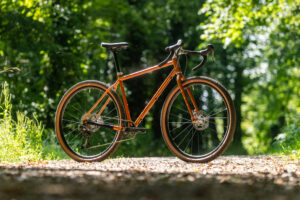
If you want to find a custom steel bike, there are a lot of choices. Every bike town has a variety of artisans who will create exactly what you want. Scarab Cycles is a bit different though. The overall approach is a hybrid of production vs custom that walks every customer through a process. You start by picking a model and then developing custom geometry to match your body measurements.
- Five things that weren’t cool – until gravel happened
- What is the spirit of gravel biking?
- Scarab Cycles – the story of a Colombian steel bike company
To get an understanding of this process, I went through it from beginning to end. Just like any customer, I relayed my sizing and finessed details that were important to me. I chose a paint scheme then picked colours and added unique detailing. Given my background, I obsessed over components and visuals more than some but that’s the nature of a custom build.
At the end of the process, I headed to Colombia to pick up the bike and spend some time exploring the country with the owners. When it was time to head home, I brought the bike back and spent more time testing it. With a full understanding, I’m ready to share the details. If you are looking for something unique then keep reading to see if the Scarab Apuna is the right choice for you.
Scarab Apuna – Technical details
I’ve already said it more than once and I’m likely to say it more, but the Scarab Apuna is a custom bike. There’s no exact spec sheet and no need to relay manufacturer details to you. Every build is going to be unique. Despite that, there are pieces of the puzzle that don’t change from bike to bike.
While some custom steel builders start with a blank slate, Scarab isn’t one of them. There are models to choose from that dictate a direction. There’s still a vast array of choices and options for every model but you start with guides in place. If you choose the Apuna, that means you are choosing the bike that does almost everything.

One of the defining features of the Apuna is the tubing. That’s always the case for a steel bike but the Apuna uses ovalised Columbus steel. There are no lugs and, if you’ve mistaken the finished product for aluminium, you aren’t alone. Oval steel isn’t the most common choice but it’s there, along with the seatstay bridge, to add stiffness and reactivity.
Instead of steel at the front of the bike, you will find a carbon Columbus Futura Gravel Fork. Like the choice to use ovalised tubing, the fork is there as a choice to add performance. There are no mounting points for bike packing accessories but there is internal cable routing and hidden fender eyelets. Beyond that, this fork is especially important to my particular build.
The official specifications for the Apuna list tyre compatibility as “700×28-700×38 or 650Bx35-650B-42” which comes from the fork, not the rear triangle. According to Columbus though, there’s room for a 700x40mm tyre and that’s with the standard ISO space on the sides. In my case, my build started from this point with the idea of making the Apuna an American gravel race bike that would primarily run 40mm tyres. If you like that idea, it does work just fine but you may run into toe overlap depending on your geometry. Given that almost every bike I’ve ever owned has toe overlap, I was willing to make that sacrifice. As we discussed the geometry though, Scarab spent time with this detail.
It wasn’t just toe overlap the Scarab spent considerable time on as it relates to the geometry. The other detail Scarab worked with me on, which I was more concerned with than overlapped, was keeping my knees from hitting the handlebars when climbing. This wasn’t something I expected was fixable but it came up as we discussed the measurements and geometry.
I’m not overly technical when it comes to geometry so I shared some of the bikes I like to ride as well as how I like a bike to feel. In many ways though that discussion was more of an opportunity to confirm that the Apuna was right for me than to make any changes. Scarab has already done the homework on the geometry and the Apuna uses several geometry tricks to make it handle fast and precise. You could also think of the short wheelbase and higher offset numbers as owing to the lean towards road bike geometry but the lower bottom bracket and longer chainstay do add some stability back. Part of the whole package is a shorter, 90mm in my case, stem that helps keep the steering quick.

Given I conceptually prefer the type of handling the Apuna offers, I didn’t request any changes as I listened to the numbers. Until we got to the stem length. At that point, I requested a longer stem to keep my knees off the bars and, instead, Scarab asked for more measurements and changed the whole bike to match. The stem length is that important.
Similarly important is the idea of telling a Colombian story through the visual design. Unlike the geometry, which I had little to add to, I spent significant time working on the visuals. Scarab offers some off-the-shelf designs. Many of them are special editions that come from the Scarab Art Director Alejandro Bustamante but there are less complicated options as well. You can then customise all of them by choosing colours and making small changes to suit you.
Like the models though, there are always guide rails in place. The colour pallet options retain a Colombian feel no matter how you combine them. The logos and the Colombian flag, are always present and there are limits to how much you can customise. For me, the discussion largely centred around choosing one of the simpler paint options and then pushing right up to the limit of customisation to add more dark paint. I wanted what I considered the dirty areas of the frame darker so we swapped the inside of the fork and rear chainstays as well as going as far up the seat tube as Bustamante would allow. I also drew a poison dart frog to add to the design given my son owns a tree frog and poison dart frogs are native to Colombia.
During the customisation process, I also added some mounting points. While I rarely ever use them, I consider mounts for a bento box and a third water bottle as necessities on a modern gravel bike. We are past the time when one must worry about scratching a frame or running out of water, so I added the mounts I wanted just in case. These are not standard on the Apuna though you can add them if you prefer.
Scarab Apuna – Componentry
Unlike the guide rails you will find elsewhere, there are no guide rails here. You can pick and choose whatever you prefer for your bike and I took full advantage of this.
I knew from the very beginning I wanted to run Cadex pieces so I started there. The Cadex AR handlebar is my favourite choice on a gravel bike and I’ve used it on two recent builds. The 8-degree flare is enough to match the style of modern gravel handlebars but isn’t enough to feel noticeably wider when riding. At the same time, the short 115mm drop matches my preference for a slammed stem (though this time I left room for a Restrap Bumper Bar) and more riding time spent on the hoods. The new Cadex race stem with its -10 angle helps with that as well. Both pieces are also exceptionally light with the bars quoted at 185 grams (40cm width) and the stem as 118 grams (90mm length).

The next piece of the puzzle was the seatpost. This is a piece I generally think should be easy and yet rarely seems to be. Cadex doesn’t have an option at the moment so it had to be from another company. It also needed to work with a round tube and fit ovalised carbon rails, and I needed a setback post for my build. Aside from meeting all these requirements, the Roval Terra seatpost I chose is also worth mentioning because it separates the angle adjustment from the fore/aft adjustment. That’s a rare and coveted design detail. I added the Cadex Amp saddle on top of the Roval post.
With the touchpoints handled, I moved to the choice of groupset. For better or worse though, there was very little choice here. I knew I wanted 12-speed gearing and electronic shifting so it was only a matter of which SRAM groupset I’d choose. Given that gravel bikes see a bit more abuse, I prefer Rival AXS and that’s the direction I went. If I break something it’s less painful and it’s an exceptionally good option for both road and gravel riding.
I then paired the SRAM groupset with Hunt 42 Limitless Gravel Aero wheelset. At 1,548 grams, they aren’t the lightest wheels available but, despite that, I’ve put more time on these wheels than any other. I’ve put them through lots of winter riding and the freehub continues to work without complaint. They are fast, reactive, and stable in crosswinds. It doesn’t hurt that they look great.
For finishing details I started with Ergon Allroad bar tape on the Cadex bars. I wrapped the wheels in 700x40mm Schwalbe G-One RS tyres to continue the theme of fast and reactive plus used Reserve Fillmore valves to make my life easier when filling them. Garmin Rally XC200 pedals take care of the power meter needs and the Silca Sicuro Black Titanium bottle cages fit the look perfectly.

To top everything off with a flourish, there’s a custom K-Edge Max XL out-front mount. These mounts are already my favourite whenever a build uses round bars. They hold my Garmin 1040 Solar and as well lights or an Insta360 camera without ever slipping. K-Edge went the extra mile though and this time it’s dipped in yellow and the frog I drew makes another appearance.
Scarab Apuna gravel bike – Performance
You’ve already seen the scores at the top of the article but there shouldn’t be any surprise that I love this bike. Unlike an off-the-rack bike, I didn’t have to make a single compromise. There’s not a single thing on this bike that I looked at and thought, “I suppose I can live with that.” Let’s talk about what that means though.
I’m not a steel bike aficionado. I don’t have any kind of romantic memories of flexible steel frames and I don’t particularly like riding rugged singletrack types of routes. I know I’m never going to put a 700x45mm tyre on my bike and I’m also far more likely to go without sleep than carry bikepacking gear. I want a bike that’s stiff, fast, light and fun to ride.
With that in mind, I started browsing the options on the Scarab website. I knew I wanted something off-road capable but I wasn’t feeling a connection to the Paramo or the Pramo Ultra. Unlike an off-the-shelf brand though, you can have a conversation with Scarab. I didn’t have to post to forums or ask bike store employees, I was able to ask the people who design and build the bikes if there was a different way of doing things. I started by asking what made the Apuna truly different compared to the Paramo.
The answer came back that the Apuna was a stiffer frame with more aggressive steering and a max of 700x38c tyre clearance. This was a conversation though. Again, unlike an off-the-shelf brand, I asked if it was possible to go just a little bigger and get a 40mm tyre to work. As it turns out the answer was yes but there might be some compromise. It wouldn’t have the kind of clearance for mud that a Paramo would and there would probably be toe overlap. Given I try my best not to ride in the mud and all my bikes have toe overlap, I was onboard.

The result is a bike for American gravel and the riding I do. In Colombia, riding unpaved roads on the Apuna is an exercise in underbiking. Riding in Colombia means either descending or climbing. When descending you’ll want to get back over the rear wheel and hang on. The stiff tubing transmits the rough surface and it’s tiring keeping a handle on a less-than-stable bike.
When it’s time to climb again on those exceptionally rough Colombian roads, you are still going to want to hang on. As you head up you’ll need to stay seated and lean forward. The weight balance on the Apuna is quick to shift from front to back. As the roads get steep, like they all seem to in Colombia, it takes some concentration to keep the front wheel down. Even with your weight in the right spot though, you can expect the front wheel to wander as it’s bounced around by large rocks.
If that all sounds a little negative, just remember that I built my Apuna for American riding, not Colombian riding. Founder Santiago Toro explained to me that if you think about bikes like shoes, a road bike is a light running shoe and the Paramo is a hiking shoe. The Apuna is more like a trail runner and it shines as you come closer to the middle ground. If I’m honest though, I think that’s even selling it short a bit.
While much of my time riding in Colombia was on some of the roughest roads I’ve ever ridden, I also spent time on paved roads. Paved or not, you will still find yourself either climbing or descending but now the Apuna feels at home. At a ready-to-ride weight (minus pedals) of 9.1kg this bike is about on par with a carbon gravel bike built with Rival AXS but certainly not particularly light. It never feels heavy though and that’s the real magic.
The quick steering and stiff tubing are a bit of a liability on the roughest roads but on smoother roads it’s an absolute blast. Every time I hit the pavement I found myself at the front of the group feeling like I was on a road bike with big tyres. The times I fell behind were rare and when it happened, I only had my legs to blame. It’s the kind of bike that perfectly balances quick steering with enough stability so you never think about it. It’s the kind of bike that practically begs for useless sprints to the county line no matter how tired you are.

It feels at home on long and relatively smooth US gravel roads. If you want to climb on roads like that, it’s a willing partner and the descents won’t be white knuckle affairs. It does handle quicker than many gravel bikes but it’s never a nervous feeling bike, just close.
Bikes like the Salsa Warbird and Trek Checkpoint talk stability first and that’s not the Apuna. Instead, think of the Apuna as coming right to the edge of stability. It toes the line and sits in a zone where there’s a lot of fun to be had.
Scarab Apuna gravel bike – Verdict
When I first arrived at the Scarab factory, I asked to check the saddle height. It’s just something I’ve taken to doing when riding new bikes and I’d forgotten this bike was different. My Scarab Apuna is perfectly matched to my body and on that first ride, everything was exactly where I wanted. That’s the same experience each time I take the bike out.
No off-the-shelf bike will ever feel quite the same. Still, you can get quite close and it’s possible to purchase a technically faster bike. Carbon lends itself to being lighter and more aerodynamic. The question is, how do you want to spend your money?
Scarab prices the bikes they sell in US dollars and, at $3,800 (£3,050), the Apuna is not what you’d call a budget bike. There are a wide variety of other bikes in the same fast gravel category that cost less. I own a Salsa Warbird and I’ve recently tested the Trek Checkpoint, Ribble Gravel SL all of which are less expensive. There are also the Ventum GS1, Canyon bikes and options from Specialized or Cannondale that have a choice of price points both above and below the Scarab Apuna. If speed and weight are more important to you then these are all excellent choices.
On the other hand, if you prefer a bike that is uniquely yours then Scarab is back in the running. It would be disingenuous to pretend there aren’t other custom bike choices though. Pricing for custom steel is all over the place but a good comparison might be the Breadwinner B-Road which is priced at almost the same price. Despite a similar price though, Scarab offers exquisite finish detailing including extensive sanding and smoothing paired with more customisation options without an upcharge.
Whatever pricing differences exist though, that’s not the defining characteristic of the Scarab Apuna. In terms of value and pricing, Scarab sits where it makes sense in the market. What sets the brand, and the Apuna specifically, apart is both a focus on performance and the Colombian story every bike tells. Breadwinner talks about exploration with the B-road but Scarab specifically calls out the Apuna as “fast, agile and aggressive.” Instead of being a steel bike, the Apuna is a gravel bike that tells a Colombian story and just happens to use steel. If that sounds good to you, Scarab and the Apuna are a perfect bike.
You might also like:
- How to pack bikepacking bags – carry everything you need
- Coaching from the pros – Team ORCC ’23 EP.03
- How to bleed SRAM, Hayes and Magura brakes
About the bike
Tell us what the bike is for, and who it’s aimed at. What do the manufacturers say about it? How does that compare to your own :
State the frame material and method of construction. List the components used to build up the bike.:
Scarab uses Columbus Spirit / Dedacciai blend ovalized steel tubing built to custom sizes and paired with a Columbus Futura Gravel Fork
Test components:
Groupset: SRAM Rival AXS 1×12
Chainset: SRAM Rival 1x 40T
Disc Brakes: SRAM Rival Hydraulic
Cassette: SRAM XPLR 10-44
Saddle: Cadex Amp
Handle Bar: Cadex AR handlebar
Stem/Seatpost: Roval Terra
Wheelset: Hunt 42 Limitless Gravel Aero wheelset
Tyres: 700x40mm Schwalbe G-One RS
Frame & Fork
Was the bike comfortable to ride? Tell us how you felt about the ride quality.:
How was the bike in terms of sizing and angles? How did it compare to other bikes of the same stated size and intent?:
Overall rating for frame
Did the bike feel stiff in the right places? Did any part of the bike feel too stiff or too flexible?:
Riding
Tell us some more about the handling. How did the bike feel overall? Did it do particular things well or badly?:
Rate the bike for sprinting:
Rate the bike for high speed descending
Rate the bike for technical descending:
Rate the bike for flat cornering:
Rate the bike for technical climbing:
Rate the bike for climbing efficiency:
Rate the bike for agility:
Suspension
Rate the fork for performance:
Rate the fork for durability:
Rate the fork for efficiency:
Rate the fork for value:
Drivetrain
Rate the drivetrain for performance:
Rate the drivetrain for durability:
Rate the drivetrain for weight:
Rate the drivetrain for value:
Wheels & tyres
Rate the wheels for performance:
Rate the wheels for durability:
Rate the wheels for weight:
Rate the wheels for comfort:
Rate the wheels for value:
Rate the tyres for performance:
Rate the tyres for durability:
Rate the tyres for weight:
Rate the tyres for value:
Controls
Rate the controls for performance:
Rate the controls for durability:
Rate the controls for weight:
Rate the controls for comfort:
Rate the controls for value:
Summary
Did you enjoy riding the bike?:
Would you consider buying the bike?:
Would you recommend the bike to a friend?:
Use this box to explain your score:
All the deals displayed on our review pages are pulled from a constantly updating database feed of the best affiliate deals available. The criteria for deciding on what are the best deals is who is offering the lowest, delivered price. In most cases we will be showing the very best deal available online, but sometimes you may be able to find an item cheaper. If you can please feel free to post a link in the comments box below. To find out more about affiliate links on road.cc click here.