


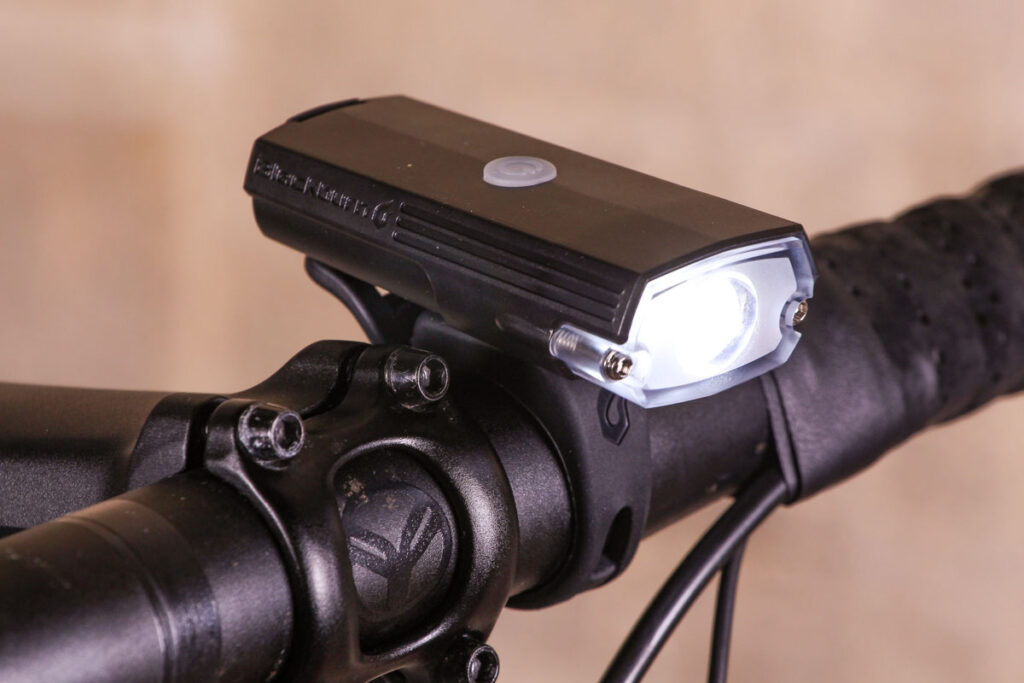
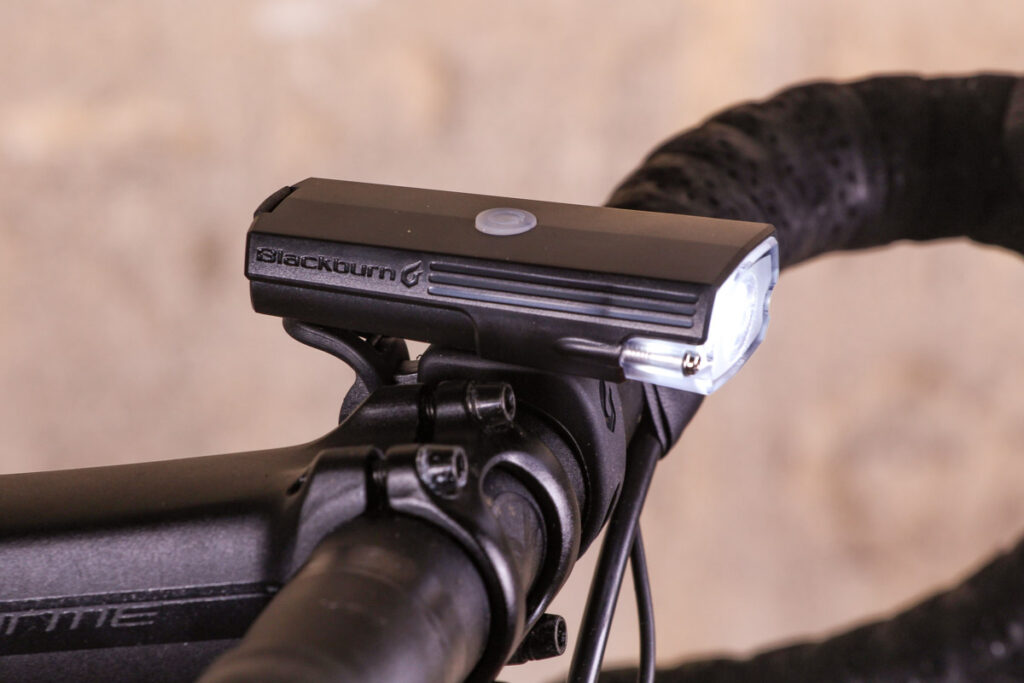

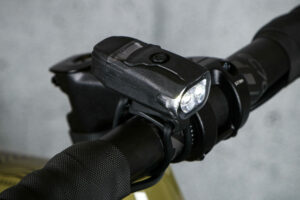
The Blackburn Dayblazer 400 is the baby of the range. It’s bijoux enough for clutter-phobic bars, and although 400 lumens are top whack, and run-times aren’t particularly generous in the lower 200-lumen setting, the strobing and flashing modes have ample presence and reasonable economy, which might appeal to urban riders.
- Pros: Inexpensive, compact, decent flashing/strobing modes
- Cons: Short run-times in constant settings
Materials/specification
The Dayblazer 400 uses TIR optics that project a combination of spot and flood beam, providing light to navigate and be seen by. It has a composite body and cowling, but build quality is reassuringly solid and it complies with IP67 for waterproofing, meaning it can endure immersion in a metre of water, for 30 minutes. Suffice to say it has passed my bucket and hosepipe torture tests with flying colours.
> Find your nearest dealer here
It also conforms to ANSI FL1 standards, which test output and accuracy of claims, including run-times. To my surprise, it also complies with the 1 metre drop test.
Unlike its bigger relations, the 400 is fuelled by a lithium polymer battery. This charges in around three hours via a super-convenient Micro USB cable. Mains refuelling will shave 20 minutes or so from this. Either way, the integrated ‘fuel gauge’ battery life indicator will turn green when it’s good to go.
Modes/output
There are four modes in total: Blitz is 400 lumens, Low 200, pulsing and strobing are 200 apiece.
Using the full 400 lumens unleashes a very pure, accurate hybrid beam. After dusk, the spot provides ample detail for navigating better-lit semi-rural sections at a steady 17mph. In such settings, oncoming traffic dipped their headlights at around 25 metres, maybe less.
In a pinch, there’s just enough bite for canal towpath cut-throughs, and I’ve also found it handy for darker suburban stretches where I’ve been able to maintain a steady 23mph with ample warning of upcoming/potential hazards.
It’s overpowered for town perhaps, but not overbearing in slow-moving, congested traffic should you forget to switch down. However, I’ve only managed to get 58 minutes from a full charge; okay, that’s just 2 minutes short of those cited, so acceptable, but it’s only really suitable for short runs.
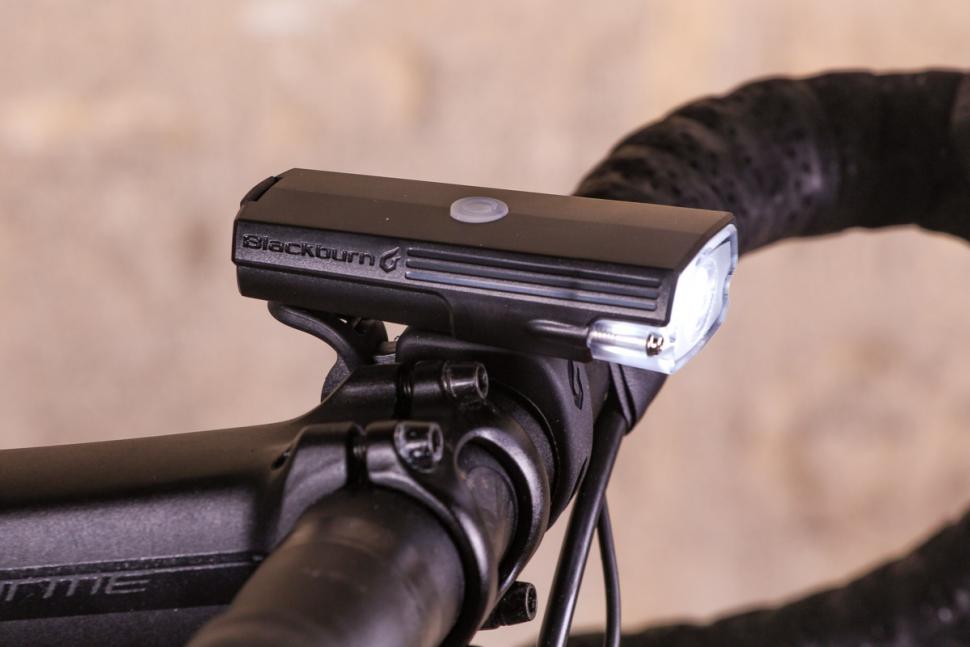
Low will last for almost 90 minutes, and is about right for the concrete jungle, the lens projecting a wide arc of very pure light that proved most beneficial at roundabouts and junctions.
However, since the main consideration in these contexts is being seen, I’ve found the pulsing mode more effective. The gentle strobe is very subtle and bright enough to navigate the outskirts of town, with other traffic tending to note me earlier than its steady counterpart – around 25 metres compared with 15 metres.
Run-times are also more realistic for commuting, or on those occasions where you’ve been enjoying some extended late summer evening playtimes on the best bike. Ours returned 5 hours 57 minutes from a full charge, which although not jaw-dropping is very practical for shorter/middle distance commuting.
It has sufficient punch for daytime too: other traffic seemed to take notice from 40 metres along open roads, 20-25m around town.
> Buyer’s Guide: The best 2018 front lights for cycling
Strobe is very distinctive and reminded me of lightning and is extremely conspicuous. We’re talking a good 150 metres along country roads, 90 or so through built-up areas; I’ve found this mode and the light’s modest proportions a very welcome complement to dynamo lamps. Run-times are cited as 10 hours and it’s returned 9 hours 56 minutes from a full charge, which is refreshingly frugal.
Switch/indicator
The centre-mounted switch is intuitive to use, even in gloved hands, and very positive, so unintentional engagement is highly unlikely.
The integrated battery life indicator gives a clear visual account at the point of selection, so despite the lack of auto ‘idiot’ kick down, being plunged into darkness should be a rare event. Green indicates you have between full and 75%, orange 75-25%, red less than 25%, and at around the 10% marker it will pulse intermittently. At this point, bargain on 15 minutes before it powers down – useful as a failsafe, particularly when helmet-mounted, but here’s when an auto kick down would come into its own.
Mounting hardware
There are two choices: bar or GoPro type helmet mount. Switching between them is simply a matter of unscrewing one from the lamp body and threading the other in place. The swivelling design means whipping it on/off the bar is quick and hassle-free. Ours has fitted standard and oversized bars/extensions with ease. If you’re going the helmet route, it might be worth checking compatibility first.
Conclusion
Allowing for the modest run-times in steady modes, the Dayblazer 400 represents very good value for money.
If you’re seeking a compact, tuneable and inexpensive model, this will serve you well. If you want to navigate unlit semi-rural/rural roads with regularity, you should look to something more powerful, with run-times to suit.
Verdict
Versatile and compact light that suits suburban/urban riding, though run-times aren’t generous on higher steady settings
All the deals displayed on our review pages are pulled from a constantly updating database feed of the best affiliate deals available. The criteria for deciding on what are the best deals is who is offering the lowest, delivered price. In most cases we will be showing the very best deal available online, but sometimes you may be able to find an item cheaper. If you can please feel free to post a link in the comments box below. To find out more about affiliate links on road.cc click here.
road.cc test report
Make and model: Blackburn DayBlazer 400 front light
Size tested: 400 lumen
Tell us what the light is for, and who it’s aimed at. What do the manufacturers say about it? How does that compare to your own feelings about it?
Blackburn says, “Not too long ago a 400 lumen headlight for this price would have been a pipe dream, but now the DayBlazer 400 is a dream come true! Featuring eye popping BLITZ daytime running mode to grab the attention of cars, IP-67 submersability and ample side visibility, the DAYBLAZER 400 puts light where riders need it most”
My feelings are that it’s a reasonable town/contingency lamp with plenty of charm and decent spec for the money. However, relatively short run times in the steady settings limit the appeal beyond city limits.
Tell us some more about the technical aspects of the light?
Meets ANSI FL-1 Standard
This standard was created by the American National Standards Institute (ANSI) to provide consistent performance measurements for handheld lights. Although bicycle lights are not required to follow this or any standard, Blackburn believes in offering full transparency in how the output, run time, water resistance and other performance claims are measured.
* Excellent Side Visibility
Built in design features channel a bright hit of light to each side providing visibility to cross traffic.
* LED Fuel Gauge/Charge Indicator
A small built in LED light indicates the battery level. Green = >75%, Orange = 75-25%, Red = <25%
* Micro-USB Rechargeable
Charges via any standard USB port.
* Universal Mount
Action camera style mount, that fits most helmets and handlebars from 22-35mm in diameter.
* IP-67 Waterproof
Ingress protection rating or ‘IP Rating,’ is a techy way to describe the level of water and dust proofness a product has. This light meets the IP-67 Standard, which means it is totally protected against dust/grit and is fully protected against the effects of immersion between 15cm and 1 meter for 30 minutes.
* TIR Lens
DAYBLAZER lights feature Total Internal Reflection (TIR) lenses that efficiently focus the light beam with a hot center and cool edges that allow the rider to see clearly down the road.
* No tools required
Lithium Polymer battery
Waterproof to IP-67 standard
3 hour recharge time
LED Charge Indicator
Runtime: BLITZ 1hr (400 lumen), Low 1.5 hrs (200 lumen)
Runtime Pulse/Strobe: 6hrs (200 lumen)/10 hrs (200 lumen)
59g
Resin construction but doesn’t feel flimsy or low rent.
Top-mounted switch is easily located and operated, even in gloved hands, but still positive – so accidental power-ups in pockets or luggage should be rare.
Intuitive to use and compatible with most hosts.
Passed my usual tests (including hosepipe) without missing a beat.
As always, it depends on how you’re using it. Pulsing and strobing are the best options, since 200 and 400 steady modes aren’t very generous or practical unless you’re doing very short runs, or prepared to charge religiously.
Very effective in terms of presence and being seen, especially in the pulsing and strobing settings.
Seems sturdy enough, particularly given the composite construction and price point.
Sufficiently light and compact for best bikes.
Remarkably good, compared with other torch type designs, although there is some trade-off when using the steady settings, which deplete the battery very quickly.
Tell us how the light performed overall when used for its designed purpose
Overall, and as a commuter/contingency lamp, the Daybright has been pleasant to use. The pulsing and strobing functions are arguably the most useable and the former’s oscillating speed is slow enough to navigate by – at least through suburban stretches – as well as making your presence known: distinctive enough to attract driver attention, especially in slow moving traffic. Strobing is arguably the most frugal, not to mention captivating. Provided you weren’t needing 400 lumens with any regularity, it could be a really useful, wallet-friendly commuting/contingency system or dynamo companion.
Tell us what you particularly liked about the light
Build quality (relative to price point), compact design, frugal pulsing/strobing modes.
Tell us what you particularly disliked about the light
Short run-times in 400 and 200-lumen steady modes.
How does the price compare to that of similar products in the market, including ones recently tested on road.cc?
Favourable, compared with other designs of this kind, boasting similar outputs.
Did you enjoy using the light? Yes
Would you consider buying the light? Possibly
Would you recommend the light to a friend? Yes, as a dynamo companion, or for town biased commuting.
Use this box to explain your overall score
It’s an inexpensive and well-made compact light that is quite versatile, provided the 400 and 200 lumens are used sparingly.
About the tester
Age: 45
I usually ride: Rough Stuff Tourer Based around 4130 Univega mtb Frameset My best bike is: 1955 Holdsworth Road Path and several others including cross & traditional road
I’ve been riding for: Over 20 years I ride: Most days I would class myself as: Experienced
I regularly do the following types of riding: cyclo-cross, commuting, touring, fixed/singlespeed, mountain biking

1 thought on “Blackburn DayBlazer 400 front light”
I’ve got this light and would
I’ve got this light and would concur with the reviewer; excellent compact light, let down by it’s runtimes. However, in the right circumstances; commute less than an hour or as a strobing auxiliary, it’s great.
Comments are closed.