


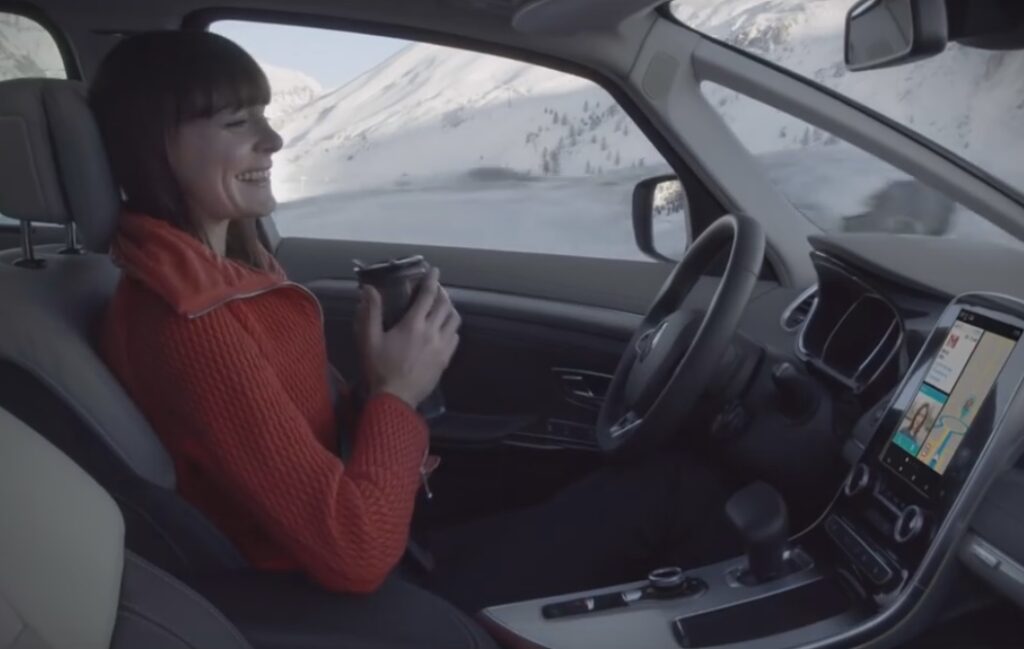

Cyclists have criticised proposed changes to the Highway Code which will allow self-driving car users to watch television while in motorway congestion, describing the measures as ‘terrifying’.
The Department for Transport (DfT) today announced that, following a public consultation, updates will be made to the Highway Code which will lay out the responsibilities of motorists using self-driving cars.
While vehicles that can drive themselves are currently not permitted on the UK’s roads, the DfT claims that Britain’s first approved self-driving cars “could be ready for use later this year”, with the planned changes set to come into effect this summer to support the early deployment of the technology. A full regulatory framework is expected to be implemented in 2025.
> Cycling and the law: how will your rights be affected by driverless cars?
The Highway Code revisions will allow the users of self-driving cars to view content that is not related to driving on built-in screens. However, as the DfT points out, this is likely to only apply when the vehicle is travelling at slow speed, such as in congestion, on motorways.
According to the proposals, motorists must be ready to resume control of the vehicle if prompted, such as on the approach to motorway exits.
It will, however, still be illegal to use mobile phones when the car is in self-driving mode, “given the greater risk they post in distracting drivers”.
The changes will also state that insurance companies, not individual motorists, will be financially liable for crashes involving self-driving cars.
> The ethics of self-driving car collisions: whose life is more important?
“This is a major milestone in our safe introduction of self-driving vehicles, which will revolutionise the way we travel, making our future journeys greener, safer and more reliable,” Transport minister Trudy Harrison said in a statement.
“This exciting technology is developing at pace right here in Great Britain and we’re ensuring we have strong foundations in place for drivers when it takes to our roads.
“In doing so, we can help improve travel for all while boosting economic growth across the nation and securing Britain’s place as a global science superpower.”
However, the proposed changes have provoked a mixed reaction among cyclists and other road users.
The failure of the government to understand that it is essential to distinguish between fully self driving cars and Level 3 where full attention is required at all times. There is no halfway point where u can watch films but still be ready to take over This will kill people!
— Christian Wolmar (@christianwolmar) April 20, 2022
Transport commentator and cycling advocate Christian Wolmar, who sits on the board of the London Cycling Campaign, tweeted in response to the DfT’s statement: “The failure of the government to understand that it is essential to distinguish between fully self-driving cars and Level 3 where full attention is required at all times.
“There is no halfway point where you can watch films but still be ready to take over. This will kill people!”
Illustrator Steven Falk said: “As a keen cyclist, the thought of encountering self-driving cars, with ‘drivers’ watching films rather than the road, terrifies me.”
The Guardian’s political correspondent Peter Walker, however, noted the limited scope of the government’s proposals:
Unless, of course, car firms persuade governments that fitting transponders to cyclists, pedestrians is the responsible thing to do/‘if it saves one life’ etc.
— Peter Walker (@peterwalker99) April 20, 2022
Not all cyclists, it must be said, are opposed to the DfT’s vision of a driverless future:
Am I the only cyclist who thinks they can only be an improvement on the current human/idiot-driven machines? Assuming they’d be programmed to give space when passing etc it’s win-win isn’t it?
— AledElwyn (@aledelwyn) April 20, 2022















36 thoughts on ““This will kill people”: Proposed Highway Code changes will allow self-driving car users to watch TV”
It’s shit.
It’s shit.
Driving requires attention and it’s difficult to switch focus between tasks which require a lot of attention. Modern cars already insulate and cocoon drivers from reality and this will make it worse. For older drivers there’s also the consideration that eyes take longer to adjust from near to far focus. As Peter Walker states all this is some way off for now but I wonder if it will turn into another smart motorways debacle. There’s also the recent ruling that drivers of self-driving cars won’t be legally liable in the event of an accident if they weren’t actively driving at the time.
kil0ran wrote:
I agree and would add that this is not infrequently the case currently. E.g. drivers of non-self-driving cars are already not held legally liable because they weren’t actively driving at the time. Or – to give the legal process its due – a magistrate / jury couldn’t be convinced that someone else hadn’t made themselves temporarily invisible or thrown themselves under the vehicle’s wheels.
Its irrevalant to cyclists.
Its irrevalant to cyclists. Unless they are illegally cycling on a motorway or in their car and get a low speed shunt.
Thats not to say its a good idea – its not at the current level of technology. This is a Govt in love with its own fantasy reality as per usual although it has some partial merit to test legislative and industry structures for handling these incidents.
At the moment.
At the moment.
(I suspect there will be a lot of ‘mission creep’, where the same legislation gets used in an increasingly wider range of circumstances…).
Personally, I think Christian Wolmar has hit the nail on the head.
As I see it there are two
As I see it there are two issues here the least significant of which is watching TV on the cars own screen – if you assume that when the car requires the driver to take over it will stop showing TV on its in built screen then this is not such an issue, although this also relies on the automated vehicle being a “better” driver than most humans.
The presumed lack of driver culpability is a major flaw – as I see it any accident or dangerous driving involving one of these cars under manual control and the driver will claim it was being auto driven, this will then place a burden of proof on the police/CPS to obtain evidence and prove the car was in manual mode at the time.
If all this has to be done within the 14 day NIP then the practical outcome of this is that only the most serious of accidents are likely to result in any evidence gathering that leads to a prosecution, so basically the already slim chance of being prosecuted for bad driving is now reduced to near zero as all you have to do is reply on the NIP that the vehicle was in auto mode so speak to the insurance company.
makadu wrote:
I think you’ll find that’s the design goal!
chrisonatrike wrote:
I think you’ll find that’s the design goal!— makadu
Isn’t that pretty much what we have to deal with right now?
Drunk driver hits cyclist on the pavement and the Police say “wear hi-viz then”.
Anyone on two wheels will still have to assume that any vehicle controlled by a human or computer at best hasn’t seen them or at worst is trying to kill them.
I can’t agree with your first
I can’t agree with your first para. If you are engrossed in the tv, it will take a few seconds for the brain to engage, then more seconds to work out what the dynamic situation is, then a few more to take action.
That’s a lot of seconds to be fully in control and a fair bit of risk of something going wrong in the interim.
hirsute wrote:
Exactly that.
Generally where driver intervention is required it is required instantaneously, not a second or two after after the car decides it needs help.
It would be like trying to argue that in slow moving traffic a driver would be fine to use their mobile phone if their car has city safe braking so it would stop it crashing into the car in front of them.
I guess this will be down to
I guess this will be down to how reliable the software and systems are, if the car is driving itself and you have no safety related input needed, i.e. the car can stop/avoid collisions then the “instant switch” may not be needed – i.e. you are only taking over once the vehicles begin to speed up – or you need to change lanes/depart the motorway.
If the software is not that reliable then it should not be used at all, and the driver should be in charge at all times.
Again – I think you’ve
Again – I think you’ve answered your own question. But just like Cars 1.0 the commercial, political and social pressures (probably in that order although eventually everything’s driven by lots of “me want!”) will mean that the pressures to accept “good enough” / “works most of the time” and find a way of justifying that will be immense.
I don’t understand why, when
I don’t understand why, when at the wheel of a vehicle, people can’t give it some attention, and not watch movies, or catch up with social media.
Its not too much to ask.
We’ve had self-flying planes for some time, yet pilots don’t (though I’ll be happy to be corrected) let the plane land itself while catching up with F1 Drive to Survive etc.
If you wish to make a journey and use the travel time for social media and movies, National Express and numerous rail services already exist for your convenience.
PRSboy wrote:
I think it comes down to a selection of things:
(1) People want to be able to game, social media, read, watch a film, or even work, while they are travelling.
(2) People like having the New Shiny Thing.
(3) People don’t want to have to share their space with Strangers.
(4) (Most) People can’t afford a chauffeur.
I think it’s become obvious
I think it’s become obvious that it is too much to ask. People simply can’t put their personal mobile device down, even when driving……
The main constraints on this
The main constraints on this are:
The use of Automated Lane Keeping System (AKLS) – so that means lane detection, such as on motorways, trunk roads, dual carriage ways, etc.
The maximum speed is 60kph (37 mph) – so that means heavy traffic on the above roads.
I can see that in a built-up area shared with other road users (ie the non-AKLS equipped vehicles, public transport, cargo transport, road furniture, cyclists, pedestrians, horse riders, etc.) that the AKLS will bleep constantly to make any watching of TV or film almost impossible.
The accompanying image for
The accompanying image for this article reminded me of a particularly exciting taxi ride I had in the Faroes. Driver had a Volvo with every single safety toy specced including auto braking and lane departure. So he spent the short but lumpy drive from the airport to Torshaven demonstrating the auto-brake facility which was set to just the wrong side of “oh crap we’re going to die” tolerance. Didn’t get a tip.
(Lovely place by the way, or would be if they didn’t insist on killing cetaceans for sport)
It is important to remember
It is important to remember that it will be possible within our lifetime to get in a car, tell it where to go and go to sleep until you get there with no need for any control of the vehicle by a human being, likely without even the override option. The roads at that point will be a lot safer. If you said to someone in 2005 that you could buy a fully electric vehicle which was capable of some self driving in less than a decade you would have been laughed at (Tesla came out with some auto pilot features in 2014). Claiming that it is never going to be possible to build a safe, functioning, fully autonomous vehicle for consumer use based on what you see now is shortsighted at best.
Those truly self driving cars will come, it is inevitable, the question is when, legislating for them now means being prepared for the future. Is this legislation right for where we are right now? No, but it is not aimed at where we are right now. It is legislating for where we expect to be when self driving vehicles are allowed on our roads. A truly self driving car should not need human attention, if it needs human attention then it would not be legal to watch TV in it as it wouldn’t be truly self driving.
Hmm. If I was feeling
Hmm. If I was feeling trollish I would say that it wont happen in my lifetime if I get squished during the experimental phrase.
Though on balance I think true self driving will eventually turn up, I believe there is also a decent minority probability that it will be like Nuclear Fusion. Always 50 years away……
Its bloody hard to get a computer to drive like even a bad driver let alone a good one….
Patrick9-32 wrote:
Even [honest] researchers in the field don’t know if this is possible. They’re working on the assumption that if they throw enough computing power at it, we’ll cross the threshold eventually. Admittedly, that has worked for a lot of things, but nobody really knows if it will here.
They’re hoping it’s merely a hard problem, not a Hard Problem.
I doubt it’s a Hard Problem
I doubt it’s a Hard Problem as tired, distracted, marginally competent and intoxicated drivers get it right enough most of the time on a daily basis.
The Hard Problem bit may be the mental and linguistic contorsions we got through – if we start thinking about it – to convince ourselves that how we do things now is all fine and actually what we want.
Patrick9-32 wrote:
Except that they’re explicitly saying that it will be legal to watch tv in cars that require some human attention. Because they’re not really interested in whether it’s true self-driving. They’re more interested in getting whatever can be built on to the road and billing it as ‘self-driving’. Because, y’know, Great British Technology™, and so on.
I don’t trust my cars self
I don’t trust my cars self-park ability, and that requires me to be the throttle and brake input…
If there is some way of limiting when this can be used – i.e. GPS / satellite restrictions so it can’t be used in urban areas, country lanes, any road not rated a motorway, and will automatically stop working at speeds of above 15mph; and that attempting to bypass or remove the restrictions renders the whole car inoperable … Then why not?
Given General Motors’
Given General Motors’ autonomous driving business (Cruise) has their cars operating in San Francisco at night, without a supervisor in car and taking passengers, it’s a lot closer than you might expect. They plan to commence manufacture of Cruise autonomous vehicles next year. Considering how AV are to operate within the Highway code seems prudent given the progress to commercialise the technology.
Did you not see the clip
Did you not see the clip recently when SFPD pulled over a Cruise car? It stopped, then as a cop walked up to the car and saw no-one behind the wheel, the car carried on to pull over when it thought it could see a better place to stop. I’m surprised the car is still alive!
Yes, I did see that. But the
Yes, I did see that. But the Cruise car was at a red light, the cop only assumed it had pulled over for him. That the car proceeded through the intersection on green and then pulled over where it was safe to stop shows it’s already smarter than humans including police ?
The problem is this ‘only on
The problem is this ‘only on motorways at slow speeds’ bit.
1. It’s the thin end of the wedge. ‘Motorway’, becomes ‘dual carriageway’, becomes ‘A-road’, etc.
2. How will it be limited to motorways? Geo-fencing? So what happens where an A-road runs close to a motorway (e.g. west London where the A4 runs under the M4 – can geofencing determine the difference?)
3. I had a car a few years ago that had the navigation on a DVD player in the dashboard (OEM fitting). This could play DVD films but would not play when moving, for safety. 5 minutes on t’internet revealed a hack where it would play DVD films when driving. Believe me, it was terrifying! So don’t say similar systems can’t be hacked.
Jem PT wrote:
Probably using road sign assist – self driving cars need cameras and the ability to tell what sort of road they are on. You may have noticed but pretty much every new car (even upto 3 or 4 years old) has a forward facing camera mounted under the interior rear view mirror.
I think it’s absurd that
I think it’s absurd that people will be allowed to watch films while in a car. Why is that ok when using a phone isn’t? Surely both are equally distracting?
A neighbour of mine has a 2009 BMW M3, a seriously high performance car. Bizarrely, it has a TV screen on the dash so it’s possible to watch while driving. Whoever thought that was safe? Even he says it’s a crazy idea. Yep, he does commute by bicycle.
OldRidgeback wrote:
If you are watching something on the car’s inbuilt display, whilst the car is driving – the car is in control and can turn this off and then inform you that it is time to take over. This is the difference between using a phone. However what is unclear is how much time you will have to take control, as you need to be fully driving (i.e. observant of your surroundings, current speed etc) before taking control.
What is the difference between this, and using your phone when stationary in traffic? The latter is bad because even when your vehicle isn’t in motion, you are still driving and need to be aware of what is happening around you.
Part of me sees a benefit of having a clear boundary between “you need to be fully aware and “you don’t need to be aware at all” – getting rid of any grey area is a good thing.
What I don’t understand is why insurance companies are liable for collisions – if the fault is of the software – unless they are saying that the software provider needs to have insurance as well as the driver and if the collision occurs when the car is driving then the software provider’s insurance pays.
Context switching in humans
Context switching in humans is expensive in time and attentiveness.
to get back up to speed can be actual minutes of time.
When you use your phone at
When you use your phone at the wheel and your vehicle is stationary, it takes a few minutes for you to switch off mentally from the task of using your phone afterwards. That is why it isn’t safe and isn’t allowed. The TRL has done a lot of rsearch into this.
As for watching TV while driving, unless the vehicle has level 5 automation, it isn’t safe.
I suspect the insurance
I suspect the insurance industry is going to make sure this doesn’t happen for a long time.
I’m expecting g the same.
I’m expecting g the same. They’re not going to take responsibility for a manufacturers cock up.
so the self driving bit works
so the self driving bit works until things are a bit difficult whereupon it throws it hands up as says “you’d better take over’. I really cant see how that makes for a relaxing trip.
As people have said it’s “not
As people have said it’s “not yet”. However it sounds like we’re pre-framing legislation to continue our habit of having a “one-off” blame-game whenever there’s a crash. So it’s laissez-fair for the drivers (“just watch TV”) until something goes wrong. Then looking for fault because “with rights come responsibilities”. As opposed to saying “People may have made a mistake but could that have been predicted? Are there system faults here as well?”
As noted by others they’re also putting some responsibility back towards insurance to pick up the cost. Probably partly to try to encourage the developers but also to make this align with current standards.
Do you need a TV licence to
Do you need a TV licence to watch TV in your car? And will the BBC and Capita now be trying to gain entry to your car upon hearing this?