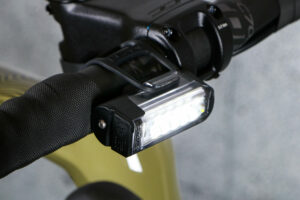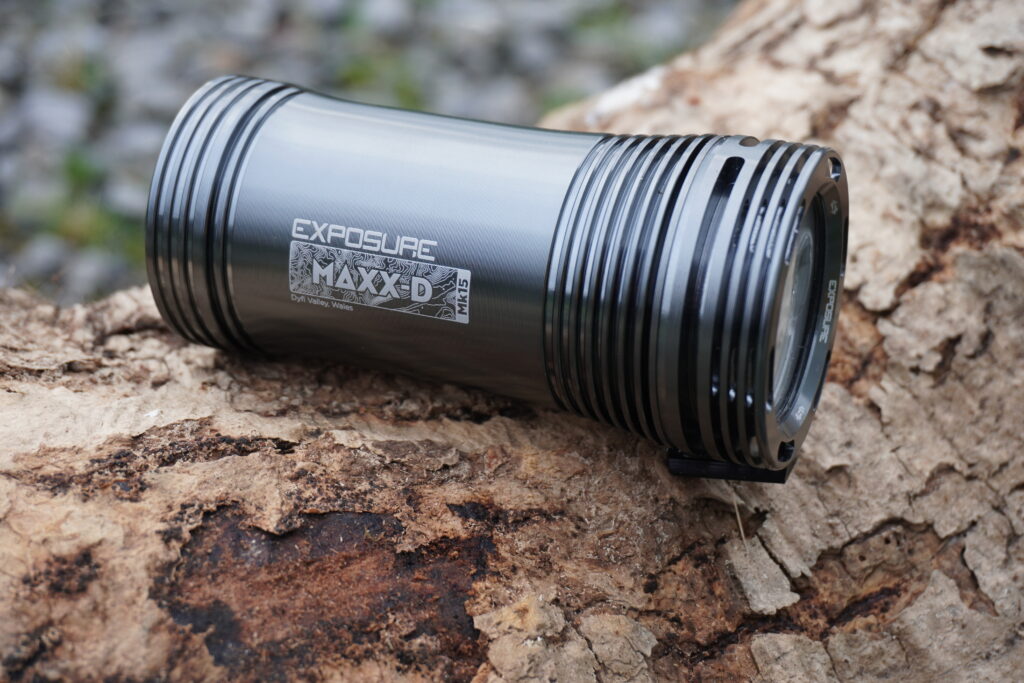

The latest Exposure Lights MaXx-D light continues to push technology boundaries by providing greater illuminating power while maintaining excellent burn times. REFLEX++ technology allows for adaptation to conditions and rider speed, and a wide range of mounts and accessories that all help to justify the high price. Read on to see how it places among the best mountain bike lights.
- Magicshine Monteer 8000S Galaxy V2 front light review
- Lumicycle Apogee Extender Pack front light review
- USE Exposure Zenith MK2 front light review
The MaXx-D was one of Exposure’s early lights, released in 2005 when LED technology for riding was still in its infancy. Exposure has continued to develop models on an annual basis, gaining more power, battery life, and added technology.
Exposure Lights MaXx-D MK15 – Technical details
The MaXx-D sits one from the top of the MTB light line-up, with four LEDs while the larger Six Pack, as the name implies, has six LEDs providing more lumens and a bigger battery to handle the demand.
The MaXx-D MK15 has a maximum continuous output of 2,900 lumens, with Reflex allowing for a boost up to 4,600.
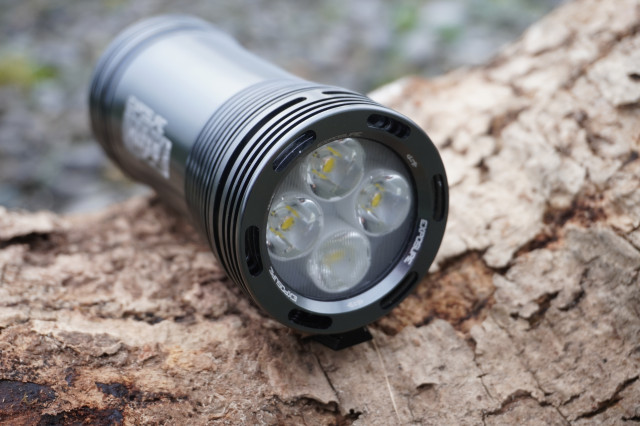
Exposure uses a bar mount that has remained the same through all versions utilising a trapezoidal layout that the light slides into. A pin locks it in and also acts as a pull release to remove the light. The accompanying mount can fit 35mm or 31.6mm handlebars with the included spacer and you can adjust the angle to suit, which could be helpful if fitted to a handlebar with a particularly sweeping shape. Exposure also makes an array of other mounts, including a stem faceplate mount, a GoPro-style mount adapter and a stem top cap. Or you can take off the female trapezoid mount on the light unit and replace it with a GoPro-style mount.
Throughout testing, I used the light with the standard handlebar mount, fitted to a 31.6mm diameter handlebar.
Exposure Lights MaXx-D MK15 – Mounts and settings
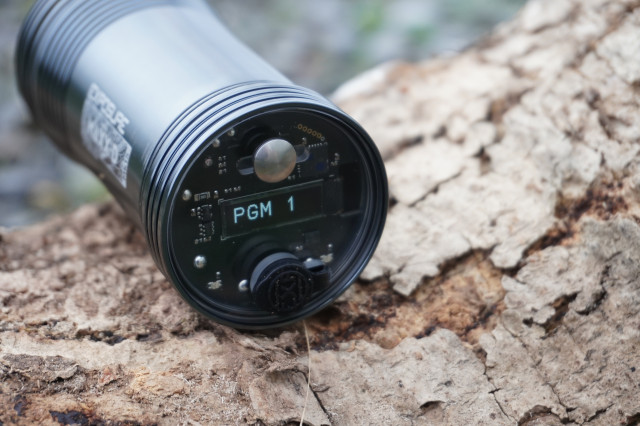
The lighting assembly is fully self-contained within the unit. It is fully sealed with an IP65 rating, which means it is fully sealed from dirt and can withstand jets of water at short distances – not that it is advised. The anodised finish provides information about the various output modes, of which there are 10. The first three are based on Reflex technology and have varied maximum burn periods. They may be switched to a lower-power constant output by pressing a button on the back of the lamp.
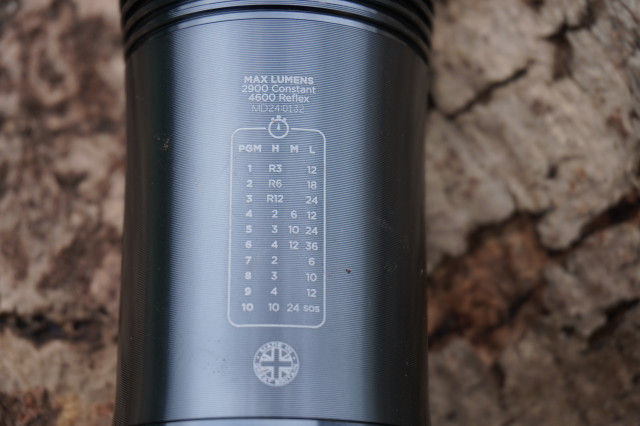
Modes four to six have three different burn times, and the back button switches between them. Seven to nine are similar, except that they feature two different brightness options, and the final tenth option has the longest steady burn times, with 10hr, 24hr and an SOS mode.
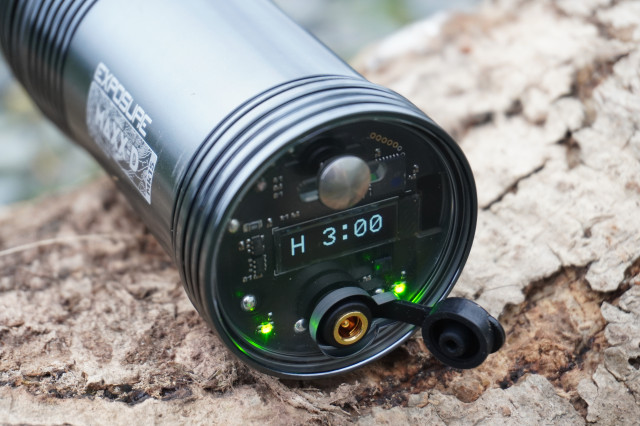
Moving between setting options can be done by pressing and holding the function button on the back, with the OLED screen displaying which mode is active. Also, in all modes, you can activate a flash setting by holding the button down for roughly one second.
External support cells with 1.7A (£35), 3.4A (£50) and 8.7A (£95) outputs are available if you need a longer burn duration or want to use a brighter setting for an extended amount of time. Adding the biggest support cell will result in an additional 75% of the main battery capacity There is a USB adapter that allows the use of an external battery pack but Exposure warns that it will not work with all external batteries and isn’t able to give information on which are compatible. The Smart Port+ can also power an Exposure RedEye rear light (£35).
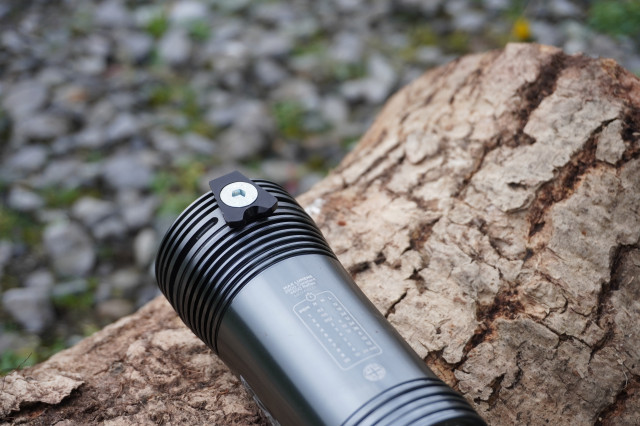
While this may seem to be confusing, it is intuitive, especially with all of the details printed on the casing. One complaint I have with other lights is that you often need to cycle through an array of settings and flash modes to get to your preferred brightness level, but with the MaXx-D you can have it move between just two. Exposure also makes a separate external switch (and costs £20) that fits into the Smart Port+ and enables you to press a button anywhere you might wish to, with the most likely position being beside the bar, allowing you to press it without removing your hand from the bars.
Two little colour LEDs have a dual function, indicating which setting (High, Medium, or Low) has been selected after each function button click, and this then moves to display the remaining burn time. A green light signifies 50-100%, an amber light indicates 25-50%, a red light indicates 5-25%, and a flashing red light indicates less than 5% remaining.
Exposure Lights MaXx-D MK15 – Performance
The beam pattern is very circular in all power modes, with a large spread that progressively goes from the brightest spot in the centre to the outer points. The suitably wide spread is ideal for off-road riding, particularly singletrack, with the beam providing illumination far down the trail. The colour of the beam seemed very natural to me, lacking the white/blue tint that some other high-power lights can have.
Exposure suggests that Reflex mode takes 20 minutes to calibrate and tune the output for the best performance. Once set, this is remembered until the riding conditions or style change. I thought it worked very well, with the changes in brightness settings being smooth and barely noticeable. The system operates by combining thermistors, 3D gyros, and 3D accelerometers that modify the output dependent on speed, roughness, and inclines. Only once during testing did I feel the light was underpowered for the conditions, after a slow, technical crest that moved immediately into a steeper downhill.
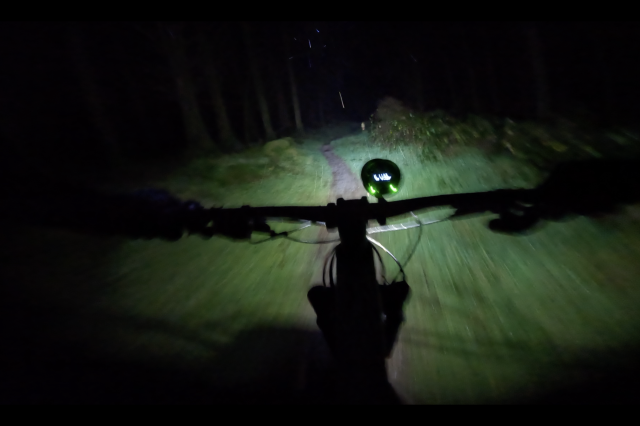
The adjustment was still quick, taking only a few seconds but a little extra brightness would have been nice for that initial movement. One potential issue with the Reflex mode is riding on the road, where the combination of beam spread and brightness could be a hazard to oncoming traffic. By pressing the function button once and switching to a low-power constant power setting, the potential issue is removed. During testing, I found the burn times displayed on the rear to be accurate, and when using the maximum three-hour mode, the power drain was a little optimistic, giving a little more time than claimed.
If you prefer a constant power level, it is simple to change it, and the brightest option has a maximum setting of two hours, delivering an incredibly bright system.
The combination of brightness and wide beam spread was so good in both Reflex modes and either two or three-hour constant mode that it eliminated the need for a helmet light. On several test rides, I used the MaXx-D with an additional Diablo helmet light, and there were very few occasions where the helmet light added anything significant, with the only exceptions being full 180-degree switchbacks or a few times with the light being higher up can provide more light in a downward direction.
I found the mount to be completely secure, with no movement or bounce at any moment. The burn times were always greater than the maximum Exposure suggests, and the wide beam spread was perfect for off-road riding.
Exposure Lights MaXx-D MK15 – Value and verdict
If you want even more power or a larger battery pack allowing a longer burn time, Exposure has the Six Pack, with a massive 3,900 lumens constant or 5,450 lumens in Reflex. The battery capacity increases from 13,600 mAh to 17,000 mAh, but the price climbs to £495.
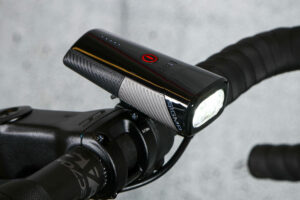
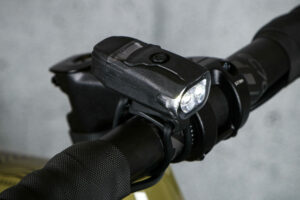
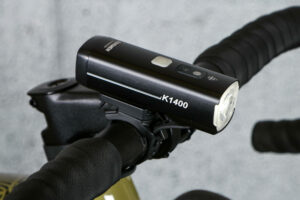
Based on quoted stats alone, the Magicshine Monteer 8000s Galaxy V2 has a significant 8,000 lumens, with 2.5 hour burn time from an external battery when using maximum output mode, and costs £390. Another option is the Lumicycle Apogee Extender Pack, which has a 6.8 Ah capacity and up to 4,500 lumens.
The MaXx-D is more expensive than some competitors but the fully enclosed design, fantastic wide beam spread, smart tech features and extensive range of accessories combine into a package that puts it beyond the competition. If you frequently ride in the dark or simply want a light that performs perfectly, the MaXx-D is an excellent choice.
You might also like:
- The best places in the UK for autumn cycling
- Trail essentials – all the kit you need to take on a mountain bike ride
- Mountain bike tyre inserts – everything you need to know
Light purpose:
Built for ripping through the trails or single track, a combination of 3 spot lenses launch light far down the track and a spread beam highlights the trail edge. REFLEX ++ automatically provides the perfect output for any change in speed or terrain. The Maxx D is backed up with 4600 measured lumens to be at one with any terrain.
Build extra:
Technical Specifications:
LEDs 4 x White XPL2(W3)
IP Rating IP65
Max Lumens 2900 (Reflex 4600)
Battery 13,600 mAh Li-Ion
Runtime 2 – 36 Hours
Charging Time 6 Hours
Weight 310g
Material Anodised 6063 Aluminium
Length 115mm
Head Diameter 54mm
In The Box MaXx-D MK15 GMB, QR Handlebar Bracket, Fast Charger, QS Guide
Light construction
Light construction extra:
Light design
Light design extra:
Light clamp
Light clamp extra:
Light waterproof
Light waterproof extra:
Light battery
Light battery extra:
Light performance
Light performance beam
Light performance beam extra:
Light durability
Light durability extra:
Light weight
Light weight extra:
Light value
All the deals displayed on our review pages are pulled from a constantly updating database feed of the best affiliate deals available. The criteria for deciding on what are the best deals is who is offering the lowest, delivered price. In most cases we will be showing the very best deal available online, but sometimes you may be able to find an item cheaper. If you can please feel free to post a link in the comments box below. To find out more about affiliate links on road.cc click here.