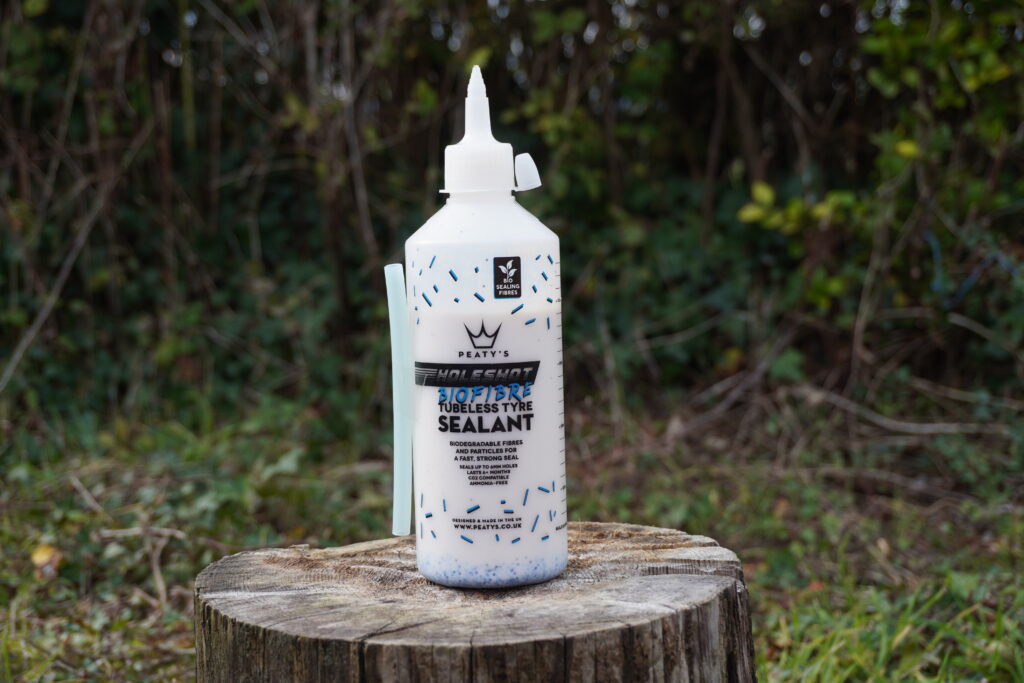

Peaty’s Holeshot Biofibre tubeless sealant impressed with its performance, sealing punctures quickly and lasting well. The eco-credentials of this product are superior to most options in the best tubeless sealants segment, with the price and glittering residue being the only minor negatives.
- WTB TCS Tubeless Tyre Sealant
- Vittoria Universal Tubeless Tire Sealant review
- Silca Ultimate Tubeless Sealant review
Peaty’s Holeshot Biofibre tubeless sealant – Technical details
This is an updated recipe for Peaty’s Holeshot Biofibre sealant, the original version that was released in 2017. The changes include the addition of biodegradable fibres, a slightly lowered viscosity, and a new colour for the platelets, which are the coloured (now black) particles that can be seen in the solution and are also biodegradable.
> Buy now: Peaty’s Holeshot Biofibre tubeless sealant 500ml from Tweeks Cycles for £17.99
Peaty’s claims the sealant works in a wide temperature range, from -20 to +50 degrees Celsius, and at pressures ranging from 15 to 120psi. If you need to use a cartridge to fix a puncture while riding, it also claims to be compatible with CO2, in contrast to some latex-based sealants.
While the new version is thinner, this is still thicker than some other sealants, especially those with a latex base. It is possible to install through a valve, and the smaller 120ml trail bag has an end fitting designed to fit onto a valve with the valve core removed so you can pour in the sealant. The pouch is designed to be refillable and maybe carry on the bike should you be worried about a puncture, and save on waste, being a re-useable container.
The sealant is a water-based latex solution that contains two different kinds of particles that help with sealing the tyre in the event of a puncture. Both the larger glitter spec and the long, thin pieces are biodegradable and composed of cellulose and starches.
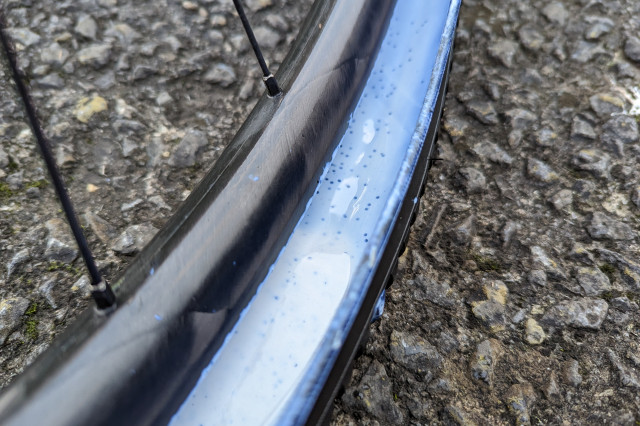
If the sealant is left to settle, the particles are all clearly visible inside and with the solution being quite thick, it is really important to shake well and ensure all the parts are mixed really well before using. The opaque bottle helps with this, and with many that will settle at the bottom, you can see if it is well mixed.
The amount needed is a little less than others, and I put 80ml into our test tyre. A typical road tyre would require 30-45ml and 29-inch MTB 100-120ml.
Peaty’s Holeshot Biofibre tubeless sealant – Performance
To test sealant performance, we created a standardised puncture test to assess each contender. The same exact tyre on the same rim for each sealant. The tyre used was a Halo GXC, measuring 47mm. Tyre sealant was added in the amount suggested by the manufacturer, and the tyre was inflated to 40 psi. This pressure was chosen to give a realistic tyre pressure for all areas of off-road riding. A digital tyre pressure gauge was used to ensure that the pressure was identical on each test. After that, the tyre was rotated sufficiently to ensure that it was distributed evenly throughout the tyre. The tyres were all punctured by driving a 3mm nail through the carcass. The wheel was rotated to assess if the sealant had successfully sealed the hole. If the sealant worked, the test was repeated using a 5mm diameter nail, and if successful on the larger hole the remaining air pressure was measured with a digital pressure gauge and the result was recorded.
With hardly any air loss on either size puncture, Peaty’s Holeshot Biofibre tubeless sealant was one of the best performers in the puncture test. There was no air loss with the smaller 3mm hole, and even with the larger puncture, there was only the smallest amount. The remaining air pressure was recorded at 39.9psi. A little sealant on the tyre carcass was the only indication of a puncture.
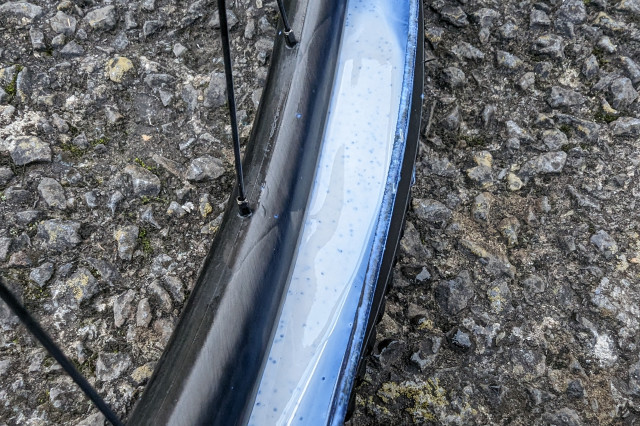
When inspecting the inside of the tyre after longer use, the sealant could be seen around the entire circumference with a very equal distribution, and all of the particles within it were still separate with no evidence of clumping.
After the testing was complete it also washed out with no dried areas of sealant, and the only evidence was a few specs of the glitter remaining within the carcass.
Although primarily a test for off-road use, Peaty’s Holeshot was also tested on a road tyre, and it successfully sealed a 2mm puncture at 60psi within a 28mm wide tyre
Peaty’s Holeshot Biofibre tubeless sealant – Verdict
Peaty’s Holeshot is available in a range of sizes. The £7.99/120ml option comes with a collapsible pouch and connection design to install through a valve. The one we had for testing is a 500ml bottle priced at £19.99, then there is 1 litre at £29.99 and also a workshop-sized 5-litre container at £124.99. The pricing is a little higher compared to the WTB sealant, which was also impressive and £5 cheaper for equivalent 500ml and 1-litre sizes.
Overall performance of Peaty’s Holeshot Biofibre has been extremely good, with instant repair during our puncture tests, excellent ability to avoid drying out and ease to clean out. It is also a formula that uses biodegradable particles throughout, simply making it one of the very best sealants available.
You might also like:
- Vittoria Universal Tubeless Tire Sealant review
- Silca Ultimate Tubeless Sealant review
- Hutchinson Protect’Air Max Sealant review
Product purpose:
Developed alongside World Cup mechanics and world champion racers. Peaty’s Holeshot Tubeless Sealant is packed full of biodegradable fibres & sealing particles to give a fast and strong seal. Using the latest fast-acting latex, our water-based sealant is ammonia-free, non-hazardous and lasts up to 6 months in the tyre in temperate climates*. It won’t ball up in the tyre and is easily washed out.
Our biodegradable fibres and particles bind together with the fast-acting latex to create a clot (like platelets in your blood) to quickly & effectively seal holes and tears up to 6mm.
Build extra:
KEY FEATURES:
Biodegradable sealing fibres
Biodegradable platelets
CO2 compatible
Seals up to 6mm holes
Operating pressures: 15 to 120 psi
Operating temperature: -20°c to +50°c
Seals porous tyres and bead/rim gaps setup
RECOMMENDED QUANTITIES:
Road 30 – 45ml
Cyclocross 60 – 75ml
26” MTB 60 – 80ml
27.5” MTB 70 – 90ml
29” MTB 100 – 120ml
Product construction
Product construction extra:
Product performance
Product performance extra:
Product durability
Product durability extra:
product value
All the deals displayed on our review pages are pulled from a constantly updating database feed of the best affiliate deals available. The criteria for deciding on what are the best deals is who is offering the lowest, delivered price. In most cases we will be showing the very best deal available online, but sometimes you may be able to find an item cheaper. If you can please feel free to post a link in the comments box below. To find out more about affiliate links on road.cc click here.