


- This topic has 12 replies, 9 voices, and was last updated 3 years, 4 months ago by
 Steve K.
-
CreatorTopic
-
May 20, 2023 at 1:18 pm #32567
snappyandrew
I expect someone clever has done the maths
I’m looking for an equation that tells me how much time I would gain if I lost a kilo on specific climb.
Does such a thing exist?
thanks in advance
-
CreatorTopic
-
AuthorReplies
-
Steve K
Cugel wrote:It also tells me (the experience) that going beyond a certain weight loss (body fat percentage, in particular) can reduce cycling abilities, with losses of power and stamina.
Never a problem I’ve had

PRSboy
This is my go-to for cycling
This is my go-to for cycling data fiddling. Endless hours of fun!
Mark1a’s spreadsheet looks fiendishly clever, and its very interesting how it breaks down the power requirement to overcome wind and gravity.
 peted76
Pretty sure there have been
Pretty sure there have been numerous calculators that you’re after.. here’s one – https://www.bergfreunde.eu/cycling-wattage-calculator/
TheBillder
If it works, can you share
If it works, can you share the name of the climb on which you lost the kilo? If I ride up it every day for a fortnight, I might get down to a decent weight. Simon E
From the articles and tests I
From the articles and tests I’ve seen online over the years (including former UK National Hill Climb champ Tejvan Pettinger here) it seems that you will climb every 100 metres of vertical gain 2 seconds faster for every 1 kilo lost.
For a climb with 500 metres of ascent = 10 seconds.
 mark1a
Cugel wrote:The thread’s OP-question seems to assume that losing weight will always mean you’ll go faster up hills. Whilst this is probably true in many cases there are likely to be other cases where body weight losses are detrimental. But if so, by how much and why?
mark1a
Cugel wrote:The thread’s OP-question seems to assume that losing weight will always mean you’ll go faster up hills. Whilst this is probably true in many cases there are likely to be other cases where body weight losses are detrimental. But if so, by how much and why?Your reply seems to assume that the OP weight reduction is body weight. For all anyone knows the kilo in the question could be taken from the bike, for example 2x 500ml bottles of water.
 Cugel
Cugel
Another question now keeps
Another question now keeps nagging at me:
What methods and degrees of body weight loss (or gain) have which effects on the various types of fitness for cycling?
Long experience tells me that a certain amount of weight loss can not only improve one’s power-to-weight ratio but also add a degree of extra ability over and above that improved ratio, to go faster and longer on a bike. It also tells me (the experience) that going beyond a certain weight loss (body fat percentage, in particular) can reduce cycling abilities, with losses of power and stamina.
I can’t find any objective-style examinations of these effects of body weight on cycling fitness but there must surely be some out there …. ?
The thread’s OP-question seems to assume that losing weight will always mean you’ll go faster up hills. Whilst this is probably true in many cases there are likely to be other cases where body weight losses are detrimental. But if so, by how much and why?
Cugel
Weight obsession amongst
Weight obsession amongst cyclists was born and growed first in service of what are now called marginal gains in competitive cycling. Even small power to weight ratio improvements might put you another 21 yards up by the end of the race, giving you first rather than fifth place.
Then the advert svengalis realised what a fine vehicle weight obession would be for selling expensive bike parts. We poverty stricken cyclists (well, I was one once) tried instead to lose body weight, often finding ourselves going all feak & weeble as the glycogen levels descended to “not enough”.
For those who don’t race, TT or otherwise compete, the weight obsession is daft, as there are many, many other aspects of cycling that’ll provide satisfaction, pleasure, a sense of achievement et al from a bike ride. Bin that timing gizmo on your handlebars! It’s a slave-driving gremlin intent on making you feel inadequate!!
On the other hand, many would do well to change their diet to something more nutricious and less likely to bring on the diabetes. Going up the hill 10 seconds faster than you did because the better diet also shed 5 kilos bodt weight might please some too, I suppose.
For details of weight effects on real world cycling, consider this article from a heavy-duty touring fellow.
However, when you’ve read it and understood what a vast waste of time and money all that shopping for the lightest bike part possible given your wallet-state was, do not burst into tears! They’ll only rust your expensive lightweight doodwat, which may then snap and throw you into the road, which will make you cry a lot more. 🙂
Geoff Ingram
“Computational cyclist” may
“Computational cyclist” may be a useful web site to look at.mark1a
Interesting question, the
Interesting question, the answer is… sort of.
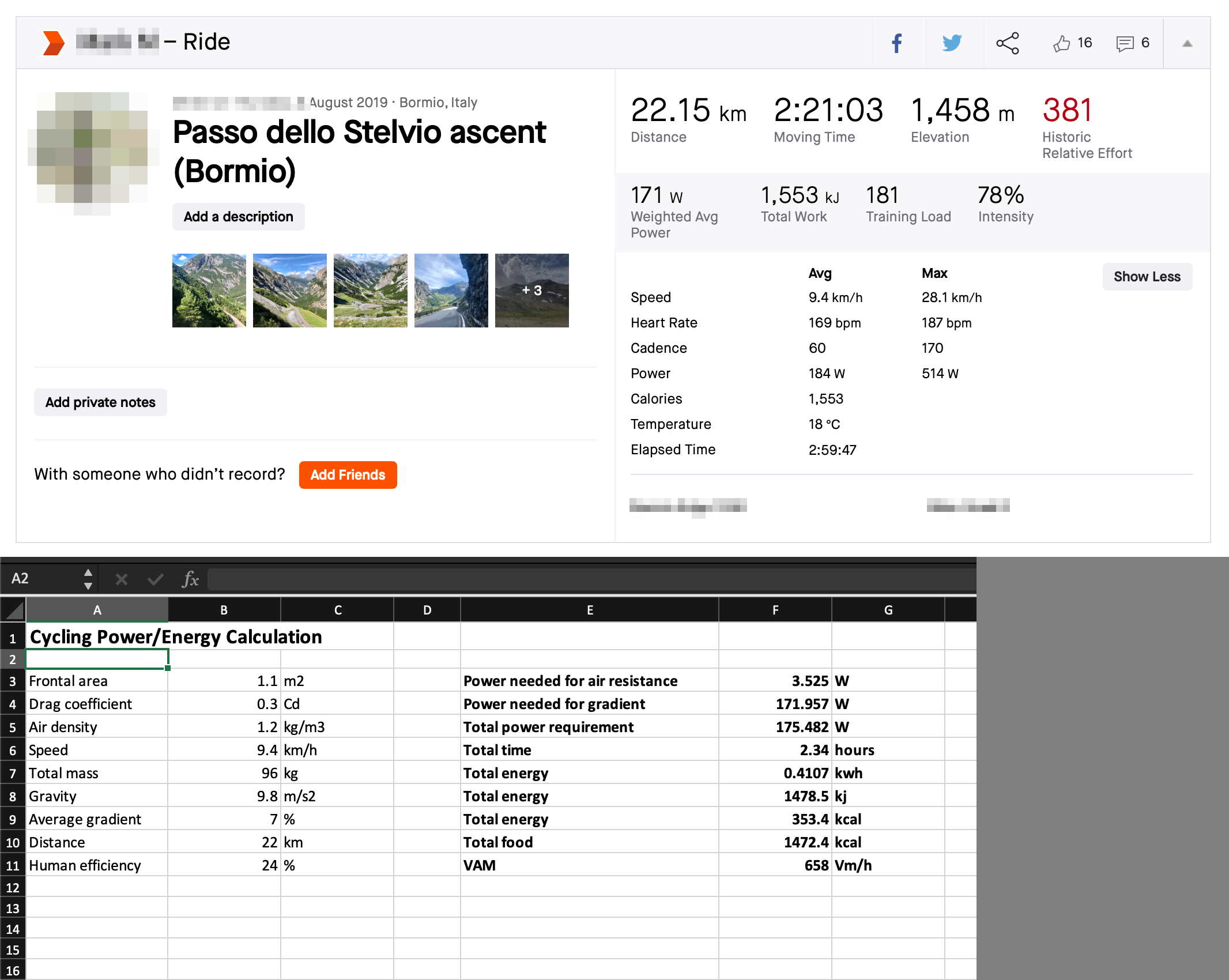
I have a spreadsheet that I made some years ago to work out what power I would need to do a particular climb at a particular speed, and staying well below FTP. As this needs weight as part of the calculation, time can be extrapolated from change to speed keeping the power constant. I couldn’t find an online calculator at the time, so scraped some formulae from various sources, including distant memories of 80s physics lessons, Sheldon Brown, etc.
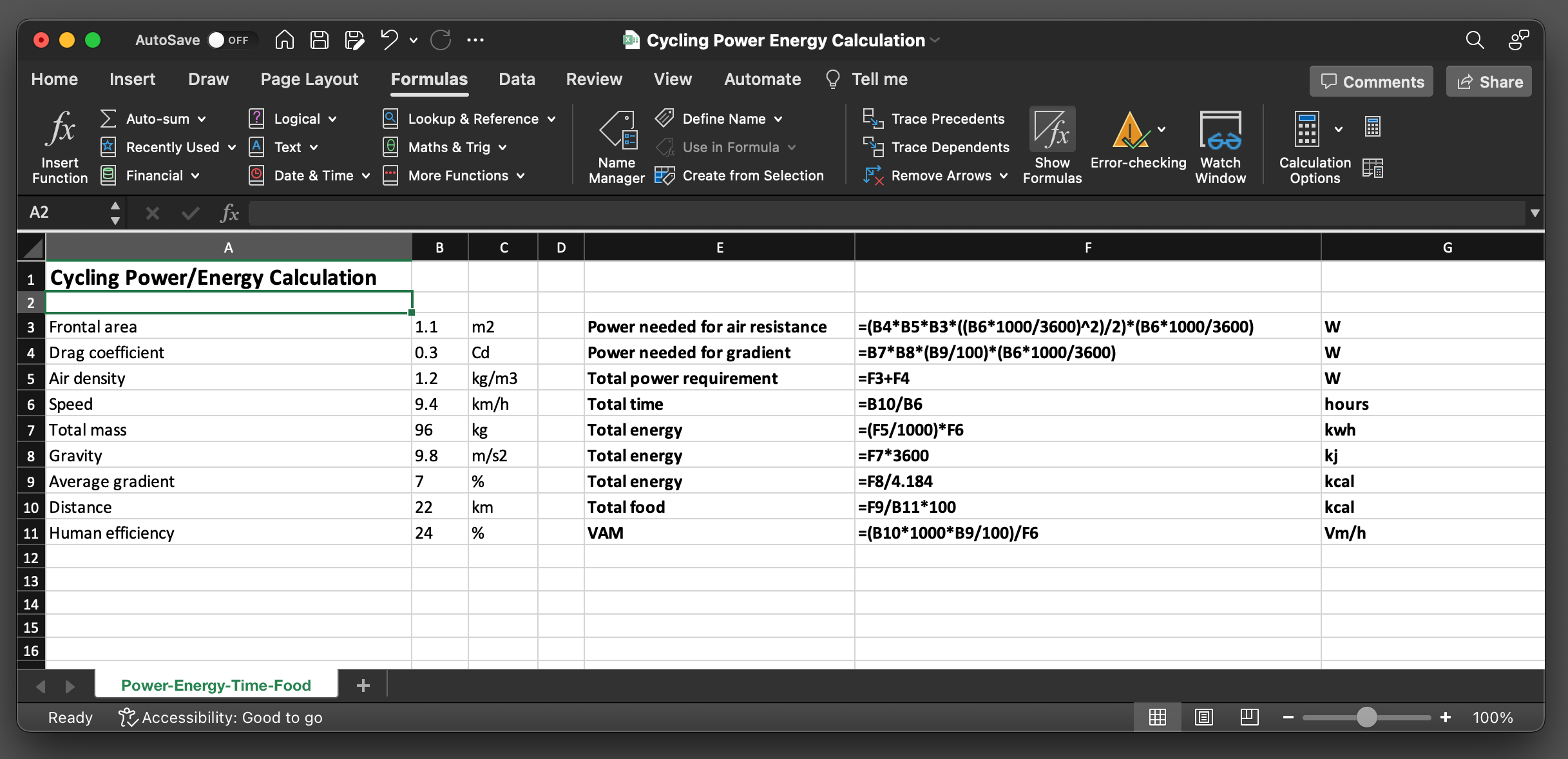
Power to overcome elevation can be calculated from slope x speed m/s x total mass x g^2. Then I took account of wind resistance which is air density x drag x frontal area x (wind or speed) /2. I ignored rolling resistance and drivetrain losses for the purposes of the spreadsheet.
I also added in some other factors such as metabolic efficiency so I could work out what fuel I’d need, extrapolated from work done in kJ.
This is all a bit “back of a fag packet”, however after I’d climbed Stelvio, the figures matched up fairly accurately.
 mark1a
Frontal area, drag
Frontal area, drag coefficient and air density and human efficiency are guesstimates, total mass is all up rider plus bike. Distance and gradient are Stelvio from the Bormio side.
mark1a
Here’s the formulae in the
Here’s the formulae in the cells, feel free to have a play, improve, etc. One day I may get around to making an online version, but it seems to work in Excel for the few times I use it.
-
AuthorReplies

- You must be logged in to reply to this topic.