



Girona-based Niche Mobility says it intends to create a new category of e-bikes, replacing mechanical gearing with a fully automatic and digital system, which it plans to market to bike manufacturers from next year. All you need to do is get on board and pedal.
“There’s no shifting involved,” says Niche Mobility’s Jaume Vila. “The system continuously adapts to speed, cadence and terrain during the ride. The idea is to remove the need to manage gears entirely, especially in everyday use.

“We’re now reaching the final stage of development, preparing for industrialisation later this year, with market launch planned for 2027.”
The drive unit is built around a patented technology that Niche Mobility has developed called ADTS (Automatic Digital Transmission System).
“The gear ratio is adjusted digitally and continuously — no mechanical shifting, no gear steps,” says Niche Mobility. “The system reads speed, slope and riding mode in real time and sets the optimal ratio automatically. Just pedal.”

The system works as a series hybrid. When you pedal, the energy goes to a generator motor housed inside the drive unit. That generator then passes the energy to a separate traction motor — also inside the drive unit — which is what actually drives the rear wheel. The pedals and the rear wheel have no mechanical connection, which is why, with the system off, pedalling doesn’t move the bike at all.
Pedal-by-wire (also called fly-by-wire) systems already exist, where you pedal into a generator and it translates that into drive in a hub motor, so there’s no chain or belt. This is a similar concept but with a chain.
Niche Mobility says the battery size will depend on each OEM (original equipment manufacturer – in this case, the e-bike brands speccing Niche Mobility’s system) and how they choose to integrate the design, and you’ll get assistance up to 25km/h (15.5mph). Future speed pedelec applications will get 45km/h (28mph). The maximum torque of the motor is 120Nm, and the range is around 80-90km (50-56 miles), depending on battery size and assistance level.
Multiple sensors measure factors like speed, slope and torque and feed data to the Bicycle Control Unit (BCU) to modify the gear ratio continuously. You get an HMI (Human Machine Interface) rather than a standard data screen, and can choose between different motor maps: Easy, Flow, Sweat and Off. Smart system features can be controlled through an app.
“It can be used as a full display, tracking the most important data, but also updating the system with over-the-air updates, anti-theft protection, localisation and wireless blocking the bike,” says Niche Mobility.
You get regenerative braking that works in two ways – actively, when you brake, and passively, as engine braking when you’re coasting or descending. You also get a reverse gear that is designed to help with manoeuvrability, operated by pushing a single button or pedalling backwards.
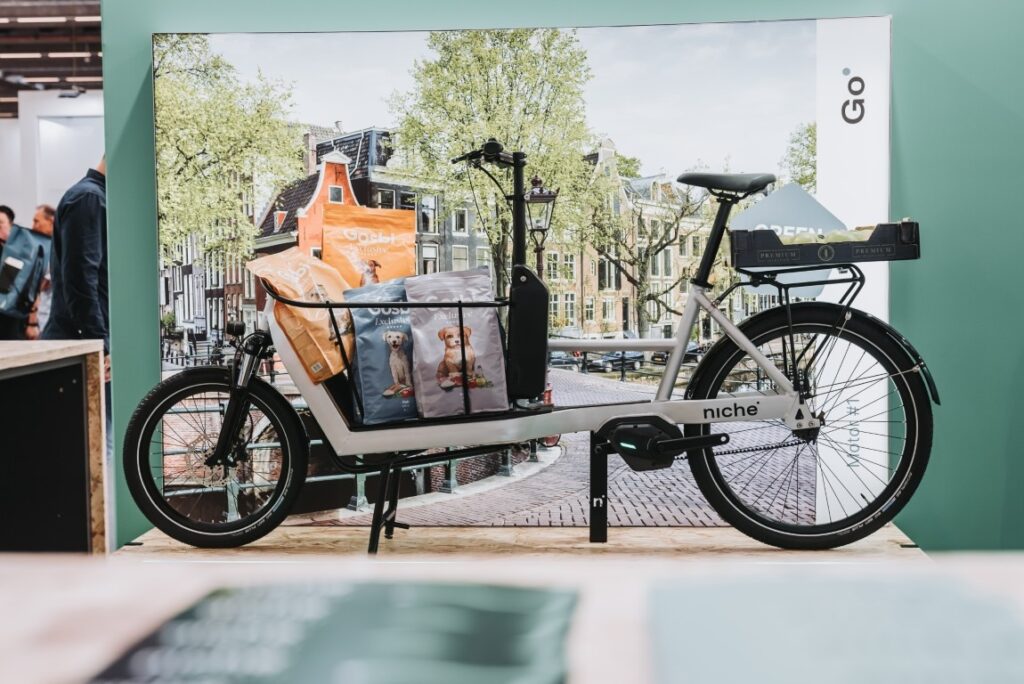
Who is it designed for? Niche Mobility’s system is said to be most suitable for urban, trekking, and cargo e-bikes – segments where simplicity, low maintenance and ease of use are highly valued features – with the launch planned for next year.
Before Niche Mobility existed, company founder Marc Barceló was building prototypes of a bicycle motor in the garage of his house in Navata, northern Catalonia.

Back in 2010, Marc founded electric motorcycle company Volta Motorbikes. The Volta team developed both the motorcycles and the electric propulsion systems that powered them.
Marc then began looking at bicycles, but instead of starting an e-bike brand, his attention shifted to the motor itself – with a focus on developing a system that could make cycling easier and more accessible. Okay, using bike gears is second nature to many of us, but others – especially beginners and occasional riders – don’t find it intuitive.
Niche Mobility says it has begun early conversations with several bicycle manufacturers interested in exploring how the motor could be integrated into their future bicycle platforms.
Pricing? That’s not something that Niche Mobility is sharing publicly at this stage, so it looks like we’ll need to wait a few months to find out.









14 thoughts on “No more gears: meet the new e-bike drive system with no mechanical link between the pedals and rear wheel”
Hmm… I’m not (yet…) the target market. OTOH allows more flexibility (apparently) within the current EAPC rules? That may have some positives eg. making it easier for firms to switch to things like the Vok U for some uses (rather than full van)…
… on the other it’s “yet more tech on a bike” * and further blurring the lines between “human-on-a-bike” level power / speeds and full motorbikes.
And another obstacle to (minimally-trained) police identifying illegal machines. Which might make them less likely to check. Of course that’s hypothetical in the UK as they barely bother currently…
* Which needs more resources / has faster built-in obsolescence / generates more waste when it wears out. Inevitable perhaps, because “progress” (upselling here). And where there’s a challenge to car sales and/or an opportunity to use new infra to sell to the bigger pool of folks who don’t have a driving licence you can bet the market is on it.
I don’t really see the point of this kind of system with a chain – surely the major advantage of a system like this is doing away with a chain and the maintenance that brings?
So basically they’ve built an ebike with no backup option if the electrics fail?
I’m failing to understand how that is an improvement?
Riding our tern GSD back home after running out of battery was a pain but at least that was possible.
If it’s true that it cannot work without battery, then I agree with you this is not an improvement.
Now in that presser, I also read about pedalling being turned into electricity so maybe … ? Also good to read about the regenerative breaking
Absolute idiocy. Imagine misjudging the battery capacity and running out of juice five miles from home in a dodgy area at night and having no option but to push it home – goodbye doubtless very expensive bike!
No, no, no – what they’ve built is an edandyhorse, with a pedal-based generator.
They can do away with the chain! Just use a belt. The belt on my belt drive bike gave over 10,000 trouble-free miles before snapping.
“Absolute idiocy. Imagine misjudging the battery capacity and running out of juice five miles from home in a dodgy area at night and having no option but to push it home – goodbye doubtless very expensive bike!”
I don’t know that they’ve done this, but certainly the electronics could be set up so that the generator drives the motor even with no battery. You could probably get over 70% efficiency, better than a NuVinci hub.
I’m not convinced these systems actually meet the requirements of an EAPC as set out under EU law:
“cycles designed to [be] pedal equipped with an auxiliary propulsion with the primary aim to aid pedalling”
It’s quite clear that the propulsion system is ‘auxiliary’ – i.e. in addition to – not a component part.
IANAL but presumably they’ve already got the legal arguments either checked out or waiting in readiness. I could well imagine it’s arguable eg. as andystow points out: if you could take out the battery and there’s a circuit from the generator (operated by the pedals) to the motor that’s just like a chain (albeit likely inefficient power transmission). Then: the “auxiliary propulsion” is simply provided through the extra power from the battery – where does it say there has to be a *separate* motor to add it in? (Again not a lawyer…)
If I’ve understood how the Vok U works correctly (I’m not certain) that’s even more “debatable” but the makers also appear to think it’s justified! (again might be wrong there, maybe they simply think like other e-things nobody cares? ). In my understanding the power you put in is simply binned and all the pedals are doing is telling the motors what power (from the batteries) to output at! (In that case I think they may also be gaming “max continuous rated power” / possibly applying that to each wheel, which may be out of the rules).
It’s quite clear that the electric motor must be ‘auxiliary’ – now, what that _actually_ means for sure cannot be known until it is tested in court, but I do think it would preclude an electric drivetrain system like this. But like you say, is anybody really bothered? Plenty of dubious e-things about these days anyway.
Article 2 paragraph (h) “pedal cycles with pedal assistance which are equipped with an *auxiliary electric motor* having a maximum continuous rated power of less than or equal to 250 W, where the output of the motor is cut off when the cyclist stops pedalling and is otherwise progressively reduced and finally cut off before the vehicle speed reaches 25 km/h;”
https://eur-lex.europa.eu/eli/reg/2013/168/oj/eng
I’ve ridden the Also TM-B ebike, which is, in principle, the same as the Niche Mobility design, although the TM-B is a lot more bespoke. If the battery dies, the crank/generator provides power to the traction motor, and can optionally trickle-charge the battery. It also has regen braking, etc. I look forward to Niche’s system being available in the US.
So it basically works like my current ebike with a hub CVT and automatic shifter addon…except if the battery runs out these will be next to useless because there’s no universe where an ungeared EAPC regs-compliant motor with no direct linkage to the pedals is going to be capable of putting significant power into the wheel. I’m sure they’ve found some wiggle room that lets it *technically* be capable of moving even with a flat battery, but you better live somewhere flat as a pancake with no wind if you expect to move anywhere.
Honestly this has the stench of a solution looking for a problem.
There’s a system from CIXI which is chainless and available on ICE recumbent trikes – although it doesn’t need to be trike-specific and is getting integrated into cargo and urban two-wheelers. Expensive but very cool, particularly as it solves the long chain issues on recumbent trikes.
https://www.cixi.life/
https://www.icetrikes.co/products/pers-chainless-e-assist-system
I’m assuming any legal/type approval stuff has been handled given that ICE is UK-based.