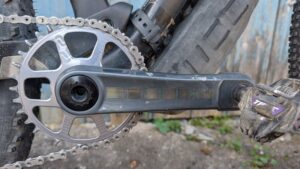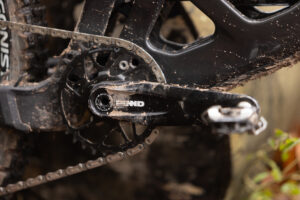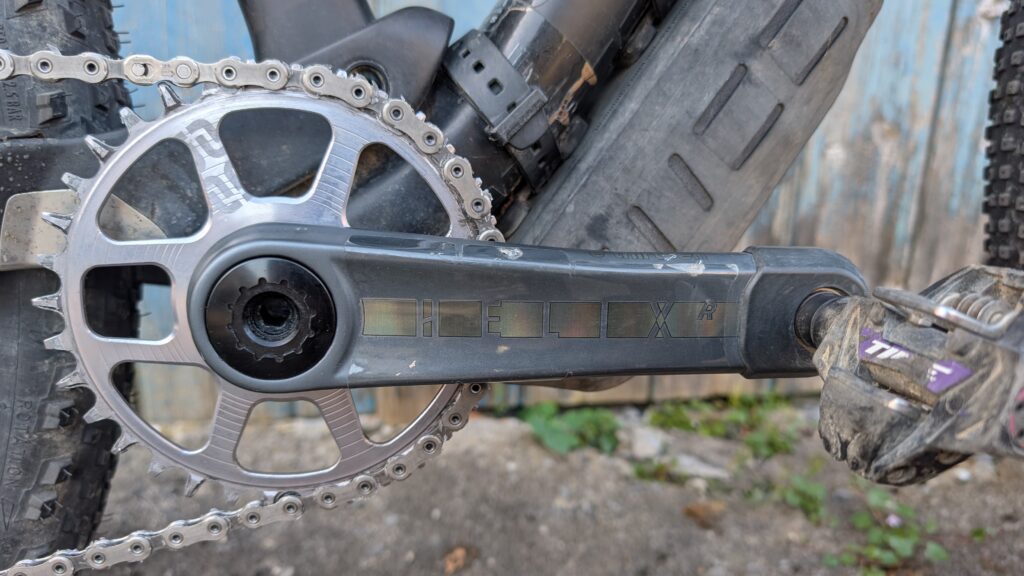

The e*thirteen Helix Race Carbon Cranks are among the very lightest available at just 366g. That figure is genuinely impressive, but these offer far more than just weight savings, combining as they do excellent stiffness with a straightforward fitting and adjustment process.
e*thirteen Helix Race Carbon Cranks – Tech details
If you’re in the market for a lightweight mountain bike chainset, big-name options like Shimano XTR and SRAM XXSL might seem the obvious contenders, but neither comes particularly close to what we have here on weight. The XXSL chainset is a claimed 475g with a 32-tooth chainring, while Shimano XTR sits higher still at 570g with a chainring. e*thirteen claim 415g for these with a 32t chainring, and we measured it at 419g.
There are lighter, more exotic options, such as the Ciamillo Gravitas Gen 13 which dips below 300g, but aside from these rarities (the Gen 13 is discontinued), very few chainsets come in under 400g without a chainring. This Helix Race hit its claimed 366g exactly in the 165mm length, and the 34-tooth chainring adds 53g.
Despite the low weight, e*thirteen rates these for all-mountain use. The construction is like most lightweight carbon cranksets, with a 30mm aluminium spindle and an 8-bolt chainring interface. When paired with an e*thirteen chainring, the system is designed around Boost spacing. Compatibility covers both 68mm and 73mm bottom brackets, and crank length options are 160, 165, 170 and 175mm.
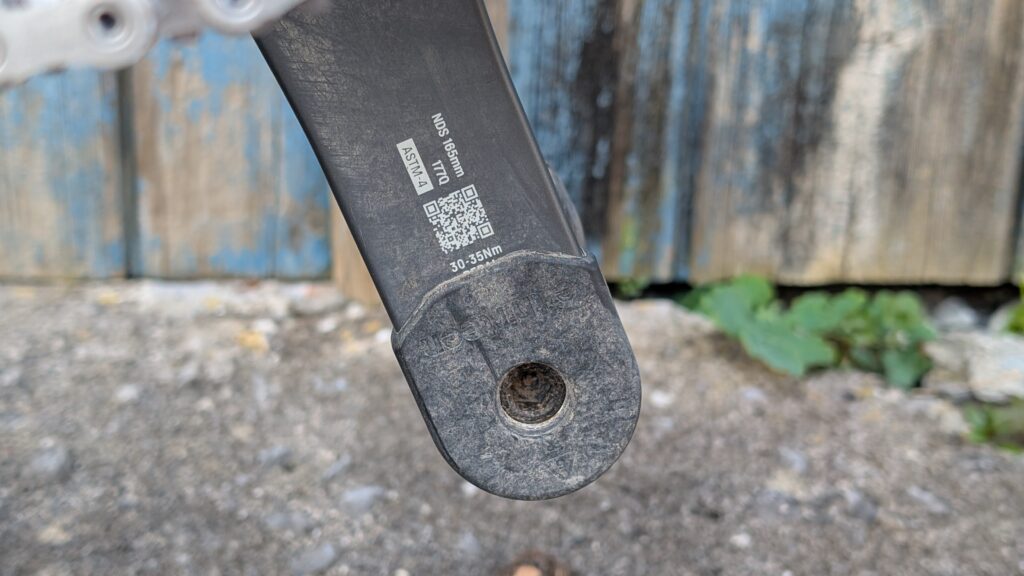
Installation is simple. A single self-extracting 8mm hex bolt secures the cranks, while preload is adjusted via the APS system. This is done tool-free, with clearly marked arrows indicating the direction of adjustment. I tested these with a direct-mount 34-tooth chainring, which was also easy to install.
e*thirteen Helix Race Carbon Cranks – Performance
While the low weight will be a major draw, it doesn’t come at the expense of performance. Stiffness is excellent, with no noticeable flex under hard efforts – there was more flex detectable through my frame and wheels than these crank arms, and I found no tell-tale noises or feedback through the chainring under load.
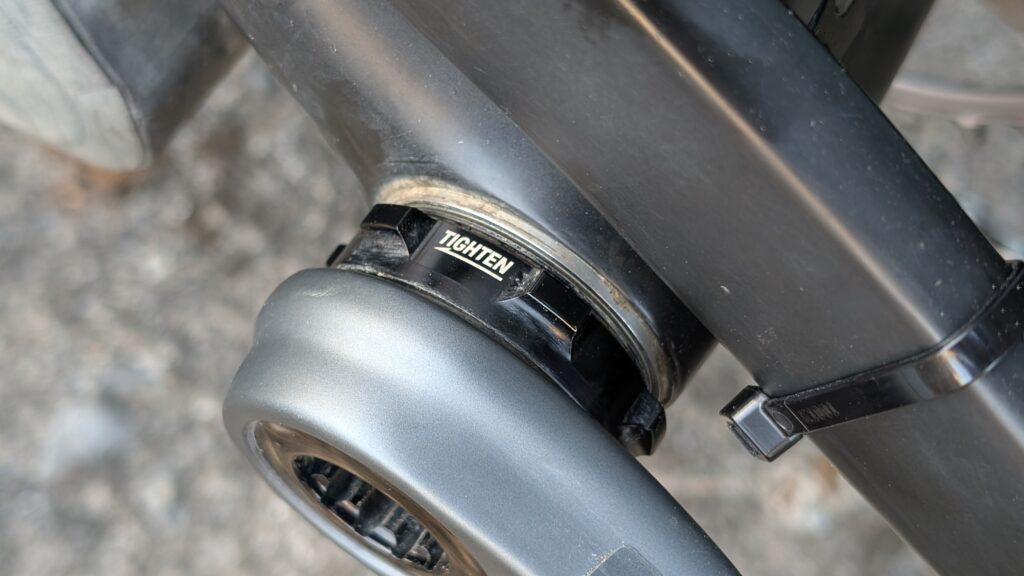
The chainring itself performed flawlessly, running quietly and retaining the chain without issue throughout testing.
For riders considering a power meter, the increasingly common 8-bolt interface is good to see as it opens up a range of third-party options, such as those from SRAM/Quarq and others.
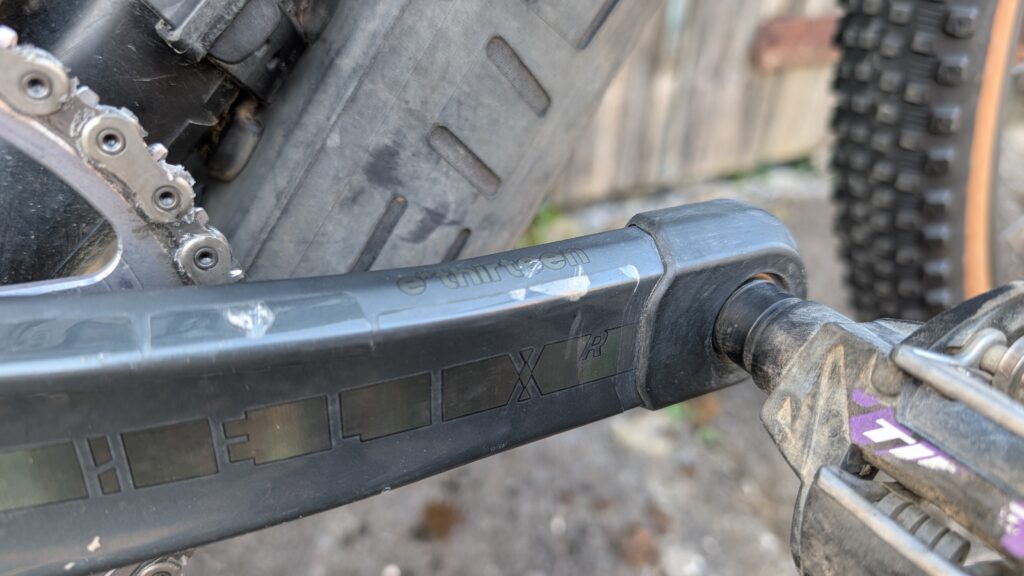
e*thirteen includes protective tape and it’s better shaped than the generic strips supplied with some rivals, though ours still lifted slightly at the edges over time. To be fair that’s happened on almost every chainset I’ve used, but some spares in the box would be a nice touch.
The APS preload system is very easy to use thanks to its tool-free design. However, there’s no locking mechanism, and I found it could drift slightly over time, meaning occasional checks are required. It’s not a major inconvenience, but a simple locking feature would improve long-term usability.
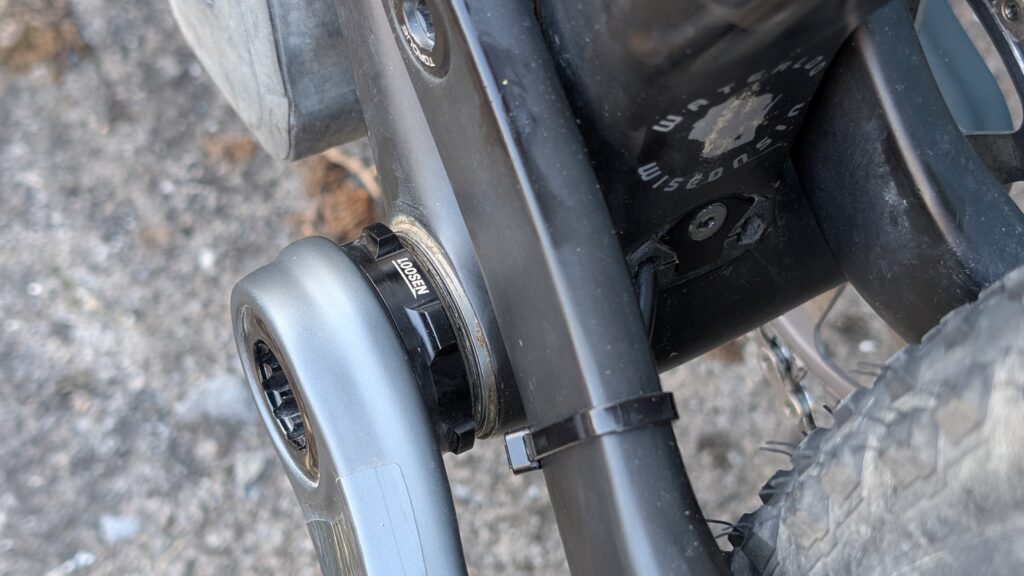
After more than 1,000km of riding, I removed the cranks (from a Hope press-fit bottom bracket) to inspect the aluminium spindle. There were no visible marks, which is reassuring – aluminium alloy is lighter than steel, obviously, but it’s also softer and more vulnerable to wear.
e*thirteen Helix Race Carbon Cranks – Verdict
Carbon cranks rarely come cheap, particularly at the lighter end of the market. The Praxis Works Lyft G2 cranks are close in price at £430, but further behind in weight at a claimed 420g for the 175mm version.
The Hope Carbon Crankset impresses with its performance and finish, but costs a chunk more at £575. It’s also heavier at 419g for the 155mm arms and 490g with a 34-tooth chainring fitted – a total of 71g more. That said, the Hope remains one of the few options if you’re after very short arms.
Another outlier is the Garbaruk XC Crankset at €420, whose machined 7075 aluminium arms bring the whole thing in at under 400g – that’s claimed – without a chainring. They’re based in Poland, hence the Euro pricing, and they also do fancy machined chainrings… presumably to considerable effect, as the company warns that Chinese counterfeiters have started selling fakes on eBay and AliExpress. Buy direct if you’re going to.
To put all these weight savings into context, switching from something like SRAM’s GX Eagle T-Type can shave off more than 300g, or around 0.7lb. Carbon cranks like these are a quick and effective upgrade for reducing overall bike weight.
Lightweight carbon components often carry a premium, and while they’re not cheap the e*thirteen Race Carbon cranks undercut many rivals while coming in lighter than most too. Combine that with excellent stiffness, straightforward installation and low maintenance – plus a good range of crank lengths – and they stand out as a strong option for riders looking to save weight without compromising performance.
Test Report
What does the manufacturer say about this product?:
E*thirteen says: “Helix Race Carbon Cranks are the most technologically advanced cranks we’ve ever produced – robust enough for all-mountain excursions, yet light enough for XC race rigs at just 366g (170mm arms). They feature carbon crank arms paired with a weight-saving, machined aluminum 30mm spindle and an 8-lobe splined interface.”
Tell us some more about the technical aspects of this product:
Chainring – Helix Race 8-Bolt Chainring for Boost 55mm Chainline (sold separately)
Color – Graphite
Compatibility – All frames with a 68/73mm BB shell
Included – Crankset, Crank Boots (x2), Chainring Bolts (x8), Sticker, User Manual
Length – 160mm, 165mm, 170mm, 175mm
Material – Carbon
Spindle – Aluminum 30mm Diameter
Weight – 366g (Cranks 355g + Boots 11g)
Any further comments on performance?:
Almost faultless.
How does the price compare to that of similar products in the market, including ones recently tested?:
These are toward the lower end for carbon cranks – many rivals are notably pricier. For example, the SRAM XXSL costs £590 (including a chainring), while Hope’s Carbon Crankset is £575 without one.
Did you enjoy using the product? Yes
Would you consider buying the product?
Yes, although an even shorter 155mm option would be good to see.
Would you recommend the product to a friend? Yes
Use this box to explain your overall score
These strike a strong balance between low weight, stiffness and everyday usability. They are exceptionally light yet very rigid under load, and pricing is competitive. Only the APS system’s gradual creep prevents a higher score.
About the tester
Age: 41Height: 168cmWeight: 61kg
I usually ride: Road / Gravel / MTBMy best bike is: Cannondale SystemSix
I’ve been riding for: Over 20 yearsI ride: Every dayI would class myself as: Semi-pro or ex-pro
I regularly do the following types of riding: Cyclocross, Gravel riding, Indoor riding, Bikepacking, Audax, Mountain bike XC