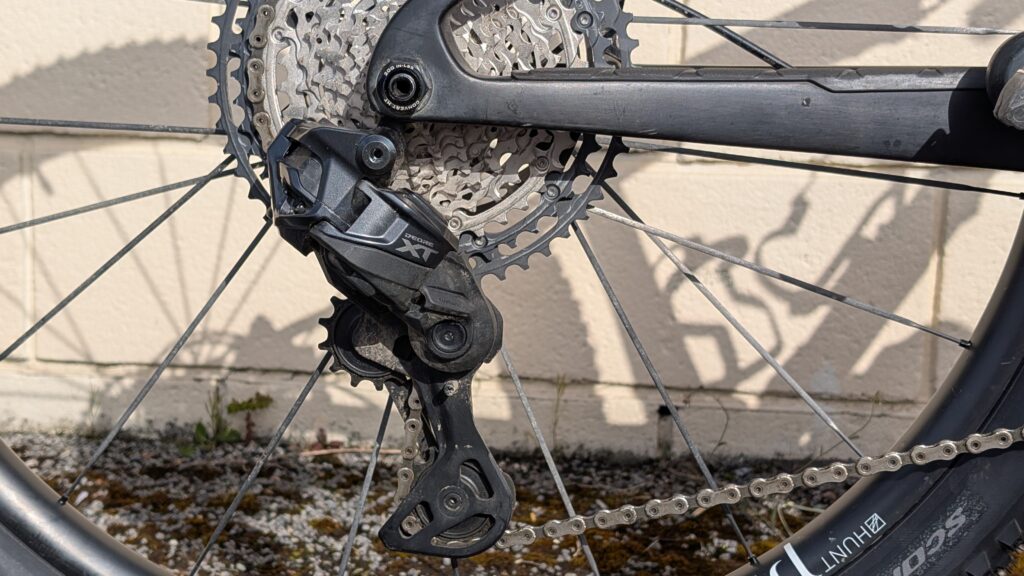

The Shimano Deore XT M8250 Di2 Upgrade Kit sees the firm finally offer a wireless drivetrain option, but has the wait been worth it? Spoilers: yes. With superb shift action, class-leading ergonomics and excellent battery life, it leads the competition in some areas. Not quite all, though…
Shimano XT Di2 M8250 upgrade kit – Technical Details
Shimano is often late to the party, and with wireless shifting it’s been no different. SRAM launched eTap in 2015, and it took almost 10 years for Shimano to offer a direct alternative; initially launching a semi-wireless road double groupset, it’s finally fully wireless with gravel and mountain bike components in the GRX, Deore, XT and XTR lines.
This upgrade kit consists of a rear derailleur and wireless shifter unit, along with a battery charger, a charging cable and even a quick-link chain connector. Within the XT line-up there are two shifter options: a band-on or I-Spec clamp, and either a medium (GS, 9–45 tooth) or long (SGS, 10–51 tooth) cage length.
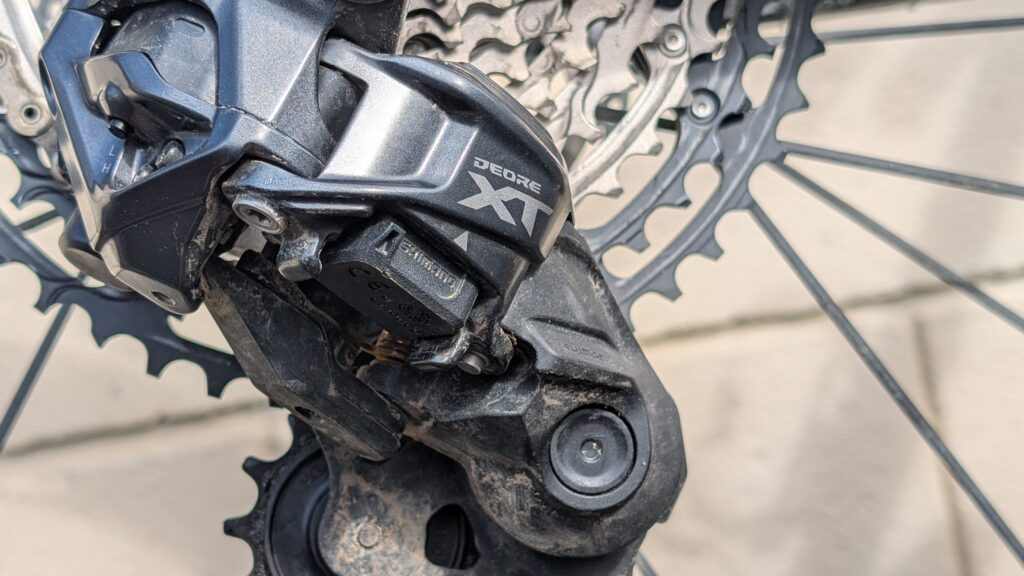
Each option retails for £650, with components such as the cassette, chain and chainset sold separately. Shimano also offers an electric bike-specific M8260 version (£430), which lacks a separate battery and instead connects to the main power unit. It also adds Auto Shift and Free Shift capabilities.
I tested this kit with a drivetrain consisting of the Shimano XT M8200 10–51 cassette (£155), Shimano CN-8100 chain (£50), Shimano Deore XT 8200 chainset (£160) and Shimano Deore XT chainring (£65). This gives a total retail price of £1,080.
Actual weights for the main wireless components are 447g for the SGS rear derailleur, 23g for the battery and 101g for the I-Spec shifter, giving a total of 571g. By comparison, SRAM GX T-Type weighs 464g for the derailleur, 26g for the battery and 47g for the shifter, for a total of 537g.
The non-T-Type 12-speed GX AXS version weighs 438g for the derailleur, 26g for the same battery and 68g for the shifter, totalling 531g. Overall then, the Shimano XT groupset is slightly heavier, but not significantly so.
Ty currently has the XTR version on test, which he has weighed at 535g including the battery. That’s 36g lighter than XT, with the upgrade kit being £800.
At the other end of Shimano’s range is the Deore M6200 version, available as individual components or as a kit. It is only available with an SGS long cage and in either 11-speed LinkGlide or 12-speed e-bike configurations. The shifter lacks the adjustable paddles found on XT, although this also makes it slightly lighter. You don’t need to stick to the same tier when creating a groupset, so it’s possible combine the cheapest Shimano Deore derailleur with the XTR switch for the extra adjustability, for instance.
Replacement or additional Shimano batteries are £45, compared to £56 for an SRAM AXS battery.
Which groupset is best for your bike, and how much should you spend?
One area where Shimano Di2 is lacking across the range is with the absence of a satellite shifter. The SRAM AXS line-up includes Blip shifters, which can be individually programmed and offer extensive third-party fitment options for easy custom shift positions. This won’t matter to all riders, but they have multiple uses, such as on aero extensions on bikepacking setups. Shimano has nothing planned at the moment, although if I were to place money on it, it may in the future. Any minute now, just give them 10 years.
Shimano has retained a standard derailleur hanger mount instead of adopting SRAM’s T-Type hanger-less fitment. While the Shimano setup requires a little more time during installation, it can be more forgiving – a T-Type derailleur requires precise fitment to exactly 35Nm and a strict step-by-step setup.
A standard hanger may initially seem like a weaker design, but Shimano suggests this improves overall durability, with the hanger acting as the sacrificial component in the event of an impact. This does mean hanger alignment is critical, and for optimal shifting, it must be straight.
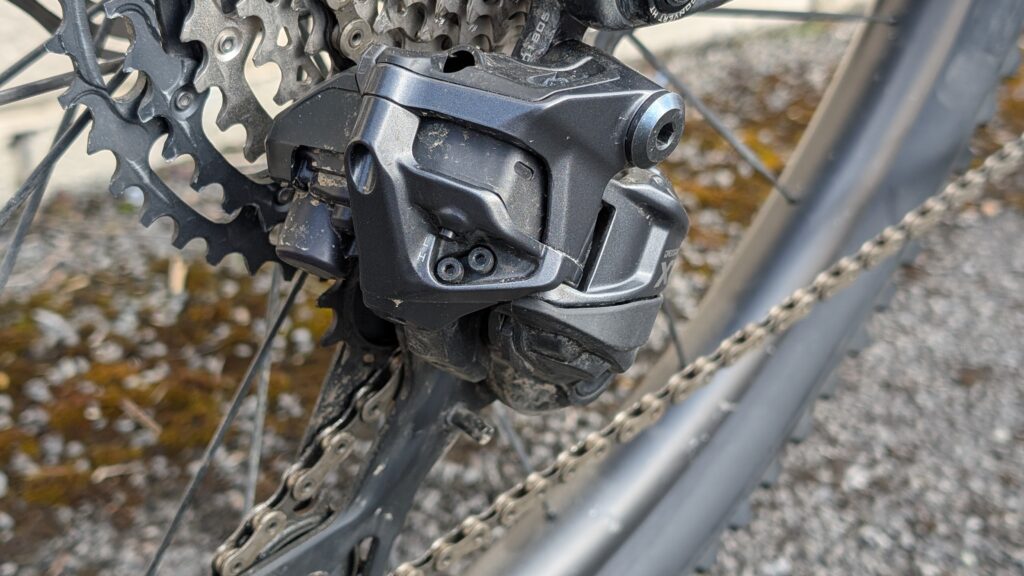
One major difference between the two systems is the battery location, with Shimano opting for a removable, hidden battery. Claimed battery life is 1000–2000km, or 30–49 hours of use. Meanwhile, SRAM AXS sits at a claimed 20–25 hours.
The battery life is impressive – it lived up to Shimano’s claims during testing, exceeding 1000km and still showing a solid green light, meaning it remained above 51% full. However the battery location itself is frustrating, as access is via an awkward hatch which comes completely free and can, consequently, be lost. SRAM’s AXS uses a much simpler clip system, and while older AXS drivetrains have the battery in an exposed position, newer versions integrate it neatly within the frameset.
I suspect Shimano intended the battery hatch to be operable with one hand, but in practice it requires two. I also found mud and grit could build up around the catch, making it even more awkward to remove and refit.
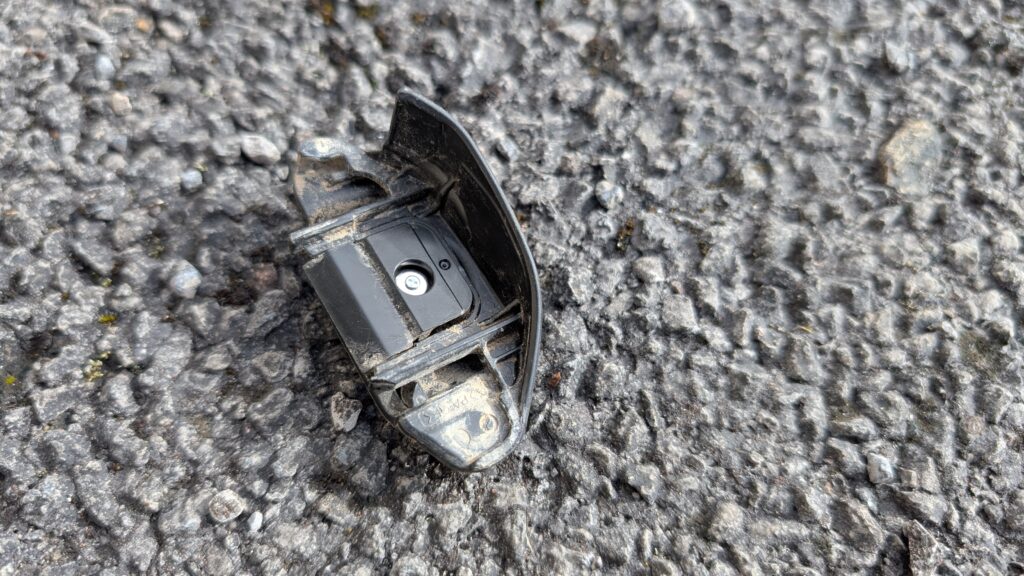
The shifter uses two CR1632 coin-cell batteries with a claimed lifespan of 3–4 years. Battery status can be checked by pressing both paddles simultaneously, with a green light indicating 11–100% and red showing 1–10% remaining.
Shimano XT Di2 M8250 upgrade kit – Performance
Fitting and setup were straightforward, as you would expect given the lack of cables. There are some minor frustrations with the Shimano eTube app, including the need to disconnect after adjusting and the inability to use the shift when connected, but overall it is relatively easy and allows quick registration, setup and customisation. Compared to the recently tested Wheeltop EDX OX2.0 it’s simple, but the SRAM AXS app remains slightly more intuitive.
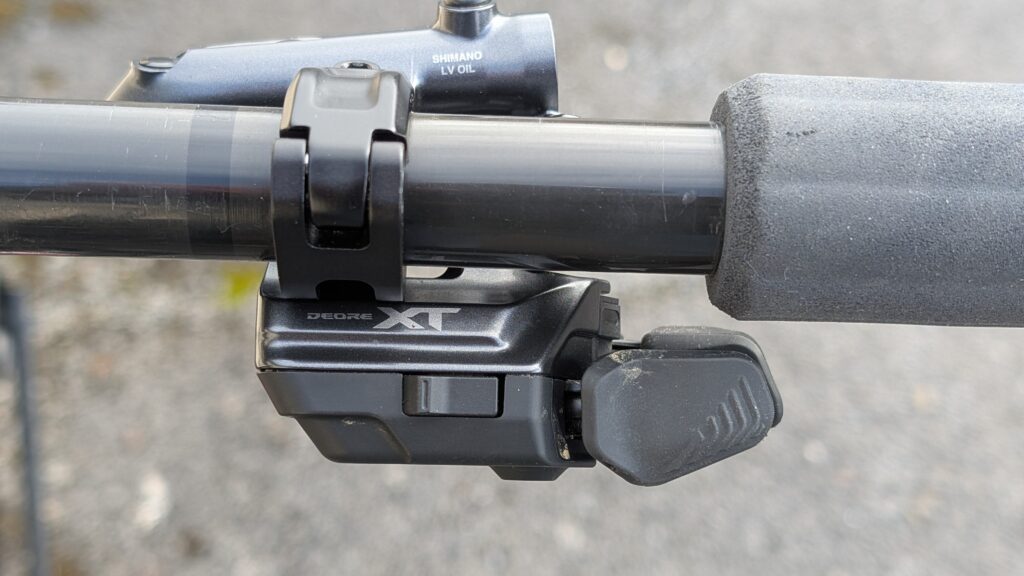
The Shimano shifter is quite large compared to SRAM’s, with a similar (but slightly bigger) profile to cable operated Shimano options. The band-on version clamps directly to the handlebar, while I-Spec integrates with compatible brake mounts or third-party clamps.
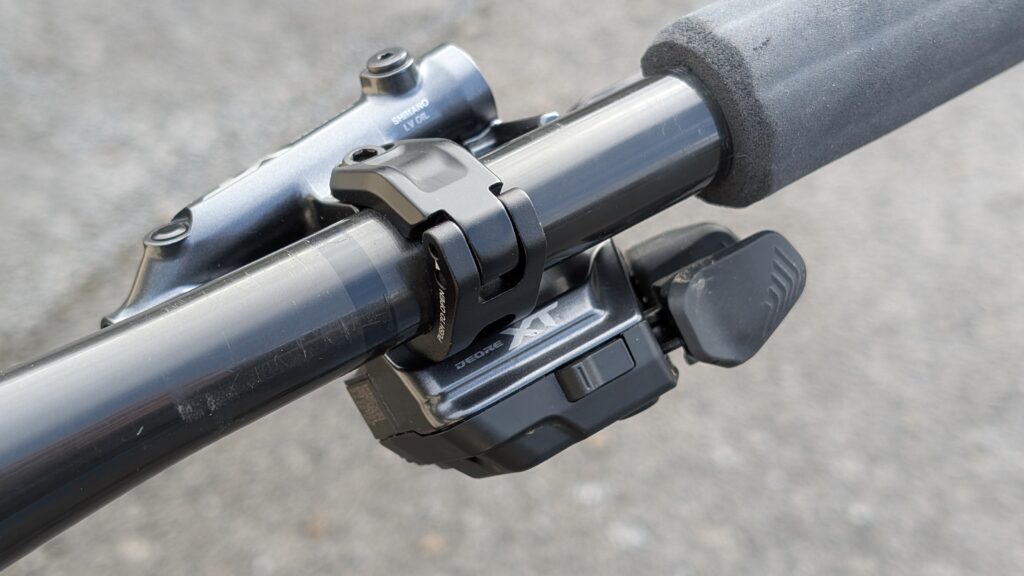
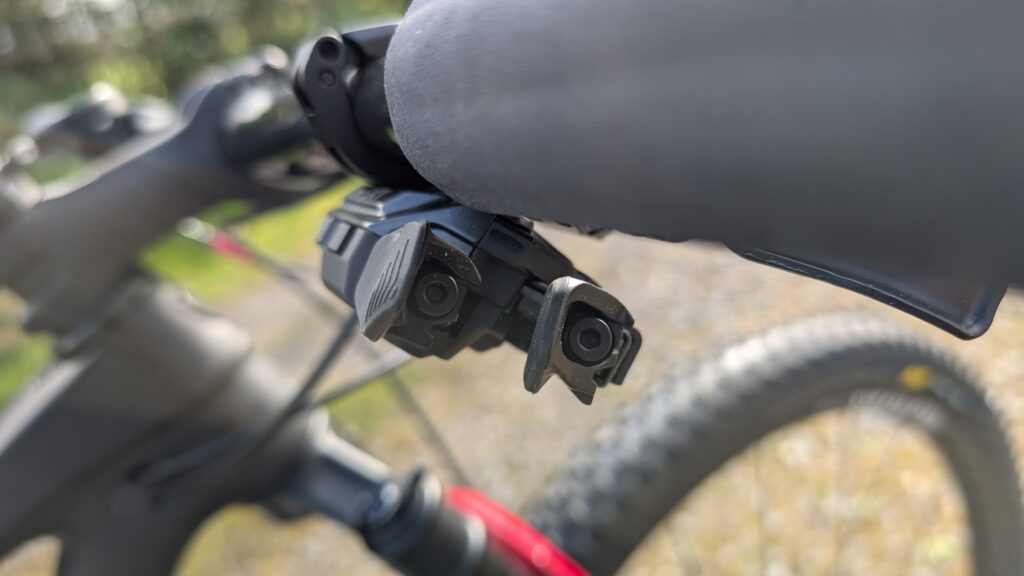
The shifter leads the competition in adjustability. Not only can the buttons be programmed through the app, but each button offers four-way adjustment for precise positioning. A third button allows on-the-fly trim adjustments (working like a cable barrel adjuster) or auto-shift mode changes, and can also control a Garmin GPS head unit. Shimano has left the third button protocol open, too, so third parties can create new ways in which it can be used.
The third button is on the main unit and is not easy to find and push compared to the two main buttons, but it’s fine when you’re stationary.
On the trail the shifter stands out for its excellent feel, delivering a crisp and tactile click through the rubber-covered traction pad. The action is short and light, with multi-function press-and-hold options available via the app. Out of the box, the paddle positioning is good, but the additional adjustment allows precise tailoring for your riding position and cockpit setup.
While the shifter initiates the gear change, the derailleur delivers the performance, and in short it’s fast and smooth. If slightly noisy. It’s louder than SRAM GX AXS, particularly on the downshift, where SRAM is nearly silent.
Shifts are smooth even under load on steep gradients or when sprinting hard. Shimano does not publish shift speed figures, but it feels very close to wired Di2 systems and marginally faster than SRAM T-Type AXS. While the single-shift action is set to a fixed speed, you can adjust the multi-shift speed across five rates. You also have the option to pair wireless GRX, XT, and XTR rear derailleurs with SRAM’s GRX drop-bar levers to create a mullet setup, just as SRAM offers cross-compatibility the other way.
One of the biggest talking points here is the removal of the traditional friction clutch, which is replaced by a dual-spring design. It’s likely intended to improve suspension performance, as a friction clutch’s resistance can affect suspension movement, but measuring any real-world difference would be difficult without back-to-back testing on identical bikes.
I can say the new dual-spring design worked as intended to retain the chain, as in testing it proved completely successful at that.
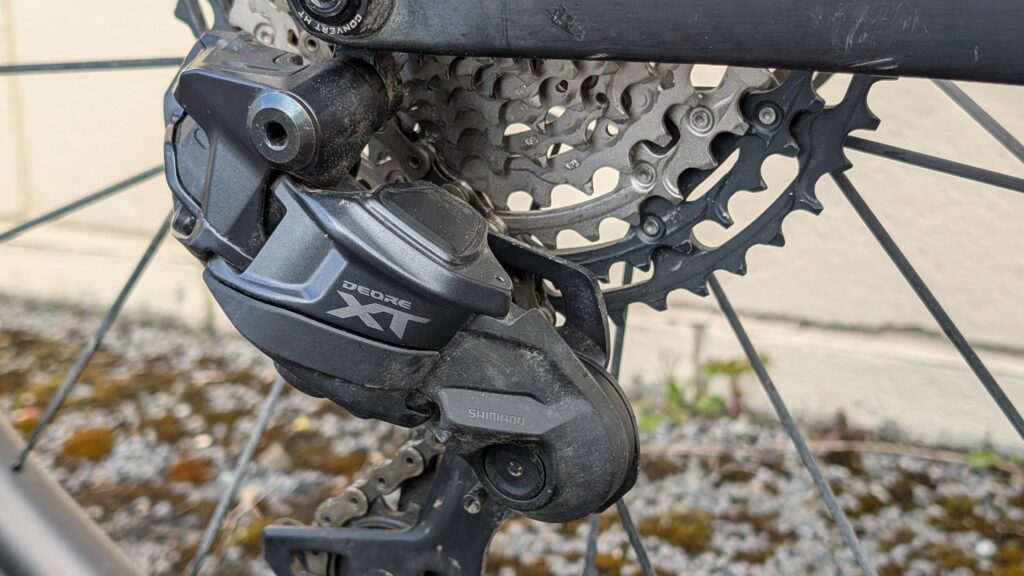
Durability is understandably a concern when spending this much on exposed components. The XT 8200 derailleur has a relatively compact shape that does not protrude excessively, and Shimano’s Impact Recovery System moves the derailleur inboard when struck before automatically returning it to its original position. SRAM offers a similar protective function, but it simply moves the chain furthest inboard and keeps it there, whereas Shimano resets itself.
While I didn’t smack anything hard enough to test this, it provides additional reassurance alongside the standard hanger design, which is intended to fail first in the event of an impact.
The system proved completely reliable throughout testing and is very much fit-and-forget. The extended battery life is particularly impressive and makes it easy to forget about charging altogether… which isn’t a good idea. With Shimano’s electronic double chainset the loss of front shifting would give you a warning of a low battery, but with single chainring systems this warning disappears. Your only early warning sign, apart from the LED colour when checked, is when the multi-shifting stops working. Assuming you have it enabled in the first place.
Shimano XT Di2 M8250 upgrade kit – Verdict
This delivers fast and accurate changes via an excellent shifter that sets a new benchmark for ergonomics and adjustability. It’s quick, precise and consistent under load.
Price comparisons with SRAM are not straightforward, though. SRAM’s £570 upgrade kit lacks a derailleur cage, as the idea is you swap your existing mechanical SRAM mech’s cage across. Meanwhile full component pricing is broadly similar, with an SRAM GX Eagle T-Type rear derailleur at £430, and a battery (£56), charger (£46) and AXS Ultimate controller pod (£215) totalling up to £747.
Had this Shimano kit had been released five years ago it would have been a triumph, and in terms of shift speed and overall performance, it kind of is now. It certainly sits above the previous SRAM AXS (non-T-Type) components, but while there are good points (the shifter and the ergonomic adjustments being highlights), overall it hasn’t wowed me enough to claim it is better than the competition.
It’s perhaps a choice more of personal preference and riding style. If you need satellite shifter options, SRAM wins by default. If your frame does not support a direct-mount Universal Derailleur Hanger (UDH) interface, only Shimano will work. For general riding, however, the differences are marginal and the decision may simply come down to which shifter feel you prefer. In that respect, for me, Shimano takes the lead.
Test Report
What does the manufacturer say about this product?:
Shimano says: “Elevate your mountain bike’s performance to the highest level with the Shimano XT Wireless Drivetrain Upgrade Kit. This comprehensive package provides everything you need to experience the precision, speed, and durability of electronic shifting. By combining the revolutionary XT Shadow ES rear derailleur with a responsive wireless shifter, this kit delivers a riding experience that is nothing short of flawless.”
Tell us some more about the technical aspects of this product:
Tested components include: Rear mech, shifter switch, BT-DN320 battery, EC-DN100 charger, SM-CN910 chain link
Any further comments on quality?:
The shifter is the highlight, with lots of adjustment and great feel. The biggest downside for me is the battery location and cover. It was awkward to remove, and because the battery is charged off the bike and the cover needs to be removed, it’s easy to lose.
Any further comments on performance?:
Excellent shifter feel and action, with lots of adjustment. The shifting is fast, accurate and setup was simple, although the app isn’t quite as intuitive as the SRAM AXS version.
How does the price compare to that of similar products in the market, including ones recently tested?:
A little cheaper than SRAM GX Eagle T-Type, but more expensive than the Chinese groupset options.
Did you enjoy using the product? Yes
Would you consider buying the product?
Maybe – I like satellite shifters though.
Would you recommend the product to a friend?
Yes, for riders who don’t need satellite shifters.
Use this box to explain your overall score
This delivers fast, precise and reliable wireless shifting, with class-leading ergonomics and excellent battery life. It improves on previous Di2 systems and rivals SRAM AXS for speed and feel, but the lack of satellite shifter options and awkward battery access are negatives.
About the tester
Age: 41Height: 168cmWeight: 61kg
I usually ride: Road / Gravel / MTBMy best bike is: Cannondale SystemSix
I’ve been riding for: Over 20 yearsI ride: Every dayI would class myself as: Semi-pro or ex-pro
I regularly do the following types of riding: Cyclocross, Gravel riding, Indoor riding, Bikepacking, Audax, Mountain bike XC