



The Cinelli Speciale Gravel combines a traditional-looking steel frameset with the newer features many riders will be looking for – internal cable routing, a carbon fork, and more. It looks fantastic, but unfortunately, that fancy fork and various aspects of geometry and spec just don’t live up to the promise.
Cinelli Speciale Gravel – Technical details
In 2023, after a gap of 30 years, Cinelli started building frames in Milan again. The Speciale Gravel is one of the first framesets that’s 100% built in Italy.
The frame is constructed of Columbus Spirit tubing (a firm also based in Milan), and features internal routing, a T47 bottom bracket, dropper post compatibility, and claimed tyre clearance of 2.2in. That might be Italian sizing, though…
The Speciale Gravel is available as a frameset (frame, fork, headset) for £2,999, or as tested with the SRAM Rival AXS build for £4500. It’s 1x or 2x compatible and available in five sizes, with a range to suit riders from 156cm to 195cm.
Cinelli Speciale Gravel – Componentry
The specification I have on my test bike is unique to the UK, and includes a SRAM Rival AXS 1×12 groupset and brakes, Mavic Allroad 1 wheels, 45mm Schwalbe G-One Allround tyres, and a Cinelli cockpit and seatpost. The saddle is a Prologo Akero.

The wheelset on this test bike came with basic plastic rim tape, which meant it wasn’t possible to set up tubeless. Cinelli says customer bikes will have tubeless tape and valves fitted.
Even running tubeless, however, the wheelset is basic, with a 2,000g+ weight and a narrowish internal rim width of 25mm given the claimed 56mm (2.2in) tyre clearance at the back.
The Speciale Gravel frameset uses a Columbus Divide Integrated carbon fork and a matching cockpit to create a very clean integrated system. With a wireless drivetrain and no dropper post as standard, there’s little to run through the frame apart from the brake cable, which exits through the headset. While there are some downsides – the most obvious and common being the added cost and time of replacing headset bearings with cables going through them – it’s pleasing to see split headset spacers here. These let you adjust the height without cutting the steerer tube and splitting the brake hose, as more limited internal routing systems require.
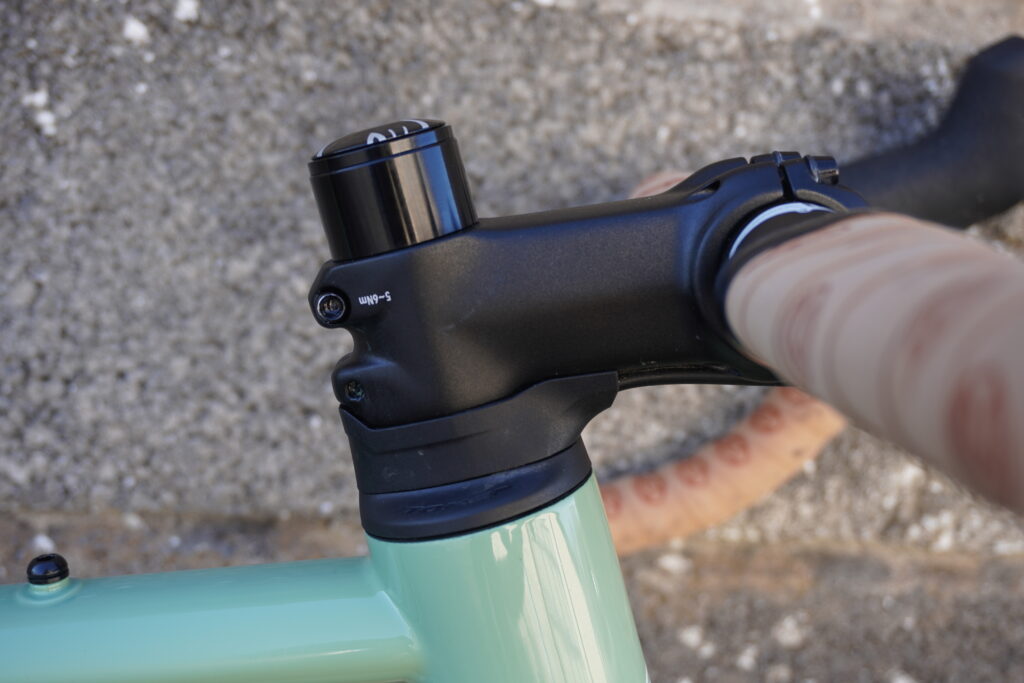
While the setup allows for flexibility, however, the headset uses a very tall cup above the bearing, and on my medium-sized frame, it effectively added 25mm onto a 135mm headtube and a fork with a 438mm axle-to-crown. The result is a noticeably high front end.
The quoted stack is 577mm, although a more realistic figure (bars as low as possible and on the standard 45mm tyres), is 940mm from the centre of the handlebar to the ground.
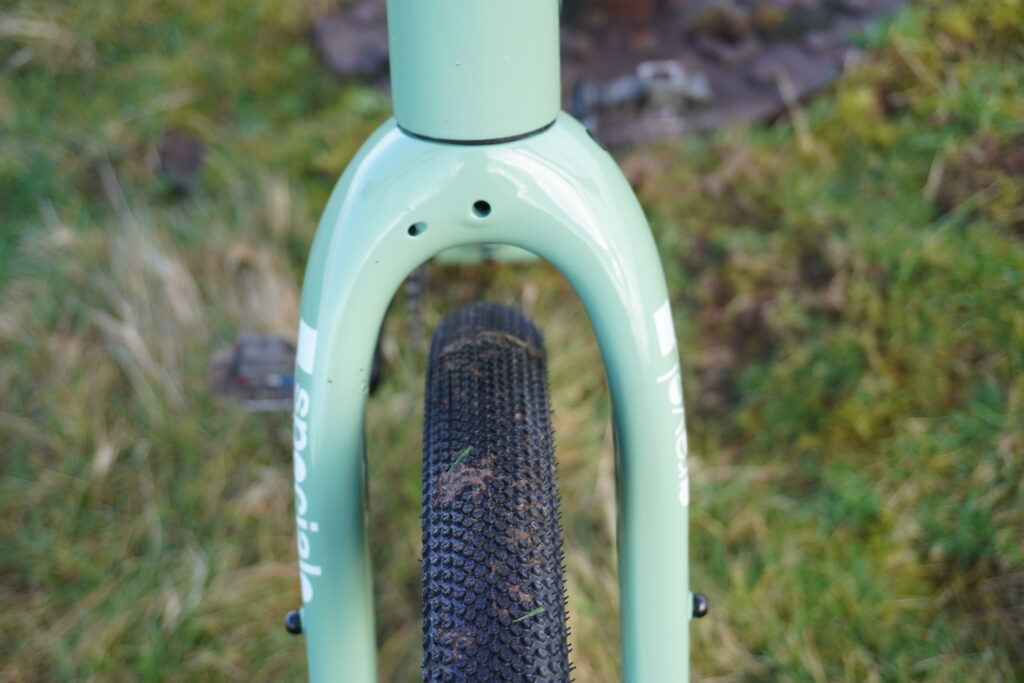
The Columbus Divide fork has claimed 2.2in (56mm) tyre clearance, and during testing I had plenty of room around 50mm rubber. The rear is rated for the same width, but my (genuinely) 2.2in wide rear tyre touched both chainstays. A 50mm tire might fit with limited mud clearance, though a 45mm tyre leaves plenty of space.
You get a full wireless SRAM Rival 1x drivetrain (although the frameset is compatible with 2x mechanical and electronic options too), and routing for a cable-actuated dropper post.
Some key geometry figures include a 70-degree head angle, consistent across all sizes, and a seat angle that ranges from 73 degrees on the XL to 74.5 degrees on the two smallest sizes. Reach on the medium frame is 402mm, which is relatively long compared with some gravel bikes, although that is often the case with more adventure-focused designs. For comparison, the Whyte Verro, which impressed me in 2025, has a 428.5mm reach on the medium frame, although it pairs this with a short 70mm stem.
Cinelli Speciale Gravel – Performance
To start with, I found it difficult to get into a comfortable riding position because of the tall front end. The combination of a tall fork, 135mm headtube (even on XS frames it’s 117mm), and tall headset sat me very upright. Small riders might struggle further, as the smallest frameset still has a stack of 563mm. For comparison, the XS Trek Checkpoint Carbon, which also has internal cable routing and 50mm tyre clearance, has a stack of 535mm – nearly 3cm lower.
The 45mm Schwalbe G-One Allroad tyres (which actually measure 43mm) make for a quick and smooth ride on the road, but they’re not designed for serious off-road terrain. They soon clog up and slip away in any form of mud. It’s an odd choice of tyre, but at least it’s something that quickly changed.
At first I thought the front was harsh and uncomfortable because I couldn’t run the low pressures that tubeless allows, and because they were relatively narrow tyres too. But swapping the wheels and running 45mm and 50mm tubeless tyres that I know have supple casings – down to 20psi – did not eliminate the harshness.
The rear gives exactly the smooth ride you’d expect from a steel frame, and perhaps that only makes the front feel worse. The Speciale can take a gravel suspension fork, and some builds are available with a Rock Shox Rudy. A sensible upgrade, perhaps.
While general comfort is limited, it was downhill where I had the biggest issues. The combination of the upright riding position and harsh front end made for a very slow and less enjoyable ride downhill. Instead of being able to rule over the bike and let it move beneath me, I found I was being jacked about and riding incredibly slowly.

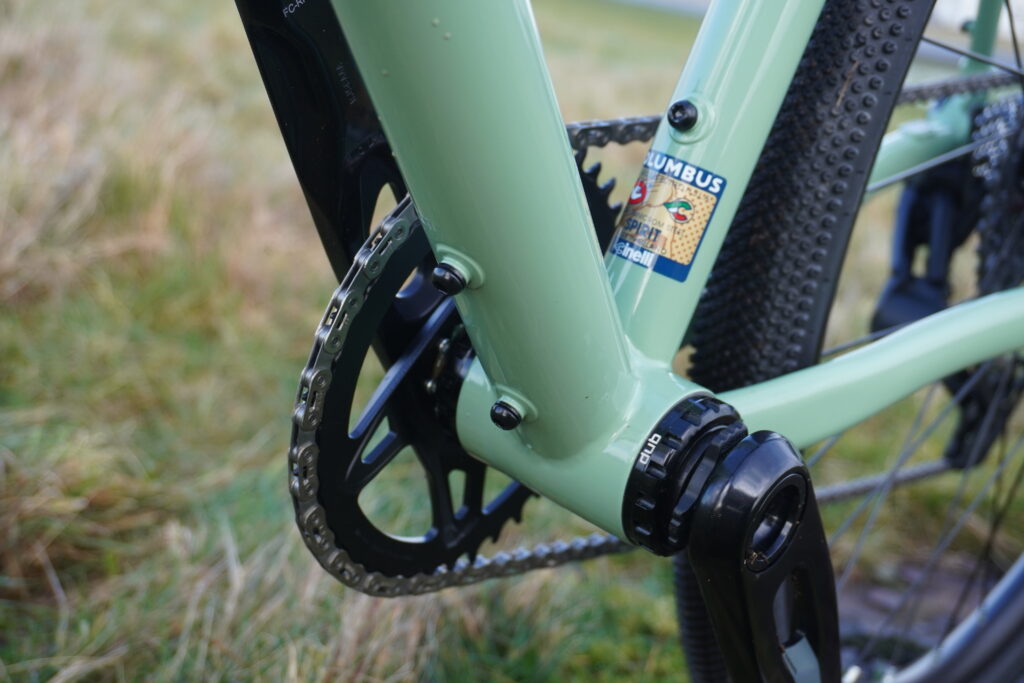
The frameset is designed with some thought to longevity and usability, with a T47 bottom bracket shell and that internal routing. The latter won’t be for everyone, but it’s amongst the best I’ve used as it allows adjustments without fully committing and cutting the steerer.
It also features lots of mounting points, with 3-bolt fittings on both the down tube and seat tube, as well as bottle mounts on the top tube and under the down tube.
The fork also has three-bolt mounts on both sides, and there are mudguard mounts front and rear. The fork’s internal routing even includes a spot for a dynamo cable, for the most adventurous riders.
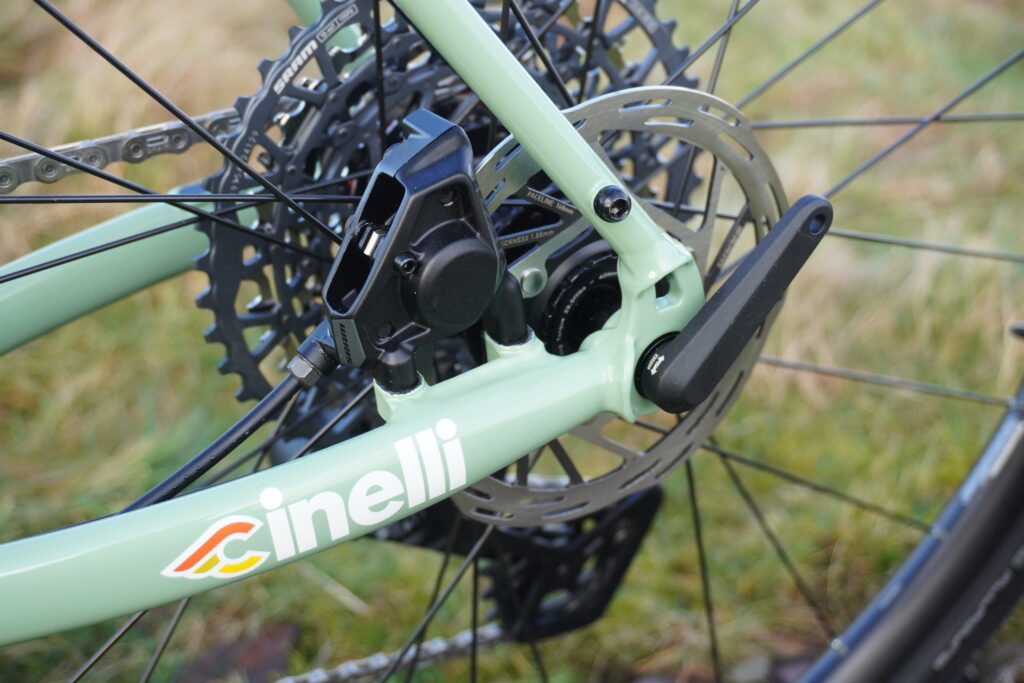
I think the frameset in the Agave colour looks fantastic, and even with all those mounting bolts, it’s sleek. Cinelli does seven other colours if you’re not keen, and five stock sizes. There’s even a made-to-measure custom size option.
My test bike was 10.7kg without pedals. So it’s far from light, and that weight can be felt when pedalling uphill, but given the bike’s adventure intentions, it’s not much of an issue. The frame is 2,120g of that (claimed), with the fork an extra 534g. The Rival AXS Eagle 1x drivetrain, with its 40 tooth chainset and 10-52T SRAM cassette, meant that even the steepest climbs were rideable anyway.
Some component choices are less successful. The little 140mm rear brake rotor feels underspecced for an adventurous bike that may well end up covered in cargo, while the thru-axles are poorly matched. The rear has a lever that catches the edge of the frame once tight, while the front has no lever at all. I’d much prefer to see no levers on either, as the one here is less effective than even the smallest of multi-tools.
Cinelli Speciale Gravel – Verdict
Cinelli has created a beautiful frameset with some great features, but it’s unfortunately a flawed and very expensive option. As tested here, it’s £4,500, while the frameset is £2,999, which is a jump even over other premium steel frames. British options include the ‘fast gravel’ Mason Bokeh frameset at £1,450 or its ‘gravel adventure’ Exposure at £2,150.
The Fairlight Secan 3.0 is also aimed at gravel adventure, and is £1,499 for the carbon-forked steel frameset. Okay, you’re not getting internal cable routing, but for some, that might be a positive.
Cinelli has created a beautiful-looking bike, and with the whole frameset made in Italy, it’s an enticing option for those who love traditional cycling heritage. But that heritage comes at a significant price, while the harsh carbon fork lacks the comfort of a real adventure bike. Add in some underwhelming spec choices and a less-than-stellar riding position, and this is a bike that needs yet more money spent on it to get the best out of that frame.
Test Report
What does the manufacturer say about this product?:
Cinelli says: “For those who dream of adventure without limits, with the performance of a cutting-edge, modern gravel bike. For cyclists who demand speed, versatility, reliability, and a striking aesthetic. The Speciale Gravel is designed for the modern cyclist who refuses to settle for ordinary, who wants a fast, aggressive gravel machine with a unique soul.”
Tell us some more about the technical aspects of this product:
Sizes: XS (45), S (49), M (51), L (53), XL (55)
Stem: Included XS (70mm), S (70mm), M (80mm), L (80mm), XL (90mm)
Frame: Evolved Columbus Steel
Fork: CC Divide 1-1/8″ – 1-1/2″ Carbon Monoc
Cable Routing: Full internal (Electronic groupset only)
Brakes: Flat mount disc brake, Rotors size up to 160mm (rear) and 180mm (front)
Headset: IS 52/28.6
Bottom Bracket: T47 68mm (Not included)
Seatpost: 32.5mm (Included)
Max Tyre Clearance: Up to 2.20″
Frame Weight: 2120g/Fork Weight: 534g
Drivetrain: SRAM Rival AXS Eagle
Handlebar: Cinelli Alu Handlebar 6061
Stem: Alu Stem 6061
Seatpost: Cinelli Vai Ø 31,6
Shifters: SRAM Rival AXS
Brakes: SRAM Rival Hydro Disc
Rotors: SRAM 160 mm
Ft. derailleur: /
R. derailleur: SRAM S1000 Eagle
Crankset: SRAM Rival 1 Wide 40t
Cassette: SRAM XS-1270 10/52t
Chain: SRAM Rival
Wheelset: Fulcrum Rapid Red AL
Tyres: Vittoria Mezcal XC 29×2.1
Saddle: Fi’zi:k Argo X5
Any further comments on quality?:
Overall this is a nice frameset with a few small problem areas, such as the rear axle lever catching the frame, and tyre clearance which isn’t the 2.2” quoted. While the fork is not comfortable, it is still well built.
Any further comments on performance?:
Some elements are great, but the fork is the biggest issue and the area holding back overall performance.
How does the price compare to that of similar products in the market, including ones recently tested?:
It is more expensive than most similar bikes. The Mason Bokeh is £3,000 with a new Rival AXS XPLR build, or £1,450 for the frameset. Although aluminium, the Whyte Verro is impressive too, and it’s under half the price at £1,799.
List the components used to build up the bike:
Drivetrain: SRAM Rival AXS Eagle
Handlebar: Cinelli Alu Handlebar 6061
Stem: Alu Stem 6061
Seatpost: Cinelli Vai Ø 31,6
Shifters: SRAM Rival AXS
Brakes: SRAM Rival Hydro Disc
Rotors: SRAM 160 mm
Ft. derailleur: /
R. derailleur: SRAM S1000 Eagle
Crankset: SRAM Rival 1 Wide 40t
Cassette: SRAM XS-1270 10/52t
Chain: SRAM Rival
Wheelset: Fulcrum Rapid Red AL
Tyres: Vittoria Mezcal XC 29×2.1
Saddle: Fi’zi:k Argo X5
Tell us what the bike is for and who it’s aimed at. What do the manufacturers say about it?:
Cinelli says: “The Speciale Gravel 2026 is designed for the modern cyclist who refuses to settle for
ordinary who wants a fast, aggressive gravel machine with a unique soul.”
Where does this model sit in the range? Tell us briefly about the cheaper options and the more expensive options:
Cinelli offers the Speciale Gravel as a frameset for £2,999. Although Cinelli directly offer other specifications, AXS Eagle is the only full build available in the UK.
Tell us about the build quality and finish of the frame and fork:
The frame is excellent and gives a comfortable ride at the back, although the tyre clearance is listed as fitting a 2.2” tyre – it’s narrow though, and my 2.2s touched both chainstays. The fork has masses of clearance, meanwhile, but it’s harsh and made it an uncomfortable ride overall.
Tell us about the materials used in the frame and fork:
Frame: Columbus Spirit Hss
Headset: IS 52/28,6 | IS 52/40
Seatpost: ø 31,6
Seat Clamp: 32,5mm (included)
BB Shell: T47-68mm
Fork: Columbus Components Divide Integrated Carbon Fork
Tell us about the geometry of the frame and fork:
For a medium frameset:
Seat tube (centre to top) – 510mm
Top tube (horizontal) – 567mm
Headtube – 128mm quoted, measured 135mm
Head angle – 70 degrees
Seat angle – 74 degrees
Chainstay length – 435mm
Wheelbase – 1073mm
Reach – 402mm
Stack – 577mm
Fork axle to centre – 435mm
How was the bike in terms of stack and reach? How did it compare to other bikes of the same stated size?:
The reach is like other gravel adventure bikes, with the medium at 402mm. The Ritchey Outback is a little shorter at 383mm, and a Canyon Grizl is 444mm for the same rider size.
Stack measures 577mm on the medium, but doesn’t drop much for the smaller sizes. The XS is 563mm. The Ritchey Outback’s smallest stack is 532mm, while the Canyon Grizl drops to a 3XS with a stack of 512mm.
Was the bike comfortable to ride? Tell us how you felt about the ride quality:
The fork is harsh and makes the ride uncomfortable, even with a big 50mm front tyre at low pressure.
Did the bike feel stiff in the right places? Did any part of the bike feel too stiff or too flexible?:
No issues. Although it isn’t designed for sprinting, I didn’t find it flexed excessively.
Was there any toe overlap with the front wheel? If so, was it a problem?:
No issues with the size medium frameset and shoe cleats in a typical position.
How would you describe the steering? Was it lively, neutral or unresponsive?:
The high front hampers control and makes it hard to get weight over the front. It makes for a slow and relatively unresponsive ride.
Tell us some more about the handling. How did the bike feel overall? Did it do particular things well or badly?:
Hampered by the harsh fork and tall front end.
Which components had the most effect (good or bad) on the bike’s performance? Would you recommend any changes?:
The fork is harsh and spoils the ride, while narrow tyres with a shallow tread are a poor choice – this is designed for adventure riding and sold in the UK.
Any comments on drivetrain performance?:
Slick and responsive with a wide cassette range.
Any issues with drivetrain durability?:
No
Tell us some more about the drivetrain. Anything you particularly did or didn’t like? Any components which didn’t work well together?:
Overall good, with a sensible gearing choice.
Any comments on wheel performance?:
Our wheels could not be set up tubeless. This should be fixed for customer bikes, but they’re still heavy and basic for the price.
Any issues with wheel durability?:
No
Any comments on wheel weight?:
As heavy as mountain bike enduro wheels, or even some downhill wheels.
Any comments on wheel comfort?:
Firm ride.
Tell us some more about the wheels. Did they work well in the conditions you encountered? Would you change the wheels? If so, what for?:
For a bike aimed at adventure riding, the rims here seem rather narrow.
Any comments on tyre performance?:
Fine for general road riding, but a poor choice for this style of bike.
Any comments on tyre durability? How much did the tyres wear during testing?:
No problems.
Any comments on tyre weight?:
Narrow, and light as a result.
Any comments on tyre comfort?:
Relative skinniness and low volume means they’re less cushioning.
Tell us some more about the tyres. Did they work well in the conditions you encountered? Would you change the tyres? If so, what for?:
This really needs something with bigger volumes and more aggressive treads.
Any comments on brake performance?:
While the Rival brakes perform well, the 140mm rear rotor feels underspecced.
Any issues with brake durability?:
No
Tell us some more about the brakes. Did they work well in the conditions you encountered? Would you change anything? If so, why?:
Larger rotor on the rear and potentially increasing the front to 180mm as well.
Any comments on controls performance?:
Basic, but do the job.
Any issues with controls durability?:
No
Any comments on controls comfort?:
The bar tape is relatively thin, but the shape of the handlebar is fine.
Tell us some more about the controls. Any particularly good or bad components? How would the controls work for larger or smaller riders?:
No problems.
Did you enjoy using the product?
It was OK, but I was regularly struggling on the descents with comfort and control, which was frustrating.
Would you consider buying the product? No
Would you recommend the product to a friend? No
Use this box to explain your overall score
While the Cinelli Speciale Gravel looks fantastic, the performance is compromised by the fork, which impacts comfort, control, and speed.
About the tester
Age: 25 Height: 173cm Weight: 65kg
I usually ride: Road bike My best bike is: Road bike
I’ve been riding for: Over 20 years I ride: Most days I would class myself as: Semi pro
I regularly do the following types of riding: road racing, general fitness riding, fixed/singlespeed, mtb,


2 thoughts on “Cinelli Speciale Gravel”
The through axle lever is removable and has a hex key. So you can put it at a suitable angle. And use it on both axles.
Thanks for this review…so disappointing, it’s such a lovely looking gravel classic! …I was very tempted, but the harsh front end, crazy tall front forks / stack anomaly, combined with poor wheel quality, rule it out, as you say. …perhaps if Cinelli revisit the front forks and upgrade the wheelset, it could live up to the ‘speciale’ name and price! ? …