



Shimano Cues U6000 is the component manufacturer’s latest 10 and 11-speed version of its lower-level road groupset, which in a way highlights just how good gear shifting and braking systems have become as there is nothing low-end about it when it comes to performance. It uses the ergonomics and technology from higher-level groupsets, so you are getting precise and quick gear changes and excellent hydraulic braking for what is, relatively speaking, not a lot of cash.
> Buy now: Shimano Cues U6000 for £721.90 from Freewheel
So, what is Cues? Shimano describes it as range of interchangeable components that “standardises compatibility across a wide range of categories”. Essentially it offers multiple options for 1x and 2x systems in 9, 10 and 11-speed setups for drop bar and flat bar bikes used for “recreational road and gravel riding”. It sits below GRX but above Shimano’s new entry-level Essa drop bar groupset, and not only for mechanical setups but Di2 as well.

While Shimano hasn’t confirmed it as such, Cues is expected to replace its 8-speed Claris, 9-speed Sora and 10-speed Tiagra groupsets over time, although we are still seeing many 2025 bikes being fitted with those by manufacturers.
It’s mind boggling how many components there are in the Cues range, but here I’ve focused on the U6000 10-speed 2x version that was installed on the Canyon Endurace Allroad I reviewed recently. It sits in between the U8000 and U4000 drop bar versions.

The setup has a complete price of £721.90 at RRP and weighs in at 3,427g.
Shimano Cues Crankset (FC-U6030-2)
£99.99
Weight: 955g (50/34T)

The U6030-2 crankset is available in 50/34-tooth and 46/32-tooth chainring options, and 165mm, 170mm, 172.5mm and 175mm crank lengths.

Personally, I think it is a really good-looking crankset and Shimano says its two-piece construction enhances rigidity, although it doesn’t get the hollow-forged cranks of the more expensive Hollowtech II U6040 models.


It’ll work with both 9-speed and 10-speed systems, and stiffness at the rings and the cranks is high, especially for the level of bikes these are likely to be fitted to. The speed of shifting isn’t quite as quick as it is on 105 and above, but unless you are riding the two side by side then you aren’t going to be complaining. The shifts are very clean, even under load.
It can be used with threaded or press-fit bottom brackets with a shell width of 68 or 70mm, and has a Q-factor (the lateral distance from the pedal-attachment point on one side of the chainset to the other) of 152mm.
Shimano Cues Cassette (CS-LG300-10)
£54.99
Weight: 335g (11-39T)

This model of cassette is available in two sizes: 11-39T and 11-48T. I’ve been riding the smaller of the two, as the 11-48T is for 1x systems.
For a 10-speed cassette the 11-39T has quite a wide range when used with a 2x crankset, but the jumps between the sprockets have been kept relatively small to help your cadence.
The first four sprockets have jumps of two teeth, going 11-13-15-17, then move to three teeth at a time – 20-23-26T – before things then get a bit more spread out – 30-34-39T.
Those larger jumps at the top of the cassette are generally fine as they are used for climbing, where a narrow range isn’t as crucial for cadence as it is on the flat. Other than that, I never found myself in between gears.
> Suffering on the hills? Find out how to get lower gears to make climbing easier
If you know your Shimano terminology you’ll be aware that pretty much all of its road cassettes over the years have used Hyperglide technology, whereas Cues uses Linkglide.
The main difference between the two is that Hyperglide uses shifting ramps and teeth designed to give fast gear shifts up and down the cassette, while Linkglide uses thicker teeth designed for higher wear resistance and less ‘shifting shock’, meaning that it gives better shifting under load. This makes it more compatible with e-bikes and also with bikes that may not always get the love and attention they require, especially those that are ridden in all kinds of weather.
When switching from riding a bike fitted with Ultegra to Cues, the biggest change is that the shifting is slightly slower, although it is very smooth. The main downside is a slight increase in weight.
Shimano claims that Linkglide cassettes last three times longer than Hyperglide, which is good news if you’re on a budget, although compared with some out there, £55 for a cassette isn’t that steep a price anyway.
Shimano Cues Front Derailleur (FD-U6030-B Band, FD-U6030-F Braze)
£29.99
Weight: 122g (11-39T)
The front mech bucks the trend for the rest of the Cues setup, as in there is just one component (well, two if you consider both mounting options), no matter what gearing you are using in this U6000 drop bar range.
Key points are that it has a chainline 2.5mm wider (47mm) than conventional road front mechs to give better tyre clearance, and an integrated cable tensioner to help set up and keep your shifts running smoothly.
It has a total capacity of 16 teeth and maxes out at a 50T chainring.
There is a smooth feel to the front mech as you swing the STI lever, moving the chain between the front rings, and it’s reliable when changing gear under load.
Shimano Cues Rear Derailleur (RD-U6020-10)
£49.99
Weight: 373g
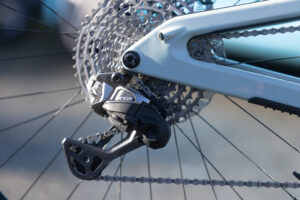
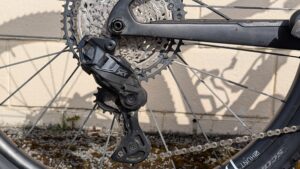
The Cues rear mech uses Shimano’s Shadow design, which means when mounted it sits more inbound compared with older rear mechs. Basically, if you were to crash or drop the bike it is less likely to get damaged as it doesn’t sit so proud of the frame.
Again, as with the crankset, I think this rear mech is a good-looking piece of kit, stealing design ‘Cues’ from more expensive groupsets.
And, as with the rest of the components I’ve already mentioned, it does a great job, offering solid gear shifts and a smooth action.
There is only one cage length on offer, which can cope with a maximum sprocket size of 39 teeth, plus it is rated for use on e-bikes. The maximum capacity of the rear mech is 44 teeth; to work out if it’s compatible with your gearing setup you need to use the equation: (largest sprocket – smallest sprocket) + (largest chainring – smallest chainring) = required capacity.
Shimano Cues STI Levers & Brake Calipers (ST-U6030-L/R)
£199.99 (each)
Weight: 474g (each)
The U6030 levers are compatible with both the 10 and 11-speed groupset options, and come in either this grey/black standard option or polished silver.
They take a lot of their design from 105, which means great ergonomics for control and comfort, plus they are designed to work with a multitude of hand sizes thanks to adjustable reach.
In use they don’t feel any different to those 105 shifters. The swing of the brake lever is very smooth and arcs in a natural movement, so they are easy to use even with thick winter gloves on. The hood shape also has a natural feel to it and the lever shape allowed my fingers to rest in a comfortable position while also giving me the ability to brake hard while riding on the hoods.
Included in the price of each lever is the hydraulic flat-mount calliper and hose, which has already been bled. The callipers use a two-piston design and offer great power, plus the excellent modulation that Shimano’s hydraulic setups have always had.
The callipers are also available in the polished silver finish as well as standard black.
Shimano Brake Rotors (SM-RT10)
£16.99
Weight: 178g (160mm)
There are no specific Cues brake rotors, with many of Shimano’s line-up being compatible. Those used on the Canyon were the RT10s with a Center Lock fitment.
They are cut from stainless steel with an aluminium alloy spider, and offer decent performance considering how little they cost. They are for use with resin pads only, so compatible with those supplied with the Cues callipers.
Shimano Chain (CN-LG500)
£29.99
Weight: 257g (average)
The LG500 chain is the final piece in this Linkguide setup, and comes in a length of 138 links, while being compatible with 10 and 11-speed Linkguide groupsets and 11-speed Hyperglide groups.
It comes with a quick link included.
I didn’t have the Canyon long enough to be able to gauge chain life, but if Shimano’s claims about Linkglide are anything to go by then it shouldn’t need replacing that often. It ran smoothly and quietly even when it was dirty, and gave crisp shifting across the cassette and chainrings, as you’d expect.
Shimano Bottom Bracket (BB-MT500-PA Pressfit, BB-MT501 BSA Threaded)
£22.99 (PF86)
Weight: 81g (PF86)

The bottom brackets aren’t Cues specific but are actually from the Deore mountain bike groupset. Both threaded and press-fit options are available, with the latter being fitted to the Canyon.
Shimano Cues: Value
I suppose the main question here is how Cues compares with the groupsets it’s likely to replace. Is it any better? Well, yes, in a lot of instances it is. For the kind of bikes this is likely to be fitted to, the Linkglide components work excellently, offering solid shifting and low maintenance.
The main highlights are the shifter levers mimicking the latest 105 for ergonomics and adjustability. The shifters also have a light action, and the slightly slower gear shifting of Linkglide compared with Hyperglide groupsets is minimal and only really noticeable if you are riding the two side by side.
And at £721.90 it compares well on price. A similarly specced 10-speed Tiagra 4700 groupset would cost you around £805 at RRP. Tiagra is Hyperglide, though, and with closer ratio cassettes is more suitable for pure road riding and entry-level racing, which is the only downside I can see with Cues if it does eventually replace Tiagra. The 11-39T cassette I’ve been using is the closest ratio option, so doesn’t suit that style of riding as well. Hopefully, Shimano will add some closer ratio cassettes to the line-up as and when it replaces Tiagra.
Other competition is limited as Campagnolo doesn’t offer entry-level groupsets anymore, and the only mechanical option from SRAM is Apex, but that is now 1x only.
Microshift sells a 2x offering of the 1x Sword groupset that we reviewed over on off.road.cc in 2024. It costs £527.95, but that only includes the chainset, front and rear mechs, shifters and cassette. You’ll need to look elsewhere for the brake callipers, chain and bottom bracket. Plus, the shifter units are for mechanical brakes not hydraulic.
Shimano Cues: Conclusion
On the whole Cues is a very good groupset in terms of performance, and, judging by Shimano’s claims, on durability too.
> Buy now: Shimano Cues U6000 for £721.90 from Freewheel
Verdict
Comfortable and easy-to-use groupset that provides loads of component choices
All the deals displayed on our review pages are pulled from a constantly updating database feed of the best affiliate deals available. The criteria for deciding on what are the best deals is who is offering the lowest, delivered price. In most cases we will be showing the very best deal available online, but sometimes you may be able to find an item cheaper. If you can please feel free to post a link in the comments box below. To find out more about affiliate links on road.cc click here.
road.cc test report
Make and model: Shimano CUES U6000
Size tested: 50/34T chainset, 11-39T cassette (10spd), 172.5mm cranks
Tell us what the product is for and who it’s aimed at. What do the manufacturers say about it? How does that compare to your own feelings about it?
Shimano says, “CUES for recreational road and gravel riding has 9, 10 and 11-speed options with the right, wide-range gears for confidence in the mountains, on descents, through forest paths, and in the city.”
There’s a huge number of components on offer for all kinds of riding, although you’ll need to stick with Tiagra if fast riding or racing is your goal.
Tell us some more about the technical aspects of the product?
The Cues line-up takes lots of trickle-down tech from Shimano’s more expensive groupset and adds durability thanks to Linkglide.
Tell us how the product performed overall when used for its designed purpose
Solid shifting in all conditions and great ergonomics for the shifter units.
Tell us what you particularly liked about the product
Pretty good value, clean gear shifts, and easy to modulate braking.
Tell us what you particularly disliked about the product
An 11-39T cassette is currently the closest ratio 10-speed cassette on offer.
How does the price compare to that of similar products in the market, including ones recently tested on road.cc?
There aren’t many groupsets out there at this price point. Tiagra is nearly £100 more than the components tested here, while Microshift’s Sword 2x is a cheaper option at £527.95 but doesn’t include all of the components as it doesn’t make them.
Did you enjoy using the product? Yes
Would you consider buying the product? Yes
Would you recommend the product to a friend? Yes
Use this box to explain your overall score
It’s very good: well made and good value for money. The ergonomics and shifting/braking performance is comparable to Shimano’s higher end groupsets.
About the tester
Age: 46 Height: 180cm Weight: 76kg
I usually ride: This month’s test bike My best bike is: B’Twin Ultra CF draped in the latest bling test components
I’ve been riding for: Over 20 years I ride: Every day I would class myself as: Expert
I regularly do the following types of riding: time trialling, commuting, club rides, sportives, fixed/singlespeed,



34 thoughts on “Shimano Cues U6000”
It seems insane to have
It seems insane to have tooled up produce the new Cues kit without clearing room by discontinuing the older stuff like Tiagra. No wonder their profits are down.
The other way of viewing that
The other way of viewing that is to commend Shimano for looking after their customers before looking after their profits. I’m a great Shimano enthusiast since the early 70s, although I think they made a pig’s ear of the pasta cranks disaster. I’m looking forward to moving gradually to Cues to see if Linkglide really is more durable
Secret_squirrel wrote:
Tiagra is still a pretty strong brand. Replacing it with Cues overnight, while technically reasonable, could cause trouble to Shimano in the first place.
BTW I don’t really get the whole concept of the Cues umbrella brand (as well as the Alivio one a few years back). The whole concept of grading was to give the consumer quick distinction between different finishes and performance levels. Now they won’t immediately know what’s installed on the bike, which sounds like an unnecessary hassle.
Also, I always thought the whole point of grading was to give the customer the pride and prestige of getting upgraded components. Now even if they buy a top-of-the-line Cues system, it’s still… well, just Cues but with more gears. I don’t really get the point.
tomlew wrote:
My understanding was that it gave good levels of interoperability between components.
Good levels of
Good levels of interoperability = Shimano not having to worry if their supply chain is useless/they under-manufacture some parts, because they can tell shops to just chuck on whatever parts they have available. Seems more like Shimano want to reduce their risk of over-manufacturing, at the expense of customers.
The main benefit of CUES is that Shimano have created a whole new set of IP associated with it, and once again kill off the 3rd party aftermarket parts supplies until those 3rd parties retool, as they did with 4-arm cranks. It’s really never about benefitting the customer.
And the lack of a more compact cassette seems like an oddity. Seems like Shimano are giving up on the budget road market?
Someone has a very short
Someone has a very short memory. COVID ring a bell? Enough with bashing Shimano – they invested heavily to develop a drivetrain ecosystem that lasts far, far longer than previous, is stronger, is cross-compatible in the event of shortages/customer wanting options, and is very well-priced.
You see all these as drawbacks if you like.
mark1a wrote:
Do the 10-speed RD and shifter use the original 10-speed road pull, or does it use the Tiagra 10-speed pull (which, for some reason is the same per-click pull as 11-speed)?
It was impossible to get any aesthetically compatbile (i.e., under bar-tape cable routing) replacement part from Shimano for 10-speed 105/Ultegra/Durace shifters now, given Tiagra 10-speed is mechanically incompatible (why Shimano, why?). I’m wondering if Cues fixes that, but… what’s the bets it follows Tiagra…
AFAIK, it’s all a totally new
AFAIK, it’s all a totally new pull ratio to ensure zero back-compatibility.
Woah there Super Conspiracy
Woah there Super Conspiracy Man. The shift ratio means the mech can deliver 11 shifts over the same space as 12 for HG – allowing the cogs to be thicker/stronger, delivering more robust shifting and much longer life.
The shift ratio is identical across the entire CUES range. So you can put a 9/10s mech on an 11s lever/cassette and it will work perfectly, you just choose which cogs you want to miss out. It’s all about *forward* compatability. Remember COVID, when we couldn’t get bike parts for years? CUES means much more compatability in the event of future supply chain shocks. It’s all good.
KiwiMike: This forward
KiwiMike: This forward compatibility is oh so great… So you’re saying I just need to accept that it’s impossible to get a part (from the maker) that works with my current RD; but maybe one day I get the future option to be able to buy spares, IF I upgraded everything now?
And what guarantee, pray tell, do I have that said maker won’t just pull this same bullshit again in another few times?
They keep doing this shit…
Paul, youre complaining that
Paul, you’re complaining that Shimano no longer offer matching parts for a groupset they stopped making a *decade ago*. If you buy a new mech, shifter and cassette, you’re sorted for many years to come.
The current roadmap is that the three top tier groupsets are all 12s, all use the same chains, and are all compatible with each other. Yay for folks on lightweight roadbikes.
The three lower groupsets also use the same 11s chain, and are all also compatible with each other (although they are different speeds, so the compatability is more a get-out-of-jail in the event you damage your bike and a 1-1 sreplacement can’t be had quickly). Yay for everyone else, or people needing a tough-as-boots groupset.
Shimano have said Sora, Claris and Tiagra will phase out over the next year or so. I don’t underestiamte the task of re-tooling the hundreds (thousands?) of machine tools across the globe to shift to the CUES parts.
At some point all manufacturers of everything move on. It’s just not possible, practical, financially sensible etc to keep making everything for ever. This isn’t a Shimano-specific thing – they are actually the good guys of the industry (see above) and you can still buy stuff that works with parts made twenty years ago like Tourney. But if you’re at the higher end (105 etc) they do the maths, they know this stuff gets ridden, and the customers who can afford it can also afford to upgrade <checks notes> once a decade or so.
CUES is a generational shift, that supports all kinds of bikes, budgets and needs. I can’t see them moving to a new pull ratio in my lifetime.
fwhite181 wrote:
Sigh. This will be the last time I ever buy Shimano, or SRAM. *BOTH* of them have left me with bikes with groupsets where a component has failed or been damaged and where I can’t buy a replacement anymore cause of their forking deliberate-obsolescence bullshit.
Grrr.. 🙁
No SRAM or Shimano? Where
No SRAM or Shimano? Where will you go?
Paul J wrote:
Which exactly components do you mean? I see all 10- and 11-speed components still available. Not all models, but at least one model of each kind.
Also 11-speed and 10-speed systems use the same pull ratio, so they are perfectly cross-compatible.
AFAIK, it’s all a totally new
AFAIK, it’s all a totally new pull ratio to ensure zero back-compatibility.
mark1a wrote:
The thing is, it has always been there.
1. Pull ratios were the same for years – until they intentionally changed them, I mean, only to backpedal now and sell it as something new.
2. Chains were interchangable for years as well. Except absolute extremes, narrower chains have always worked with older systems
3. Chainrings have always accepted different “speed-number” chains and FDs (again, except 1 above).
4. With the new system being incompatible with ANYTHING made before, I’d argue it’s hard to really call it interoperability.
Nothing really new here.
tomlew wrote:
Wait – how can both of them be the whole point?
“Nobody expects the Shimano naming system…”
mdavidford wrote:
If only you had quoted the whole sentence (or at least the whole relevant part) instead of extracting what you wanted to make fun of 🙂
tomlew wrote:
Ah, yes – that makes all the difference (apart from making no real difference at all ?♂️).
mdavidford wrote:
Whole concept and whole point. I think it’s like strategy and tactics. Or maybe the other way round.
in its current guise CUES is
in its current guise CUES is a poor replacement for Tiagra for road cyclists who prefer closer ratios.
I have 13 year old Tiagra (with an even older 10 speed Ultegra deraileur) which I’ve run with a 50/34 and 12-28 Cassette, which for me is perfect. Its close ratio and beause I don’t regularly climb lots of massive hills the 34/28 is low enough. CUES has nothing like this, the gaps between its gearing and huge range would give me gears that would be wasted (it’s more like the ratios you’d get on a 1x gravel bike really). Without Tiagra, if you want true Road bike ratios you’re forced to upgrade to 105 now and go 12 speed with all its extra expense.
I read in the article that 11
I read in the article that 11 speed Linkglide and 11 speed Hyperglide are compatible. So, to overcome the lack of a closer ratio casette option, you could just get something Hyerglide compatible instead.
You read wrong. The *chain*
You read wrong. The *chain* is a normal 11S chain, and you can use *any* 11s chain – KMC, SRAM etc – on a CUES setup – 9, 10 or 11 speeds.
The super-long-life tough-as-boots magic is in the cassette, which spreads 11 cogs across the space used for 12 under Hyperglide.
So you *cannot* use a HG cassette with CUES.
I thought 12 speed HG just
I thought 12 speed HG just squashed 12 gears into the same space previously used for 11 speed HG? Or at least both 11 speed and 12 speed (road) cassettes use 36.8mm HG freehubs?
“The LG500 chain is the final
“The LG500 chain is the final piece in this Linkguide setup, and comes in a length of 138 links, while being compatible with 10 and 11-speed Linkguide groupsets and 11-speed Hyperglide groups.”
That to me really says an 11 speed HG cassette is compatible.
Nope. The shift ratios are
Nope. The shift ratios are wrong. You can’t run a HG cassette with a Cues mech. It’s impossible.
Nope. The shift ratios are
Nope. The shift ratios are wrong. You can’t run a HG cassette with a Cues mech. It’s impossible.
“The LG500 chain is the final piece in this Linkguide setup, and comes in a length of 138 links, while being compatible with 10 and 11-speed Linkguide groupsets and 11-speed Hyperglide groups.”
That to me really says an 11 speed HG cassette is compatible
Kiwi has already refuted this Total Logic Failure, but it’s worth repeating: apparently, any designated ’11-speed’ chain will work on both Linkglide and Hyperglide- this is clearly not the same as ‘HG and LG 11-speed cassettes are interchangeable’
The author states “Those
The author states “Those larger jumps at the top of the cassette are generally fine as they are used for climbing, where a narrow cadence isn’t as crucial as it is on the flat. Other than that, I never found myself in between gears.” Does he know that it is ratio differences that matter, not the absolute number of teeth? If you do the math(s) then the jumps are all between 13 and 18% and in fact the spacing on the 4 easier/climbing gears is generally tighter than on the 4 faster gears, which is opposite to the author’s summary. Given the “engineering” background of the author, I would expect him to be capable of figuring this out before publishing incorrect statements.
Here’s the actual percentage
Here’s the actual percentage difference ratios for a 34T chainring (yay Copilot on mobile whilst drinking tea)
Thanks for showing the
Thanks for showing the numbers. They don’t quite correspond with my statement of “13 to 18%” differences because it matters in which direction you are making the shift, but that doesn’t change the conclusions. You clearly show that Shimano have done a decent job of choosing the cog sizes so that the (ratio) steps are reasonably consistent across the entire range.
Stu Kerton wrote:
It is an odd thing to say because the biggest jumps are between 11-13 (18.2%) and 17-20 (17.6%). All the other ratios are 15.4% or under. 30-34 is the same as 15-17 (13.3%) and 34-39 is 14.7%. The slightly larger jumps bang in the middle of the cassette can be annoying on a false flat with heavy load or gusty wind from my experience with a 9sp 11-34 cassette that uses the same ratios.
“…where a narrow cadence
“…where a narrow cadence isn’t as crucial…”. What’s a ‘narrow cadence’? Keeping your knees together?
“Linkglide cassettes have triple the wear rates of Hyperglide, which is good news”. Faster wear is good?
I assume you’re not wasting any money on editors.
Well, the Die is Cast! Just
Well, the Die is Cast! Just over £200 of Black Friday cash has gone on a conversion to 9-speed cable-disc Cues, although I decided to omit a left brifter in the hope some bodging would make either the present front derailleur or the Cues one work with the present front shifter. The changeover will be next early summer while I eke out the present setup which is mainly limited by crappy old inners and outers, so a refresh should see it through with the help of my daughter’s 9-speed 120BCD 46 ring from when I install the GRX Hollowtech to replace her square taper. Shimano may have made a pigs-ear of the pasta cranks and power meters, but I’ve been using their good stuff since 1970.