Slate article on regulating Teslas

  • Creator
    Topic
  • #31737
    brooksby

    https://slate.com/technology/2021/08/tesla-autopilot-nhtsa-clever.html

    The whole article is pretty interesting, but there was one bit I found particularly so (my emphasis):

    [quote]

    Car buyers want to be safe, and they frequently opt for pricier models or optional ADAS features like collision avoidance that they believe can better protect them. But most customers are far less willing to pay extra to reduce danger posed to people outside their vehicle in the event of a collision.

    As a result, carmakers have little incentive to invest in designs or technologies that protect vulnerable road users, since they can’t charge more for them. Worse, automaker’s lineups are steadily shifting toward taller, heavier SUVs and trucks, which provide a sense of security to their occupants while they endanger everyone else on the road.

    Researchers have cited this shift toward bulky SUVs and trucks as a key factor in the rising number of vulnerable road users killed on American roadways. Traffic deaths among people inside automobiles, meanwhile, have fallen 28 percent in the last 40 years. Notably, drivers who feel safer behind the wheel may drive more recklessly, assuming that they’ll come out of it OK if they end up in a crash (this is the Peltzman effect, named after an economist who argued that seat belt laws induced riskier driving). Pity the pedestrian or cyclist struck by a driver who felt secure in a Hummer that weighs as much as an elephant.

    [/quote]

Viewing 15 replies - 1 through 15 (of 23 total)
  • Author
    Replies
  • #983457
    0
    haruto

    interesting article, which I

    interesting article, which I read too and want to write some review about it on college. I study on my course work project about future of tesla. But I have some problems with writing so decide to apply to https://essayshark.com/write-my-paper-for-cheap.html for getting some tips and help with its writing.

    #983459
    0
    wycombewheeler
    Cycloid wrote:
    If it’s a head on collision the driver may well die.

    Well perhaps not, as presumably code could be written to ensure the autonomous car drives at a speed that allows it stop in the space it can see to be clear. So Impact speed could be lower in the blind corner test. Of course if both cars were autonomous, there would be no collision as a car would not decide to go round a blind bend on th wrong side of the road.

    In either case the responsibility would be with the driver on the wrong side, while te responsibilty for wiping out pedstrians would be entirely with the manufacturer

    #983455
    0
    Rich_cb

    Interesting!
    Interesting!

    Kudos to the authors for attempting to derive some statistics and for acknowledging their, unavoidable, unreliability.

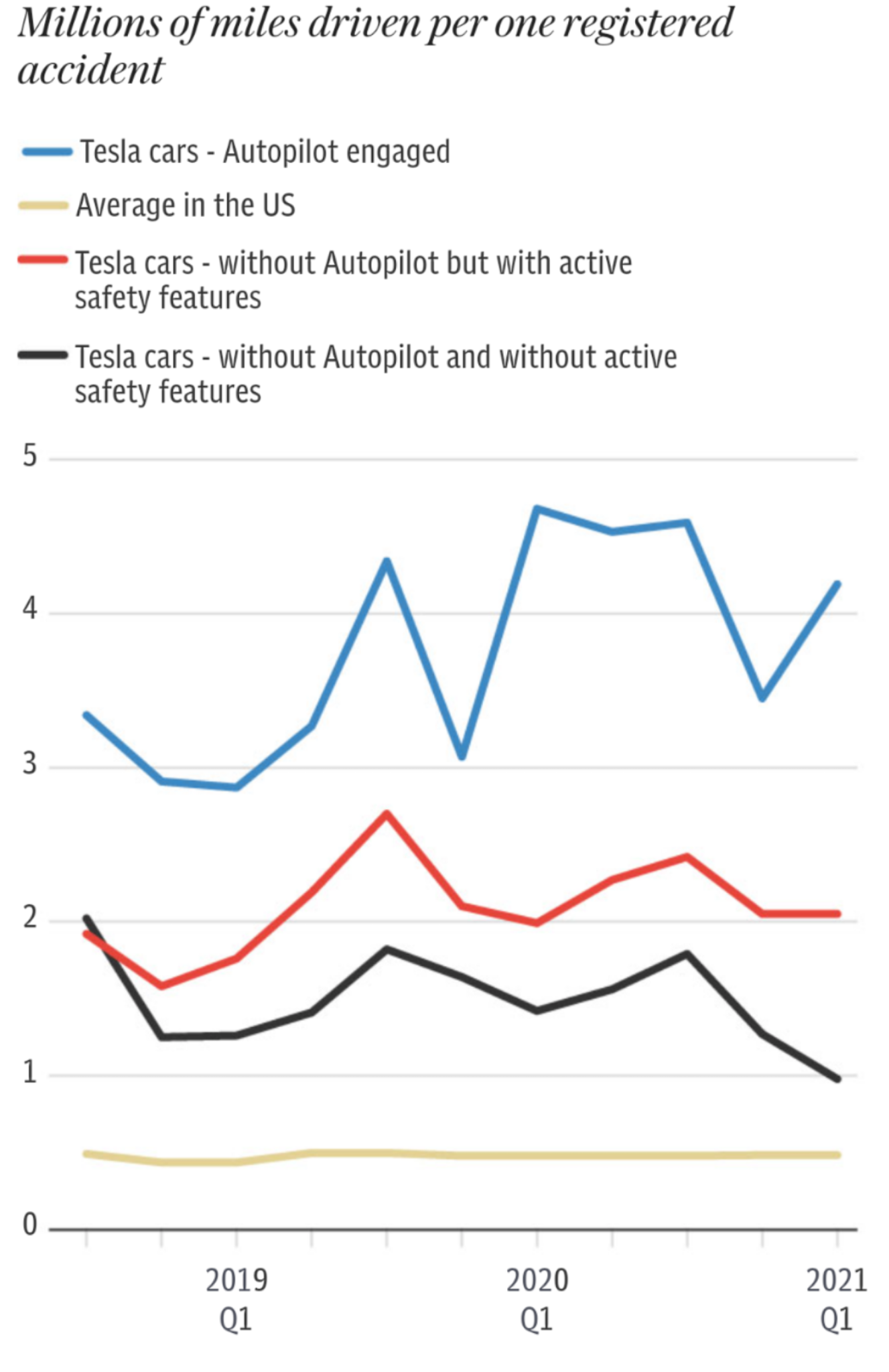
    The best benchmark, IMHO, is to Teslas without Autopilot engaged. It does seem, based on that benchmark, that Autopilot improves safety but with the important caveat that these are Tesla’s own figures.

    If the figures in your link are accurate they do give some cause for hope though, there seems to have been a rapid improvement in safety and we seem to have already approximated to the human driver fatality rate. If the figures are accurate and the rapid progress continues we should see fewer people dieing on our roads very soon.

    #983453
    0
    hawkinspeter

    Excellent!

    Excellent!

    I’ve just been reading a bit of this analysis: https://www.greencarreports.com/news/1119936_tesla-fatal-crash-rate-with-autopilot-still-no-better-than-with-human-drivers

    It dives a bit more into how they’re getting their figures as Tesla are obviously cherry picking statistics to make themselves look better.

    While these updated numbers for Autopilot are encouraging, it’s clear that Tesla’s claims of its vastly superior safety—at least in terms of fatal accidents—are still vapor. It’s way too soon to come to any firm conclusions about Autopilot safety.

    Musk has compared Autopilot’s fatality rate to government figures for the overall U.S. traffic fatality rate. Surely someone as smart as Musk realizes that comparing Tesla’s Autopilot numbers to the NHTSA figure is not just apples-to-oranges. It’s apples-to-aardvarks.

    NHTSA’s Fatality Rate per 100 Million Vehicle Miles Traveled, the figure repeatedly cited by Musk as the Autopilot benchmark for comparison, includes bicycles, pedestrians, motorcycles, and buses. Musk is essentially equating a Tesla Autopilot crash to a pedestrian getting run over by a bus.

    #983451
    0
    Rich_cb

    I have a graph!
    I have a graph!

    It’s from https://www.telegraph.co.uk/technology/2021/08/23/silicon-valleys-driverless-car-dream-road-disaster/

    Which, as you’ve probably guessed from the link, is a telegraph hatchet job on driverless cars so certainly not likely to overstate their effectiveness.

    https://cdn.road.cc/wp-content/uploads/roadcc/Screenshot_20210830-145659.png

    #983449
    0
    hawkinspeter

    Do the Teslas have a better

    Do the Teslas have a better crash record than other vehicles? I haven’t seen a comparison, but their tendency to crash into stationary vehicles doesn’t sound great as usually human drivers avoid those kinds of crashes (I’m ignoring all the examples on the Car Crashing into Buildings thread on here).

    Edit: I’ve just had a brief search for comparisons and as there’s little data yet it seems inconclusive. I believe Tesla published a comparison of Tesla autonomous vehicles vs all other vehicles and it came out safer, but a more targetted comparison of autonomous Tesla vehicles vs other passenger cars would reach the opposite conclusion.

    #983447
    0
    Rich_cb

    Self preservation is a strong
    Self preservation is a strong instinct for humans and corporations alike.

    For the corporation the blameless head on collision is far lower risk than the deliberate collision with pedestrians.

    If the car is aware the collision is inevitable and has time to react then it also has time to brake heavily, tighten seatbelts and pre-deploy airbags etc lowering risk to the driver considerably. À la Demolition man IIRC.

    #983445
    0
    Rich_cb

    I agree that humans perform
    I agree that humans perform poorly in such situations.

    The question that needs to be asked is whether overall the ‘Tesla’ system you’ve described is safer than a 100% human system?

    Crash statistics seems to indicate that it is.

    100% human control leads to thousands of unnecessary deaths and injuries every year.

    Any system, however flawed, that improves that statistic, should be welcomed.

    #983443
    0
    hawkinspeter

    I think they could be a major

    I think they could be a major part of achieving Vision Zero, but first we have to get rid of the ridiculous Tesla idea of having partly autonomous vehicles but relying on a human driver to step in and take control. People are utterly unable to concentrate on a boring task where they have to do nothing for long periods, so when the car suddenly turns control over to them, they’ve been doing something else other than watching the road.

    #983441
    0
    ktache

    Much as I think that the hype

    Much as I think that the hype over driverless cars is ridiculous, there could eventually be some benefits.  For a computer POWER is not the answer.  The decision is one hell of a lot faster. There is no need to move the foot from the accelerator to the brake to even start the braking process.

    Braking should start sooner, and (maybe, hopefully) they driverless vehicle will not be breaking the speed limit so that the initial speed and energy will be lower.

    #983439
    0
    hawkinspeter
    Cycloid wrote:
    A collision is inevitable, so it’s the head on collision

    The idea is to reduce the energy of the impact and ideally you don’t want to be introducing rotational forces into the collision as that could end up with the vehicles hitting pedestrians etc. Also, the front of the car is often the most heavily protected with crumple zones and passenger airbags.

    It’s possible to contrive situations where slowing down as much as possible in a straight line isn’t the best choice, but 99% of the time it’s the best thing to do. Ideally with computer reacting as quickly as possible, the vehicle should be able to come to a complete stop which certainly makes the liability easier to determine.

    #983437
    0
    Cycloid

    If it’s a head on collision

    If it’s a head on collision the driver may well die.

    Would you rather be dead or in court for dangerous driving?

    Would you buy a car that goes for the head on collision option? If you have been overtaken on a blind bend while riding the bike, you will know that the driver never goes for the head on collision.

    It’s probably not a real world problem, and there is no right or wrong answer.

    This is a variation on the trolley car problem from moral psychology.

    #983435
    0
    Cycloid

    A collision is inevitable, so

    A collision is inevitable, so it’s the head on collision

    #983433
    0
    hawkinspeter
    Cycloid wrote:
    As we move towards fully autonomous cars becoming the norm on our roads this begs the question “what does a car do when a collision is inevitable?”

    The obvious answer is to slow down as much as possible in a straight line.

    #983431
    0
    Rich_cb

    If we accept the extremely
    If we accept the extremely cynical view that the prime motivation will be financial then the obvious answer is to take the vehicular collision.

    The corporation will not be found liable for such a crash and their financial risk will be zero.

    Deliberately crash into a mother and child (I’m assuming there’s a child in the buggy) and they’d be on the hook for huge damages.

    Driverless cars won’t be flawless and they will harm people but they offer us the chance to achieve zero road deaths as they improve. We will never achieve that with human drivers.

Viewing 15 replies - 1 through 15 (of 23 total)
  • You must be logged in to reply to this topic.