‘Extreme frustration’ after Bristol activists vandalise 150 vehicles

  • Creator
    Topic
  • #32737
    hawkinspeter

    https://i.pinimg.com/originals/20/b3/44/20b344cb77432ef186b62002959c0de5.jpg

    From https://www.bristolpost.co.uk/news/bristol-news/extreme-frustration-after-bristol-activists-8913213

    [quote=Reclaim Our Community]

    “We are a group of young people angered and fearful of the world we are inheriting. The UN estimate 1 billion climate refugees by 2050, how did Europe cope with a mere 1 million Syrian refugees in 2015?

    “Irreversible feedback loops may have already been triggered, or will soon be set off: through the destruction and retreat of the Amazon rainforest, the melting of permafrost in the Artic circle and the bleaching of coral reefs. This could lead to spiralling ecological collapse.

    “By now, everyone agrees that the climate crisis is immediate, grave and caused by human activity. Although our means of tackling this issue are not unified.

    “After pursuing many democratic avenues in an attempt to affect change: writing to MPs, attending dozens of peaceful protests, working with the Green Party. No real change has occurred.

    “In fact we see the opposite: we see the government support 100 new licenses for oil and gas, which led the Parliament’s Public Accounts Committee to say that “the Government has no coordinated plan towards achieving the net zero emissions by 2050 target”. We are left with no other option. If the institutions of power will not affect the necessary change, we must do so ourselves.”[/quote]


Viewing 15 replies - 16 through 30 (of 77 total)
  • Author
    Replies
  • #1018885
    0
    wtjs

    Capitalism drives

    Capitalism drives exploitation

    I agree that what he writes is tripe- it’s essentially the basis of ‘everything will be all right if we buy a Tesla and we can all drive around everywhere at 100mph’, because all the targets are repeatedly moved so they’re more than 5 years away and therefore don’t exist

    #1018883
    0
    hawkinspeter
    mattw wrote:
    Aren’t Tefal a company that make frying pans?

    Yes

    https://cdn.road.cc/wp-content/uploads/roadcc/squirrel-pan-650-1645446933-JuCd-column-width-inline-3152623668.png

    #1018881
    0
    hawkinspeter
    mattw wrote:
    Tried it on Windows.

    Ω

    That’s an Omega not an Ellipsis.

    It’s Alt-0133

    Yeah, I found that out too after trying it on a Windows PC.

    I’m going to stick with my copy/paste method – works almost everywhere.

    #1018879
    0
    mattw

    Aren’t Tefal a company that

    Aren’t Tefal a company that make frying pans?

    #1018877
    0
    mattw

    Tried it on Windows.

    Tried it on Windows.

    Ω

    That’s an Omega not an Ellipsis.

    It’s Alt-0133


    #1018875
    0
    levestane

    It’s interesting that for

    It’s interesting that for such a complex system an empirical 2nd order polynomial fit to the Mauna Loa data (R2 = 0.9994) gives the annual rate of increase of the increase of 0.026 ppm yr-2 and predicts close to 440 ppm by 2030 and 500 ppm by 2050. When the data starts to drop below the prediction then maybe we can say that effective action is starting to be taken.

    #1018873
    0
    levestane

    Rich_cb wrote:

    Rich_cb wrote:
    You only have to look at the UK and other parts of Europe to see that continuing economic growth is possible whilst our ecological footprint declines.

    UK ecological footprint exceed biocapacity by 240%. The global value is 70% exceedance.  Per capita UK footprint is 3.9 ha. There is an awful lot of declining to do.

    #1018871
    0
    hawkinspeter
    levestane wrote:
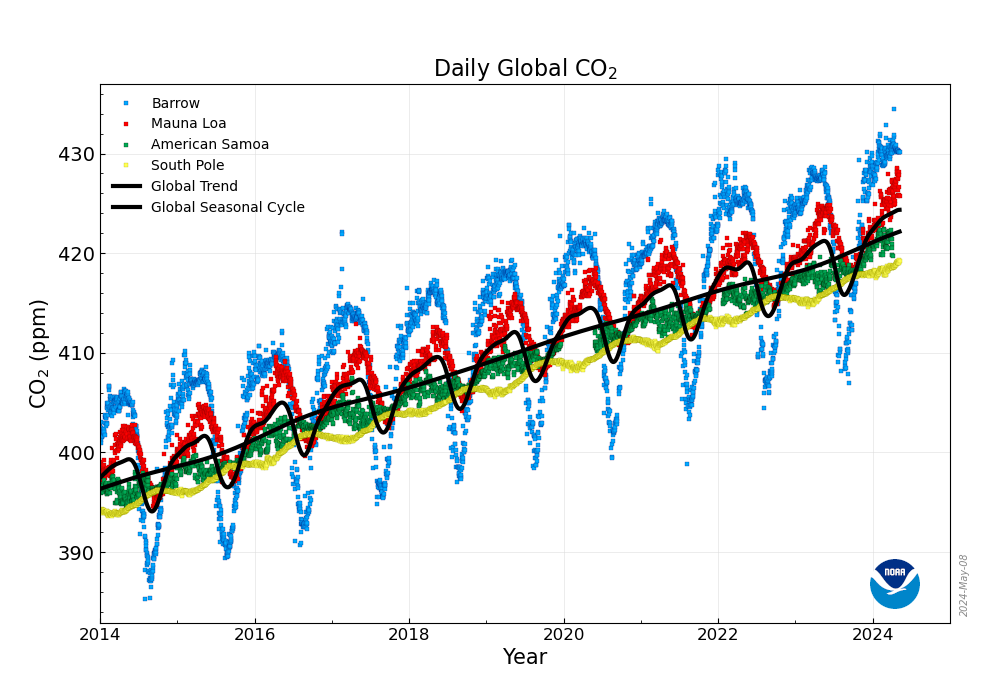
    Atmospheric CO2 concentration integrates sources and sinks. The rate of increase continues to increase (d2[CO2]/dt2 +ve). Chris Packham’s view (Channel 4) that it has become ‘ethically correct to break the law’ in seeking action on reducing ecological degradation is an interesting public development.

    This graph probably shows the situation more clearly (from https://gml.noaa.gov/ccgg/trends/gl_trend.html):

    https://gml.noaa.gov/webdata/ccgg/trends/global_trend.png

    I’d agree with Chris Packham. The law is mainly serving unethical interests such as protecting the assets of companies that make profit from destroying the climate. It’s unsustainable and we all know it.

    #1018869
    0
    levestane
    hawkinspeter wrote:
    It’s certainly notable that the world is not reducing CO2 emissions, but merely slowing the rate of increase of CO2 emissions. It’s like the driver of a speeding car claiming that they’re not accelerating as fast as they were (but still accelerating none the less).

    Atmospheric CO2 concentration integrates sources and sinks. The rate of increase continues to increase (d2[CO2]/dt2 +ve). Chris Packham’s view (Channel 4) that it has become ‘ethically correct to break the law’ in seeking action on reducing ecological degradation is an interesting public development.

    #1018867
    0
    hawkinspeter

    Rich_cb wrote:

    Rich_cb wrote:
    You can look at consumption based emissions to take into account offshoring. These are also falling. Capitalism drives efficiency. If a process uses rare or hard to process materials there is a huge profit motive to adapt that process to use common and cheaper resources. Likewise with energy use, reducing the energy intensity of any process leads to more profit. Li-ion batteries are a good example of this. Cobalt free batteries are now commonplace. Lithium free batteries are on the cusp of commercial roll out. In both cases the removal of a rare or difficult to obtain material leads to both cost reductions and reductions in ecological damage.

    Capitalism drives exploitation.

    If a process requires natural resources, then Capitalism will encourage the businesses that exploit those resources the fastest and those that can use loopholes to avoid any clean up. That’s certainly a big part of why we’re in such a mess – privatise the profits and socialise the losses.

    If BP/Shell had to pay for cleaning up their messes, the world would be in a much better shape.

    However, the exploit everything mindset pervades other political systems, but it’s certainly an integral part of Capitalism.

    #1018865
    0
    hawkinspeter
    chrisonatrike wrote:
    This is definitely in territory where numbers / detailed studies would be helpful… but are you sure you’re not falling for a general “ecological nimbysm”?

    As in – for our more efficient activity here in the UK we’re relying on outsourcing production of both material inputs to process and the energy it requires – ergo “not on the balance sheet here!”

    We have certainly made processes more efficient.  However for any industry which has had a certain period of development (thinking of the chemical industries here) after a point while we can still be “more efficient” what we’re doing is expanding the resource space – we’re shifting to using different – or additional – process inputs or equipment.  The materials are often rarer / have a greater ecological impact to extract and process.  More technologically advanced equipment often requires more detailed equipment itself / more energy / more rare resources.

    So the immediate process is definitely more efficient than yore (and garners more profit) and looks “cleaner” (especially – cleaner here) – but ultimately depends upon the use of more resources.

    Jevon’s paradox certainly isn’t a physical law and the direction of travel is not always towards more resource usage … but that is definitely the overall direction!

    It’s certainly notable that the world is not reducing CO2 emissions, but merely slowing the rate of increase of CO2 emissions. It’s like the driver of a speeding car claiming that they’re not accelerating as fast as they were (but still accelerating none the less).

    #1018863
    0
    Rich_cb

    You can look at consumption
    You can look at consumption based emissions to take into account offshoring. These are also falling.

    Capitalism drives efficiency. If a process uses rare or hard to process materials there is a huge profit motive to adapt that process to use common and cheaper resources. Likewise with energy use, reducing the energy intensity of any process leads to more profit.

    Li-ion batteries are a good example of this. Cobalt free batteries are now commonplace. Lithium free batteries are on the cusp of commercial roll out.

    In both cases the removal of a rare or difficult to obtain material leads to both cost reductions and reductions in ecological damage.

    #1018861
    0
    chrisonabike

    Rich_cb wrote:

    Rich_cb wrote:
    You only have to look at the UK and other parts of Europe to see that continuing economic growth is possible whilst our ecological footprint declines. Increased efficiency lowers costs and increases profits. This translates into economic growth. Increased efficiency also reduces ecological footprint …

    This is definitely in territory where numbers / detailed studies would be helpful… but are you sure you’re not falling for a general “ecological nimbysm”?

    As in – for our more efficient activity here in the UK we’re relying on outsourcing production of both material inputs to process and the energy it requires – ergo “not on the balance sheet here!”

    We have certainly made processes more efficient.  However for any industry which has had a certain period of development (thinking of the chemical industries here) after a point while we can still be “more efficient” what we’re doing is expanding the resource space – we’re shifting to using different – or additional – process inputs or equipment.  The materials are often rarer / have a greater ecological impact to extract and process.  More technologically advanced equipment often requires more detailed equipment itself / more energy / more rare resources.

    So the immediate process is definitely more efficient than yore (and garners more profit) and looks “cleaner” (especially – cleaner here) – but ultimately depends upon the use of more resources.

    Jevon’s paradox certainly isn’t a physical law and the direction of travel is not always towards more resource usage … but that is definitely the overall direction!

    #1018859
    0
    Rich_cb

    You only have to look at the
    You only have to look at the UK and other parts of Europe to see that continuing economic growth is possible whilst our ecological footprint declines.

    Increased efficiency lowers costs and increases profits. This translates into economic growth. Increased efficiency also reduces ecological footprint.

    IMHO we are about to reach a tipping point both in terms of global fossil fuel use and global emissions.

    Fossil fuel use is now predicted to peak before the end of this decade. Reducing the harm associated with ongoing fossil fuel use by focusing on fossil fuels with the lowest ecological footprint, eg by reducing methane flaring, will accelerate the reduction in ecological footprint.

    #1018857
    0
    hawkinspeter
    levestane wrote:
    There are folk on the right of politics trying to do the right thing.

    However, that’s just talk and we need action. Seven Bins Sunak is not going to listen to advice when he’s just setting things up so that his wife’s family can get the most money from their investments in oil companies.

Viewing 15 replies - 16 through 30 (of 77 total)
  • You must be logged in to reply to this topic.